Physician-poet who led Angola's liberation struggle and became its first president
"Our land, our mother / we shall return." Lines from the poem "Havemos de voltar" in the 1974 collection Sacred Hope (Sagrada Esperança).
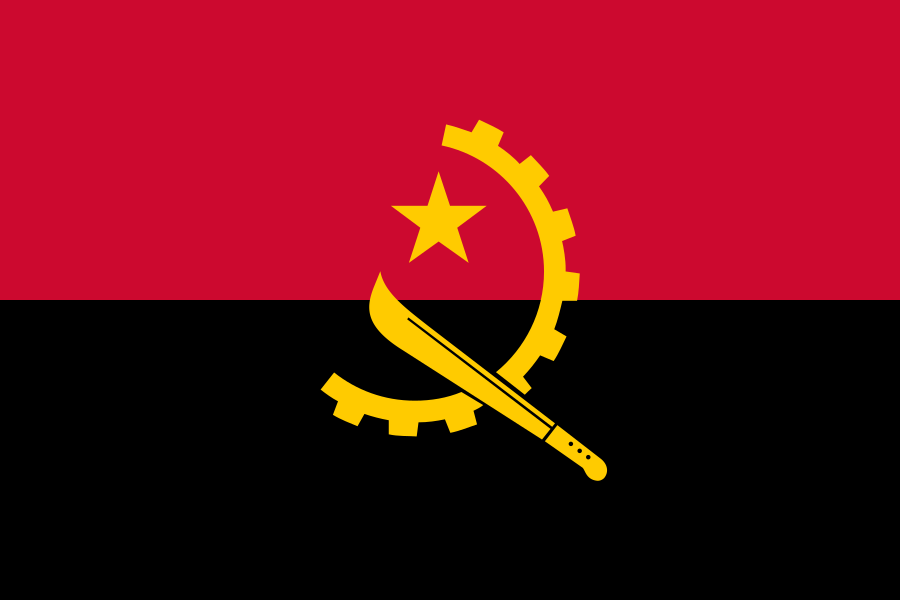
Physician and poet who led Angola's independence struggle. He was president of the MPLA at its founding in December 1956 and, after imprisonment and exile, was elected its effective chairman at the December 1962 conference, leading the independence war until 1974. He became the first president of the People's Republic of Angola on 11 November 1975, building a one-party socialist state in close alignment with the USSR and Cuba while crushing a 1977 coup attempt and carrying out mass purges.
Career timeline
- 1947Left for Portugal; studied medicine at Coimbra and Lisbon universities while joining anti-colonial student activism
- 1956Became the MPLA's president at its founding (Viriato da Cruz was secretary-general)
- 1960–1962Arrested by the PIDE, imprisoned in Lisbon; escaped in 1962 and went into exile in Congo-Léopoldville
- 1962–1974Elected effective chairman at the MPLA conference; led the independence war and built ties with the USSR, Cuba and Yugoslavia
- 1975Became first president of the People's Republic of Angola on 11 November; declared a socialist course
- 1975–1979Defended the state in civil war with Cuban troops and Soviet aid; suppressed Nito Alves's 1977 coup attempt
- 1977Reorganized the MPLA into the MPLA-Workers' Party, adopting Marxism-Leninism as official doctrine
From agronomist to master theorist of African liberation
“Tell no lies. Claim no easy victories.” — party watchword, 1965
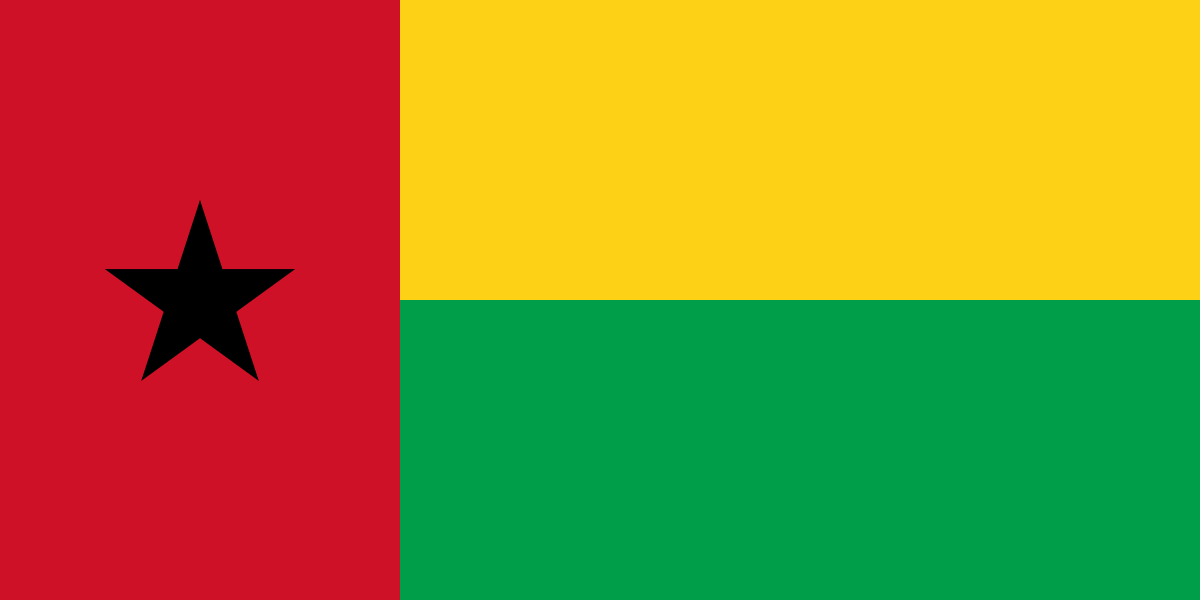
Anti-colonial revolutionary of Guinea-Bissau and Cape Verde and founder of the PAIGC. An agronomist who learned the colony by walking it village by village, he fused armed struggle with cultural liberation into an original strategy against Portuguese rule. Assassinated in 1973 on the eve of the independence he had made inevitable.
Career timeline
- 1945–1952Agronomy in Lisbon; organizes African nationalist student circles
- 1952–1954Agricultural census of Portuguese Guinea — learns the country village by village
- 1956Founds the PAIGC
- 1963–1973Leads the liberation war; schools and clinics in the freed zones
- 1966Presented The Weapon of Theory at the first Tricontinental Conference
- 1973.01Assassinated in Conakry, months before independence
Ideologue of Angolan liberation, MPLA founding member
In the 27 May 1977 Fractionism conflict, the Nitista faction's Thirteen Theses in my Defence accused Lara of being a 'social democrat' and leading the MPLA's alleged turn right. Responsibility for the ensuing mass purge is attributed to Lara and Iko Carreira under Neto's authority.
Full name Lúcio Rodrigo Leite Barreto de Lara, known by the war name Tchiweka; an Angolan revolutionary and physicist-mathematician, and a founding member and leader of the MPLA. He joined the Angolan Communist Party in 1955 and signed the MPLA's founding manifesto of December 1956, becoming its main ideologue and the figure credited with its Marxist-Leninist orientation. He was secretary of organisation and cadres from 1962 and secretary-general in 1964-65, promulgated the constitution and swore in Agostinho Neto as first president in November 1975, served as acting president of Angola from 10 to 20 September 1979 after Neto's death, and left public life in 2003 for health reasons. Historians and witnesses attribute responsibility for the mass purge that followed the 27 May 1977 Fractionism conflict to Lara and Iko Carreira under Neto's authority.
Career timeline
- 1949–1958Studied mathematics at the University of Lisbon, graduating in 1952, then entered the University of Coimbra in 1954 for physical chemistry, abandoning the course in 1958.
- 1955–1956Joined the Angolan Communist Party, active alongside the Portuguese Communist Party, and was a founding signatory of the December 1956 MPLA manifesto.
- 1959Fled PIDE political police pursuit from Lisbon, passing through West and East Germany, Italy, Tunisia and Morocco, and arranged the MPLA's first international office in Conakry.
- 1962–1965Elected secretary of organisation and cadres and Central Committee member at the first national conference in December 1962; secretary-general in 1964-65 and effective number two of the party from 1964.
- 1974–1975Led the first MPLA delegation into Luanda on 8 November 1974; promulgated the Constitution on 10 November 1975 and swore in Agostinho Neto as the country's first president.
- 1977–1985Re-elected to the MPLA Central Committee on 10 December 1977 as the second-ranking Political Bureau member after Neto and party vice-president, responsible for organisation and ideology; in 1985 José Eduardo dos Santos removed him from the Political Bureau, leaving him on the Central Committee.
- 1979Acting president of Angola from 10 to 20 September 1979 after Neto's death; convened the 2nd MPLA Congress on 11 September and worked for the election of José Eduardo dos Santos on 20 September.
- 1975–2003Was a member of the Angolan parliament from independence until 2003, resigning his legislative mandate in November 2003 for health reasons; the Ministry of Defence retired him as an army general in 2004, though he refused to use the rank.
Founder of Angola's People's Armed Forces and its first Defence Minister
After the October 1976 plenum, Carreira officially declared that "for the MPLA, the only socialism that exists is the socialism of Marx, Engels and Lenin, scientific socialism."
First Defence Minister of independent Angola, founder and commander-in-chief of the People's Armed Forces (FAPLA), and the MPLA's military strategist second only to Agostinho Neto. After the October 1976 Central Committee plenum he officially declared that 'for the MPLA, the only socialism that exists is the socialism of Marx, Engels and Lenin, scientific socialism,' marking the party's adoption of Marxism-Leninism. He directed the suppression of the 1977 Nitista uprising and its military tribunals, but lost power after Neto's death in 1979 and spent his last years denouncing Angola's 'savage capitalism.'
Career timeline
- 1957Joined the independence movement
- 1961Deserted the Portuguese army, joined the MPLA
- 1971Secretary-General of the MPLA
- 1975–1980First Defence Minister of the People's Republic of Angola
- 1982Graduated from the Voroshilov General Staff Academy, first African officer to earn a general's diploma
- 1983–1986Commander of the People's Air Force of Angola
- 1987Ambassador to Algeria