Hungarian communist who backed Soviet intervention with Kádár in 1956 and became prime minister after the revolution was crushed
Born into a German Catholic family in Seregélyes, he studied law and was taken prisoner on the Eastern Front in 1915 and sent to Tomsk. There he joined the Bolsheviks and commanded an international POW unit; back in Hungary in 1918 he helped found the Hungarian Communist Party and was war commissar of the Slovak Soviet Republic. He lived in the Soviet Union from 1922 to 1936 and, under the name Otto Flatter, commanded the XI International Brigade in the Spanish Civil War. After the war he was Budapest’s chief of police and then a diplomat. In the 1956 revolution he was interior minister under Imre Nagy, but in November he went to Moscow with János Kádár and openly backed Soviet armed intervention. As minister of the armed forces and public security in Kádár’s government he helped organise the security regiments and the Workers’ Militia, and he was prime minister from 1958 to 1961.
Career timeline
1915Captured by the Russians; held in Tomsk
1918Co-founder of the Hungarian Communist Party
1919War commissar of the Slovak Soviet Republic
1936–1939Commander of the XI International Brigade in Spain
1946–1949Budapest chief of police
1956Interior minister under Nagy; minister of the armed forces and public security under Kádár
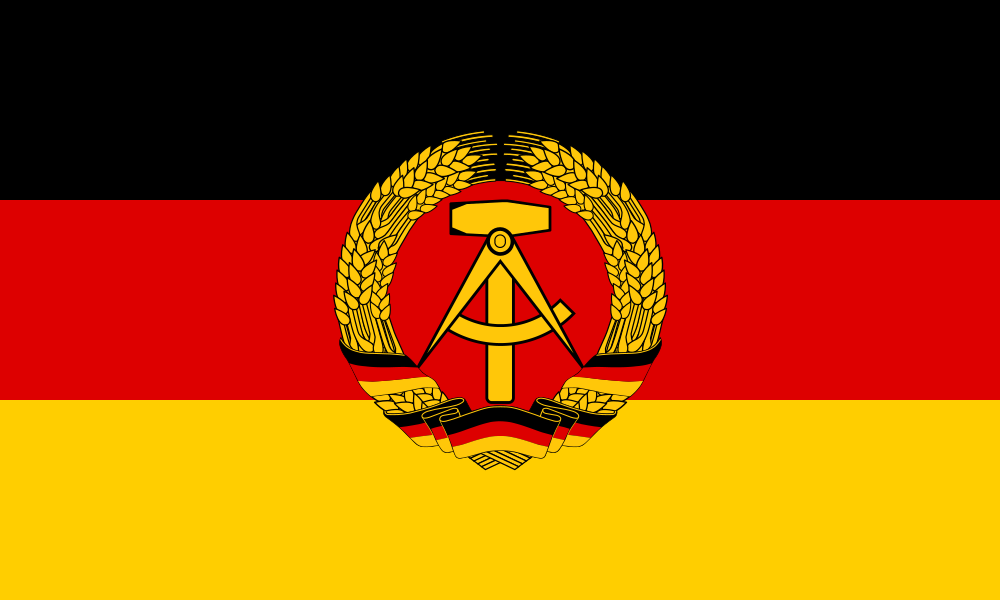
First East German Minister for State Security, purged in 1953 after trying to replace Ulbricht
Born in Gelsenkirchen to a gendarmerie sergeant’s family, he trained as a teacher and was a military leader of the Red Ruhr Army during the Kapp Putsch of 1920. As a GRU agent and Comintern military adviser he co-organised the Guangzhou Uprising in China, and in the Spanish Civil War, as “Gomez”, he led the International Brigades. He returned to Germany in 1947, joined the SED, and in 1950 became the first Minister for State Security and a Politburo member, building up the Stasi. After the uprising of June 1953 he moved to replace Ulbricht with Herrnstadt, but once Ulbricht had Khrushchev’s backing he lost his ministry and all his posts in July and was expelled from the party. He worked as a translator, died in East Berlin in 1958 and was rehabilitated after 1990.
Career timeline
1920Red Ruhr Army leader during the Kapp Putsch
1927–1930Comintern military adviser in China
1936–1938International Brigades commander in Spain (“Gomez”)
1950–1953GDR Minister for State Security; Politburo member
1953Stripped of all posts and expelled from the SED
Refusing clemency after his secret trial death sentence, June 1958: "My only consolation is the conviction that sooner or later the Hungarian nation and the international working class will clear me of these grave charges."
A Hungarian communist. Taken prisoner by the Russian army in the First World War, he joined the Bolsheviks and became an agrarian expert during his Moscow exile. As agriculture minister in 1945 he carried out the land reform, but clashed with Rákosi and Gerő over the pace of collectivization in 1948–49 and was pushed aside. Prime minister from July 1953, he pursued a 'New Course' of lower investment, security for individual farms and the closing of the internment camps, until his dismissal in 1955. Returning as premier in the 1956 revolution, he proclaimed a multi-party system and neutrality, and was executed after a secret trial in 1958.
Career timeline
1916–1921POW in Russia; joins the Red Army and the party
1930–1944Moscow exile; agrarian research for the Comintern
1945–1946Agriculture Minister: land reform
1953–1955Premier: the New Course, camps closed, peasant burdens eased
1955Removed and expelled
1956.10–11Premier of the rising: multi-party rule, neutrality
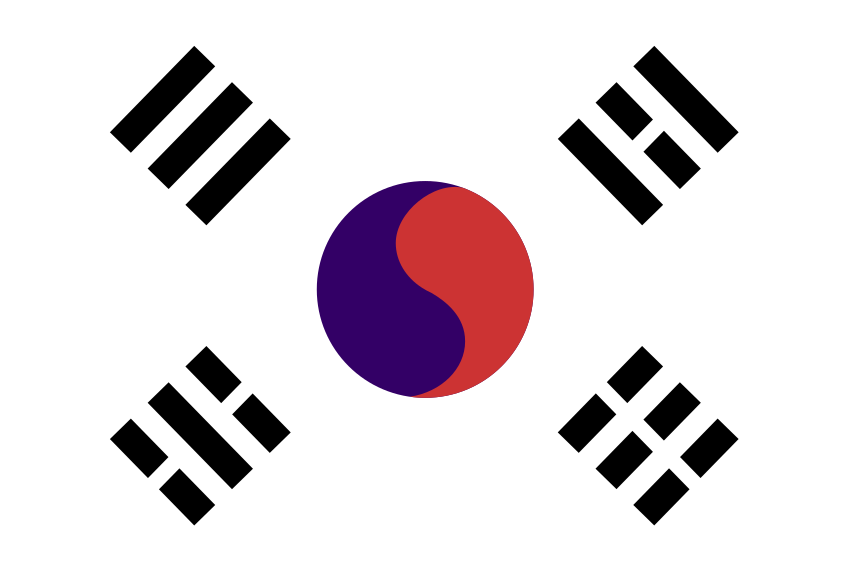
Principal organizer of the Workers' Party of Korea and leader of its early Soviet faction
At the Second Party Congress in March 1948, Ho Ka-i took the podium unannounced and rebuked officials who had apologized without admitting wrongdoing: "An apology that does not own the mistake is empty words" — setting a new standard of party discipline.
A Soviet Korean revolutionary dispatched to Pyongyang in 1945 by the Soviet occupation authorities, he became the principal organizer in the founding of the Workers' Party of Korea. As first secretary and second vice-chairman of the Central Committee, he pursued a Soviet-style elite cadre party and, during the Korean War, led a sweeping purge that expelled over 450,000 of the party's 600,000 members. His clash with Kim Il Sung over whether to build a mass party or a vanguard party led to his removal in 1951, making him the emblematic figure of the Soviet faction's rise and fall in the early DPRK.
Career timeline
1930Joined the CPSU(B)
1932Secretary of the Far Eastern Komsomol committee
1937Purged from the Party; deported to Central Asia with other Soviet Koreans
1939Reinstated in the Party; resumed cadre work in Uzbekistan
1946Member of the Political Committee and head of the Organization Department, Workers' Party of North Korea
1948Vice-chairman of the Workers' Party of North Korea and chairman of the Inspection Committee
1949First Secretary and Second Vice-chairman of the Workers' Party of Korea Central Committee
1951Dismissed after confrontation with Kim Il Sung; demoted to Deputy Premier
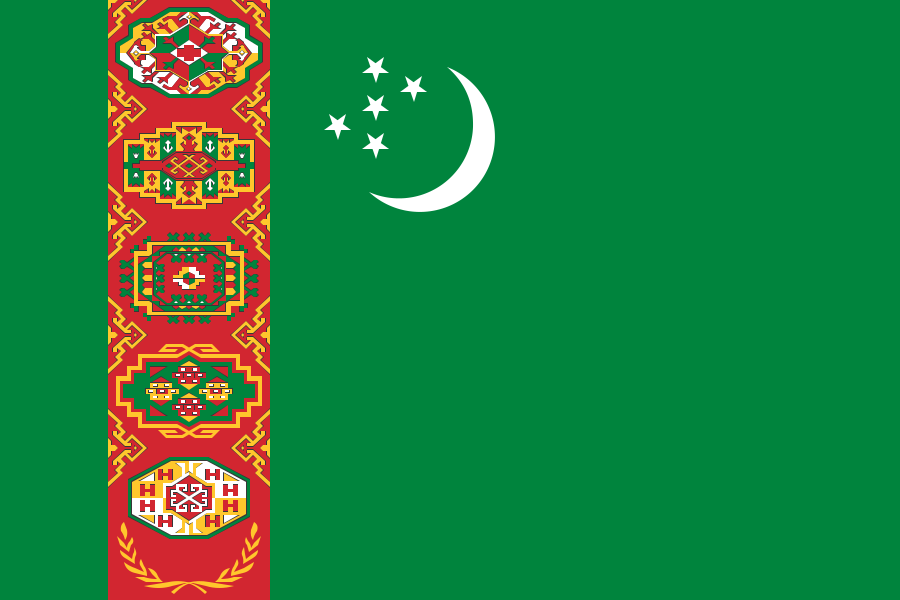
A Turkmen leader who turned late-Soviet rule into personal rule over an independent state
At the 1991 9+1 meetings, he weighed a reworked union against preserving Turkmenistan’s autonomy.
Saparmurat Niyazov was the Soviet-era party and government leader who became independent Turkmenistan’s first president. He led the Turkmen delegation in the 9+1 meetings during the 1991 New Union Treaty process, while the republic’s guarded autonomy limited his role in the negotiations themselves. After independence he invoked neutrality and state sovereignty while concentrating power in the presidency and using the Ruhnama and an extensive personality cult to organize public life. His rule remains a case of post-Soviet state formation fused with authoritarian consolidation.
Career timeline
1962Joined the Communist Party of the Soviet Union
1970–1980Cadre in the Communist Party of Turkmenistan Central Committee
1980–1984First Secretary of the Ashgabat City Party Committee
1985Chairman of the Council of Ministers of the Turkmen SSR
1985–1991First Secretary of the Communist Party of Turkmenistan
1990–1991Chairman of the Supreme Soviet of the Turkmen SSR
1990–2006President of Turkmenistan
1991Head of Turkmenistan’s delegation at the 9+1 New Union Treaty meetings
A ruler who recast the loss of the Soviet Union as a narrative of state restoration
“The collapse of the Soviet Union was the greatest geopolitical catastrophe of the century.”
Vladimir Putin is a Russian politician and former Soviet security officer who rose to national power amid the crises of the 1990s. Alternating between the presidency and premiership, he strengthened federal and presidential authority while making the restoration of Russia’s international influence a central narrative of rule. In 2005, he called the Soviet collapse “the greatest geopolitical catastrophe of the century,” a remark that condensed his memory of dissolution as a Russian experience of loss and dislocation. His rule also narrowed political competition and independent media while expanding the state’s military interventions abroad.
Career timeline
1975–1991Officer, KGB of the Soviet Union
1990–1996Head of the Committee for External Relations and senior deputy official, Saint Petersburg administration
1998–1999Director, Federal Security Service (FSB)
1999Secretary, Security Council of the Russian Federation