Independence activist, linguist, and Yan'an faction leader who served as the first head of state of the DPRK
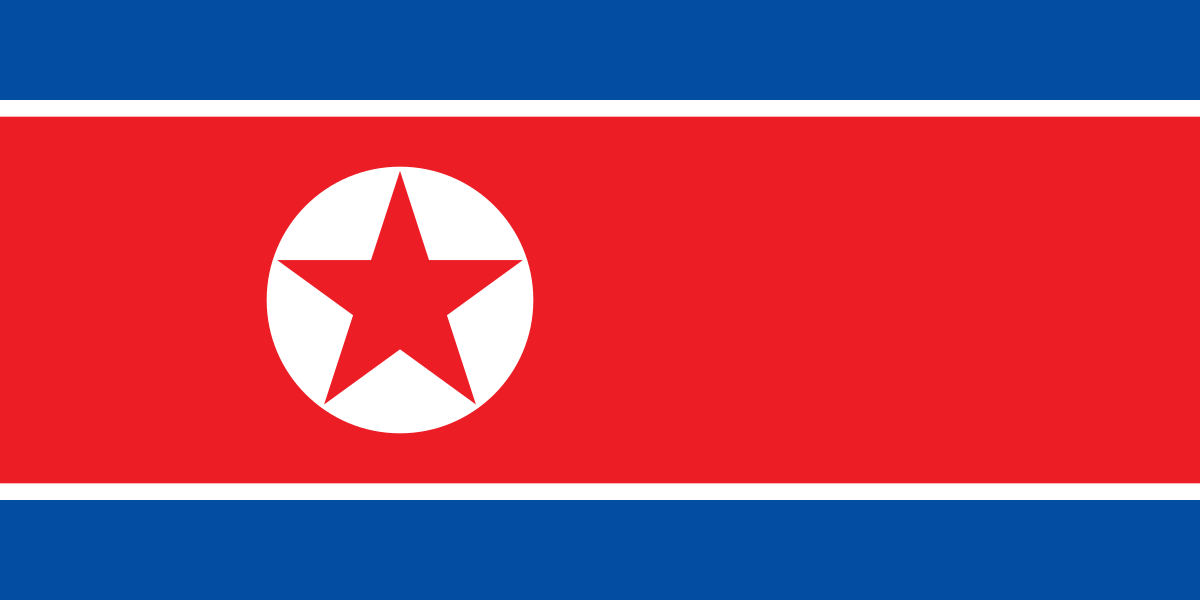
On the day the People's Assembly adopted the new DPRK flag in July 1948, Kim Tu-bong personally lowered the Taegeukgi and raised its replacement. Barely a year earlier, he had been the man passionately explaining the old flag's philosophical meaning to a skeptical Soviet general.
A Hangul linguist trained under Chu Sigyŏng who led the Korean Independence League in Yan'an. Became the DPRK's first head of state in 1948, though real power lay with Kim Il Sung. Purged and vanished in the 1958 August Faction Incident.
Career timeline
- 1908–1916Studied Hangul under Chu Sigyŏng; helped compile MalMoi dictionary
- 1919Joined March First Movement, then exiled to Shanghai provisional government
- 1920–1930sCombined communist activism with linguistic research in Shanghai
- 1942–1945Founded Korean Independence League in Yan'an; led the Yan'an faction
- 1946.02–08Chairman of the New People's Party of Korea
- 1946.08–1949.06Chairman of the Workers' Party of North Korea Central Committee
- 1948.09–1957.09Chairman of the SPA Standing Committee — first head of state of the DPRK
- 1957–1958Dismissed from all posts over August Faction Incident; disappeared
The founder of North Korea returned from the Soviet Far East
On 14 October 1945, more than 100,000 gathered at Pyongyang's sports ground for a rally honouring the liberating Soviet army. A Soviet general introduced 'the national hero and famous partisan leader, comrade Kim Il Sung.' Onto the podium stepped a 33-year-old — the crowd stared in disbelief, having expected a legendary guerrilla in his fifties.
After guerrilla activity against Japanese rule, he served with the Soviet Far East’s 88th Separate Rifle Brigade in the 1940s and rose to the center of power in northern Korea under Soviet occupation authorities after 1945. Having founded the DPRK in 1948, he concentrated party, state, and military power over decades.
Career timeline
- 1930sAnti-Japanese guerrilla activity in Manchuria
- 1942–1945Served with the Soviet 88th Separate Rifle Brigade
- 1945–1948Built a power base in northern Korea under Soviet occupation
- 1948–1972Premier and Workers’ Party leader
- 1961Treaty of Friendship, Cooperation and Mutual Assistance with the USSR
- 1972–1994President of the DPRK
The successor between a Soviet birth record and the Paektu myth
One sentence at the 25 April 1992 military parade: "Glory to the heroic soldiers of the Korean People's Army!" — his only recorded public utterance in 17 years of rule.
Consolidated as successor from the 1970s, he inherited power after Kim Il Sung's death in 1994 and led the DPRK for 17 years through post-Soviet isolation, economic crisis, and the nuclear confrontation with the United States.
Career timeline
- 1941 or 1942Divergent Soviet and DPRK birth narratives
- 1964–1974Rose through the Workers’ Party Central Committee
- 1980Consolidated as successor at the Sixth Party Congress
- 1991–1994Supreme Commander and prepared succession to state power
- 1994–2011Supreme leader of the DPRK
- 2000First inter-Korean summit