 1889–1958?
↓ Vanished after removal 1958
1889–1958?
↓ Vanished after removal 1958
Independence activist, linguist, and Yan'an faction leader who served as the first head of state of the DPRK
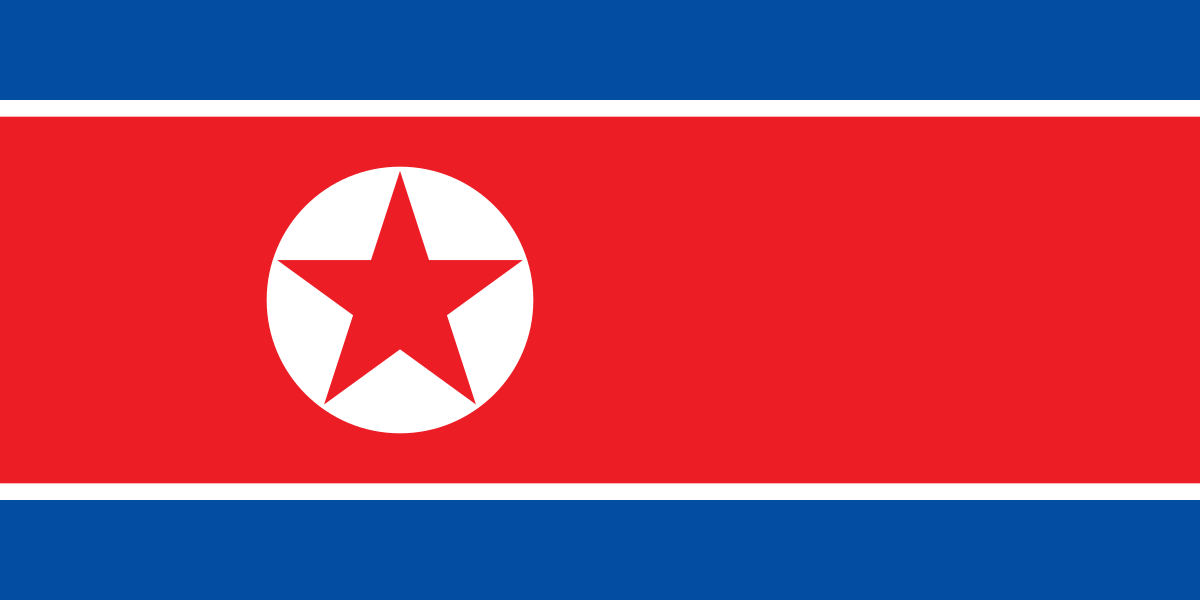
On the day the People's Assembly adopted the new DPRK flag in July 1948, Kim Tu-bong personally lowered the Taegeukgi and raised its replacement. Barely a year earlier, he had been the man passionately explaining the old flag's philosophical meaning to a skeptical Soviet general.
A Hangul linguist trained under Chu Sigyŏng who led the Korean Independence League in Yan'an. Became the DPRK's first head of state in 1948, though real power lay with Kim Il Sung. Purged and vanished in the 1958 August Faction Incident.
Activities and affiliations
Career Timeline
- 1908–1916Studied Hangul under Chu Sigyŏng; helped compile MalMoi dictionary
- 1919Joined March First Movement, then exiled to Shanghai provisional government
- 1920–1930년대Combined communist activism with linguistic research in Shanghai
- 1942–1945Founded Korean Independence League in Yan'an; led the Yan'an faction
- 1946.2–1946.8Chairman of the New People's Party of Korea
- 1946.8–1949.6Chairman of the Workers' Party of North Korea Central Committee
- 1948.9–1957.9Chairman of the SPA Standing Committee — first head of state of the DPRK
- 1957–1958Dismissed from all posts over August Faction Incident; disappeared
Related historical events
Work as a Hangul Scholar and Early Korean Linguistics
Before he was a politician, Kim Tu-bong was a Hangul scholar, and his scholarly identity ran through his entire life. After graduating from Bosung College in 1908, he studied Hangul and Korean linguistic methodology at Chu Sigyŏng's summer night school; he became known as Chu's finest disciple. From 1911 to 1914, he worked alongside Chu, Kwŏn Tŏk-kyu, and Yi Kyu-yŏng to compile MalMoi, the first-ever Korean-language dictionary. The manuscript was never published but survives today in the National Hangeul Museum. When Chu died suddenly in 1914, Kim took up his teacher's mission: in 1916 he compiled and published Joseonmalbon, a Korean dictionary written entirely in Hangul with Chinese-character glosses. After going into exile in Shanghai, he thoroughly revised it and released Gipdeo Joseonmalbon in 1922. These works, based on the Seoul vernacular and applying systematic methodology to Korean grammar and vocabulary, were landmark achievements in the infancy of Korean linguistics. Later, in North Korea, he directed the Korean Language Research Society and the Academy of Sciences in establishing new orthographic rules and spelling systems, shaping language policy from the top. His scholarly life, devoted to Hangul and the study of the Korean language, was erased from official memory after his political downfall. Yet it remains an indelible legacy in the history of Korean linguistics.
Creation of the National Flag and Replacement of the Taegeukgi
Kim Tu-bong played the central role in the adoption of the DPRK's national flag. In summer 1947, Soviet Major General Lebedev summoned him to discuss the flag for the soon-to-be-established state. Kim gave a detailed explanation of the Taegeukgi's philosophical basis, but the Soviets dismissed it as medieval superstition and decided on a new design. After Moscow dictated the new flag pattern, the North Korean People's Assembly formally adopted it in July 1948; Kim personally lowered the Taegeukgi and raised the new flag in its place. Ten days later he gave a press conference explaining the decision, and in August 1948 published a book, On the Establishment of the New National Flag and the Abolition of the Taegeukgi: a remarkable work that addressed skeptics with reasoned argument rather than invective, and made no mention of Kim Il Sung. As the Kim Il Sung–centered historical narrative was consolidated, the flag's creation was reattributed to Kim Il Sung and Kim Tu-bong's role was erased from official memory.
The August Faction Incident and Purge
Kim Tu-bong was not a direct instigator of the 1956 August Faction Incident. When Yan'an and Soviet faction figures criticized Kim Il Sung's personality cult and economic failures and attempted to remove him at a Central Committee plenum, Kim Tu-bong, though uneasy with Kim Il Sung's methods, believed the attempt was doomed and refused to participate. A senior official reported to the Soviets in May 1956 that "Kim Tu-bong is a wise old man, respected by everybody; he prefers to grow flowers in his garden and is not interested in state and Party affairs." After the opposition was defeated at the Central Committee on August 31, Kim Il Sung launched an across-the-board "anti-factional struggle" targeting the Yan'an faction. At the January 1957 Central Committee plenum Kim Tu-bong was fiercely criticized; at the First Party Conference in March 1958 he was branded a counter-revolutionary factionalist, expelled from the Party, and removed as Chairman of the SPA Standing Committee. The accusations against him included salacious personal attacks: that he had illegally procured sexual stimulants after marrying a much younger woman. His advanced age spared him execution, but he was sent to a remote cooperative farm in Sunan County, South P'yŏngan Province, to perform hard labor, after which he vanished from all official records. A joint Sino-Soviet delegation led by Peng Dehuai and Anastas Mikoyan demanded the purges be reversed; Kim Il Sung gave only a show of compliance before resuming the purges and consolidating his power even further. The destruction of the Yan'an faction was the watershed that marked the completion of Kim Il Sung's one-man dictatorship in North Korea.