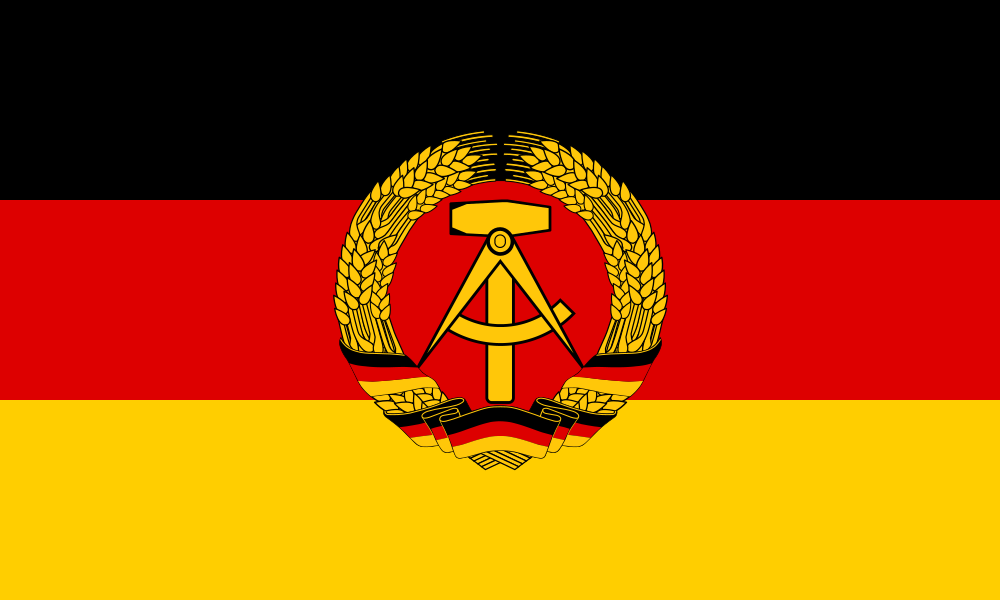
First East German Minister for State Security, purged in 1953 after trying to replace Ulbricht
Born in Gelsenkirchen to a gendarmerie sergeant’s family, he trained as a teacher and was a military leader of the Red Ruhr Army during the Kapp Putsch of 1920. As a GRU agent and Comintern military adviser he co-organised the Guangzhou Uprising in China, and in the Spanish Civil War, as “Gomez”, he led the International Brigades. He returned to Germany in 1947, joined the SED, and in 1950 became the first Minister for State Security and a Politburo member, building up the Stasi. After the uprising of June 1953 he moved to replace Ulbricht with Herrnstadt, but once Ulbricht had Khrushchev’s backing he lost his ministry and all his posts in July and was expelled from the party. He worked as a translator, died in East Berlin in 1958 and was rehabilitated after 1990.
Career timeline
- 1920Red Ruhr Army leader during the Kapp Putsch
- 1927–1930Comintern military adviser in China
- 1936–1938International Brigades commander in Spain (“Gomez”)
- 1950–1953GDR Minister for State Security; Politburo member
- 1953Stripped of all posts and expelled from the SED
Communist who ran an anti-fascist sabotage network before the war and headed the Stasi from 1953 to 1957
Born in Münden in the Province of Hanover, he took part in the sailors’ revolt of 1918, joined the KPD in 1919 and led party military wings; he sat in the Reichstag in 1932–1933. In exile he organised the “Wollweber League” in 1936–1940, which carried out 21 known acts of sabotage against ships of fascist nations, and supplied arms to the Spanish Republicans. Back in Germany in 1946 he ran shipping administration. In July 1953, when Zaisser was removed and the Ministry for State Security was downgraded to a State Secretariat, he became its head, and in November 1955 Minister of State Security again. He clashed with Ulbricht and Honecker and sided with Schirdewan, resigned in 1957, and in 1958 was removed from the Central Committee for “factional activity”. He died in East Berlin in 1967.
Career timeline
- 1918Took part in the sailors’ revolt
- 1932–1933KPD Reichstag deputy
- 1936–1940Organised the Wollweber League sabotage network
- 1953–1955State Secretary of State Security
- 1955–1957Minister of State Security
- 1958Removed from the Central Committee
Communist who chaired the German Economic Commission, the forerunner of the GDR government, and led East German economic policy
Born in Feuerbach near Stuttgart, he worked as a metal presser at Bosch and passed through the Spartacists and the USPD into the KPD in 1919, becoming the party’s leading agricultural policy maker in the 1920s. Imprisoned after the Nazis came to power, he emigrated to the Soviet Union and in the Spanish Civil War commanded the XI International Brigade. Interned in France and handed to the Gestapo by Vichy in 1942, he was liberated at Mauthausen. In March 1948 he became chairman of the German Economic Commission (DWK), which carried out the eastern currency reform and the first plans. In the GDR he was a Politburo member, deputy prime minister and chairman of the State Planning Commission; at the Politburo session of 8 July 1953 he recommended replacing Ulbricht, yet kept his posts. Minister of Machine Construction and then of Foreign Trade, he died of a heart attack in 1961.
Career timeline
- 1919Joined the KPD
- 1923Head of the KPD agricultural division
- 1937–1938Commander of the XI International Brigade
- 1943–1945Mauthausen concentration camp
- 1948–1949Chairman of the German Economic Commission
- 1950–1961SED Politburo member; deputy prime minister
- 1955–1961Minister of Foreign and Inter-German Trade