The poet of Doctor Zhivago and the refused Nobel Prize
The Doctor Zhivago affair brought publication, international politics, and a writer's survival into collision around one book.
A major Russian poet, translator, and author of Doctor Zhivago. The novel's first publication in Italy and his 1958 Nobel Prize drew fierce Soviet condemnation, and he declined the prize under pressure.
Career timeline
1914Publishes first poetry collection, Twin in the Clouds
1957Doctor Zhivago first published in Italy
1958Awarded Nobel Prize in Literature; declines under pressure
Soviet major general who turned dissident to defend human rights and deported nations
"In the underground one can meet only rats" — his credo of open, public dissent, which became the title of his memoirs.
A Soviet major general (1959) turned dissident, Grigorenko led the Crimean Tatars' struggle for the right of return and co-founded both the Moscow and Ukrainian Helsinki Groups. He openly condemned the 1968 invasion of Czechoslovakia and endured two forced psychiatric incarcerations (1964–65, 1969–74), becoming the landmark case exposing Soviet political abuse of psychiatry.
Career timeline
1927–1929Komsomol secretary, member of Ukrainian Komsomol Central Committee
1934–1939Graduated with honors from Military Engineering Academy and General Staff Academy
1939–1943Khalkhin Gol, Far Eastern Front staff officer, brigade commander
1943–1945WWII: deputy chief of staff, 10th Guards Army; chief of staff, 8th Rifle Division (wounded)
1945–1961Frunze Military Academy professor, head of cybernetics department; major general 1959
1961–1964Dismissed for political speech, exiled to Far East, founded League for Revival of Leninism
1964–1974Forced psychiatric incarceration — two periods in special psychiatric hospitals
1976–1977Founding member, Moscow Helsinki Group and Ukrainian Helsinki Group
Prisoner Shch-854, who told the world about the Archipelago
February 9, 1945, on the East Prussian front. An artillery captain decorated for pinpointing enemy batteries was arrested at his unit headquarters. The charge: mocking Stalin under the coded nickname 'Pakhan' in letters to a friend. The insignia were torn from his uniform, and he boarded a prison transport bound for the Lubyanka.
An artillery captain sentenced to eight years for mocking Stalin in a private letter. One Day in the Life of Ivan Denisovich (1962) made him the emblem of the thaw; The Gulag Archipelago earned him the Nobel Prize and deportation (1974) together. He returned in 1994 and died in Russia, outliving the system he had testified against by seventeen years.
Career timeline
1945–1953Arrested over a censored letter; eight years in the camps
1953–1956Exile in Kazakhstan; schoolteaching
1962One Day published with Khrushchev’s sanction
1970The Nobel Prize in Literature
1973–1974The Gulag Archipelago in Paris; deportation
He built the hydrogen bomb, then turned on the system
On 15 December 1986 KGB officers installed a telephone in the Gorky flat; the next day Gorbachev called personally: "You may return to Moscow." Sakharov thanked him and at once raised the release of political prisoners. Nearly seven years of exile ended; he never set down the agenda of conscience.
Father of the Soviet hydrogen bomb and the conscience who laid its privileges down. His decisive break came through the secret letter of 21 July 1967 opposing ABM deployment and the essay "Reflections on Progress, Peaceful Coexistence, and Intellectual Freedom", completed in May 1968 and circulated in samizdat, after which he was removed from weapons research; he denounced the Soviet entry into Czechoslovakia that August. Criticism of the Afghan invasion sent him into internal exile in Gorky in 1980. A single telephone call from Gorbachev brought him back in 1986; he died a people's deputy, still fighting from the rostrum.
Career timeline
1948–1953On the hydrogen bomb project; the 1953 test
1953Full academician at thirty-two
1961Argues against atmospheric testing to Khrushchev’s face
1968Progress, Coexistence and Intellectual Freedom circulates in samizdat
1975Nobel Peace Prize; barred from travel, his wife accepts it
The physicist who held the Kremlin to the Helsinki human-rights promises it signed
At his closed trial in May 1978 he told the court: 'Trials like these cannot cure the ills and failings of society to which the documents of the Helsinki Group bear witness.'
A particle-accelerator physicist who became the founder of the Soviet Union's first human-rights monitoring group. In 1956 he called Stalin and Beria 'killers who held power' at a party meeting and was expelled and dismissed; twenty years later, in May 1976, he founded the Moscow Helsinki Group to monitor Soviet compliance with the Helsinki Final Act's human-rights provisions. It was an effort to turn the third-basket promises the Kremlin had itself signed back against it from within. Arrested in February 1977 and sentenced to seven years' camp plus five years' exile, he was stripped of citizenship and deported to the United States in 1986, ending as a professor of physics at Cornell.
Career timeline
1952–1956Physicist in the secret nuclear laboratory later ITEP
1956Denounces Stalin and Beria; expelled from the Party and dismissed
1956–1972Yerevan Physics Institute; Doctor of Sciences in 1963
1968Corresponding member of the Armenian Academy of Sciences
1973Founds the first Amnesty International group in the USSR
1976.05Founds and chairs the Moscow Helsinki Group
1977–1986Arrested; sentenced to seven years' camp and five years' exile
1986Denationalized and deported; professor at Cornell
Abram Tertz, from Novy Mir critic to symbol of the Soviet dissident movement
At his February 1966 trial, Sinyavsky pleaded not guilty — rare in a Soviet political trial. Historian Fred Coleman called this moment "the birth of the modern Soviet dissident movement."
Soviet literary scholar, critic, and writer. A Candidate of Philological Sciences (1952), he worked at the Gorky Institute of World Literature and taught at Moscow State University and the Moscow Art Theatre School. He became a leading critic at Aleksandr Tvardovsky's Novy Mir, then the most liberal legal Soviet publication, while publishing satirical fiction and the essay "On Socialist Realism" (1959) in the West as Abram Tertz. In 1966, he and Yuli Daniel became the first Soviet writers convicted for fiction alone; their show trial is seen as the birth of the modern Soviet dissident movement. After six years in Dubravlag labour camp, he emigrated to France in 1973 and became professor of Russian literature at the Sorbonne, co-founding the journal Sintaksis.
Career timeline
1949Graduated from Moscow State University, philology
1952Candidate of Philological Sciences; joined IMLI
1955–1965Published fiction and essays in the West as Abram Tertz
late 1950s–1965Leading literary critic, Novy Mir
1960Admitted to Union of Soviet Writers
1966Sentenced to 7 years for anti-Soviet agitation; imprisoned at Dubravlag
1971Released early
1973–1997Professor of Russian literature, Sorbonne; co-founded Sintaksis
The dissident biologist who argued the archives contain no evidence Stalin planned a Jewish deportation
After his 1970 release from the psychiatric hospital: "No honest and principled scholar can be sure of his safety if such grounds can lead to repression in the form of indefinite confinement in a psychiatric hospital."
A Soviet biologist and dissident historian. Born in Tbilisi, he studied at the Timiryazev Agricultural Academy and researched the molecular mechanisms of aging. In 1962 he wrote a samizdat manuscript exposing Trofim Lysenko's pseudoscience, published in the US in 1969 as The Rise and Fall of T.D. Lysenko, which brought international attention to the corruption of Soviet biology. In 1970 he was forcibly confined in a psychiatric hospital and released after protests by Sakharov, Solzhenitsyn, and others; in 1973, while on a scientific visit to London, he was stripped of his Soviet citizenship and spent the rest of his life in exile. His late work Stalin and the Jewish Problem (2003) argued that no archival documents support the claim that the Doctors' Plot was meant to trigger a mass deportation of Soviet Jews.
Career timeline
1925Born in Tbilisi (Tiflis), named after French socialist leader Jean Jaurès
1943Drafted into the Red Army, seriously wounded on the Taman Peninsula and discharged
1950Graduated from Timiryazev Agricultural Academy; Candidate of Biological Sciences
1962Dismissed from Timiryazev Academy over samizdat manuscript criticizing Lysenko's pseudoscience
1963–1969Head of molecular radiobiology lab, Institute of Medical Radiology, Obninsk
1970Forcibly confined in Kaluga psychiatric hospital; released after protests by Sakharov, Solzhenitsyn, and others
1973Stripped of Soviet citizenship while on research leave in London; remained in exile in Britain
1990–1992Soviet citizenship restored by Gorbachev; joined Chernobyl exclusion zone radiobiological expeditions
From Let History Judge: "I have never betrayed either my convictions or the ideals of my youth. In this I see my father's influence; he was able to instill in me his commitment to socialism, though my ideas about socialism have of course changed. I could not have written my books other than out of deep conviction."
Soviet Marxist historian and communist publicist. From the 1960s he participated actively in the dissident movement, editing the samizdat journal Political Diary. His magnum opus, Let History Judge (nearly two decades in the making), subjected Stalinism to a meticulous, source-based Marxist critique and led to his expulsion from the CPSU in 1969. He never abandoned his socialist convictions; reinstated in 1989, he served as a People's Deputy, Supreme Soviet member, and Central Committee member. He authored over 35 books, pioneering a tradition of self-critical Marxist historiography within the socialist movement.
Career timeline
1925Born in Tiflis, named after Indian communist M. N. Roy
1946–1951Graduated with honors from the Philosophy Faculty of Leningrad State University; Komsomol secretary
1958Candidate of Pedagogical Sciences, Moscow State Pedagogical Institute
1960sEdited the samizdat journal Political Diary; active in dissident circles
1969Expelled from the CPSU for Let History Judge
1970Co-signed open letter with Sakharov and Turchin to the Brezhnev leadership on democratization
1989–1991People's Deputy of the USSR, Supreme Soviet member; reinstated in CPSU, Central Committee member
1991–2002Co-chairman of the Socialist Party of Working People of the Russian Federation
Historian and playwright who foresaw the Soviet collapse by 1984
“This trial inspires neither respect nor fear in me. The process of intellectual liberation that has begun is irreversible.” — final statement at Sverdlovsk court, November 1970
A historian and absurdist playwright, he predicted the Soviet system's inherent collapse in his essay "Will the Soviet Union Survive Until 1984?" (1970). Imprisoned twice for dissident activity, he was forced into exile in 1976 and continued writing in the West.
Career timeline
1959–1963Studied at Moscow State University history faculty; expelled for Normanist dissertation
1963–1965Wrote absurdist plays and collected avant-garde art
1965–1966Arrested for 'parasitism,' sentenced to 2.5 years exile in Tomsk region, Siberia
1966–1968Released early, returned to Moscow; freelance at Novosti Press Agency
1969Wrote 'Will the Soviet Union Survive Until 1984?'; published abroad
1970–1975Arrested for anti-Soviet defamation; 3-year labor camp term plus 3-year extension, commuted to Magadan exile after hunger strike
1976Helped conceive Moscow Helsinki Group; forced emigration to the Netherlands
1976–1980Researcher at Utrecht University, lectured in the US, wrote in France
Dissident
1939–1989
✕ Death in a suspicious car crash
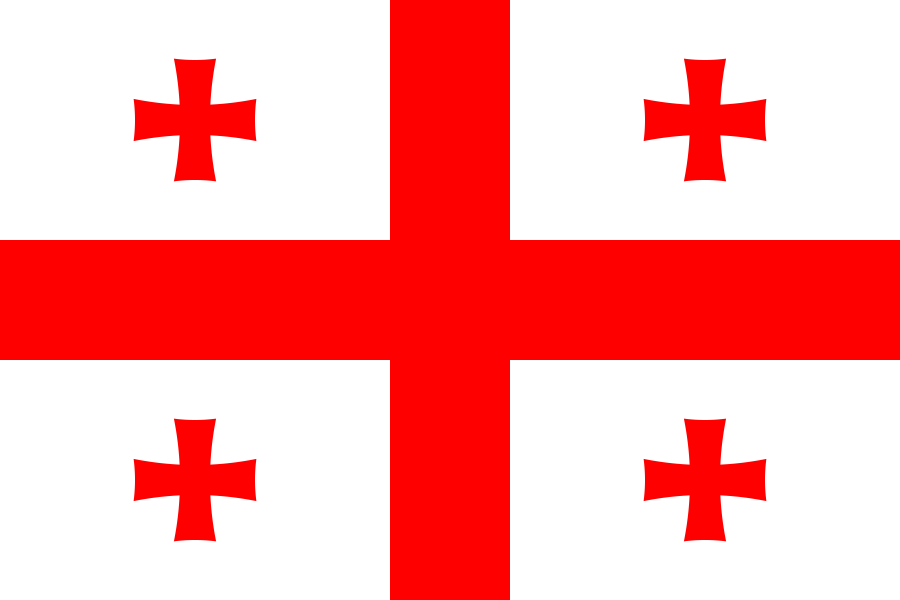
A poet who joined the struggle for independence to the defense of human rights
On April 9, 1989, he was arrested as an organizer of the Tbilisi independence protest and released 45 days later under public pressure.
Merab Kostava was a musician, poet and dissident who fought for Georgian independence and human rights. With Zviad Gamsakhurdia, he built underground publishing and Helsinki human-rights networks that challenged Soviet repression of national and religious life. After years of imprisonment and exile in Siberia, he returned in 1987 and helped lead the mass independence movement and Tbilisi protests from 1988 onward. He died in a suspicious car crash in 1989 and was later honored by Georgia as a national hero.
Career timeline
1954Co-founded the underground youth group Gorgasliani with Zviad Gamsakhurdia
1956–1958First arrested and detained for dissident activity
1962–1977Teacher in Tbilisi music schools; pursued musical and literary work
1973–1976Founded the Initiative Group for Human Rights and the Georgian Helsinki Group
1977–1987Imprisoned and exiled to Siberia on anti-Soviet propaganda charges
1987–1989Led the independence movement and organized the April 9, 1989 Tbilisi protest
Estonian former political prisoner who survived the Soviet camps and co-organized the first open rally of the Baltic independence movement
The Hirvepark demonstration, Ahonen said, 'broke open the path for the expression of opinion,' an historic turn he called 'the icebreaker effect.'
Heiki Ahonen was born in 1956 in Pärnu, Estonia. His grandfather was shot by the NKVD, his father imprisoned in the camps, and his mother deported to Siberia: every member of his family was repressed. Joining the underground resistance in 1977, he distributed samizdat and fed information on Soviet human rights violations to Western journalists; convicted of anti-Soviet agitation in 1983, he served five years in the Perm labour camps. Released in early 1987, he co-organised the Hirvepark rally that August, the first open mass demonstration demanding disclosure of the Nazi-Soviet pact's secret protocols, breaking the dam for the Baltic independence movement; then was forcibly expelled by the KGB, spent a decade in exile, and came home as the founding director of the Museum of Occupations.
Career timeline
1977–1983Underground resistance, samizdat distribution, human rights documentation
1983–1987Five years in Perm labour camps (anti-Soviet agitation)
1987.08Co-founder of MRP-AEG, co-organiser of Hirvepark rally
1988.01Co-founder, Estonian National Independence Party (ERSP)
1988–1989Deputy chairman, Help Center for Estonian Political Prisoners (Stockholm)
1989–1998Director of Estonian service, Radio Free Europe (Munich/Prague)
2003–2012Founding director, Museum of Occupations, Tallinn