Five-time Socialist Party presidential candidate and pioneer of industrial railroad unionism
At his 1918 sentencing he declared: "While there is a lower class, I am in it, while there is a criminal element, I am of it, and while there is a soul in prison, I am not free."
The most iconic figure of American socialism and a pioneer of industrial unionism. After leading the American Railway Union through the Pullman Strike of 1894, he embraced Marxism in prison and helped found the Socialist Party of America (1901) and the IWW (1905). He ran for president five times, winning 6.0% in 1912, and from an Atlanta prison cell in 1920 he won over 914,000 votes, the high-water mark of American socialist electoral politics.
Career timeline
1875Joined Brotherhood of Locomotive Firemen
1880–1893BLF Grand Secretary-Treasurer & magazine editor
1885Indiana State Representative (Democrat)
1893–1897Founder & president, American Railway Union
1901Co-founder, Socialist Party of America
1905Founding member, Industrial Workers of the World
1900–1920Socialist Party presidential candidate (5 campaigns)
SR leader imprisoned by both Tsar and Bolsheviks, who became founder of Harvard's sociology department
In an open letter written from the Cheka basement in Veliky Ustyug in 1918 while awaiting execution, Sorokin renounced his SR party membership and declared an end to his political activity.
A leading figure in the Socialist Revolutionary Party (SR) during the Russian Revolution, Sorokin served as secretary to Prime Minister Kerensky and was elected to the Constituent Assembly. Imprisoned three times by the Tsarist regime, he was sentenced to death by the Bolsheviks after 1917 and exiled in 1922 on the 'philosophers' ship.' In the United States he founded Harvard's department of sociology in 1930, becoming one of the 20th century's most important sociologists through his work on social stratification, social mobility, and the cyclical theory of sociocultural dynamics in his magnum opus Social and Cultural Dynamics.
Career timeline
1906Joined SR party; arrested and imprisoned in Kineshma
1909–1914Graduated from St. Petersburg University, Faculty of Law, in criminology
1917SR leader, secretary to PM Kerensky, Constituent Assembly deputy
1919–1922Professor at Petrograd University; founded Russia's first sociology department
1922Exiled from Soviet Russia ('philosophers' ship')
1924–1930Professor at University of Minnesota
1930–1959Professor at Harvard; founded and chaired sociology department
1965President of the American Sociological Association
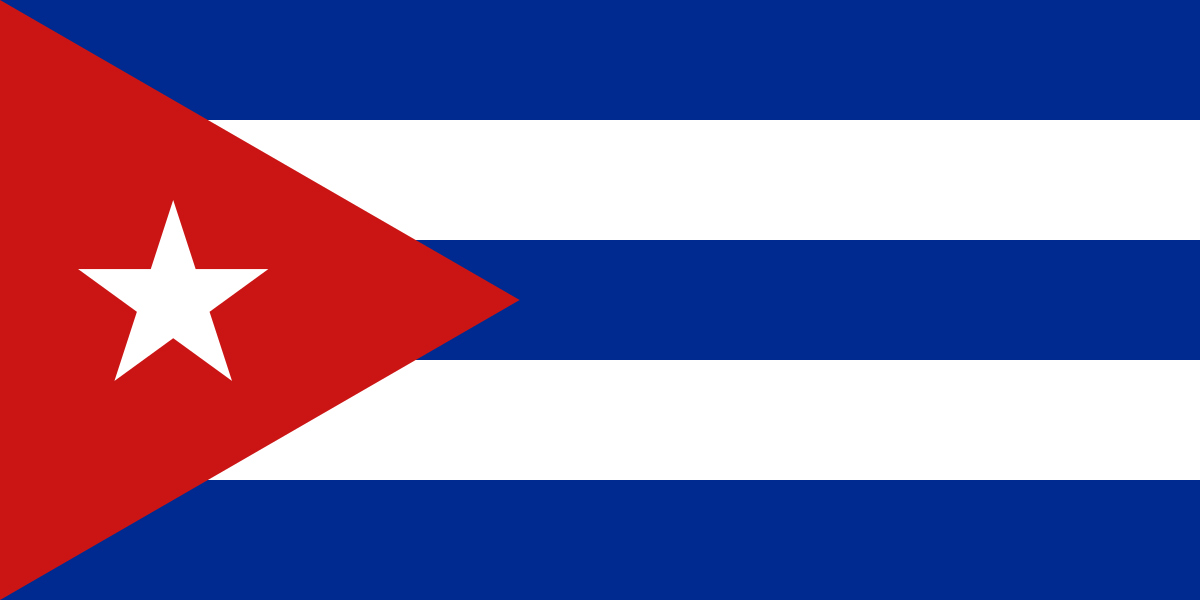
American sociologist who reopened the debate on the Cuban Revolution
In The Origins of the Cuban Revolution Reconsidered (2006) he cast the revolutionary leaders as autonomous actors pursuing their own ideological vision rather than a master plan, challenging the dominant reading.
Born in Marianao, Cuba, to Jewish immigrant parents from Poland. He joined the anti-Batista movement as a high school student, moved to the United States in 1958 and took his PhD in sociology at UC Berkeley in 1969. He taught at UCLA, SUNY-Old Westbury, Fairleigh Dickinson and Brooklyn College (CUNY), retiring in 2007, and has written on the Cuban Revolution, the Castro government, Soviet history and US politics from a left-wing, radical-democratic standpoint. No death record is confirmed.
Career timeline
1939Born in Marianao, Cuba
1950sTook part in the anti-Batista mass movement as a high school student
1958Moved to the United States
1969PhD in sociology, UC Berkeley
1976Published Revolution and Reaction in Cuba, 1933–1960
1990Published Before Stalinism
2006Published The Origins of the Cuban Revolution Reconsidered