The agronomist who pushed a sovereignty declaration through the Soviet system and led Estonia out of the empire
Lukyanov warned him of a ten-year sentence for 'anti-constitutional activity.' Rüütel stood his ground: 'We will convene the Supreme Council and put the Declaration of Independence to a vote,' inadvertently saying 'Independence' instead of 'Sovereignty,' as he later recalled.
An agricultural economist from the Estonian island of Saaremaa, Rüütel rose through the Soviet system: rector of the Estonian Agricultural Academy, Communist Party functionary, and finally chairman of the Presidium of the Estonian SSR Supreme Soviet in 1983. On 16 November 1988, defying Moscow's threat of imprisonment, he pushed the Estonian sovereignty declaration through the legislature, opening the first crack in the Soviet edifice; in 1990, as chairman of the Supreme Council, he declared Soviet rule illegal and initiated the transition to restored independence. After independence he was elected president in 2001 and served until 2006, steering Estonia into NATO and the European Union.
Career timeline
1949–1950Senior agronomist, Saaremaa Executive Committee agricultural department
1955–1957Teacher, Tartu School of Agricultural Mechanization
1957–1963Senior zootechnician and director, experimental farm of the Veterinary and Animal Husbandry Research Institute
1963–1969Director, Tartu Reference State Farm
1969–1977Rector, Estonian Academy of Agriculture
1977–1979Secretary for agriculture, Central Committee of the Communist Party of Estonia
1979–1983First Deputy Chairman, Council of Ministers of the Estonian SSR
1983–1990Chairman, Presidium of the Supreme Soviet of the Estonian SSR
1990–1992Chairman, Supreme Council of the Republic of Estonia
Soviet Union
Soviet communism
1934–1993
○ Natural causes
A Soviet republican leader who asserted institutional authority in crisis
“A state of emergency was declared and troops were sent in without the republic’s consent.”
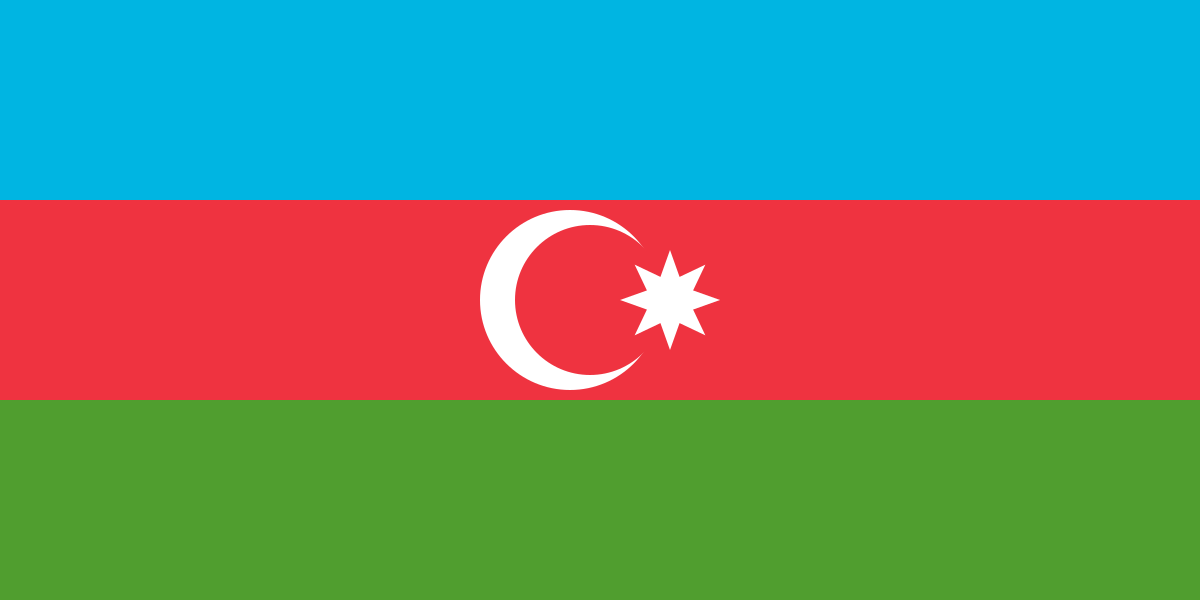
Elmira Kafarova was an Azerbaijani Soviet politician and diplomat who moved through education and foreign-affairs administration before leading the republic’s Supreme Soviet. In January 1990, she publicly protested the declaration of emergency in Baku and the entry of Soviet troops, stating that the decision had been taken while she was in Moscow and without her knowledge. Her institutional dissent, unusual within the Soviet republican leadership, illuminates how the nationalities crisis became a collision among republican institutions, a mass movement, and Union power.
Career timeline
1958Graduated from Azerbaijan State University; pursued philological research
1966–1970First Secretary of the Komsomol Central Committee of the Azerbaijan SSR
1971Ideology secretary of the Baku City Party Committee
1980–1983Minister of Education of the Azerbaijan SSR
1983–1987Minister of Foreign Affairs of the Azerbaijan SSR
1987–1989Deputy Chair of the Council of Ministers of the Azerbaijan SSR
1989–1990Chair of the Presidium of the Supreme Soviet of the Azerbaijan SSR
1990–1992Chair of the Supreme Soviet of Azerbaijan
The communist propagandist who became Ukraine's first president and signed the Soviet Union out of existence
It was a long road we walked to Belavezha. It was not by accident; it was our deliberate choice because we had no other option.
A party man who spent three decades climbing the propaganda and ideology apparatus of the Ukrainian Communist Party, Kravchuk pivoted to 'national communism' after becoming chairman of the Supreme Soviet in 1990. At the Novo-Ogaryovo negotiations he insisted on a confederation, not a federation, and delayed the signing of the new Union Treaty until September; after the August 1991 coup collapsed, he presided over Ukraine's Declaration of Independence on 24 August. Elected Ukraine's first president on 1 December 1991, he signed the Belavezha Accords with Yeltsin and Shushkevich a week later, formally ending the Soviet Union. His presidency saw the surrender of Ukraine's nuclear arsenal and a deep economic slump, but he stepped down after a peaceful electoral defeat and remained active in politics as a deputy.
Career timeline
1958–1970From political-economy teacher to head of agitation and propaganda, Chernivtsi region
1970–1980Rose through CC CPU agitation and propaganda department
1980–1988Head of CC CPU agitation and propaganda department
1988–1989Head of CC CPU ideology department
1989–1990.06CC CPU secretary, Politburo member, second secretary
1990.07–1991.08Chairman of Supreme Soviet of Ukraine; presided over independence declaration
1991.12–1994.07First President of Ukraine; signed Belavezha Accords; lost to Kuchma
1994–2006People's Deputy, parliamentary leader of SDPU(o)
The nuclear physicist who demanded Chernobyl truth, hosted the meeting that dissolved the USSR, and called Gorbachev to tell him
Gorbachev asked, 'Have you thought about the international reaction?' I answered, 'Yeltsin is on the phone with Bush right now. Bush seems to be in favor!'
A nuclear physicist from Minsk, he was a professor at Belarusian State University and a specialist in radio electronics. In 1986, as a member of the Chernobyl investigation commission, he demanded the truth be made public against the Soviet cover-up and was removed, an experience that propelled him into politics. As chairman of the Belarusian Supreme Soviet in 1991, he hosted Boris Yeltsin and Leonid Kravchuk at the Viskuli hunting lodge for what was billed as a discussion of oil and gas supplies; when the conversation turned to dissolving the USSR, he was the first to say he would sign, and he was the one who telephoned Gorbachev to inform him the Soviet Union had ceased to exist. The first head of state of independent Belarus, he was ousted in 1994 by Alexander Lukashenko's corruption allegations and spent his final decades in Minsk as an unyielding opposition elder.
Career timeline
1956Graduated, Faculty of Physics and Mathematics, BSU
1963–1965Associate Professor, Nuclear Physics, BSU
1966–1970Vice-Rector for Research, Minsk Radio Engineering Institute
Ukrainian SSR head of state during Chernobyl who pushed the evacuation of 526,000 children from Kyiv against Moscow's resistance
Recalling the interior deputy minister's report on the morning of 26 April 1986: 'The fire was put out, everything is fine. The people? Some are having a wedding, some are gardening, some are fishing in the Pripyat River.'
As Chairwoman of the Presidium of the Supreme Soviet of the Ukrainian SSR during the Chernobyl disaster, she defied Moscow's directives and oversaw the evacuation of 526,000 children from Kyiv and contaminated zones in just five days. Born the daughter of a miner in Kryvyi Rih, she rose through Komsomol and the deputy ministry of education to become the republic's formal head of state in 1985, spending her tenure navigating between central information control and the realities on the ground. In 1989 she refused to sign the resolution banning the People's Movement of Ukraine (Rukh), and after retirement led children's and women's welfare foundations while maintaining a sympathetic view of the Soviet system and a critical stance toward independent Ukraine.
Career timeline
1954–1957Pioneer leader, geography teacher, school Komsomol secretary in Kryvyi Rih
1957–1962Secretary of Kryvyi Rih city Komsomol, then Dzerzhinsky district party committee
1962–1969Secretary and department head, Komsomol Central Committee of Ukraine
1969–1972Deputy Minister of Education, Ukrainian SSR
1975–1985Deputy Chair, Presidium of the Supreme Soviet, Ukrainian SSR
1985–1990Chair of the Presidium, Supreme Soviet, Ukrainian SSR (head of state)
1985–1989Deputy Chair, Presidium of the Supreme Soviet, USSR
Soviet Union
Soviet communism
1937–2010
↓ Arrested · amnestied 1994
First and only Vice President of the USSR and the face of the August 1991 coup
To KGB chairman Kryuchkov during the August 1991 coup: 'Understand my character—if even one person dies, I won't be able to live.'
After serving as First Secretary of the Gorky Oblast Komsomol and chairman of the USSR Committee of Youth Organizations (1968–1980), Yanayev became VTsSPS chairman, a Politburo member and CC Secretary in 1990. That December Gorbachev forced through his election as the USSR's first vice president. In August 1991, as the face of the GKChP, he declared himself acting president citing Gorbachev's 'illness'. The coup failed within three days and he was arrested. Amnestied in 1994, he published the memoir Last Battle for the USSR and spent his remaining years in academia.
Career timeline
1959–1963Mechanised-agriculture detachment chief → Selkhoztekhnika branch manager, Gorky Oblast
1966–1968First Secretary, Gorky Oblast Komsomol
1968–1980Chairman, USSR Committee of Youth Organizations
The Communist Party secretary who led Latvia's Supreme Council through the restoration of independence
On 14 January 1991, General Kuzmin's ultimatum to the chairman of the Supreme Council was simple: repeal the laws Latvia had adopted, or the army would act. Gorbunovs did not repeal them, and a week later flew to Moscow to face Gorbachev.
A farmer's son from Pilda in eastern Latvia, he graduated from construction college, Riga Polytechnical Institute, and the Moscow Academy of Social Sciences, then rose through the Latvian Communist Party apparatus to become Central Committee secretary for ideology. He broke with the party's hard line in 1988 by backing the Latvian Popular Front, and as Chairman of the Supreme Council presided over the 4 May 1990 session that declared the Soviet Union an occupying power and began the transition to restored independence. During the January 1991 Barricades he stood firm against General Kuzmin's ultimatum, then flew to Moscow on 21 January to confront Gorbachev directly.
Career timeline
1959–1965Technician at Nīkrāce state farm, employee at Riga Agricultural Engineering Institute, Soviet Army service
1970–1974Senior lecturer at Riga Polytechnical Institute, Kirov district Komsomol first secretary
1974–1988Various posts in the Latvian Communist Party Central Committee, rising to secretary for ideology
1988–1990Chairman of the Presidium of the Supreme Soviet of the Latvian SSR
1990–1993Chairman of the Supreme Council of the Republic of Latvia, acting head of state after independence
1993–1995Speaker of the 5th Saeima
1995–2002Deputy Prime Minister, Minister for Environmental Protection and Regional Development, Minister for Transport
The Supreme Soviet chairman who stood with Yeltsin against the coup, then fell to Yeltsin's tanks
During the October 1993 siege of the White House, when Yeltsin offered safety guarantees, Khasbulatov replied: 'I need no guarantees, I can offer guarantees to Yeltsin myself.'
Ruslan Khasbulatov was a Chechen-born Soviet economist and Russian politician who became the last chairman of the RSFSR Supreme Soviet. On the day of the August 1991 coup, he was Yeltsin's closest ally: he personally drafted the appeal 'To the Citizens of Russia' and helped organize the defense of the White House. After the Soviet collapse, however, he turned the parliament into the center of opposition to Yeltsin's economic reforms and concentration of power, leading to the 1993 constitutional crisis in which he and Vice-President Rutskoy commanded the parliamentary resistance until tanks shelled the building and they were arrested. Amnestied in 1994, he left politics and returned to academia, teaching world economics at his alma mater.
Career timeline
1965Graduated from the Faculty of Law, Moscow State University
1970–1990Professor and head of the Department of International Economic Relations, Moscow Institute of National Economy (Plekhanov)
1990.03Elected RSFSR People's Deputy from the Grozny constituency
1990.06–1991.10First Deputy Chairman of the RSFSR Supreme Soviet
1991.07–10Acting Chairman of the RSFSR Supreme Soviet
1991.10–1993.10Chairman of the RSFSR/Russian Federation Supreme Soviet
1994–2023Head of the Department of World Economics, Plekhanov Russian University of Economics