Author of the 14-volume History of Soviet Russia; diagnosed a "latent incompatibility" between NEP markets and planning
'There was a latent incompatibility between the principles of the New Economic Policy and the principles of planning.' From Foundations of a Planned Economy (1969).
A British historian and former diplomat, he authored the 14-volume A History of Soviet Russia (1950–1978), a comprehensive account of Soviet political, economic, and social life from 1917 to 1929. In international relations, The Twenty Years' Crisis (1939) helped lay the foundations of classical realism, while What Is History? (1961) redefined the historian's craft as interpretation rather than the accumulation of facts. On the NEP, he judged that there was 'a latent incompatibility between the principles of the New Economic Policy and the principles of planning,' an assessment that became one of four major historiographical positions on the policy's viability. He remained a fellow of Trinity College, Cambridge, until his death.
Career timeline
- 1916–1936Diplomat, British Foreign Office; Paris Peace Conference (1919) and Riga embassy (1925–1929)
- 1936–1947Woodrow Wilson Professor of International Politics, Aberystwyth
- 1941–1946Assistant Editor, The Times
- 1950–1978Published A History of Soviet Russia (14 vols.)
- 1953–1955Fellow and tutor in politics, Balliol College, Oxford
- 1955–1982Fellow, Trinity College, Cambridge
Harvard sinologist whose Origins of the Cultural Revolution trilogy and Mao’s Last Revolution dissected China’s elite politics
A journalist in London through 1961 who covered Chinese developments from afar, he first reached mainland China only in 1972; he went on to study elite Chinese politics from the founding of the People's Republic through the Cultural Revolution.
A Briton born in India, he was a journalist and a Labour MP before becoming a scholar, and founded and edited The China Quarterly. The three volumes of The Origins of the Cultural Revolution (1974–1997) traced the line struggles inside the top leadership from the Hundred Flowers of 1956 to 1966, showing the Cultural Revolution as the outcome of political conflicts accumulated since the failure of the Great Leap rather than a personal whim of Mao. Mao’s Last Revolution (2006, with Michael Schoenhals) is the standard narrative of 1966–1976. He was a professor at Harvard and director of its Fairbank Center.
Career timeline
- 1974–1979Labour MP for Belper
- 1984–2019Professor of government, Harvard University
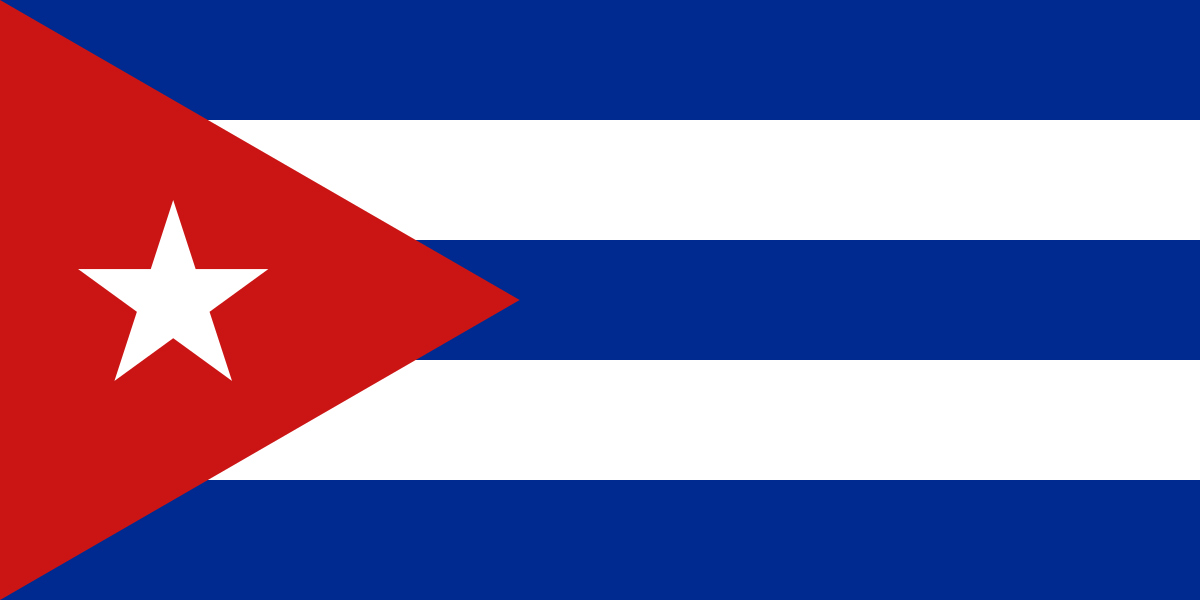
American sociologist who reopened the debate on the Cuban Revolution
In The Origins of the Cuban Revolution Reconsidered (2006) he cast the revolutionary leaders as autonomous actors pursuing their own ideological vision rather than a master plan, challenging the dominant reading.
Born in Marianao, Cuba, to Jewish immigrant parents from Poland. He joined the anti-Batista movement as a high school student, moved to the United States in 1958 and took his PhD in sociology at UC Berkeley in 1969. He taught at UCLA, SUNY-Old Westbury, Fairleigh Dickinson and Brooklyn College (CUNY), retiring in 2007, and has written on the Cuban Revolution, the Castro government, Soviet history and US politics from a left-wing, radical-democratic standpoint. No death record is confirmed.
Career timeline
- 1939Born in Marianao, Cuba
- 1950sTook part in the anti-Batista mass movement as a high school student
- 1958Moved to the United States
- 1969PhD in sociology, UC Berkeley
- 1976Published Revolution and Reaction in Cuba, 1933–1960
- 1990Published Before Stalinism
- 2006Published The Origins of the Cuban Revolution Reconsidered
- 2007Retired from Brooklyn College (CUNY)