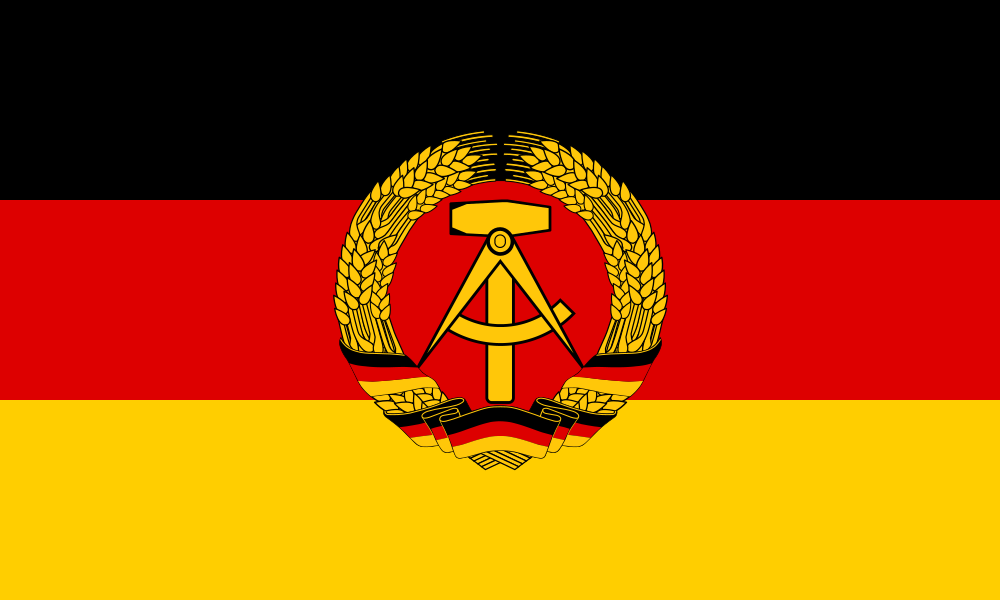
Communist who ran an anti-fascist sabotage network before the war and headed the Stasi from 1953 to 1957
Born in Münden in the Province of Hanover, he took part in the sailors’ revolt of 1918, joined the KPD in 1919 and led party military wings; he sat in the Reichstag in 1932–1933. In exile he organised the “Wollweber League” in 1936–1940, which carried out 21 known acts of sabotage against ships of fascist nations, and supplied arms to the Spanish Republicans. Back in Germany in 1946 he ran shipping administration. In July 1953, when Zaisser was removed and the Ministry for State Security was downgraded to a State Secretariat, he became its head, and in November 1955 Minister of State Security again. He clashed with Ulbricht and Honecker and sided with Schirdewan, resigned in 1957, and in 1958 was removed from the Central Committee for “factional activity”. He died in East Berlin in 1967.
Career timeline
- 1918Took part in the sailors’ revolt
- 1932–1933KPD Reichstag deputy
- 1936–1940Organised the Wollweber League sabotage network
- 1953–1955State Secretary of State Security
- 1955–1957Minister of State Security
- 1958Removed from the Central Committee
East German heavy-industry minister who faced the striking workers outside the House of Ministries on 16 June 1953
The son of a coppersmith from Lauterbach in Hesse, he was working underground at seventeen, served in the First World War and in 1918 sat on a soldiers’ council. He joined the USPD in 1920 and the KPD in 1922, becoming the party’s political secretary in Saxony and a Reichstag deputy. Arrested in 1933, he survived the Nazi years in prisons and in concentration camps including Sachsenhausen and Flossenbürg. After the war he was Saxony’s minister for economics and planning, then deputy chairman of the German Economic Commission, and in the GDR minister of industry and of heavy industry. On 16 June 1953 he walked into the crowd outside the House of Ministries and tried to address it from a desk, but was whistled down. In 1958 Ulbricht pushed him out of his offices for a “deviant attitude”, and he turned to writing. He died in East Berlin in 1975.
Career timeline
- 1922Joined the KPD
- 1932–1933Reichstag deputy
- 1933–1945Imprisoned; held in Sachsenhausen and Flossenbürg
- 1948–1949Deputy chairman of the German Economic Commission
- 1949–1955Minister of Industry, then of Heavy Industry
- 1958Pushed out of office for a “deviant attitude”
The minister whose broken promise sparked the Poznań Uprising
On 27 June 1956, before the gathered ZISPO workforce, he withdrew the promises he had made to their delegation in Warsaw only the day before.
A Polish communist technocrat with a mechanical-engineering background who became Minister of Machine Industry in 1955. On 26 June 1956 he promised the ZISPO workers' delegation in Warsaw wage increases and refunds of withheld taxes, only to withdraw these promises in Poznań the next day, a reversal that lit the fuse of the 28 June uprising. He then continued in the planning apparatus, serving as an industrial bureaucrat of the Polish People's Republic until retirement.
Career timeline
- 1938Graduated Warsaw Polytechnic as a mechanical engineer
- 1942–1944Engineer at Magnitogorsk metallurgical works
- 1949Undersecretary of State, Ministry of Heavy Industry
- 1952Undersecretary of State, Ministry of Machine Industry
- 1955–1956Minister of Machine Industry
- 1958Undersecretary of State, Council of Ministers; deputy chair of the Foreign Economic and Scientific-Technical Cooperation Committee
- –1968Deputy chair of the Planning Commission at the Council of Ministers