Gorbachev's classmate turned critic: the last speaker of the Soviet parliament
“Gorbachev and Yeltsin were afraid that if I conducted the V Congress of People's Deputies, the deputies might nullify all the results of the August victory of democracy.” — Lukyanov on why he was arrested.
Anatoly Lukyanov was a Soviet jurist and statesman who helped design the USSR's constitutional architecture and defended it to the end. A law-school contemporary of Mikhail Gorbachev, he co-drafted the 1977 Soviet Constitution, headed the General Department of the CPSU Central Committee, and became the last Chairman of the Supreme Soviet (1990–1991). An early Gorbachev ally, he grew alarmed at the union's unraveling and broke publicly with him at the June 1991 plenum. Arrested as a GKChP sympathizer, he spent fifteen months in prison before co-founding the Communist Party of the Russian Federation in 1993 and serving three terms in the Duma. A Doctor of Juridical Sciences who published poetry as Anatoly Osenev, he embodied the Soviet establishment intellectual who refused to accept the liquidation of the system he served.
Career timeline
1956–1961Senior consultant, Legal Commission of the USSR Council of Ministers
1961–1976Senior referent, then deputy department head, Presidium of the Supreme Soviet
1977–1983Chief of the Secretariat, Presidium of the Supreme Soviet
1983–1985First Deputy Head, General Department, CPSU Central Committee
1985–1987Head, General Department, CPSU Central Committee
1987–1988Secretary, CPSU Central Committee (legal and administrative affairs)
1988–1990Candidate member, CPSU Politburo
1990–1991Chairman, Supreme Soviet of the USSR
1993–2003Deputy, State Duma of the Russian Federation (CPRF)
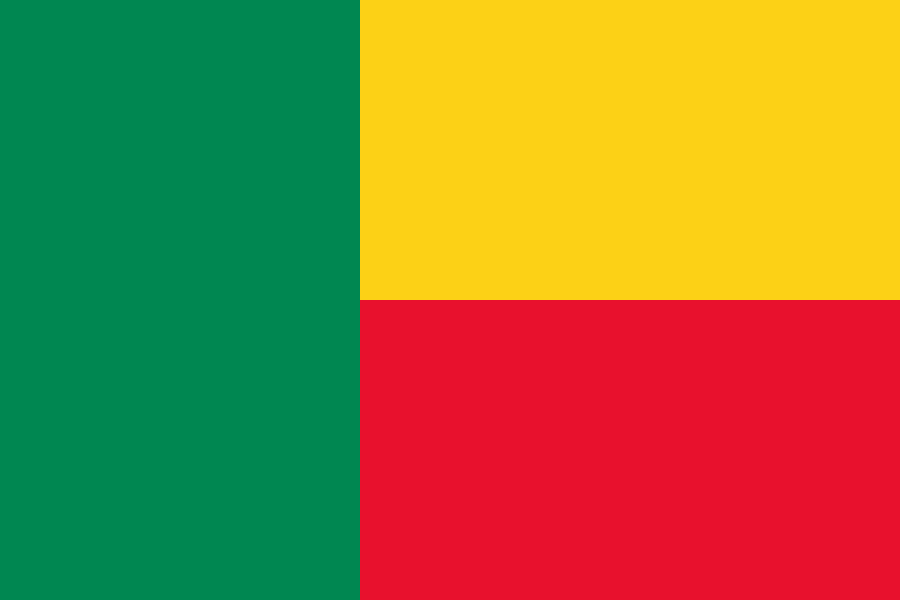
The jurist who draughted Benin’s 1990 constitution
On 9 August 1990 the constitutional commission he chaired adopted the draft constitution; it was approved by referendum on 2 December 1990 and promulgated on 11 December 1990.
A Beninese jurist and legal scholar born in 1934 at Zinvié, Dahomey. He chaired the National Conference’s constitutional affairs commission in February 1990 and prepared the draft of the constitution of 11 December 1990. He presided over the constituent assembly in 1990–1991, worked at UNESCO, wrote on the political and social history of Dahomey, and served on UN human rights bodies.
Career timeline
1965–1966Adviser to the UNESCO Director-General
1967–1992UNESCO official
1975–Professor of law at the Sorbonne
1989–1993Deputy Director-General of UNESCO
1990Chair of the National Conference’s Commission on Laws and Constitutional Affairs
1990–1991President of the constituent assembly
1994–2002UN Special Rapporteur on contemporary forms of racism
Constitutional Assembly chairman and first elected mayor of Saint Petersburg
"Volodya, just don't turn to bronze" — last words to Putin, February 2000
Anatoly Sobchak was a legal scholar and democratic reformer who became the first democratically elected mayor of Saint Petersburg (1991–1996) and co-authored the 1993 Constitution of the Russian Federation as chairman of the Constitutional Assembly. A popular Leningrad State University law professor whose students included Vladimir Putin and Dmitry Medvedev, he was elected to the Congress of People's Deputies in 1989 and co-chaired the Inter-Regional Deputies Group alongside Andrei Sakharov and Boris Yeltsin. During the August 1991 coup he organized resistance in Leningrad, negotiating with the military commander to keep troops off the streets and rallying 200,000 citizens on Palace Square. Corruption allegations forced him into exile in Paris from 1997 until Putin, then prime minister, secured his return in 1999.
Career timeline
1989–1990USSR People's Deputy
1989–1990Co-chair, Inter-Regional Deputies Group (with Sakharov & Yeltsin)
The Deputy Prosecutor General whose TV broadcast lit the fuse of the Sumgait pogrom
On 27 February 1988, on Central Television, he named the two youths killed in the Askeran clash as Azerbaijanis; that night the Sumgait pogrom erupted.
A Soviet military jurist of Belorussian birth, Alexander Katusev was appointed Deputy Prosecutor General of the USSR in 1987 and led high-profile corruption investigations in Uzbekistan. His name entered history on 27 February 1988, when he appeared on Central Television and named two Azerbaijani youths killed in a clash near Askeran, specifying their nationality; the broadcast became the immediate spark for the Sumgait pogrom that evening. As Chief Military Prosecutor (1989–1991), he investigated and debunked the Panfilov Twenty-Eight myth in his essay 'Another's Fame,' but was forced into retirement after the August coup.
Career timeline
1950sGraduated Dneprodzerzhinsk Metallurgical School, worker at Dnieper Metallurgical Combine
1965Graduated Kharkov Law Institute
1966Investigator, garrison procuracy, Transbaikal Military District
1970s–1987Investigator, senior investigator, head of investigation departments, chief of Main Investigation Directorate, USSR Procuracy
1987–1989Deputy Prosecutor General of the USSR
1989–1991Chief Military Prosecutor and Deputy Prosecutor General of the USSR
The law professor who surrendered his Supreme Soviet seat to Yeltsin in a moment that captivated the nation
Years later Kazannik recalled his decision: "Five and a half million people voted for Yeltsin in Moscow, 1.7 million for me. I had not the slightest doubt that by any measure Yeltsin deserved the first seat in the Supreme Soviet."
Born into a large Ukrainian peasant family, Kazannik worked as a carpenter in Kazakhstan and served in the Soviet engineering corps before earning his law degree from Irkutsk State University; from 1975 he taught environmental and state law at Omsk State University. Elected a People's Deputy of the USSR in 1989, he became famous overnight on May 29 when, after Yeltsin failed to win a Supreme Soviet seat, Kazannik rose at the First Congress and surrendered his own seat to him. Appointed Prosecutor General of Russia by Yeltsin in October 1993, he resigned in February 1994 after refusing the president's demand to block the Duma's amnesty for the 1991 putschists and the October 1993 rebels, defending the constitution against the Kremlin. He later served as deputy governor of Omsk Oblast (1996–2003) and returned to teaching law until his death in 2019.
Career timeline
1959Carpenter, Temirtau (Kazakh SSR)
1960–1963Soviet Army, engineering corps
1963–1975Irkutsk State University: law degree, graduate school, assistant, senior lecturer
1975–1991Associate professor, Omsk State University (environmental and state law)
1989–1991People's Deputy of the USSR; member, Interregional Deputies Group
1993–1994Prosecutor General of the Russian Federation
1996–2003Deputy Governor of Omsk Oblast
2003–2019Professor, Omsk State University; first vice-rector, Omsk Law Institute (2003–07)
An Estonian legal scholar who challenged the Soviet official narrative in the language of law
On the Yakovlev commission, he argued that the Estonian Soviet Socialist Republic was legally null and void.
Igor Gräzin is an Estonian legal scholar and politician whose work has ranged across legal theory, philosophy of law, and comparative jurisprudence. Elected to the Congress of People's Deputies of the Soviet Union in 1989, he served on the Yakovlev commission examining the secret protocols and the legal meaning of the Baltic states' incorporation. His intervention brought legal expertise into the political struggle over sovereignty and historical memory during the Soviet Union's final crisis.
Career timeline
1952Born in Tartu
1975Graduated in law from Tartu State University
1979–1987Researched law at Soviet state and law institutions and earned a doctorate
1988–1989Headed the law department of the Estonian Academy of Sciences Institute of Philosophy, Sociology and Law
1989–1991Member of the Congress of People's Deputies and the Yakovlev commission
1990–2000Professor and researcher at the University of Notre Dame
Founder of North Korea's state security and enforcer of its political repression
Arrival dates conflict: Russian Wikipedia and Lankov say 1946 (Lankov: September), English Wikipedia says October 1945. By 1947 he already headed the state protection (political police) department, and Lankov considers it likely he was the first head of North Korean state security.
A Koryo-saram from the Russian Empire whose birthplace is undocumented and whose birth year sources give as 1912, 1913 or 1914. He worked in the Soviet NKVD and intelligence agencies. Russian Wikipedia and Lankov date his arrival to 1946, English Wikipedia to October 1945. By 1947 he already headed the state protection (political police) department, and in September 1948 became Deputy Minister of Internal Affairs and Director of the Political Security Bureau, though Lankov holds he was never again allowed to control the political police. He held the security portfolio as Minister of Social Security (March/May 1951) and Interior Minister until November 1960. Russian Wikipedia describes him both as organizer of the North's repression system and as an executor who carried out the leadership's directives. Of the Soviet faction, he escaped the purges and died on 18 July 1992.
Career timeline
1937–1944Deported to Kazakhstan, then investigator in Kzyl-Orda and prosecutor's office work in Kzyl-Orda and Taldy-Kurgan oblasts, 1942–1944 (Russian Wikipedia); joined the party in 1940. Lankov says his record before 1946 is undocumented
1947Head of the state protection (political police) department, Interior Bureau, North Korean People's Committee (Lankov). English Wikipedia has him as Director-General of the Interior Affairs Bureau from May 1947, which does not fit the bureau-under-ministry structure after 1948
Sep 1948 – Feb or Mar 1951Deputy Minister of Internal Affairs and Director of the Political Security Bureau (English Wikipedia). Per Lankov he was afterwards never allowed to control the political police again
Mar or May 1951 – 1952Minister of Social Security (the Political Security Bureau was reorganized as the Ministry of Social Security). March per English Wikipedia and the Encyclopedia of Korean Culture; May per English Wikipedia's Ministry of Social Security article
1952.10–1960.11Minister of Interior (the Ministry of Social Security was merged back into the Ministry of Internal Affairs)
1956.08As Minister of Internal Affairs during the August faction incident mobilized the police to monitor Pyongyang and led the investigation of the 'factionalists' (English Wikipedia). The same article also records a claim that he was abroad at the time
1956–1980Member of the WPK Central Committee (elected April 1956; reelected November 1970 and October 1980)
1960.11–1972Deputy Director of the Central Court; from November 1966 information director of the party Liaison Bureau
1972.12–1992President of the Central Court (reappointed 1982 and 1986, in office until his death)