The 'Red Millionaire' who exposed Nazi terror through publishing, the Comintern's greatest propagandist, who broke with Stalin
"Stalin, you are a traitor!" — Münzenberg's response to the 1939 Molotov–Ribbentrop Pact
The Comintern's most brilliant mass-propagandist. He founded Workers International Relief, co-founded the League Against Imperialism, and his Brown Book (1933) exposed the Reichstag fire as a Nazi frame-up. He broke with Stalin and died under mysterious circumstances.
Career timeline
- 1915–1919Secretary, Intl. Union of Socialist Youth Organizations
- 1919–1921First Secretary, Young Communist International
- 1921–1937Founder & leader, Workers International Relief (IAH/Mezhrabpom)
- 1924–1933Reichstag deputy for Hesse-Nassau (KPD)
- 1927–1935Co-founder & leader, League Against Imperialism
- 1933–1939Directed anti-fascist exile publishing & solidarity (Paris)
- 1939–1940Publisher of Die Zukunft, independent anti-Nazi/anti-Stalinist line
Baltic German Nazi ideologue from Reval who served as Reich Minister for the Occupied Eastern Territories in 1941–1945
Born in 1893 in Reval (Tallinn), in the Governorate of Estonia of the Russian Empire, he studied architecture at the Riga Polytechnical Institute. In 1918 he left for Germany with the retreating German army and in January 1919 joined the German Workers’ Party, eight months before Hitler; in 1923 he became editor of the party newspaper Völkischer Beobachter. In 1930 he published his racial treatise The Myth of the Twentieth Century, and he fed Hitler’s belief in Jewish conspiracies by introducing him to The Protocols of the Elders of Zion. Appointed Reich Minister for the Occupied Eastern Territories on 17 July 1941, he had Hinrich Lohse installed as Reichskommissar for Ostland, though his own authority was severely limited. He saw the Baltic lands as German “Lebensraum”. Found guilty on all four counts at Nuremberg, he was hanged on 16 October 1946.
Career timeline
- 1919Joined the German Workers’ Party
- 1923Editor of the Völkischer Beobachter
- 1930Published The Myth of the Twentieth Century
- 1941–1945Reich Minister for the Occupied Eastern Territories
- 1946Sentenced to death at Nuremberg and executed
Nazi Party propaganda chief and minister who promoted antisemitism and dictatorship.
Joseph Goebbels was a Nazi Party propaganda leader who headed the party organization in Berlin from 1926 and became its propaganda chief in 1930. Appointed minister of propaganda by Hitler in 1933, he brought the press, film, radio, and cultural life under Nazi ideological control and promoted antisemitism and persecution of Jews. He was a chief instigator of the November 1938 pogrom and later campaigned for total war.
Career timeline
- 1926–1945Nazi Party Gauleiter for Berlin
- 1930–1945Nazi Party propaganda chief
- 1933–1945Minister of Public Enlightenment and Propaganda
- 1944–1945Reich Plenipotentiary for Total War
Editor of Neues Deutschland who helped draft the 1953 New Course, moved against Ulbricht and was purged as a “faction”
Born into a wealthy Jewish family in Gleiwitz, he became a correspondent for the Berliner Tageblatt and an agent of Soviet military intelligence (GRU). Exiled in the Soviet Union from 1939, he edited the newspaper of the National Committee for a Free Germany. Back in Berlin in 1945 he ran the Berliner Zeitung and helped found Neues Deutschland, whose editor always followed Moscow’s line. In June 1953 he and Zaisser set themselves against Ulbricht, and he helped formulate the New Course approved by the Central Committee. After the uprising he proposed a collective leadership, but in July he was removed from the Central Committee for “anti-party factionalism” and in January 1954 expelled from the SED. He worked at the Central Archives in Merseburg, died in 1966 and was rehabilitated only in 1989.
Career timeline
- 1930Recruited as a GRU agent
- 1943Editor-in-chief of Freies Deutschland
- 1945Editor-in-chief of the Berliner Zeitung
- 1950–1953SED Central Committee member and Politburo candidate
- 1953Removed from the Central Committee for “anti-party factionalism”
- 1954Expelled from the SED
- 1989Posthumously rehabilitated
Economist and the SED’s chief ideologue until 1958, when he was expelled from the Politburo in the Schirdewan affair
Born in Leipzig, he joined the USPD in 1919 and the KPD in 1920 and worked as an editor on party papers. From 1926 he studied in Moscow at the International Lenin School and the Institute of Red Professors. In exile from 1933 he was Ulbricht’s secretary in Paris; in Moscow he lost his teaching posts in 1936 for alleged deviations, and in the war became chief editor of Moscow Radio’s German service. Returning with the Ackermann Group in 1945, he ran the party’s propaganda and education work, joined the Politburo in 1950 and was Central Committee secretary for propaganda from 1950 to 1955, effectively the party’s chief ideologue. In June 1953 he set up the command in Halle that put down the uprising. After 1956 he opposed the complete collectivisation of agriculture, and in 1958 he was expelled from the Politburo. He then directed the Institute of Economics of the Academy of Sciences.
Career timeline
- 1920Joined the KPD
- 1926–1932International Lenin School and Institute of Red Professors, Moscow
- 1941–1944Chief editor of Moscow Radio’s German service
- 1950–1958SED Politburo member
- 1950–1955Central Committee secretary for propaganda
- 1958–1969Director of the Institute of Economics, Academy of Sciences
German communist who drafted the KPD’s 1945 appeal and argued for a “special German road to socialism”
The son of a hosier from Thalheim in Saxony, he joined the KPD in 1926 and attended the International Lenin School in Moscow. After underground work and exile under the Nazis he directed a political school of the International Brigades in the Spanish Civil War, and in Moscow ran the “Free Germany” radio station. In 1945 he led the KPD group sent to Saxony and drafted the party’s appeal of 11 June 1945. In 1946 he argued that socialism could be built in Germany without a preceding dictatorship of the proletariat, a “special German road to socialism” he had to recant after Tito’s break with Stalin in 1948. He served as deputy foreign minister and first head of the GDR’s foreign intelligence service, and in 1953 was stripped of all posts for supporting Zaisser. Gravely ill with cancer, he took his own life in 1973.
Career timeline
- 1926Joined the KPD
- 1935KPD Central Committee member and Politburo candidate
- 1945Head of the KPD group in Saxony; drafted the 11 June appeal
- 1946Member of the SED Central Secretariat
- 1949–1953Deputy foreign minister
- 1953Removed from all posts
Youngest member of the Ulbricht Group who fled to Yugoslavia in 1949 and became a leading Western scholar of Soviet communism
Born Vladimir Leonhard in Vienna, he went into Soviet exile with his Communist mother in 1935; she was arrested in 1936 and spent twelve years in the Vorkuta camps. After the Comintern school he became an announcer for Radio Free Germany, and on 30 April 1945 he returned to Berlin as a member of the Ulbricht Group. He worked in the agitation and propaganda department of the KPD and then SED Central Committee and from 1947 lectured at the party college. Convinced that Germany would replicate the Soviet system, he fled via Czechoslovakia to Yugoslavia in March 1949 and moved to West Germany in 1950. His 1955 memoir Die Revolution entlässt ihre Kinder became an international bestseller, and from 1966 to 1987 he taught Soviet history at Yale.
Career timeline
- 1935Went into Soviet exile with his mother
- 1943Announcer at Radio Free Germany
- 1945Returned to Berlin with the Ulbricht Group
- 1947Lecturer at the SED party college
- 1949Fled to Yugoslavia
- 1955Published his memoir
- 1966–1987Professor at Yale
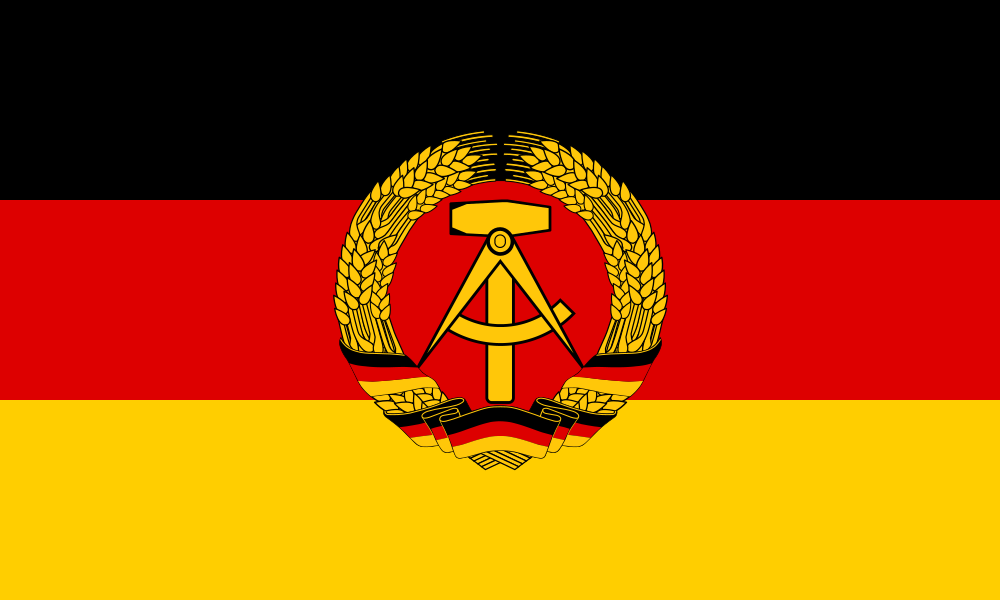
The East German Politburo spokesman whose mistake brought down the Berlin Wall
Asked 'When does it take effect?' at the press conference, he shuffled through his papers and replied: 'As far as I know… immediately, without delay.'
The GDR's leading propagandist, he rose from editor-in-chief of Neues Deutschland to SED Politburo member and First Secretary of East Berlin. On 9 November 1989, asked at a press conference when new travel regulations would take effect, he answered 'immediately, without delay,' triggering the rush that breached the Berlin Wall that night. He later called his mistake 'the final nail in the coffin' of the regime; after reunification he was convicted for the border deaths, but his public acceptance of moral guilt earned him a reduced sentence.
Career timeline
- 1947Began journalism career as editor at FDGB paper Tribüne
- 1952Joined the SED
- 1967–1968Studied at the CPSU party academy in Moscow
- 1978–1985Editor-in-chief of Neues Deutschland, the SED central organ
- 1981–1989SED Central Committee member and Politburo candidate, full member from 1984
- 1985–1989First Secretary of the SED East Berlin district
- 1989.11.09Triggered the Wall's fall by announcing travel rules effective immediately
- 1997–2000Sentenced to 3 years for border deaths; pardoned after serving one