General who struck the 1918 secret pact with Ebert that preserved the officer corps and later served Weimar as defence and interior minister
On 10 November 1918, he made a secret telephone pact with Ebert, pledging army support for the new government while preserving the officer corps’ command.
A Württemberg staff officer and railway transport expert, he ran the War Office in the war, directing munitions production and labour mobilisation. In October 1918 he succeeded Ludendorff as First Quartermaster General and in November told the emperor that the army no longer stood behind him. On the night of 10 November he struck a secret telephone pact with Ebert, trading the army’s support for the preservation of the officer corps’ command. He later served as transport, defence and interior minister and fell in 1932 over his ban on the Nazi SA.
Career timeline
1884Entered the army.
1912Became head of the General Staff’s railway department, overseeing wartime troop movement and supply.
1918In October replaced Ludendorff as first quartermaster general; after the armistice, worked with Ebert on troop repatriation and volunteer units to suppress the uprising.
SPD defence minister who said “someone has to be the bloodhound” and used the Freikorps to crush the left risings of 1919
He directed the suppression of the 1919 Berlin uprising with Freikorps and army forces, then authorized summary executions by military forces in a March order.
A basket-maker from Brandenburg who became an SPD journalist, he entered the Reichstag in 1906 and was known as its military expert. Sent to Kiel as the government’s representative in November 1918, he calmed the mutiny and became governor. After the Christmas crisis he joined the Council of People’s Deputies for military affairs and, saying “someone has to be the bloodhound”, organised the Freikorps that crushed the January rising and the March battles. First defence minister from February 1919, he resigned after the Kapp Putsch of 1920, later governed the province of Hanover and was arrested after the July 1944 plot.
Career timeline
1890sHelped build the social-democratic movement and basket-makers’ union; chaired the Social Democratic Association in Brandenburg.
1906Elected to the Reichstag, where he became known as an expert on naval and army affairs.
1918.11–12Sent to Kiel as government representative, he led the sailors and Workers’ and Soldiers’ Council; on 28 December he became national commissioner for the army and navy.
1919.02–1920Appointed Reichswehr minister, he deployed Freikorps and army forces against the January uprising and March fighting in Berlin; he resigned after the 1920 Kapp Putsch.
1920–1933Served as chief president of the Prussian province of Hanover; dismissed in September 1933 under the Law for the Restoration of the Professional Civil Service.
German Eastern Front chief of staff who placed his soldier's boot on the Brest-Litovsk negotiating table
"The General on several occasions put his soldier's boot on the table around which the discussion was taking place": Trotsky, who wrote that 'Hoffmann's boot was the only reality to take seriously'
An outstanding strategic staff officer who, as Chief of Operations of the German Eighth Army, devised the plans that destroyed the Russian armies at Tannenberg and the Masurian Lakes. As Chief of Staff of the Eastern Front from late 1917, he was the driving force behind the German position at the Brest-Litovsk peace talks: on 18 January 1918 he spread a map before the Soviet delegation and demanded the severance of Poland, the Baltic states, and Ukraine from Russia. After Trotsky's 'neither war nor peace' declaration, Hoffmann commanded Operation Faustschlag, an unopposed advance that compelled the Bolsheviks to accept far harsher final terms. He embodied the asymmetry between revolutionary diplomacy and imperial military force, most memorably by placing his soldier's boot on the negotiating table.
Career timeline
1899–1914Served in Russian Section of German General Staff; observer with Japanese army, Russo-Japanese War
1914–1916Operations officer, 8th Army, 9th Army & Ober Ost; architect of Tannenberg & Masurian Lakes
1916–1918Chief of Staff, Eastern Front (Major General); led German side at Brest-Litovsk negotiations
1918.02–03Commanded Operation Faustschlag; imposed final treaty terms on Soviet Russia
1919–1920Brigade commander on Polish border; retired March 1920
1920–1927Campaigned for anti-Soviet coalition intervention (Hoffmann Plan); wrote memoirs
German anarchist thinker who served in Bavaria’s revolutionary government and was killed by counterrevolutionary troops in 1919.
The state is a social relationship. Create new communities, and it can be replaced by a different social relationship.
Landauer argued that the state was not merely an apparatus to overthrow but a social relationship that could be replaced by creating voluntary communities. In 1908 he founded the Socialist Bund to pursue socialism through cooperatives and communal association. He opposed the First World War and came to Munich at Kurt Eisner’s request in 1918 to support the revolution. In April 1919 he joined the Bavarian Soviet Republic as Commissioner for Enlightenment and Public Instruction. After government forces crushed the republic, he was arrested and killed at Stadelheim Prison on 2 May.
Career timeline
1908Founded the Socialist Bund
1918Came to Munich at Kurt Eisner’s request to support the revolutionary government
1919Commissioner for Enlightenment and Public Instruction in the Bavarian Soviet Republic
Social Democratic chancellor whose government accepted the Treaty of Versailles under an Allied ultimatum
Born in Darkehmen in the Province of Prussia, he worked as a lawyer’s clerk, co-founded the office employees’ union and was second chairman of the General Commission of Trade Unions from 1908 to 1918. Elected to the Reichstag for the SPD in 1912, he became labour secretary in Max von Baden’s cabinet in October 1918. When Scheidemann resigned in protest at the Treaty of Versailles in June 1919, Bauer, until then a vocal critic of the treaty, succeeded him and got it through the National Assembly. His government carried out tax reform and extended social insurance, but was forced out in March 1920 over the negotiations conducted with the Kapp putschists. He was later vice-chancellor and treasury minister, and the Barmat corruption scandal cost him his seat in 1925. He died in Berlin in 1944.
Career timeline
1908–1918Second chairman of the General Commission of Trade Unions
The lone vote against the war; the revolution's first martyr
“The main enemy is at home.” — anti-war pamphlet, 1915
German socialist revolutionary. The only Reichstag deputy to vote against war credits during the First World War. Co-founded the Spartacus League and the Communist Party of Germany (KPD) with Rosa Luxemburg. Murdered by Freikorps after the January 1919 uprising.
Career timeline
1907Published Militarism and Anti-Militarism and was sentenced to fortress imprisonment
1912–1916Reichstag deputy; the sole vote against war credits in December 1914
1916Arrested at a May Day anti-war rally; sentenced to prison
1918.11November Revolution — proclaims the 'Free Socialist Republic' from the Berlin palace
1918.12–1919.01Co-founds the Spartacus League and the KPD; the January uprising
1919.01Seized by the Freikorps and killed alongside Luxemburg
SPD leader who headed the revolutionary government of 1918, steered the councils into parliamentary democracy and became the first president
During the November Revolution of 1918, Ebert led the Council of People’s Representatives and advocated elections to a National Assembly. Elected the first president of the German Republic in 1919, he served until 1925.
Born to a tailor in Heidelberg, he worked as a saddler, became a party organiser in Bremen and in 1913 succeeded Bebel as SPD co-chairman. In the war he backed war credits and the Burgfrieden. Taking over the chancellorship on 9 November 1918, he led the Council of People’s Deputies and that night won the army’s support in a secret pact with General Groener. Elected president by the National Assembly in February 1919, he put down risings from left and right with the army, the Freikorps and emergency decrees under Article 48. He died in office in 1925 after an appendicitis operation.
Career timeline
1889Joined the Social Democratic Party of Germany (SPD).
1905Elected to the SPD party executive.
1912Became a member of the Reichstag of the German Empire.
1913Elected one of the SPD’s two chairmen.
1918Took over state affairs from Chancellor Max von Baden during the November Revolution and led the Council of People’s Representatives.
1919Elected president of the German Republic by the National Assembly.
1925Died on 28 February from complications of appendicitis.
The last Empress, whose reliance on Rasputin helped doom the dynasty
When told of Nicholas's abdication, Alexandra said only: 'Dieu donne que cela sauve la Russie!' — 'God grant that this may save Russia!'
Granddaughter of Queen Victoria, Alexandra became Empress of Russia in 1894 and guided Nicholas II with an unshakeable conviction that autocratic power was a divine trust that could not be compromised. Desperate to save her hemophiliac son Alexei, she fell under the sway of Grigori Rasputin, and during World War I (with Nicholas at the front as supreme commander) she dismissed and replaced ministers on Rasputin's counsel, effectively directing domestic policy. Her German birth, her reliance on Rasputin, and her refusal of political reform earned her public hatred and accelerated the collapse of the Romanov dynasty. On 17 July 1918 she was shot by Bolsheviks in the cellar of the Ipatiev House in Yekaterinburg, alongside her husband and five children.
Career timeline
1894Marries Nicholas II, Empress of Russia
1904Birth of Tsarevich Alexei
1905First meets Rasputin
1915–1917Controls domestic affairs with Rasputin during Nicholas's absence at the front
The 'Rook' who flew across borders building the Iskra network, and the revolution's first martyr
He was handsome, a fine fellow with a guitar — even in exile he played, composed epigrams on the spot, drew caricatures. So the historian Vladlen Loginov recalled Bauman.
A Volga German veterinary surgeon turned Bolshevik, he ran Lenin's Iskra illegal distribution network inside Russia. Killed by a monarchist during the October 1905 demonstrations, his funeral drew 100,000 mourners and turned into a show of revolutionary force.
Career timeline
1895Graduates Kazan Veterinary Institute; works in Saratov province
1896–1897Member, St. Petersburg Union of Struggle for the Liberation of the Working Class
1897–1899Arrested; 22 months solitary in Peter and Paul Fortress; exiled to Vyatka
1900Works with Lenin in Switzerland to launch Iskra; heads illegal transport into Russia
1901–1903Moscow Committee; arrested in Kiev, escapes ('Escape of the Eleven'); delegate to 2nd RSDLP Congress — Bolshevik
1903–1904Leads Moscow Bolshevik organization & Northern Bureau of CC; arrested, 16 months in Taganka Prison
1905.10Released from prison; killed days later by a monarchist during a street demonstration
Soviet Union
Soviet communism
1874–1940
→ Died in prison
The Menshevik statistician who designed Gosplan's early control figures and balance method, leading voice of genetic planning
December 27, 1929, at the All-Union Conference of Marxist Agrarians. Stalin, from the rostrum, aimed directly at Groman's theory that 'the October Revolution gave the peasantry less than the February Revolution.' When a voice from the audience asked 'Who was it?' Stalin answered: 'It was Groman.' In that moment, genetic planning received its political death sentence.
Statistician and economist, born in Moscow to a German father and Russian mother. Joined the RSDLP in 1898 as a Menshevik, co-authoring the agrarian program; as head of the Penza statistical bureau he developed a multi-phase sampling method. After the February Revolution he chaired the Petrograd food-supply commission, and in 1921 joined Gosplan where he headed the Conjunctural Institute, designing the first Control Figures and the balance method. With Bazarov he championed the genetic planning approach; after Stalin's public condemnation he was arrested in 1930 and as lead defendant in the 1931 Menshevik Trial received ten years, dying in the Suzdal camp.
Career timeline
1894–1908Entered Moscow University; expelled for revolutionary activity; graduated externally 1908
1898–1905Joined RSDLP; stayed Menshevik after 2nd Congress; co-authored agrarian program; began statistical work in exile in Vyatka and Yenisei
1909–1914Headed Penza provincial statistical bureau; developed multi-phase sampling method for peasant household surveys
1917–1918After February Revolution: chairman of Petrograd Soviet food commission and Central Food Administration; after October: Northern Regional Food Administration head
1921–1926Headed Gosplan's Conjunctural Institute; designed first Control Figures and the balance method; formulated 'restorative growth' concept
1926–1929Chaired Gosplan agricultural section; with Bazarov championed genetic planning; publicly condemned by Stalin at All-Union Conference of Marxist Agrarians
1930–1940Arrested in 'Union Bureau of Mensheviks' case; 1931 trial: 10 years; died in Suzdal ITL 1940; rehabilitated 1991
German social-democratic politician and co-chair of the Independent Social Democratic Party.
A painter and journalist, Crispien opposed the Social Democratic Party's support for the war and helped found the Independent Social Democratic Party (USPD) in 1917. He served as interior minister in Württemberg's provisional government in 1918–19 and became a USPD co-chair in 1919. He attended the Communist International's Second Congress in 1920 as a USPD delegate but opposed its admission conditions and merger with the Communist Party of Germany. After most of the USPD reunited with the Social Democratic Party in 1922, he joined its leadership; he went into exile after the Nazi seizure of power in 1933.
Career timeline
1918–1919Interior minister in Württemberg's provisional government
1919–1922Co-chair of the Independent Social Democratic Party
1920Attended the Second Congress of the Communist International as a USPD delegate
1922–1933Co-chair of the Social Democratic Party of Germany
A Social Democratic politician of the Weimar Republic who served twice as chancellor.
Müller joined the Social Democratic Party in 1893 and rose to its leadership. As foreign minister from 1919 to 1920, he signed the Treaty of Versailles for Germany. His first chancellorship in 1920 combined the suppression of left-wing uprisings with reforms expanding disability employment, primary education, unemployment benefits and workers’ social protection. He returned as chancellor in 1928 to lead a grand coalition, which collapsed amid the Great Depression and disputes over financing unemployment insurance; he resigned in 1930.
Career timeline
1893Joined the Social Democratic Party of Germany.
1916Elected to the Reichstag of the German Empire.
1919–1920Served as foreign minister and signed the Treaty of Versailles.
1920Served as chancellor.
1928–1930Served as chancellor of the grand coalition.
Non-party chancellor who answered the Ruhr occupation with passive resistance and fell amid hyperinflation
Born to a civil servant’s family in Suhl, he studied law and, as a Treasury official, helped organise Germany’s food supply early in the First World War. In 1917 he joined the Hamburg America shipping line, which he went on to head. In November 1922 he was appointed chancellor by presidential decree without a Reichstag vote, the first Weimar chancellor who belonged to no party, and formed a “business ministry”. When French and Belgian troops occupied the Ruhr in January 1923 he called for passive resistance; paying for it, mostly by printing money, began the run-up to hyperinflation. Amid a wave of strikes his cabinet resigned in August in the face of a no-confidence vote initiated by the SPD. In 1932 he joined in advising Hitler on economics, and he died in January 1933.
Wehrmacht field marshal who directed the encirclement of Leningrad
In September 1941 he believed Leningrad was about to fall, but the city did not surrender.
Wilhelm Ritter von Leeb was a German field marshal and one of the Wehrmacht's senior operational commanders in the Second World War. In 1941 he led Army Group North through the Baltic states toward Leningrad, completing the land encirclement and directing the operational pressure that sustained it. Forces under his command committed crimes against civilians and cooperated with the SS in the murder of Jews. Convicted after the war in the High Command Trial for transmitting the Barbarossa Decree and its criminal application by subordinate units, he was sentenced to time served and released.
Career timeline
1895Entered the Bavarian Army
1914–1918Served on the Eastern Front and in the Serbian campaign during the First World War
1930–1933Commander of the 7th Division
1939–1941Commander of Army Group C
1941.06–1942.01Commander of Army Group North, directing the attack and encirclement of Leningrad
1948Convicted in the High Command Trial and released after a sentence of time served
A Nazi German naval commander who pursued a grand surface fleet
In the 1940 planning for Operation Sea Lion, control of the English Channel and the vulnerability of invasion transport exposed the German navy’s fundamental weakness.
Erich Raeder was an admiral who rose through the Imperial German Navy and went on to command the navies of the Weimar Republic and Nazi Germany. He pursued a battleship-centered ocean fleet combined with commerce raiding, although Germany’s navy was unready to confront the Royal Navy when the Second World War began. Raeder was skeptical of Operation Sea Lion in 1940, pointing to German weakness in controlling the English Channel and the vulnerability of an invasion transport, and those naval limits constrained the plan’s feasibility. At the postwar International Military Tribunal at Nuremberg, he was convicted of conspiracy, crimes against peace, and war crimes, sentenced to life imprisonment, and released in 1955.
Career timeline
1894Entered the Imperial German Navy
1912–1918Senior naval staff officer; served in the First World War
1928–1935Chief of the Naval Command, Reichsmarine
1935–1939Commander-in-chief of the Kriegsmarine; Generaladmiral
1939–1943Grand Admiral and commander-in-chief of the Kriegsmarine
1943Resigned as commander-in-chief and retired
1946–1955Convicted at Nuremberg and served a life sentence
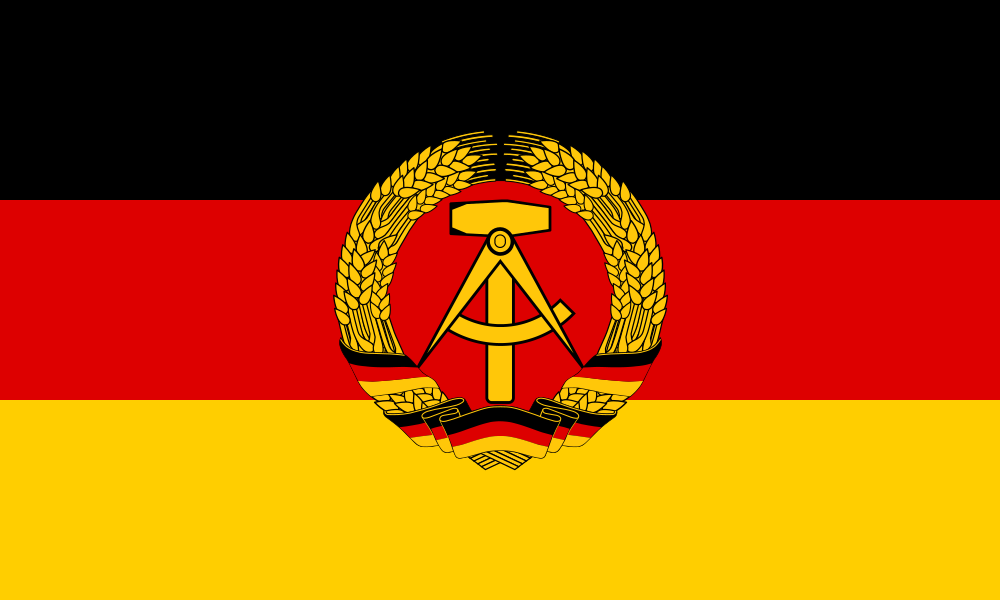
From the Spartacus League to GDR head of state, the sole founding member who lived the full arc of German communism
On the night of 15 January 1919, Pieck was arrested alongside Luxemburg and Liebknecht and taken to the Eden Hotel. He became the sole survivor — the last to witness his comrades alive.
A coachman's son turned carpenter, he joined the SPD in 1895 and was radicalized under Rosa Luxemburg's influence. Court-martialed for anti-war agitation, he co-founded the Spartacus League and the KPD. Arrested with Luxemburg and Liebknecht in January 1919, he alone survived. He served on the ECCI (1921) and its Presidium (1931), then led the KPD in Moscow exile as Comintern secretary. Returning after the war, he drove the SPD-KPD merger that created the SED and became the first President of the GDR in 1949, holding that office until his death.
Career timeline
1895Joins the Social Democratic Party of Germany (SPD)
1915Conscripted; court-martialed for anti-war agitation; flees to Amsterdam
1918–1919Co-founds Spartacus League and KPD; Central Committee member
1921ECCI member; elected to the Prussian Landtag
1928–1933Reichstag deputy
1931Elected to the ECCI Presidium
1934–1946KPD chairman (exile leadership)
1935–1943Secretary of the Comintern
1943Co-founds the National Committee for a Free Germany
1946–1950Co-chairman of the Socialist Unity Party (SED)
1949–1960President of the German Democratic Republic
The chancellor who made provisional statehood durable
As president of the Parliamentary Council, Adenauer helped present the Basic Law as a provisional settlement rather than a final constitution for a divided Germany.
Konrad Adenauer was a Catholic conservative statesman who helped shape the Federal Republic after the collapse of Nazism and the division of Germany. As president of the Parliamentary Council, he supported a provisional Basic Law rather than a permanent constitution, leaving open the possibility of reunification while establishing democratic institutions in the western zones. As the first Federal Chancellor, he pursued Westbindung, European integration, and a socially regulated market economy, while his anti-communist policy hardened the political division of the Cold War. His career thus joined parliamentary reconstruction with the consolidation of a state whose provisional founding became durable.
Career timeline
1906–1909Deputy mayor of Cologne
1917–1933Lord Mayor of Cologne
1921–1933President of the Prussian State Council
1948–1949President of the Parliamentary Council
1949–1963First Federal Chancellor of the Federal Republic of Germany
1951–1955Federal Minister for Foreign Affairs
1950–1966Chairman of the Christian Democratic Union
Weimar chancellor who ended passive resistance in 1923 and, as foreign minister, concluded the Locarno treaties
Born in Berlin, he entered the Reichstag for the National Liberals in 1907 and during the war backed annexations and unrestricted submarine warfare. After the defeat he founded the German People’s Party and came to accept the republic. Chancellor and foreign minister from August 1923, he ended passive resistance in the Ruhr, used the army to remove the Saxon and Thuringian governments that included Communists, and halted hyperinflation with the Rentenmark. Ousted by a no-confidence vote in November, he remained foreign minister until his death, shaping the Dawes Plan, the Locarno treaties and entry into the League of Nations, and shared the 1926 Nobel Peace Prize. He died of a stroke in 1929.
Weimar finance minister who founded the CDU in the Soviet zone in 1945 and was deposed for opposing the land reform
The son of a Cologne railway worker, he studied agriculture and from 1911 worked at the International Institute of Agriculture in Rome. A member of the Catholic Centre Party, he became Minister of Food in 1920 and was Minister of Finance from 1922 until the Cuno cabinet resigned in August 1923. Arrested after the Nazis took power, he later served as an economic adviser to the government of Colombia. Back in Germany he joined the resistance around Goerdeler, was arrested after 20 July 1944 and sentenced to death in January 1945, but his wife delayed the execution until the Red Army took Berlin. On 26 June 1945 he became the first chairman of the CDU of Berlin and the Soviet zone; because he refused to agree to the land reform without compensation, SMAD deposed him in December. In the West he founded the German Farmers’ Association and argued for reunification.
Career timeline
1911–1914Department director at the International Institute of Agriculture, Rome
1920Reich Minister of Food
1922–1923Reich Minister of Finance
1945Sentenced to death by a Nazi court
1945Chairman of the CDU in the Soviet zone; deposed in December
First woman to lead a Soviet government, between revolution and terminal illness
As German troops advanced on Kyiv, Bosch refused to abandon the city without a fight. Her comrades had to forcibly evacuate her.
A Bolshevik of German settler background, she became the first woman to head a Soviet government as acting leader of Ukraine's People's Secretariat in 1917. In Swiss exile she opposed Lenin on the national question; later she signed the Left Opposition's Declaration of 46. She died in 1925 after years of incurable illness.
Career timeline
1901Joined RSDLP; active in Bolshevik faction after the 1903 split
1907–1911Underground revolutionary work in Kyiv; secretary of the Kyiv Committee
1912–1914Arrested, exiled to Siberia, escaped via Japan and the US to Switzerland
1914–1917Swiss exile; opposed Lenin on the national question in the 'Baugy group'
1917.04–07Chair of South-Western Regional Party Committee; VI Party Congress delegate
1917.12–1918.03Acting head, People's Secretariat of Ukraine; People's Secretary of Internal Affairs
1918–1919Chair of Penza Party Committee; political commissar on Caspian-Caucasus Front
1923–1924Joined the Left Opposition; signed the Declaration of 46
Lathe operator who led Berlin’s Revolutionary Stewards, chaired the council Executive in 1918 and later wrote the revolution’s history
During the November Revolution of 1918, he chaired the Executive Council of Workers’ and Soldiers’ Councils. He led the Revolutionary Stewards in organising political strikes against the war from 1916.
A lathe operator from rural Thuringia, he became a leader of the turners’ branch of the Berlin metalworkers’ union. In the war he led the Revolutionary Stewards, a clandestine network of factory delegates, organising the 1916 strike against Liebknecht’s arrest and the mass strikes of April 1917 and January 1918. On the night of 9 November 1918 he occupied the Reichstag and called council elections, and as chairman of the Executive Council of the Greater Berlin workers’ and soldiers’ councils was formal head of the council regime. He later joined and left the KPD, and published a three-volume history of the revolution in 1924–1925.
Career timeline
1916Began organising political strikes against the First World War with the Revolutionary Stewards.
1918Chaired the Executive Council of Workers’ and Soldiers’ Councils during the German Revolution.
Freikorps officer who ordered the murders of Rosa Luxemburg and Karl Liebknecht in January 1919 and joined the Kapp Putsch
As a staff officer, he ordered the murders of Rosa Luxemburg and Karl Liebknecht in January 1919. He organised the 1920 Kapp-Lüttwitz Putsch and became a leading Heimwehr organiser in Austria.
As staff officer of the Guards Cavalry Rifle Division, the largest Freikorps unit, he had Rosa Luxemburg and Karl Liebknecht interrogated after their capture in January 1919 and ordered them killed, later boasting “I had them executed”. A leading figure in the Kapp Putsch of 1920, he went to Austria to help organise the right-wing Heimwehr and was deported. In Nazi Germany he faded from public life, only loosely tied to the party. In a 1962 interview and his memoirs he claimed Noske and Ebert had approved the killings, which was never confirmed. Never punished, he died in Düsseldorf in 1970.
Career timeline
1911–1913Served as a first lieutenant in the Prussian General Staff.
1914–1918Served on the Western Front in the First World War as a captain and staff officer.
1918–1919As first general staff officer of the Guards Cavalry Rifle Division, took part in suppressing the revolution in Berlin. After Rosa Luxemburg and Karl Liebknecht were captured and briefly interrogated on 15 January 1919, he ordered their murder.
1919–1920As managing director of the nationalist National Association, organised the Kapp-Lüttwitz Putsch; he fled to Austria after its failure.
1921–1930Became chief of staff of the Tyrolean Heimwehr, then federal chief of staff in 1928. Arrested and expelled from Austria in 1930.
1930–1943Headed the arms department at Rheinmetall-Borsig in Berlin and acquired his own business in 1938. In 1943 he remained in Switzerland and received political asylum.
1955–1970Returned to Germany in 1955. He took no further part in politics after the war and died in Düsseldorf in 1970.
Chief of the Hungarian General Staff who was the strongest advocate of alliance with Germany and of war on the Soviet Union
Born into a Swabian family at Rezsőháza in the Banat (now Knićanin, Serbia), he became a cadet in Vienna in 1897 and served as an Austro-Hungarian officer in the First World War. In 1919 he commanded the I Corps of the Hungarian Soviet Republic’s Red Army before going over to Horthy’s National Army in June. Retired in 1936, he was recalled in 1938 as Chief of the General Staff and, with Defence Minister Károly Bartha, became the leading advocate of alliance with Germany. He oversaw the invasion and annexation of Carpatho-Ukraine in March 1939 and, after the Kassa bombing of June 1941, at once blamed the Soviet Union and urged an immediate declaration of war. He left the post of chief of staff in September 1941; arrested by Soviet forces in February 1945, he was taken to the USSR and died there in 1952.
Career timeline
1897–1901Infantry cadet school, Vienna
1914–1918Austro-Hungarian staff officer
1919Commander, Red Army I Corps; joined the National Army in June
1938–1941Chief of the General Staff
1945–1952Arrested by Soviet forces; died in Soviet captivity
German field marshal who commanded the Stalingrad offensive
In May 1941, days after Yugoslavia's surrender, he ordered reprisals killing one hundred Serbs for every German soldier wounded.
Maximilian von Weichs was a German professional officer shaped by the Bavarian and Reichswehr staff traditions who commanded corps and armies in Nazi Germany's wars of aggression. In 1942 he became commander of the newly formed Army Group B, placing the Sixth Army and Axis allies within the command structure of the southern offensive toward Stalingrad, where he advocated withdrawal after the encirclement but could not overcome Hitler's orders. He later commanded Army Group F and the German forces in the Balkans, where responsibility for reprisals against civilians and other war crimes was raised, and proceedings against him in the Hostages Trial were halted because of his failing health.
Career timeline
1900Joined the Bavarian Army's 2nd Heavy Cavalry Regiment
1935Commanded the 1st Panzer Division
1937–1939Commander of XIII Army Corps and Military District XIII
1939–1942Commander of the 2nd Army
1942–1943Commander of Army Group B during the offensive toward Stalingrad
1943–1945Commander of Army Group F and OB Southeast
1947Released from the Hostages Trial proceedings on medical grounds