Last surviving GKChP member who led the Soviet space industry
In 1991 I stood up for the defense of our state.
A technocrat who rose from mounter at the Kharkov instrument plant to Minister of General Machine-Building, overseeing the entire Soviet rocket and space industry, and led the Energia–Buran reusable spacecraft programme, the last great project of Soviet spaceflight. In 1988 he became CC CPSU Secretary for Defence Industry, directing the Party's military-industrial policy, and in August 1991 he joined the eight-member State Committee on the State of Emergency (GKChP) in a failed attempt to prevent the USSR's dissolution, for which he was imprisoned for a year and a half. At his death in 2021 he was the GKChP's last survivor.
Career timeline
1950–1962Mounter and radio-equipment tuner at Kharkov Instrument-Engineering Plant
Heydar Aliyev's successor who crumbled before the Karabakh crisis
In connection with the events that occurred in Nagorno-Karabakh and Sumgait, I recognize that I morally have no right to lead the party organization of the republic.
First Secretary of the Azerbaijan Communist Party (1982–1988), appointed after Heydar Aliyev was promoted to Moscow. Personally honest but politically inert, he proved unable to manage the cascading crises of February 1988, when the Nagorno-Karabakh Autonomous Oblast soviet voted for transfer to Armenia and the Sumgait pogrom erupted days later. Distrusted by Gorbachev, he resigned in May declaring that he 'morally had no right to lead the republic's party organization,' and withdrew entirely from public life thereafter.
Career timeline
1949Mechanic, Baku gas office
1957Graduated Azerbaijan Polytechnic Institute; assistant, senior lecturer, deputy dean of construction
1968–1971Deputy Head, Construction and Public Utilities Dept, Council of Ministers, Azerbaijan SSR
1971–1974Head, Construction and Urban Economy Dept, CC Azerbaijan CP
1974–1978First Secretary, Sumgait City Party Committee
1978–1982Secretary, CC Azerbaijan CP
1982–1988First Secretary, CC Azerbaijan CP
1990–1992Chairman, State Committee for Industrial Safety and Mining Control, Azerbaijan
At the presidential selection in the Supreme Soviet on 25 October 1990, neither he nor Apas Jumagulov won a majority, and Akayev was chosen first president on 27 October. In the 1995 election he lost to Akayev, 71.6 to 24.4 percent.
Kyrgyz Soviet party and state leader, born on 10 April 1933 in Alysh, Osh oblast, died on 31 July 2004 in Bishkek. A mining engineer trained at Kyzyl-Kiya and in Moscow, he began work in 1956 at the Kyzyl-Kiya coal administration and rose through party bodies. Elected first secretary of the Communist Party of Kirghizia on 2 November 1985, he held the post to 6 April 1991, was a member of the CPSU Central Committee from 1986 to 1991 and of the CPSU Politburo from 14 July 1990 to 25 April 1991. Chairman of the Supreme Soviet of the Kirghiz SSR in 1990, he lost the presidential selection to Akayev and the 1995 election. From September 1992 until 2004 he led the Party of Communists of Kyrgyzstan. Sources differ on the death date, 31 July or 1 August.
Career timeline
1956–1961Assistant chief engineer at the Komsomolskaya mine of the Kyzyl-Kiya coal administration, then assistant chief engineer of the Kirghizugol trust
1961–1973Instructor of the Osh regional party committee, student at the Alma-Ata higher party school, party-state control posts, head of the Osh regional party department for industry and transport, deputy head of a Central Committee department, first secretary of the Tash-Kumyr city party committee
1972–1974Chairman of the Frunze City Executive Committee
1974–1979Secretary of the Central Committee of the Communist Party of Kirghizia
1979–1985First Secretary of the Issyk-Kul Regional Party Committee
1985–1991First Secretary of the Central Committee of the Communist Party of Kirghizia (elected 2 November 1985 at the 21st plenum; released 6 April 1991 to move to the CPSU Central Committee apparatus). Member of the CPSU Central Committee 1986–1991 and of the CPSU Politburo from 14 July 1990 to 25 April 1991
1990Chairman of the Supreme Soviet of the Kirghiz SSR (elected 10 April 1990 at the first session of the 12th-convocation Supreme Soviet, released at his own request on 10 December 1990)
1991Consultant to the ideological department of the CPSU Central Committee (April–August 1991)
1992–2004Leader of the Party of Communists of Kyrgyzstan from September 1992; chairman of its central control commission and a member and deputy chairman of the executive council of the Union of Communist Parties–CPSU
1993–1996Director of the State Inspectorate for industrial safety and mining supervision (January 1993–June 1996)
1994–2004Chairman of the I. Razzakov Foundation from 1994
1995–2004Deputy of the Assembly of People's Representatives of the Zhogorku Kenesh (elected April 1995, re-elected April 2000); from 2000 a deputy of the Legislative Assembly
In 1988, after testifying on the INF treaty before the Soviet parliament, Bessmertnykh lingered in a Kremlin corridor to chat with an American journalist in easy English about the treaty's political significance — informality unusual for a top Soviet official.
A career diplomat and the first MGIMO graduate to head the Soviet Foreign Ministry, Bessmertnykh succeeded Shevardnadze in January 1991. A seasoned Americanist shaped by thirteen years at the Soviet embassy in Washington, he oversaw the signing of the START I treaty, laid groundwork for the Madrid Middle East peace conference, and became the first Soviet foreign minister to visit Israel. He advanced a 'belt of friendship and cooperation' concept to reorient Soviet diplomacy toward all perimeter states. Refusing to join the GKChP during the August 1991 coup but declining to publicly condemn it, he was dismissed within days. He later founded Russia's Foreign Policy Association and continued as an analyst.
The last Communist Party first secretary of Soviet Armenia
He left the CPSU Politburo because the Nagorno-Karabakh question remained unresolved.
Vladimir Movsisyan was a politician who rose through the agricultural and party administration of Soviet Armenia. In 1990 he became first secretary of the republic’s Communist Party and a member of the CPSU Politburo, but left the Politburo after the Nagorno-Karabakh question remained unresolved. After the Soviet collapse, he remained involved in refugee administration, defence, and agricultural policy, helping shape the institutions of independent Armenia.
Career timeline
1958–1965Chief veterinarian in several districts of the Armenian SSR
1969–1973First secretary of the Artashat district party committee
1975–1978Head of the Agriculture Department of the Communist Party of Armenia
1984–1990First deputy chairman of the Council of Ministers of the Armenian SSR
1990First secretary of the Communist Party of Armenia and member of the CPSU Politburo
1991Deputy Minister of Agriculture and Food of the USSR
The last Komsomol heavyweight who ran the Soviet publishing empire
The day after Yegorychev openly criticised Brezhnev's defence policy at the 1967 CC plenum, Pastukhov called him: "I'm proud of you." Yegorychev replied: "Borya, why did you do that? You've ruined your life."
A Soviet functionary who led the Komsomol as First Secretary from 1977 to 1982, heading the 40-million-strong youth organisation at the height of the Brezhnev era. He oversaw massive youth mobilisation (the BAM railway, the first ski expedition to the North Pole) and became a full member of the CPSU Central Committee in 1978. As chairman of Goskomizdat (1982–1986) he ran the Soviet publishing and censorship apparatus, then served as ambassador to Denmark and to Afghanistan during the withdrawal and its aftermath. After the Soviet collapse he continued as Russian First Deputy Foreign Minister, CIS Affairs Minister, and State Duma deputy, embodying the late Soviet elite's continuity into post-Soviet governance.
Career timeline
1958Graduated Bauman Moscow Higher Technical School (mechanical engineering); 2nd Secretary, Bauman District Komsomol
1959–1961First Secretary, Bauman District Komsomol, Moscow
1961–1962Second Secretary, Moscow City Komsomol Committee
1962–1964First Secretary, Moscow City Komsomol Committee
1964–1977Secretary, Komsomol Central Committee
1977–1982First Secretary, Komsomol Central Committee
1982–1986Chairman, USSR State Committee for Publishing, Printing and Book Trade (Goskomizdat)
1986–1989Ambassador of the USSR to Denmark
1989–1992Ambassador of the USSR/Russia to Afghanistan
1992–1996Deputy Minister of Foreign Affairs, Russian Federation
1996–1998First Deputy Minister of Foreign Affairs, Russian Federation
1998–1999Minister for CIS Affairs, Russian Federation
A Belarusian party organizer who sought continuity as the Union dissolved
After the 1991 coup failed, he called the State Committee's formation “a crime against the party.”
Anatoly Malofeyev was a Soviet and Belarusian politician who rose from industrial work through party administration to republican leadership. In the final years of perestroika, he led Belarus's Communist Party with a record of regional administration and a union-preserving party line, and supported the State Committee on the State of Emergency in 1991. After the coup's defeat, he sought to preserve the party organization and later worked in the parliamentary politics of independent Belarus.
Career timeline
1933Born in Gomel
1949–1952Mechanic at railway-car repair plants in Gomel and Minsk
1952–1956Served in the Soviet Navy
1962–1975Worked in Gomel and Mozyr party organizations, becoming Mozyr city first secretary and a Gomel regional party secretary
1978–1985Chairman of the Gomel regional executive committee and first secretary of the Communist Party of Belarus regional committee
1985–1990First secretary of the Communist Party of Belarus Minsk regional committee
1990–1991First secretary of the Communist Party of Belarus Central Committee and member of the CPSU Politburo
1996–2000First chairman of the House of Representatives of Belarus's National Assembly
Nuclear industry minister who inherited Sredmash in the shadow of Chernobyl
Ryabev later recalled: 'I was in Chernobyl from 2 May and worked there more than a month. All that time I felt something terrible, heavy for all of us had happened — and pain and resentment at what had occurred.'
A physicist from Vologda who trained at MIFI and began his career at the secret nuclear weapons institute VNIIEF in Sarov. As director of VNIIEF from 1974, he led development of new nuclear warheads before moving to the Central Committee's Defense Industry Department to oversee the entire medium machine-building sector. In November 1986, in the immediate aftermath of Chernobyl, he succeeded Yefim Slavsky as Minister of Medium Machine-Building, taking command of the entire Soviet nuclear weapons and atomic energy complex. He later served as Deputy Chairman of the USSR Council of Ministers with responsibility for the fuel and energy complex. After the Soviet collapse, as First Deputy Minister of Atomic Energy of the Russian Federation, he helped preserve the nuclear weapons complex and devoted himself to the multi-volume documentary history of the Soviet atomic project.
Career timeline
1957–1963Engineer, senior engineer at VNIIEF (KB-11), Sarov
1963–19672nd Secretary, Kremlyov City Party Committee
1967–1969Deputy chief engineer for production, VNIIEF
1974–1978Director, VNIIEF
1978–1984Head of medium machine-building sector, Defense Industry Dept., CC CPSU
1984–1986Deputy, then 1st Deputy Minister of Medium Machine-Building
1986–1989Minister of Medium Machine-Building, USSR
1989–1991Deputy Chairman, USSR Council of Ministers; Chairman, Bureau for Fuel-Energy Complex
1993–20021st Deputy Minister of Atomic Energy, Russian Federation
The most qualified female cosmonaut candidate, grounded by politics
She told Tereshkova, 'The Komsomol and the party have irreparably spoiled you,' Kamanin recorded in his diary.
A Moscow Aviation Institute graduate and the only pilot among the five women selected for the cosmonaut corps in 1962, she scored highest on her final exams, and medical director Yazdovsky ranked her first for flight. But Kamanin recorded her independent manner as 'arrogance,' her smoking and drinking as 'moral instability,' and Korolev told her a working-class woman was needed for the flight, so Tereshkova was chosen. She later trained for an all-female Voskhod mission with a spacewalk, but the program was cancelled, and she never flew.
Career timeline
1951–57Graduated Moscow girls' school No. 156 with gold medal; Moscow Aviation Institute (liquid rocket engines)
1957–62Assigned to OKB-1, then researcher at Academy of Sciences Applied Mathematics Division under Keldysh
1962.4Selected for women's cosmonaut group (5); enlisted in Soviet Air Force
1962–63Vostok-6 training; highest exam score; assigned second backup to Tereshkova
1965–66Trained for Voskhod-4 female spacewalk mission (cancelled)
1969–88Senior researcher at Gagarin Training Center; taught orbital mechanics to cosmonauts
1988–2023Senior researcher at Institute of History of Natural Science and Technology, RAS; head of cosmonautics history group
A politician who linked internationalism with regional rule
In February 1978, during an Asia-Africa people's solidarity session in Nicosia, Black September militants took him hostage; within forty minutes everyone except the Egyptian and Palestinian delegates was released.
Alexander Dzasokhov was a Soviet party and diplomatic politician whose career grew out of youth organizations and solidarity work with Asia and Africa. After serving as ambassador to Syria and leading the North Ossetian party organization, he reached a position where international politics and the nationality question converged. At the 28th CPSU Congress he was elected to the Politburo and Central Committee Secretariat, making him part of the last Soviet leadership as reform and the Union’s dissolution intersected. He later served in the Russian State Duma and as president of the Republic of North Ossetia–Alania, where he dealt with federal relations and interethnic tensions.
Career timeline
1957First Secretary, Ordzhonikidze City Komsomol Committee
1967–1986First Secretary, then First Deputy Chair, Soviet Committee of Solidarity of Asian and African Countries
1986–1988Soviet Ambassador to Syria
1988–1990First Secretary, North Ossetian Regional Committee of the CPSU
1989–1991People’s Deputy of the USSR; Chair of the Supreme Soviet Committee on International Affairs
1990–1991Member of the CPSU Politburo and Central Committee Secretariat
1993–1998Deputy of the Russian State Duma
1998–2005President of the Republic of North Ossetia–Alania
Gagarin's second backup, the cosmonaut ranked third for the first flight who never reached orbit
On 18 February 1966, the note he left his wife before leaving home: "Zinok! You were always the best. You'd have to search to find a woman like you. Forgive me."
In January 1961 the State Commission ranked the first-flight candidates: Gagarin, Titov, Nelyubov. He was the second backup for Vostok 1 and later trained as backup for the Vostok 3/4 dual flight, but in March 1963 a clash with a military patrol at Chkalovskaya station (drunk, and refusing to apologize) cost him his place in the cosmonaut corps. Exiled to a fighter unit in the Far East, he fell into alcoholism and depression; on 18 February 1966 he stepped in front of a train, aged thirty-one. His existence was kept secret until glasnost, his image airbrushed from the 'Sochi Six' photograph and his name erased from official histories.
Career timeline
1957Graduated Yeysk Naval Aviation School; naval aviation pilot
1960.03Selected for first cosmonaut group (Vanguard Six)
Youngest KGB general turned its highest-ranking defector-critic
"I like Americans very much. But after seven months here I am convinced more than ever that the Communist system is better than yours." — 24-year-old KGB officer Kalugin, posing as a Fulbright scholar to Newsweek, 1959.
A KGB Major General who, as the youngest general in the agency's history, headed foreign counterintelligence (Directorate K) and directed Cold War espionage against the United States. He broke with the service in the late 1980s, publicly denouncing its corruption, backed Yeltsin during the 1991 coup, and emigrated to the US, where his memoirs exposed the inner workings of the KGB.
Career timeline
1952–1956KGB Foreign Languages Institute, Leningrad
1956–1958Higher Intelligence School No. 101, KGB
1958–1959Operational trainee, Columbia University under Fulbright cover
1960–1964Operative, KGB New York residency (Radio Moscow cover)
1965–1970Deputy resident / acting chief, KGB Washington residency
1971–1973Deputy head, 2nd Service (later Directorate K), First Chief Directorate
1973–1980Head, Directorate K (foreign counterintelligence), First Chief Directorate
1980–1987First deputy chief, KGB Leningrad Directorate
1990Elected People's Deputy, Supreme Soviet of the USSR
Re-entry: the capsule engulfed in 3,000-degree plasma, ten Gs pressing on his body. Inside, Gagarin whistled — Shostakovich's "The Motherland Hears, The Motherland Knows." He later wrote in his autobiography: "I sang that song the whole way down to Earth."
A collective-farm carpenter’s son circled the planet in 108 minutes on April 12, 1961: “Poyekhali!”, let’s go. In the middle of the Cold War he became the one man both camps loved. Training for a return to space, he died in a MiG crash in 1968. He was thirty-four.
Career timeline
1955–57Air force pilot
1960Selected for the first cosmonaut group
1961.4.12Vostok 1: the first human spaceflight, 108 minutes
1961–67World tours; deputy head of cosmonaut training
A Soviet republican leader who asserted institutional authority in crisis
“A state of emergency was declared and troops were sent in without the republic’s consent.”
Elmira Kafarova was an Azerbaijani Soviet politician and diplomat who moved through education and foreign-affairs administration before leading the republic’s Supreme Soviet. In January 1990, she publicly protested the declaration of emergency in Baku and the entry of Soviet troops, stating that the decision had been taken while she was in Moscow and without her knowledge. Her institutional dissent, unusual within the Soviet republican leadership, illuminates how the nationalities crisis became a collision among republican institutions, a mass movement, and Union power.
Career timeline
1958Graduated from Azerbaijan State University; pursued philological research
1966–1970First Secretary of the Komsomol Central Committee of the Azerbaijan SSR
1971Ideology secretary of the Baku City Party Committee
1980–1983Minister of Education of the Azerbaijan SSR
1983–1987Minister of Foreign Affairs of the Azerbaijan SSR
1987–1989Deputy Chair of the Council of Ministers of the Azerbaijan SSR
1989–1990Chair of the Presidium of the Supreme Soviet of the Azerbaijan SSR
1990–1992Chair of the Supreme Soviet of Azerbaijan
First to open the door to the cosmos, and the first to draw it from inside
"It was so quiet I could even hear my heart beat. I was surrounded by stars and was floating without much control." — the first human to walk in space, 18 March 1965.
A Siberian miner's son, Leonov became the first human to walk in space on 18 March 1965, floating outside Voskhod 2 for twelve minutes, and nearly dying when his suit ballooned so badly he had to bleed oxygen to squeeze back into the airlock. He was also the first artist in space, sketching an orbital sunrise with coloured pencils tethered together in weightlessness. A decade later, as commander of Soyuz 19, he led the Soviet half of the Apollo-Soyuz Test Project (the first US-Soviet docking in orbit) and forged a lifelong friendship with American commander Thomas Stafford. From 1976 to 1982 he served as deputy director of the Yuri Gagarin Cosmonaut Training Center and chief cosmonaut, overseeing the next generation. Twice Hero of the Soviet Union and a major general of aviation, he produced over 200 space-themed paintings across a life that fused exploration with art.
Career timeline
1957Graduated Chuguev Air Force Pilots School; fighter pilot
1959Assigned to reconnaissance regiment, Group of Soviet Forces in Germany
1960Selected to first cosmonaut group (alongside Yuri Gagarin)
1965.3.18Voskhod 2: first spacewalk in history, 12 min 9 sec
1968Selected as first Soviet Moon-landing commander; program cancelled
1971Soyuz 11 prime crew commander; replaced on medical grounds — backup crew all died on reentry
1975.7Soyuz 19 commander: Apollo-Soyuz Test Project, first US-Soviet docking
1976–1982Deputy director, Gagarin Cosmonaut Training Center; Chief Cosmonaut
1991Retired as Major General of Aviation
2002–2019Member, Supreme Council of United Russia party
The last minister who tried to preserve the Soviet machine-tool industry through perestroika
Asked in 2012 about the state of the industry, Panichev answered: 'Many development programs have already been adopted. Over thirty government documents on machine-tool building alone. Nothing has budged.'
Nikolai Panichev was the last Minister of Machine Tool and Instrument Building Industry of the USSR (1986–1991), a production administrator who rose from lathe operator to director at the Leningrad Ilyich plant over twenty-five years before joining the ministry. As minister he sought to keep Soviet machine-tool manufacturing competitive by introducing CNC machines, flexible manufacturing modules, and robotic complexes, but the sector was caught between the old command system and the half-built market reforms. After the Soviet collapse he founded the Russian machine-tool association Stankoinstrument and chaired the public council of former USSR and RSFSR ministers. His 2004 memoir Razlom (Fracture) offers a first-hand account of late-Soviet industrial achievement and the failure of reform.
Career timeline
1953–1955Served in the Soviet Army
1955–1956Chairman, Dribin District DOSAAF Committee
The general who sent men onto the Chernobyl roof when the robots died
'How is this possible?' I still cannot stop asking myself. 'Did we come from the Stone Age, to collect sheets of lead and cut makeshift protection for vital organs?'
A Soviet civil defence general and doctor of technical sciences. Four months after the Chernobyl explosion, when every remote-controlled robot had failed, the government commission handed him the most dangerous decontamination zone. He ordered lead sheeting stripped from the walls of government offices and improvised into protective gear, then ran 3,828 soldiers through the roofs of reactor 3 in 40–90-second shifts; they cleared 200 tonnes of highly radioactive debris by hand. He developed radiation sickness, wrote two books about the operation, and was nominated for Hero of the Soviet Union, only to be struck from the list after a conflict with the chief of staff of the Kiev Military District.
Career timeline
1953Graduated Kharkov Military Technical School
1963Graduated Kharkov Automobile and Highway Institute, mechanical engineering
1967–72Instructor at Moscow Military School of Civil Defence; adjuncture at Kuibyshev Engineering Academy
1972–86Senior specialist, Military Technical Committee; First Deputy Chief, All-Union Civil Defence Research Institute; Deputy Chief of Civil Defence Staff, RSFSR
1986Commander, removal of highly radioactive debris from Chernobyl danger zones
1988Commander, rescue operations after the Spitak earthquake
1990s–Published memoirs; member of Union of Russian Writers; Sholokhov Literary Prize
The cosmonaut who spent five days alone in orbit, setting a solo spaceflight record that still stands
On 18 June 1963, while Vostok 5 was still orbiting, the Party Central Committee reviewed his application and admitted him as a full member without a candidate period.
Soviet cosmonaut, the fifth to fly in space. Launched on 14 June 1963 aboard Vostok 5, he orbited Earth 81 times over nearly five days, setting a solo space endurance record that still stands. The original Vostok plan called for two women to fly simultaneously, but the mission was restructured as one woman and one man: Bykovsky launched two days before Valentina Tereshkova. He went on to command Soyuz 22 (1976) and Soyuz 31 (1978) with East Germany's first cosmonaut Sigmund Jähn, becoming the only Vostok/Voskhod-era cosmonaut to complete three spaceflights.
Career timeline
1955Graduated Kachinsk Military Aviation Academy; fighter pilot
1960Selected in first cosmonaut group
1962.08Backup pilot for Vostok 3
1963.06.14–19Vostok 5: 81 orbits, 4 d 23 h 6 min; solo endurance record
1976.09.15–23Soyuz 22 commander, Earth observation mission with Vladimir Aksyonov
1978.08.26–09.03Soyuz 31 commander, Salyut 6 visiting mission with East German Sigmund Jähn
1988–1990Director, House of Soviet Science and Culture, Berlin
Propaganda-trained culture minister who executed glasnost-era cultural liberalization
In June 1989, the USSR Supreme Soviet reviewed Premier Ryzhkov's proposed cabinet and rejected Zakharov's renomination as culture minister. For the first time in decades, the rubber-stamp legislature told a sitting minister he was unqualified and sent him packing.
Trained as an economist, he rose through the Leningrad party organization's propaganda and agitation apparatus to reach Moscow, where Gorbachev appointed him Minister of Culture in 1986. His tenure oversaw a decisive shift in Soviet cultural policy: the publication of previously banned books, the relaxation of film censorship, and expanded autonomy for artistic creation. He personally mediated the acrimonious split of the Moscow Art Theatre. In 1989 the newly empowered Supreme Soviet rejected his renomination, the first major case of the legislature exercising real confirmation power over a sitting minister. After leaving office, he served as deputy premier of the Russian republic and later wrote memoirs judging the Gorbachev era a 'reign of missed opportunities.'
Career timeline
1957–1973Lecturer in political economy at Tomsk and Leningrad institutes; doctorate in economics (1973)
1973–1983Head of Propaganda and Agitation Department, then Secretary of Leningrad Oblast Committee, overseeing culture, science, and education
1983–1986First Deputy Chief of CC Propaganda Department → Second Secretary of Moscow City Committee under Boris Yeltsin
1986–1989Minister of Culture of the USSR, lifting bans on books, easing censorship, and granting theatres autonomy during glasnost
1989–1990Deputy Chairman of the RSFSR Council of Ministers
A steadfast defender of Latvia's Communist Party at the Soviet Union's end
After the August 1991 coup attempt, he was arrested, becoming a jailed defendant after trying to preserve the Soviet union-wide order.
Alfrēds Rubiks was a Latvian communist politician formed by work in Riga's municipal administration and the Communist Party of Latvia. In the conflict between the Soviet system and Latvian independence, he sought to preserve the party's union-wide order, and his support for the August 1991 coup attempt brought arrest, conviction, and imprisonment. After his release, he continued that political line as leader of the Socialist Party of Latvia and later as a Member of the European Parliament.
Career timeline
1954–1957Served in the Soviet Army
1957–1961Process engineer at the Riga Electromachine-Building Plant
1982–1984Minister of Local Industry of the Latvian SSR
1984–1990Chairman of the Riga City Executive Committee
1990–1991First Secretary of the Central Committee of the Communist Party of Latvia and member of the CPSU Politburo
1991–1997Imprisoned over the 1991 coup attempt, sentenced to eight years in 1995
1999–2015Chairman of the Socialist Party of Latvia
Second human to orbit Earth and builder of Soviet military space systems
"Once you have your arms and legs arranged properly, space sleep is fine... I slept like a baby." — the first human to sleep in orbit, Vostok 2, August 1961.
Soviet cosmonaut and military space commander. On 6 August 1961, aboard Vostok 2, he became the second human to orbit Earth; his 17-orbit, 25-hour flight, the first long-duration mission, proved humans could eat, sleep, and work in space. At 25, he remains the youngest orbital pilot in history. He was the first to manually pilot a spacecraft, the first to film Earth from orbit, and the first to experience space sickness. After his flight he led cosmonaut training for the Spiral orbital spaceplane, and from 1979 to 1991 served as First Deputy Chief of GUKOS/UNKS, the USSR Ministry of Defence space directorate, overseeing military space systems including the Marshal Nedelin-class tracking ships. Elected to the Russian State Duma as a CPRF member (1993–2000).
Career timeline
1957Graduated Stalingrad Military Aviation School; fighter pilot, Leningrad Military District
1960Selected in first cosmonaut group
1961.04Backup pilot for Vostok 1 (Yuri Gagarin)
1961.08Vostok 2 — 17 orbits, 25 hr 18 min; second human to orbit Earth
1965–1968Head of cosmonaut training group for Spiral orbital spaceplane
1968Graduated Zhukovsky Air Force Engineering Academy
1972Graduated General Staff Military Academy; Deputy Chief of Space Command and Control
1973–1979Deputy Chief of GUKOS for research and development
1979–1991First Deputy Chief of UNKS, USSR MoD; Lt. Gen. → Col. Gen.
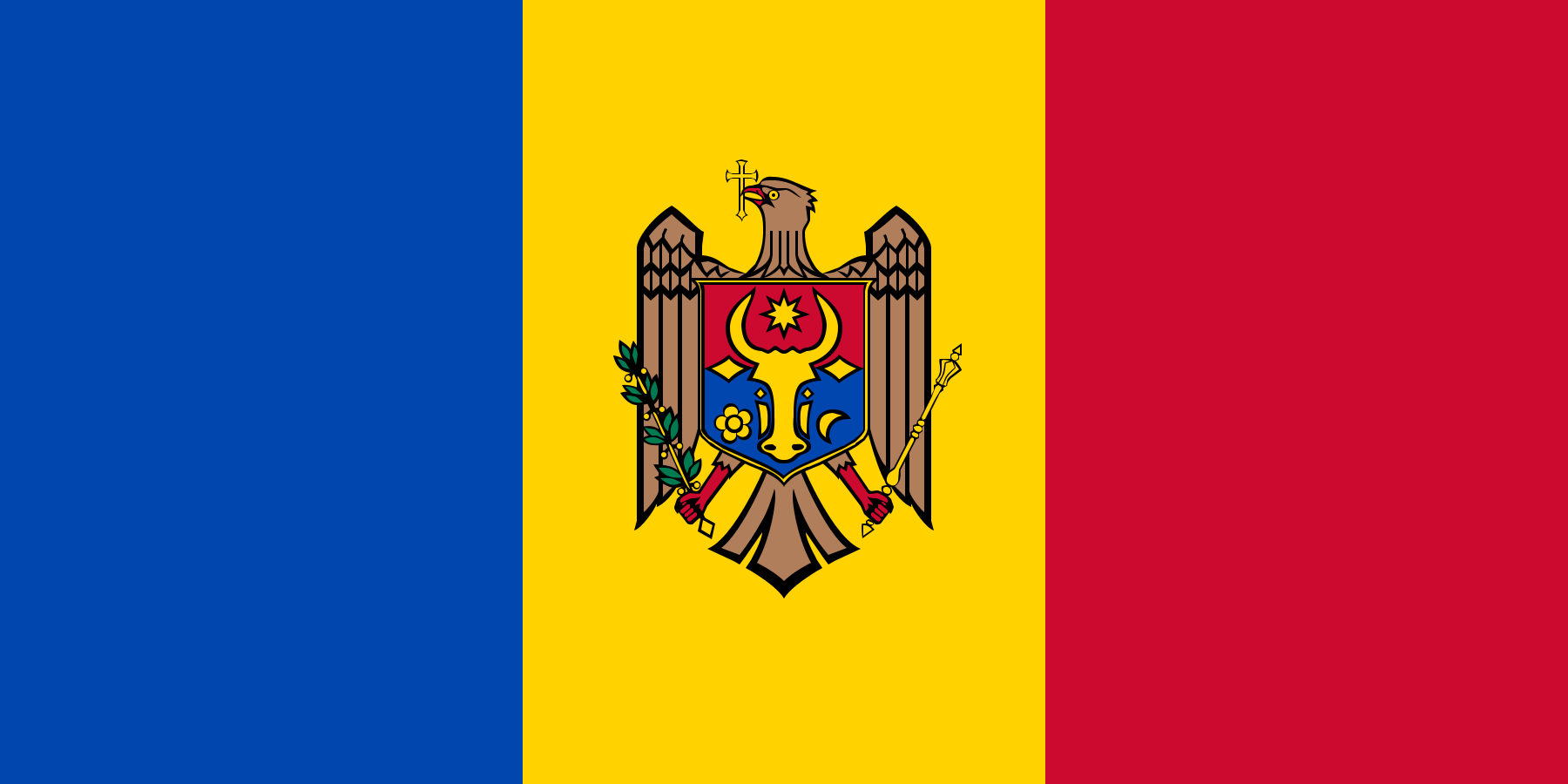
The final head of Soviet Moldavia's Communist Party
He called the 1991 banning of the Communist Party “an illegitimate act.”
Grigore Eremei was a Moldavian party and state official whose career reached its decisive moment at the end of the Soviet system. As First Secretary of the Communist Party of Moldavia in 1991, he occupied the republic's leading party post while the Union was breaking apart and Moldova moved toward independence. After the party was dissolved, he continued in public life as a Moldovan diplomat and parliamentarian, linking a Soviet political career to the institutions of the independent republic.
Career timeline
1952Began working as a village secondary-school librarian
1954–1956Served in the Soviet Army
1966–1970First Secretary of the Kotovsk district party committee
1970–1980Deputy and First Deputy Chairman of the Council of Ministers of the Moldavian SSR
1980–1990Chairman of the Moldavian republican council of trade unions
1989–1991People's Deputy of the USSR
1991First Secretary of the Communist Party of Moldavia and member of the CPSU Politburo
The conservative apparatchik who founded the Russian republic's Communist Party
Gorbachev later said: 'I have known Polozkov for a very long time. He is an honest, decent fellow, but stupid and uneducated. Someone writes something for him, and he recites it.'
Founding First Secretary of the Communist Party of the RSFSR (1990–1991), the first republican-level Communist Party in Russian history, and the public face of the conservative anti-perestroika opposition within the CPSU. In May 1990 he contested Boris Yeltsin for the chairmanship of the RSFSR Supreme Soviet and led in early counts before the Politburo ordered him to stand down; weeks later the founding congress elected him to lead the new Russian party. A provincial apparatchik who had run the Krasnodar party organization for five years, he rose to the CPSU Politburo but was caught between reformers and hardliners, resigning after a heart attack in August 1991. He remained a symbolic elder of the Russian communist movement through the CPRF's consultative council after the party's dissolution.
Career timeline
1957–1962Komsomol and party functionary, Solntsevo district, Kursk Oblast
1969–1972Deputy department head, Kursk Oblast Party Committee
1972Chairman, Rylsk District Executive Committee
1973–1978, 1980–1983CPSU Central Committee apparatus
1983–1984Ideology secretary, Krasnodar Krai Party Committee
1984–1985Sector head, Organizational-Party Work Dept, CPSU CC
1985–1990First Secretary, Krasnodar Krai Party Committee
1990–1991First Secretary, CPRSFSR CC · CPSU Politburo member
The last Soviet trade minister, formed in consumer cooperatives
In 1987, he reported declining sugar reserves to the government, putting figures to the consumer crisis.
Kondrat Terekh was a Soviet economic administrator who rose from village-cooperative bookkeeper to become the last Minister of Trade of the USSR (1986–91) during perestroika. Bearing responsibility for all-Union consumer distribution until the planned economy's collapse, he stood at the front line of a consumer crisis of rationing and shortages.
Career timeline
1952–1954Senior accountant in a rural consumer cooperative
1954–1958Served in the Soviet Navy
1959–1963Director of Vileyka city food trade
1967–1977Minsk regional trade chief and First Deputy Chairman of Belkoopsoyuz
1977–1984Chairman of Belkoopsoyuz
1984–1986Deputy Chairman of the Council of Ministers of the Byelorussian SSR