Heroic Corps founder who evolved from anarchist bombings to DPRK cabinet, lone figure spanning the Korean revolutionary spectrum
On first meeting Kim Ik-sang in Beijing, Kim Won-bong told him: 'Freedom is won by our strength and our blood… We must be the first to shed it.' Kim Ik-sang joined the Heroic Corps on the spot and weeks later walked into the Japanese Government-General building in Seoul and threw a bomb.
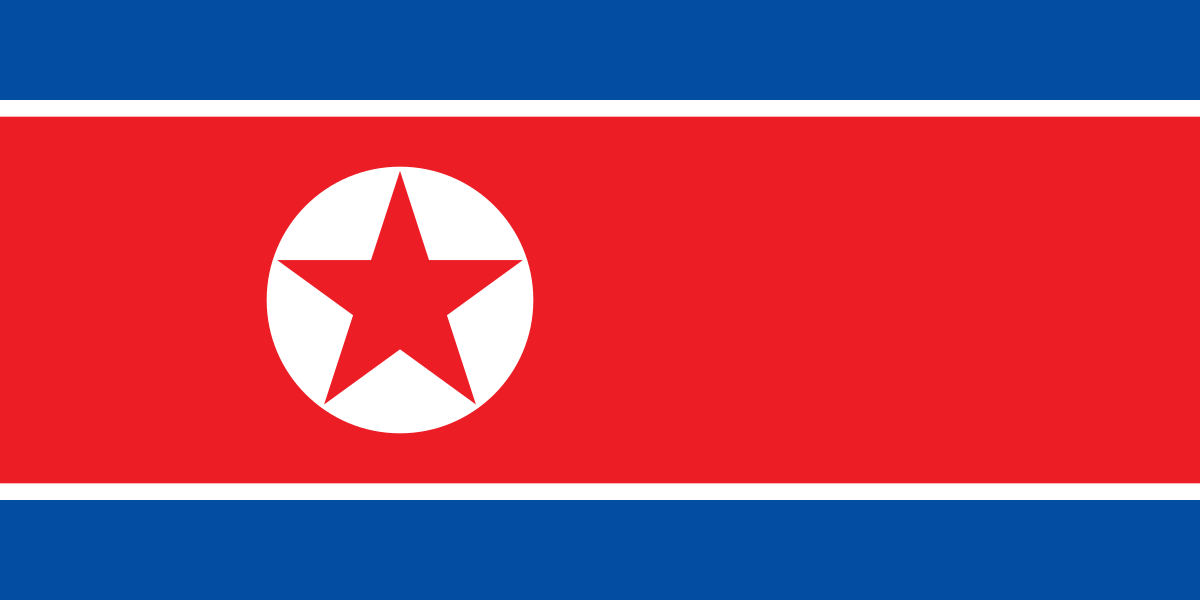
Anarchist militant who founded the Heroic Corps (Ŭiyŏltan) in 1919 and led a six-year campaign of bombings and assassinations against Japanese colonial authorities. After military training at the Whampoa Academy, he founded the Korean National Revolutionary Party (1935) to build a united front, commanded the Korean Volunteer Corps, and later joined the Provisional Government as Deputy Commander of the Korean Liberation Army and Minister of Military Affairs. Following liberation he pursued left-right cooperation, but after Yeo Un-hyeong's assassination he joined the 1948 North-South talks and remained in the DPRK as State Inspection Commissioner and Minister of Labor until his purge in 1958. His trajectory, from anarchist bombings to united-front politics to DPRK cabinet, makes him the only figure to span the entire Korean revolutionary spectrum.
Activities and affiliations
Career Timeline
- 1919Founded the Heroic Corps, became its leader (Ŭibaek)
- 1926Enrolled in Whampoa Military Academy, 4th class
- 1935Founded the Korean National Revolutionary Party
- 1938Organized the Korean Volunteer Corps, became commander
- 1944Minister of Military Affairs, Provisional Govt.; Deputy Commander, Korean Liberation Army
- 1948State Inspection Commissioner, DPRK
- 1952Minister of Labor, DPRK
- 1957Vice Chairman, SPA Standing Committee
Related historical events
Founding and division of the Korean Volunteer Corps
Kim Won-bong founded the Korean Volunteer Corps in Hankou in 1938 and became its commander-in-chief. The military unit was organized by the Korean National Front Federation, a coalition of left-wing groups active in mainland China that included the Korean National Revolutionary Party; its initial strength was about 200. Its work included not only combat but also intelligence gathering in Japanese-occupied areas, interrogation of prisoners, propaganda directed at Japanese troops and at Chinese forces and civilians, and translation of captured enemy documents. Its strength rose to 314 by February 1940, and units operated in Hunan, Jiangxi, Anhui, and around Luoyang. After the Korean Liberation Army was established in September 1940, some members transferred to it and others left; by May 1941 the Corps numbered 81.
Separately, the main body of the Corps moved north to North China. The headquarters under Kim remained in Chongqing; following a decision in November 1940, the members assembled at Luoyang and crossed the Yellow River into North China in March 1941. In July, the North China detachment was formed at Linxian and fought Japanese forces in the Taihang Mountains region. In April 1942 the Provisional Government of the Republic of Korea decided to incorporate the Corps in Chongqing into the Korean Liberation Army; the following month Kim became deputy commander of that army and commander of its First Detachment. The North China detachment was not part of this incorporation. Its main force was reorganized in July 1942 as the Korean Volunteer Army under the Korean Independence Alliance. Thus the North China transfer and the incorporation into the Liberation Army were separate paths taken by different parts of the Corps.