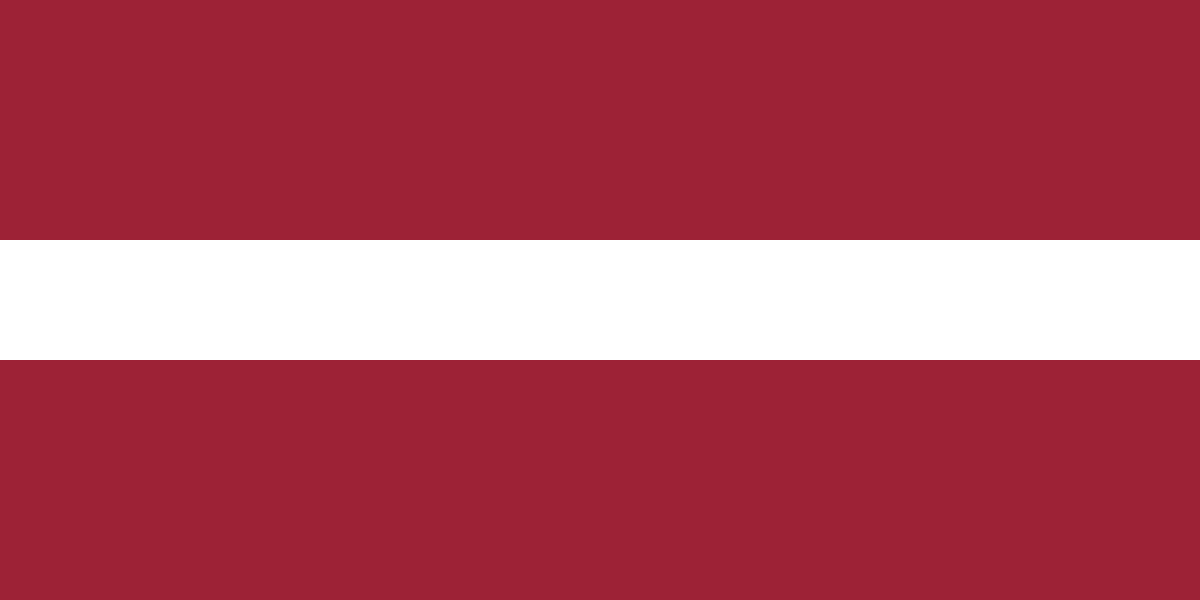
Microbiologist who headed the puppet government chosen by the Soviet embassy in 1940 and requested Latvia’s incorporation into the USSR
Born the son of a tenant on a manor in Mazsalaca, Livonia, he studied at the Tartu Veterinary Institute, took part in the revolution of 1905 and emigrated to Switzerland, working at a tuberculosis institute in Davos. He served as a military veterinarian in the Serbian army in the First World War and as a captain in the veterinary units of the Latvian War of Independence. In 1919 he founded a Microbiology Institute at the University of Latvia, and in 1923 he defended the first doctoral thesis in Latvia; politically he supported social democracy. In June 1940 the Soviet embassy offered him the leadership of the new puppet government; as prime minister, and from 21 July acting president, he requested Latvia’s incorporation into the Soviet Union. He chaired the Latvian SSR Supreme Soviet’s presidium in 1940–1952, joined the Communist Party in 1941 and died in Riga in 1963.
Career timeline
1893–1901Tartu Veterinary Institute
1911Assistant at the tuberculosis institute in Davos
1919Founded the Microbiology Institute at the University of Latvia
1940Puppet prime minister and acting president
1940–1952Chairman of the Latvian SSR Supreme Soviet’s presidium
Soviet Union
Soviet communism
1875–1946
○ Natural causes
The long-serving formal head of state
On 1 March 1921, before the Kronstadt uprising, Kalinin entered the fortress unarmed with his wife, was met with applause at Anchor Square, but the sailors derailed his speech with jeers and catcalls.
A peasant-born Bolshevik metalworker who became the Soviet Union's formal head of state from 1919 until his death in 1946, serving 27 years as the country's nominal president. He signed the key laws of the mass-repression period, including the 7 August 1932 decree on state property, the 1 December 1934 decree on simplified terror cases, and the 7 April 1935 decree lowering criminal responsibility to 12. He also approved a cipher from the Belarusian first secretary proposing to shoot 3,000 and expel 9,800 people, and in March 1940 signed the order to execute 25,700 Polish officers and prisoners. Yet on 4 May 1932 he voted against the expulsion of 38,000 peasant families as unfounded, and the reversal halted the operation.
Soviet Union
Soviet communism
1888–1970
○ Natural causes
Formal head of state in late Stalinism
On 9 January 1905, 16-year-old factory worker Nikolai Shvernik witnessed the 'Bloody Sunday' shootings before the Winter Palace. That autumn he joined the Bolsheviks.
A Petersburg worker who joined the Bolsheviks at 17, he built the Soviet trade-union system as First Secretary of the All-Union Central Council of Trade Unions for 14 years. He succeeded Kalinin as Chairman of the Supreme Soviet Presidium in 1946, though real power lay with Stalin and the Politburo. During the war he directed industrial evacuation and the Nazi atrocities investigation commission; after Stalin's death he worked with Khrushchev as head of the Party Control Committee, overseeing the rehabilitation of victims of political repression.
Career timeline
1920s–1930sRises through trade-union and party administration
1938–1946Chairman of the Soviet of Nationalities, a pillar of Stalin-era formal federal representation
1946–1953Chairman of the Supreme Soviet Presidium, the titular head of state
1953–1956Moves into trade-union and state-administrative elder roles after Stalin
after 1956Works on rehabilitation and discipline issues through party-control bodies
Soviet Union
Soviet communism
1890–1946
✕ Probable suicide
Poet and doctor whom Zhdanov forced on Estonia as puppet prime minister in June 1940, and who led the petition to join the Soviet Union
Born to a farming family near Viljandi, he studied medicine in Kiev and served as a military physician in the First World War and the Estonian War of Independence. He became a well-known poet and radical socialist under the pen name Johannes Barbarus. After the Soviet occupation of June 1940, Andrei Zhdanov forced President Konstantin Päts to appoint him prime minister of a communist-dominated puppet government, and he headed the delegation that delivered the petition to join the Soviet Union. He then chaired the Estonian SSR Supreme Soviet’s presidium, fled to Soviet Russia when the Germans came in 1941, and after returning in 1944 was investigated by the NKVD over his role in the War of Independence. He died in the presidential residence in Kadriorg, Tallinn, in November 1946, most probably by suicide, though murder has also been suggested.
Career timeline
1910–1914Studied medicine at the University of Kiev
1918–1920Military physician in the Estonian War of Independence
1940Puppet prime minister; led the delegation petitioning to join the USSR
1940–1946Chairman of the Estonian SSR Supreme Soviet’s presidium