At the October 1939 Vilnius celebrations, Paleckis publicly demanded President Smetona's resignation — and was arrested and sent to a forced-labor camp. Eight months later, under Soviet auspices, he returned as Lithuania's new head of state.
He became a leader during Lithuania’s Sovietization and later chaired the Soviet of Nationalities. He is a symbolic figure of Baltic republic representation.
Career timeline
1920s–1930sWorks as a Lithuanian left-wing journalist and politician
1940Becomes head of the people’s government during Soviet annexation of Lithuania
1940–1967Chairman of the Lithuanian SSR Presidium, the official face of the republic
1966–1970Chairman of the Soviet of Nationalities, symbolizing Baltic republic representation
after 1970Retires into honorary posts and memoir work
The 20-year formal head of state of the Russian republic under Brezhnev
"He had the firm administrative hand of an authoritative man and knew construction better than anyone." — Contemporary assessment
Mikhail Yasnov rose from leather worker and courier to the formal head of state of the Russian SFSR for nearly two decades. As Moscow City Executive Committee chairman (1950–1956), he directed the second reconstruction of the capital: completing the Stalinist high-rises, launching mass housing in the southwest, opening the metro ring line, and doubling residential construction. He served briefly as RSFSR premier (1956–1957), then spent nineteen years as Chairman of the RSFSR Supreme Soviet Presidium (1966–1985), the republic's ceremonial head of state throughout the Brezhnev era. A construction engineer who had directed Moscow's defensive fortifications during the Battle of Moscow, he was remembered by contemporaries as harsh but effective.
Career timeline
1918–1922Courier, People's Commissariat of Health RSFSR
1922–1928Leather factory worker
1925Graduated workers' faculty, Moscow State University; joined CPSU
1928–1930Military service, Red Army
1930–1938Managerial posts in Moscow construction trusts
1938–1949Deputy/First Deputy Chairman, Moscow City Executive Committee; directed defensive construction during Battle of Moscow
1949–1950Deputy Minister of Urban Construction, USSR
1950–1956Chairman, Moscow City Executive Committee; simultaneously Chairman of the Soviet of the Union (1950–1954)
1956–1957Chairman, Council of Ministers of the RSFSR
1957–1966First Deputy Chairman, Council of Ministers of the RSFSR
1966–1985Chairman, Presidium of the Supreme Soviet of the RSFSR (republican head of state)
The Latvian who chaired the Soviet of Nationalities for a decade under Brezhnev
On December 8, 1983, at a Human Rights Day press conference, Rubenis described the exiled Andrei Sakharov as "a talented but sick man" whose banishment to Gorky "was necessary above all for himself, to preserve his peace of mind."
A Moscow-born Latvian Soviet politician who served as Chairman of the Latvian SSR Council of Ministers and Chairman of its Supreme Soviet Presidium before chairing the Soviet of Nationalities (1974–1984) for a decade under Brezhnev. His decade-long tenure was a rare case of a non-Russian republican cadre stably occupying a key federal parliamentary post, and he exemplified the loyal technocrats Arvīds Pelše elevated after the 1959 purge of Latvian national communists.
Career timeline
1934–1941Worked as agronomist after graduating from technical school
1942–1943Editor, Stakhanovsky Trud district newspaper, Rybinsk
1947–1948Second Secretary, Daugavpils Uyezd Committee, CP Latvia
1958–1960Head of Agriculture & Procurement Dept, Gosplan of Latvian SSR
1960–1961Head of Agricultural Dept, CC CP Latvia
1962–1970Chairman, Council of Ministers of the Latvian SSR
1970–1974Chairman, Presidium of Supreme Soviet of Latvian SSR; Deputy Chairman, Presidium of USSR Supreme Soviet
1974–1984Chairman, Soviet of Nationalities of the USSR Supreme Soviet
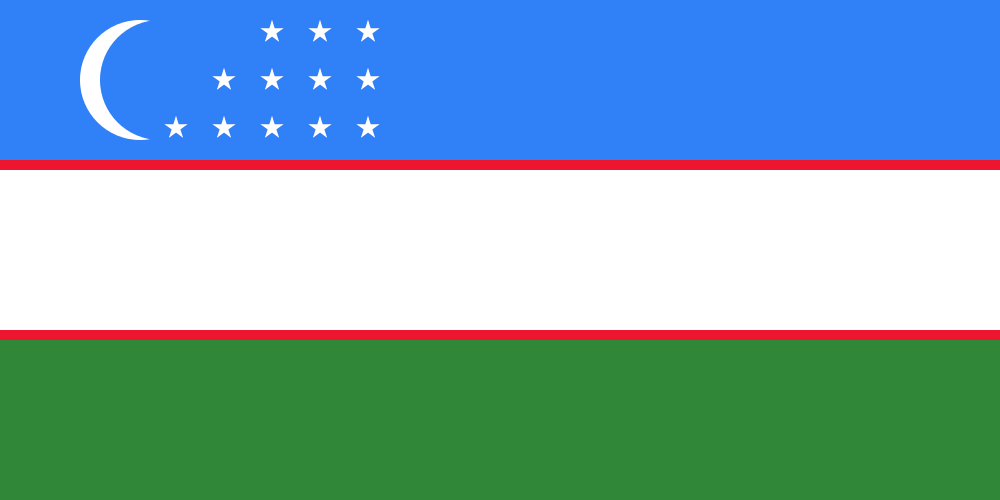
Uzbek SSR figure who chaired the Soviet of Nationalities
In a meeting with Crimean Tatar civil rights activists, she openly opposed their return to Crimea, bluntly stating that Uzbekistan needed their labor.
Rising from the Uzbek republic leadership, she chaired the Soviet of Nationalities. Her career shows the link between central power and republic elites under Brezhnev.
Career timeline
1940s–1950sRises through Uzbek Komsomol, party and state administration
1959–1970Chairwoman of the Uzbek SSR Supreme Soviet Presidium
1970–1974Chairwoman of the Soviet of Nationalities, reaching a high post in central federal representation
1974Leaves office amid Uzbek leadership changes and political pressure
after 1974Moves away from the center of official politics