
A face of Soviet Lithuania
At the October 1939 Vilnius celebrations, Paleckis publicly demanded President Smetona's resignation — and was arrested and sent to a forced-labor camp. Eight months later, under Soviet auspices, he returned as Lithuania's new head of state.
He became a leader during Lithuania’s Sovietization and later chaired the Soviet of Nationalities. He is a symbolic figure of Baltic republic representation.
Activities and affiliations
Career Timeline
- 1920s–1930sWorks as a Lithuanian left-wing journalist and politician
- 1940Becomes head of the people’s government during Soviet annexation of Lithuania
- 1940–1967Chairman of the Lithuanian SSR Presidium, the official face of the republic
- 1966–1970Chairman of the Soviet of Nationalities, symbolizing Baltic republic representation
- 1970 이후Retires into honorary posts and memoir work
Portrait of a Writer: Paleckis as Journalist, Poet, and Translator
Before he was a politician, Paleckis was a journalist and poet. Born the son of a blacksmith, he worked in a print shop from 1915 and began publishing poems in 1919. From 1922 he taught in Riga, chaired the Latvian Lithuanian association 'Rūta,' and founded and edited the illustrated magazine Naujas žodis. In 1926 he moved to Kaunas and was appointed director of ELTA, the Lithuanian national news agency, only to be dismissed after the December military coup. He then studied at the University of Lithuania while working as a journalist for progressive outlets, and in 1931 made contact with the underground Lithuanian Communist Party. He visited the USSR in 1933 and was elected to the Kaunas Anti-Fascist Committee in 1937. His writing extended well beyond journalism: he translated Latvian authors into Lithuanian, published poetry collections including Dienų nelaisvėj (1932), and authored the three-volume documentary novel Paskutinis caras ('The Last Tsar,' 1937–1938), a portrait of the Romanov dynasty's fall that went through multiple Soviet-era reprints. Before his arrest in 1939 for publicly demanding President Smetona's resignation at the Vilnius celebrations, Paleckis was a left-wing intellectual who intervened in the world through the pen. Even after becoming the first leader of Soviet Lithuania, he continued writing poetry and memoirs, leaving behind travelogues and reminiscences into the 1970s.
June 1940: Head of the Soviet People's Government
On June 14, 1940, the Soviet Union delivered an ultimatum to Lithuania; Soviet troops entered the next day. After President Antanas Smetona fled, the Soviets demanded that acting president Antanas Merkys name Paleckis head of a new government. Paleckis was a left-wing journalist who had been arrested and sent to a forced-labor camp, then exiled to Latvia, after publicly demanding Smetona's resignation during the October 1939 celebrations of Vilnius's return to Lithuania. Sworn in on June 17 as both prime minister and acting president, he joined the Communist Party immediately. His government dissolved the existing Seimas on July 1 and organized elections to a People's Seimas, which convened on July 21 and resolved to establish the Lithuanian Soviet Socialist Republic and petition for admission to the USSR. On August 25, Paleckis became chairman of the Presidium of the newly formed Lithuanian SSR Supreme Soviet. The convergence of independent Lithuania's last head of government and Soviet Lithuania's first official leader in a single figure remains one of the most contested hinges in modern Lithuanian history.
The National Communist: Defending Lithuanian Particularity
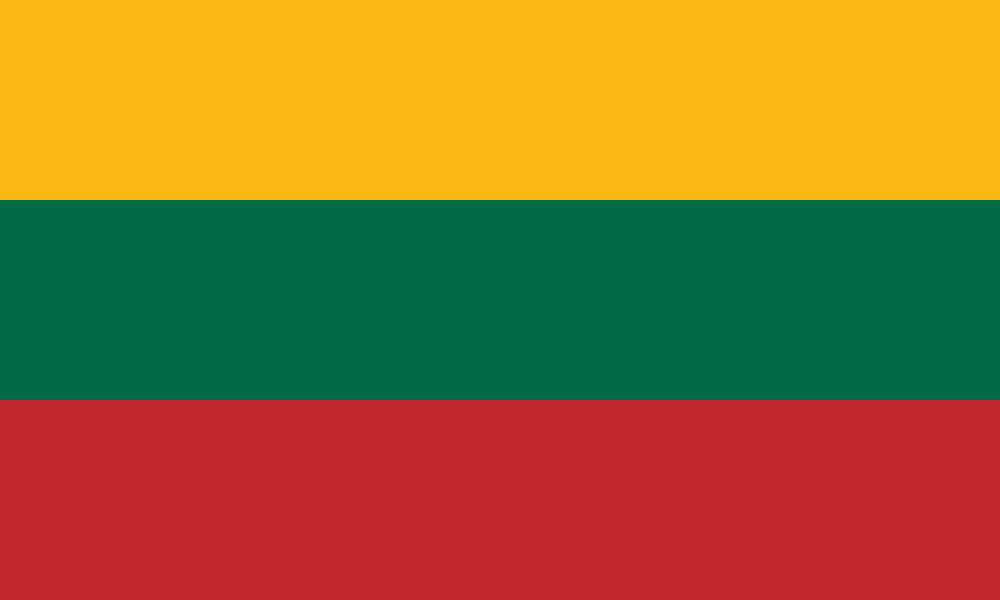
Over 27 years as Chairman of the Presidium of the Lithuanian SSR Supreme Soviet, Paleckis emerged as a defender of Lithuania's historical and cultural particularity within the Soviet system. He publicly emphasized that Lithuania was a 'unique republic' with a long statehood tradition, unlike other Soviet republics, and argued that making Soviet rule more attractive required cooperation with the interwar Lithuanian intelligentsia and the development of the Lithuanian language and culture. He proposed adopting Vincas Kudirka's 'Tautiška giesmė' (the National Hymn) as the anthem of Soviet Lithuania and sought to preserve national colors in the republic's flag. But the Lithuanian Communist Party leadership, especially First Secretary Antanas Sniečkus, did not support these initiatives, and Paleckis was repeatedly criticized at party forums for 'bourgeois nationalism.' As unification and Russification tendencies intensified during late Stalinism, the political window for national communism effectively closed. Paleckis remained the official face of Soviet Lithuania while real power concentrated in the party apparatus. Still, his trajectory paralleled that of Central European national communists who sought to preserve republican identity within the Soviet framework, a revealing chapter in the complex history of Soviet Lithuania.
On the All-Union Stage: 25 Years as Deputy Chairman of the USSR Supreme Soviet Presidium
A less visible but structurally significant axis of Paleckis's political career was his all-union role: for twenty-five years, from 1941 to 1966, he served as Deputy Chairman of the Presidium of the USSR Supreme Soviet. Though the post was largely ceremonial, his election as a deputy to the USSR Supreme Soviet across eight convocations (1941–1974) and his status as a candidate member of the CPSU Central Committee from 1952 to 1971 show that he was not merely a provincial functionary but a figure trusted by the centre. Simultaneously a member of the Central Committee and CC Bureau of the Lithuanian Communist Party (1940–1966), he operated in a dual position bridging republic and union. After Stalin's death, during the political thaw, this duality grew more complex: he sought to defend Lithuanian interests on one side while having to prove his loyalty to Soviet ideology on the other. The repeated accusations of 'nationalism' he faced at Lithuanian CP plenums and congresses reflect precisely this tension. His election as Chairman of the Soviet of Nationalities in 1966 marked the apex of his all-union career, making him one of the rare Baltic figures to hold a major ceremonial office at the federal level.