Korolev's key partner in shaping the R-7's packet design
On 21 August 1957, the R-7 whose design Kryukov helped shape finally completed its planned flight.
Sergei Kryukov was a Soviet rocket and space-technology designer who helped define the R-7's overall form and its packet arrangement of four strap-on blocks around a central stage. If Korolev directed the programme as chief designer, Kryukov turned its concept into an integrated structure and working design through the project department he led. He later directed automated interplanetary-station and launch-vehicle work at the Lavochkin bureau and Energia. His career shows that the space programme was built not by a lone genius but by specialised collective design and production systems.
Career timeline
1918–1940Born in Bakhchysarai; studied at the Stalingrad Mechanical Institute
1940–1945Supervised artillery production at the Barrikady and No. 526 factories
1946–1947Joined NII-88; studied German rocket technology and led its return shipment
1947–1956Rose from senior engineer to project-section leadership at OKB-1
1956–1961Head of Design Department 3 and chief designer of the R-7; Hero of Socialist Labour
1961–1970Deputy chief designer at OKB-1, then department head at TsKBEM
1970–1977Chief designer at the Lavochkin bureau; directed automated interplanetary-station work
1977–1996First deputy general designer and later scientific consultant at Energia
Architect of Soviet counterintelligence for 40 years, from SMERSH radio games to chief of the KGB Second Chief Directorate
Grigorenko personally organized and ran 181 SMERSH radio games — operations code-named 'Zagadka' (Riddle), 'Tuman' (Fog), and others — feeding disinformation to German command while penetrating Abwehr and Zeppelin agent networks.
Grigory Grigorenko was the backbone of Soviet counterintelligence for over forty years. During the Second World War he personally ran 181 radio games at SMERSH, deceiving the Abwehr and Zeppelin with disinformation operations, then rose through MGB and KGB counterintelligence departments. As chief of the KGB Second Chief Directorate from 1970 to 1983, he built the system that serially unmasked deep-cover CIA and Western agents, and from 1978 he served concurrently as Deputy Chairman of the KGB, becoming a key lieutenant of Yuri Andropov. His counterintelligence architecture paralyzed foreign intelligence stations in Moscow for years and remained the methodological foundation of Russian counterintelligence long after the Soviet collapse.
Career timeline
1940–1942NKVD Special Department operative; Southwestern Front and Battle of Stalingrad
1943–1946Senior operative, SMERSH 3rd Department; conducted 181 radio games
1954–1956First Deputy Representative of the KGB in Hungary
1962–1969Chief of Foreign Counterintelligence, PGU KGB
1970–1983Chief of the 2nd Chief Directorate, KGB
1978–1983Deputy Chairman of the KGB (concurrent with 2nd Chief Directorate)
1983–1989Deputy Minister of General Machine Building, USSR
The merchant marine minister who conquered the Arctic with a nuclear icebreaker fleet
On 9 August 1977, the minister himself boarded the Arktika at the Murmansk pier. If it failed, he would carry the blame alone. Eight days later, a surface ship reached the North Pole for the first time in human history.
Born the son of a village blacksmith in Oryol Governorate, he grew into an engineer handling Arctic convoy cargo at the wartime Murmansk port. He turned the Sakhalin Shipping Company profitable, becoming the youngest head of a Soviet shipping company at 37, and rose to Minister of Merchant Marine in 1970. Over 16 years he transformed a subsidised sector into the fifth-largest foreign-currency earner among nearly 80 ministries, while expanding the nuclear icebreaker fleet from the single Lenin to eight vessels. In 1977 he personally boarded the nuclear icebreaker Arktika and led the world's first surface-ship voyage to the North Pole, earning the title Hero of Socialist Labour. Forced from office in 1986 after the Admiral Nakhimov passenger liner disaster, the Arctic route and icebreaker fleet he built remain the foundation of Russia's northern strategy today.
Career timeline
1942–1949Starts as shift mechanic at Murmansk port, rises to mechanization chief and chief engineer, responsible for restoring cargo operations under Arctic convoy bombing
1951–1955Kholmsk port chief → Korsakov port chief → head of Sakhalin Shipping Company, turning a loss-making enterprise profitable
1955–1960At 37, the youngest head of a Soviet shipping company, completes the turnaround of Sakhalin Shipping
1960–1962Head of Personnel, Ministry of Merchant Marine
1962–1966Deputy head, Transport & Communications Dept, CPSU Central Committee
1966–1970First Deputy Minister of Merchant Marine
1970–1986Minister of Merchant Marine: transforms subsidised sector into 5th-largest forex earner, expands nuclear icebreaker fleet from 1 to 8 vessels, opens year-round Arctic navigation
1977Personally leads Arktika North Pole expedition, awarded Hero of Socialist Labour
In December 1982, newly appointed interior minister, Fedorchuk held his first expanded collegium not at MVD headquarters but at the KGB building on Lubyanka. A colleague recalled: 'He had no intention of leaving.'
A military counterintelligence officer from a poor Ukrainian peasant family, he saw combat at Khalkhin Gol and in the defense of Moscow before rising through SMERSH and KGB military counterintelligence. From 1970 he led the Ukrainian KGB for twelve years (securing Brezhnev-era stability in the republic), and when Andropov became General Secretary, Fedorchuk briefly succeeded him as chairman of the Soviet KGB. Moved to the Interior Ministry after only seven months, he purged some 90,000 personnel on corruption charges before Gorbachev dismissed him in 1986.
Career timeline
1939–1970sBuilds a long security career in Ukraine and military counterintelligence
1970–1982Chairman of the Ukrainian KGB, commanding a republic-level security apparatus
1982Promoted to KGB chairman when Andropov becomes General Secretary
1982–1986Moved to interior minister and involved in discipline campaigns under Andropov and Chernenko
A fiscal realist who warned against abrupt prohibition
On April 4, 1985, Dementsev warned that cutting vodka production would cost the budget 4 billion rubles in 1986 and 15 to 16 billion by 1990.
Viktor Dementsev was an economic administrator who rose from regional finance offices to the upper ranks of Soviet financial management. In 1985 he publicly challenged the abrupt production cuts proposed for the anti-alcohol campaign, exposing the structural tension created by the state budget's reliance on alcohol revenue. His warning calculated not only lost income but also the likely growth of moonshine and resulting sugar shortages, making him a revealing witness to the campaign's fiscal and social contradictions.
Career timeline
1934–1939Accounting and district finance posts in Chita and Kamchatka
1944–1947Controller-auditor in Kamchatka regional audit bodies
1949–1962Regional finance chief and executive-committee deputy chair in Gorno-Altaysk and Yaroslavl
1962–1965Head of State Revenues and deputy finance minister of the RSFSR
1965–1973Deputy Minister of Finance of the USSR
1973–1986First Deputy Minister of Finance of the USSR
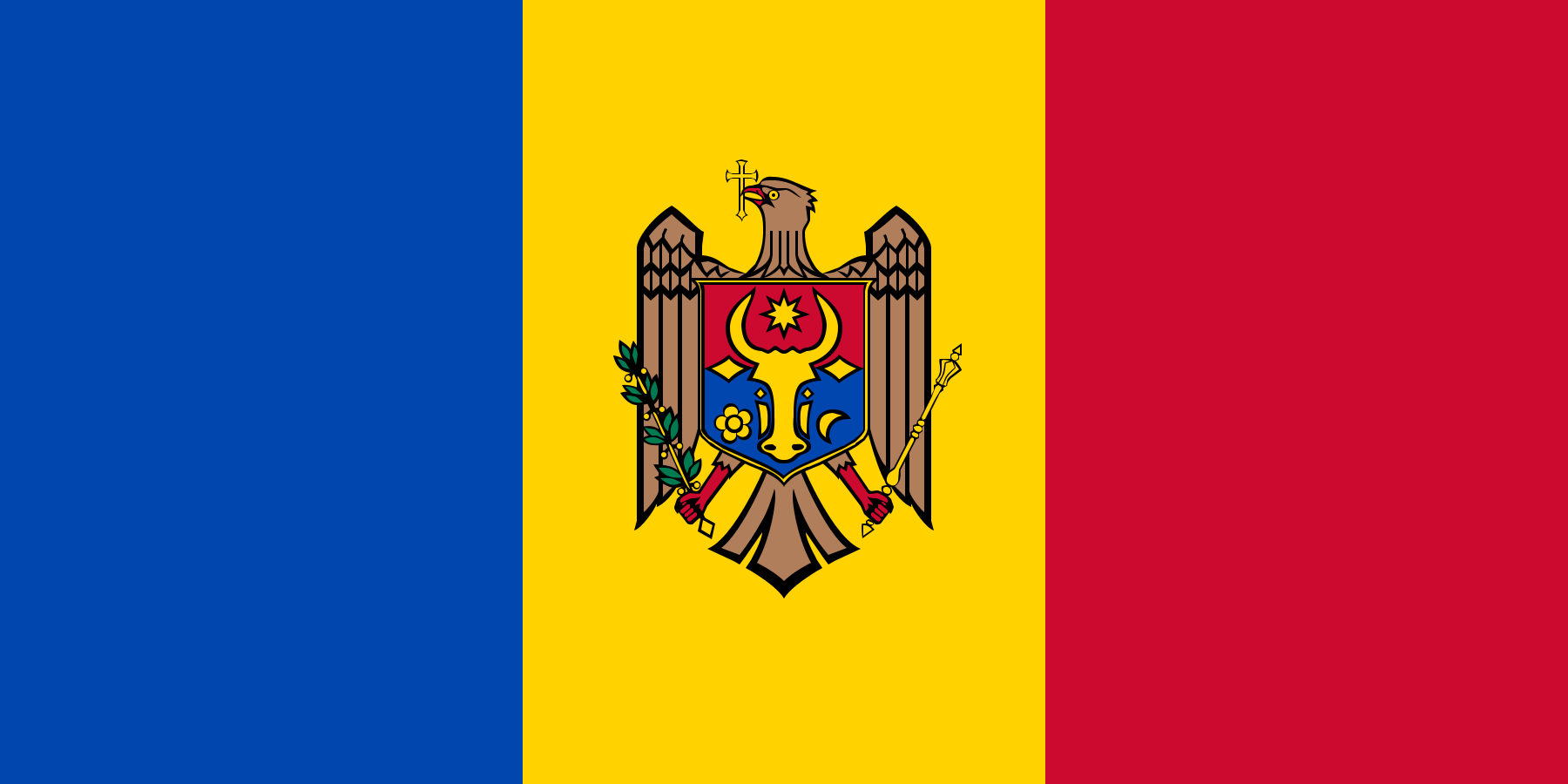
The republic first secretary who ruled Moldavia for nearly 20 years as Brezhnev's close ally
Of writer Ion Druță, forced to relocate to Moscow, Bodiul said publicly: 'If he returns home, I'll hang him on the first lamppost.'
He served nearly 20 years as First Secretary of the Communist Party of Moldavia, one of the longest-serving republican party chiefs in Soviet history. A close Brezhnev ally, he transformed agrarian Moldavia with new industries (machine-building, electronics, food processing) and built some of Europe's largest orchards and livestock complexes. Yet he also pursued aggressive Russification: suppressing Romanian, closing churches, and threatening writer Ion Druță with hanging. Elevated to Deputy Chairman of the USSR Council of Ministers in 1980, his 2003 Order of the Republic award provoked eight Moldovan writers to renounce their own medals in protest.
Career timeline
1937–1938Senior agronomist, collective farm
1942–1946Veterinary officer, Red Army (127th Guards Artillery Regt → 59th Guards Rifle Div → 10th Guards Rifle Corps)
1946–1951Agricultural aide and inspector, Moldavian SSR Council of Ministers
1951–1956First Secretary, Chișinău / Volontirovka / Olănești District Party Committees
1956–1959Higher Party School graduate; instructor, CC CPSU Org-Party Work Dept
1959–1961Second Secretary, CC of the Communist Party of Moldavia
1961–1980First Secretary, CC of the Communist Party of Moldavia
1980–1985Deputy Chairman, USSR Council of Ministers
From Ukrainian premier to USSR steel minister: a Dnieper-born technocrat who ran Soviet ferrous metallurgy for twenty years
"How are you not ashamed, Comrade Kazanets... you boast that you smelt more than the USA. But what about the quality of the metal? Only 40% of every ton becomes finished product — the rest goes out as slag and shavings!" — Brezhnev dressing him down at the 1972 Central Committee plenum.
A Ukrainian technocrat from a family of Dnieper river pilots, he started as an electrician and gained shop-floor experience at the Kuznetsk and Yenakiieve metallurgical combines. Handpicked by Khrushchev in 1953 at age 35 to head the Donetsk Oblast Party Committee, he rose to Second Secretary of the Ukrainian Communist Party CC in 1960 and served as Chairman of the Ukrainian SSR Council of Ministers from 1963 to 1965. When the Kosygin reforms re-established the USSR Ministry of Ferrous Metallurgy in 1965, he became its first minister and held the post for twenty years, making the Soviet Union the world's largest steel producer. He sat on the CPSU Central Committee throughout the Brezhnev era and retired just after Gorbachev came to power in 1985.
Career timeline
1937–1944Electrician, engineer, substation section head at Kuznetsk Metallurgical Combine; graduated Siberian Metallurgical Institute
1944–1952Shift chief, party committee deputy secretary, shop head at Yenakiieve Metallurgical Plant; party organiser from 1950
1952–1953First Secretary, Yenakiieve City Committee → Makiivka City Committee
1953–1960First Secretary, Donetsk Oblast Committee, Communist Party of Ukraine
1960–1963Second Secretary, CC of the Communist Party of Ukraine
1963–1965Chairman, Council of Ministers, Ukrainian SSR
1965–1985USSR Minister of Ferrous Metallurgy
1961–1986Member, CPSU Central Committee (candidate 1956–1961)
“I am certain of twelve, absolutely certain. If you stretch it, perhaps fifteen.”
Yevgeny Pepelyayev was a Soviet fighter pilot and regimental commander who carried experience from the Second World War and the Far East into the Korean War’s jet combat. He led the 196th Fighter Aviation Regiment from bases in Manchuria against United Nations air forces, becoming one of the war’s leading Soviet aces with 19 officially credited victories. Sources place his total between 19 and 23 because he reportedly assigned some victories to wingmen, leaving the ranking disputed alongside Nikolai Sutyagin. Awarded Hero of the Soviet Union in 1952, he later served in air-defence command and research before retiring in 1973.
Career timeline
1938Graduated from the 8th Military Pilots School; posted to the Far East
1943Training and operational flying with the 162nd Fighter Aviation Regiment on the Belorussian Front
1945Deputy commander of the 300th Fighter Aviation Regiment; served in the war against Japan
1949–1952Commander of the 196th Fighter Aviation Regiment
1951–1952Served in the Korean War, commanding MiG-15 formations
1958–1960Commander of the 133rd Fighter Aviation Division
1960–1973Chief of aviation of the 78th Air Defence Fighter Aviation Corps; served at the central command post, then retired
Father of electroslag welding who led Ukraine's Academy of Sciences for 58 years
“Science is the essence of my life, and the Academy is not merely my job but my only family.”
Boris Paton presided over the Ukrainian Academy of Sciences for 58 years, from 1962 until his death in 2020. A pioneer of electric welding, he led development of electroslag welding in the 1950s, enabling joints of unlimited thickness that transformed Soviet heavy industry. During WWII he helped accelerate tank production at the Krasnoye Sormovo plant in Gorky. He directed space welding research, producing devices cosmonauts used in orbit, and adapted the technology to medicine with a method for joining living tissues now widely used in surgery. Twice Hero of Socialist Labour and a CPSU Central Committee member, he warned against building the Chernobyl plant near Kyiv and defended Ukrainian scientific autonomy through the Soviet collapse.
The GRU colonel who fed the West over 5,000 classified documents on Soviet missile weakness, exposing Khrushchev's strategic bluff
At a London safe house, Penkovsky tried on American and British army colonel's uniforms, photographed himself, and spoke of 'the day I'll wear one of these for real.'
A GRU colonel who, disillusioned with Khrushchev's leadership, approached MI6 and the CIA in 1961 and over 18 months fed the West more than 5,000 classified documents: Soviet ICBM capabilities, Cuban missile site layouts, and military doctrine. His intelligence confirmed to Kennedy that the Soviet missile arsenal was far weaker than Khrushchev claimed, providing the factual basis for the U.S. to stand firm during the Cuban Missile Crisis. Arrested by the KGB in October 1962, he was convicted in a televised show trial and executed by firing squad in May 1963.
Career timeline
1937–1939Graduated from 2nd Kiev Artillery School, commissioned as lieutenant
1939–1945Fought in Poland, Winter War, and the Eastern Front; twice wounded; adjutant to artillery commander, 1st Ukrainian Front
1945–1948Graduated Frunze Military Academy, promoted to colonel at age 30
1949–1953Graduated Military-Diplomatic Academy, assigned to GRU 4th (Middle East) Directorate
1955–1956Assistant military attaché in Turkey and GRU resident, recalled after misconduct
1960–1962Deputy chief of foreign relations at State Committee for Science and Technology, GRU cover post
1961.4–1962.10Double agent for MI6 and CIA; passed 5,000+ classified items in London, Paris, and Moscow
1963.5.11–16Convicted of treason and sentenced to death, executed five days later
From Izvestia editor to Soviet of the Union chairman: a Brezhnev-era media mandarin who became the face of the supreme legislature
When Andropov took power after Brezhnev's death, Tolkunov — who had once worked alongside him in the Central Committee — asked to return to newspaper work. Andropov offered him Pravda; Tolkunov chose Izvestia instead.
A Soviet journalist and state leader born into a railway worker's family who began as a Pravda reporter in 1938. During World War II he served as a war correspondent across multiple fronts, and from the early 1960s worked in the CPSU Central Committee's department for relations with socialist countries, managing the party's external propaganda line. Appointed editor-in-chief of Izvestia in 1965, he led the paper for 11 years before being transferred to head the Novosti Press Agency in 1976, then returned to Izvestia in 1983 when his old CC colleague Andropov came to power. Elected Chairman of the Soviet of the Union in 1984, he served until 1988 as the institutional head of the USSR's supreme legislative body.
Career timeline
1938–1939Reporter, Pravda information dept → literary contributor, assistant to editor-in-chief
The Chernobyl commander who built Siberia's oil empire
At 10 a.m. on 27 April 1986, Shcherbina opened the government commission meeting in Pripyat with a single sentence: 'We begin the evacuation.' Thirty-two hours after the explosion, an entire city of 50,000 boarded buses.
The architect of the West Siberian oil and gas complex that made the USSR the world's top hydrocarbon producer. As Tyumen party chief and Minister of Oil and Gas Construction, he drove pipelines, cities, and railways through taiga and permafrost. As Deputy Premier, he personally chaired the government commissions for the Chernobyl disaster (1986) and Armenian earthquake (1988), remaining on site even as radiation exposure deteriorated his health.
Career timeline
1939Volunteered for Winter War, 316th Ski Squadron
1942–1944Komsomol Secretary, Kharkov Oblast
1951–1961Secretary → 2nd Secretary, Irkutsk Oblast CPSU
1961–1973First Secretary, Tyumen Oblast CPSU
1973–1984Minister of Construction of Oil & Gas Industry, USSR
1984–1989Deputy Chairman, USSR Council of Ministers (fuel & energy)
1986Chairman, Chernobyl disaster government commission
1988Chairman, Armenian earthquake relief commission
Everyone fled. He stayed with the radio. 'I heard the whistle of a 50-kilo shell. Our side started hammering them!' Four tanks burned, two disabled.
Born to a Smolensk peasant family, he served as an artillery officer in the Great Patriotic War and earned the title Hero of the Soviet Union for calling artillery fire onto his own position. Rising through Soviet foreign trade institutions (trade adviser in the US, head of currency administration, and Deputy Minister of Foreign Trade), he chaired Gosbank from 1976 to 1986, managing the planned economy's monetary and credit system through the Brezhnev years. He left office amid early perestroika financial-reform pressures and the fallout from his daughter's defection to the West.
Career timeline
1947–1950Completes All-Union Academy of Foreign Trade, earns PhD with dissertation on British banks
1950–1967Rises through Foreign Trade Ministry research institutes and currency administration; trade adviser in the US
1967–1976Deputy Minister of Foreign Trade, coordinating Soviet foreign settlements and currency policy
1976–1986Gosbank Chairman, managing payments, credit and currency issuance in the planned economy
1986Leaves office amid early perestroika financial reforms and the fallout from his daughter's defection
CC department head who directed the Soviet chemical industry
"Without the chemical industry, not a single national task can be solved at an optimal level," he declared in his 1973 book, justifying full-spectrum chemicalization as a party line.
A graduate of the Moscow Institute of Chemical Machine Building, Bushuyev rose from Gosplan engineer to a figure who straddled central planning and party supervision of the Soviet chemical industry. As head of the Chemical Industry Department of the CPSU Central Committee from 1965 to 1976, he directed from the party line the Kosygin-era modernization drive: a massive expansion of synthetic rubber, plastics, mineral fertilizers, and petrochemicals. He simultaneously served on the Central Auditing Commission (1966–1981), overseeing party finances and documentation, and was a three-term deputy to the RSFSR Supreme Soviet. His 1973 book The Chemical Industry in Light of the Decisions of the 24th Party Congress became a standard party reference for chemical-industry policy under Brezhnev.
Career timeline
1941Graduated Moscow Institute of Chemical Machine Building
1942–1950sEngineer → senior engineer, State Planning Commission (Gosplan)
1947Joined the VKP(b)
1950s–1965Sector head → deputy department head, Gosplan under the USSR Council of Ministers
1965–1976Head of the Chemical Industry Department, CPSU Central Committee
1966–1981Member of the Central Auditing Commission, CPSU
1967–1980Deputy to the Supreme Soviet of the RSFSR (7th, 8th, 9th convocations)
The quiet gatekeeper who controlled Brezhnev's paper flow
Tsukanov's 'rule of three nails': 'I hang Brezhnev's orders on an imaginary first nail. If he insists, it moves to the second. Only at the third nail do I start making calls — and barely a tenth ever get carried out.'
A metallurgical engineer by training, Tsukanov served as Leonid Brezhnev's senior assistant for nearly two decades and was a pivotal figure in the party apparatus. Having attended the same Dneprodzerzhinsk Metallurgical Institute that Brezhnev graduated from, he joined the Central Committee apparatus in 1958 and effectively ran the General Secretary's secretariat for Brezhnev's entire tenure. He filtered Politburo materials and directives, controlling the information flow that reached the General Secretary, and managed the vast bureaucratic workload through a distinctive pragmatism encapsulated in his 'rule of three nails.' Quiet and unassuming on the surface, he was one of the few people who met Brezhnev daily and wielded enormous behind-the-scenes influence in stagnation-era Soviet politics.
Career timeline
1937–1958Worked at ferrous metallurgy enterprises in Dnepropetrovsk and Chelyabinsk regions; chief engineer at Dzerzhinsky Metallurgical Plant in Dneprodzerzhinsk
1958–1960Apparatus of the CC CPSU
1960–1963Apparatus of the Presidium of the Supreme Soviet of the USSR
1963–1964Assistant to the Secretary of the CC CPSU
1964–1966Assistant to the First Secretary of the CC CPSU (Brezhnev)
1966–1983Assistant to the General Secretary of the CC CPSU (Brezhnev, then briefly Andropov)
1983–1985First Deputy Head, CC CPSU Department for Work with Foreign Cadres
From Stalin's interpreter to UN ambassador, the Soviet diplomat who weathered Cold War crises with wit
Doused in red paint by Maoist protesters in the Security Council chamber, Troyanovsky looked up calmly and said, 'Better red than dead.'
Oleg Troyanovsky was a Soviet diplomat who rose from Stalin's interpreter to Khrushchev's foreign policy adviser, then served as ambassador to Japan, Permanent Representative to the UN, and ambassador to China across four decades at the forefront of Soviet diplomacy. The son of the first Soviet ambassador to the United States, he spent his adolescence in Washington and brought an unusual bicultural fluency to his work, beginning with the 1945 London Conference that established the Nuremberg Tribunal. During his ten years at the UN he navigated the twin crises of the Afghanistan invasion and the KAL 007 shootdown with a composure and wit that earned Western respect: encapsulated by his deadpan retort when doused with red paint by Maoist protesters: 'Better red than dead.'
Career timeline
1941–1944Red Army, Military Institute of Foreign Languages
1944–1947Attaché in London, interpreter for Stalin
The defense industry minister who ran Soviet conventional arms production from late Brezhnev through perestroika
In July 1941, the 22-year-old Finogenov reached Kovrov's Plant No. 2 after a seven-day train ride. He went straight to the shop floor and did not leave the factory for two months. 'They put me on the breech — the most critical part of the ShVAK cannon.'
A wartime arms production administrator who at 22 was assigned to the Degtyaryov plant and led the output of ShVAK aircraft cannons and PTRD anti-tank rifles, later rising to plant director after managing postwar conversion to motorcycle production. As director (1954–1960), he built the serial production system for S-75 surface-to-air missile guidance units and the USSR's first anti-tank guided missile, the Shmel. In 1979 he succeeded Sergei Zverev as Minister of Defense Industry, directing all Soviet artillery, small arms, ammunition, and optics production for a decade that spanned the Afghan war and perestroika. Hero of Socialist Labor (1976), laureate of the Lenin Prize (1982) and two State Prizes (1979, 1989).
Career timeline
1941Assigned as shift master at Plant No. 2 (Degtyaryov) in Kovrov — ShVAK aircraft cannon production
A missile-defence builder who disclosed a Cold War false alarm
His memoirs turned Petrov’s false-alarm judgment from a military secret into a public episode of Cold War history.
Yuri Votintsev was a Soviet artillery officer who moved from combat command in the Second World War into organizing air-defence and missile-and-space defence systems. As the first commander of the missile and space defence forces created in 1967, he joined military command with the construction of a new technical field. In 1983 he was the direct superior who first received Stanislav Petrov’s false-alarm report, and his later memoirs made the episode public, bringing Petrov’s judgment to wider attention. His account also shows the system’s contradiction: Petrov was praised, yet reprimanded over the military diary.
Career timeline
1936–1938Studied at artillery schools in Leningrad and Sumy
1938–1942Instructor and battery commander at artillery schools in Tbilisi and Penza
1943–1945Command and staff service with the 295th Mortar Regiment at the front
1959–1963Commander of the Turkestan and 30th Independent Air Defence Corps
1963–1967Commander of the 12th Independent Air Defence Army
1967–1986First commander of the Missile and Space Defence Forces
1984Awarded the title Hero of Socialist Labour
1993–2005Wrote memoirs and worked in a Moscow veterans’ organization
Stalin's son-in-law who criticized Lysenko, recanted, then built Rostov University over 31 years as rector
Stalin at the Politburo, turning on Yuri Zhdanov: "What, don't you know that our entire agriculture rests on Lysenko?"
Son of Andrei Zhdanov and briefly Stalin's son-in-law, Yuri Zhdanov was appointed head of the CC Science Department at age 28 in 1947, becoming a key science-policy official in late Stalinism. In April 1948 he publicly criticized Lysenko's theories (Stalin summoned him to the Politburo with the rebuke "Don't you know our entire agriculture rests on Lysenko?") and Zhdanov was forced to publish a humiliating recantation in Pravda. He took part in the 1950 antisemitic campaign against Jewish scientists, yet after Stalin's death he rebuilt his career as rector of Rostov State University (1957–1988), transforming it over 31 years into one of the USSR's top universities. An organic chemist with over 800 publications, he discovered acylotropy and chaired the North Caucasus Scientific Center.
Career timeline
1941–1945Instructor and literary propagandist, Main Political Directorate, Red Army
1947–1948Head of the Science Department, Agitprop Directorate, CC VKP(b)
1948–1950Head of the Science Sector, Agitprop Department, CC VKP(b)
1950–1952Head of Science and Higher Education Department, CC VKP(b)/CPSU
1952–1953Head of Natural and Technical Sciences and Higher Education Dept, CC CPSU
1952–1956Member of the CPSU Central Committee
1953–1957Assistant, docent, professor, Rostov State University; Head of Science and Culture, Rostov obkom
Secret planner of the Cuban Missile Crisis deployment and last Chief of Staff of the Warsaw Pact Joint Armed Forces
In the early planning of Operation Anadyr, only five officers on the General Staff were privy to the secret. The plans were handwritten — every page — to deny knowledge of the operation to even a single secretary.
A Soviet General of the Army whose Cold War career ran from the General Staff operations directorate to high coalition command. As a senior operations officer in 1962, he drafted the initial plan for Operation Anadyr, the secret deployment of nuclear missiles to Cuba, and served on the ground during the crisis as the defence minister's personal representative to the Soviet force. He later commanded the Leningrad Military District (1973–1976) and served as Chief of Staff of the Warsaw Pact Joint Armed Forces from 1976 to 1989, the alliance's final peacetime holder of that post. After retirement, he co-authored the joint US–Soviet memoir Operation Anadyr (1994), disclosing the inner workings of the crisis from both sides.
Career timeline
1939–1940Tank platoon commander, 39th Light Tank Brigade; fought in the Winter War
1941–1945Operations officer and General Staff representative on Western, Bryansk, Kalinin, and Southern Fronts
1960–1965Chief and deputy chief of operations, Main Operations Directorate, General Staff
1962Planned Operation Anadyr; deployed to Cuba as representative of the Minister of Defence
1965–1968Commander, 7th Guards Army, Transcaucasus Military District
1973–1976Commander, Leningrad Military District
1976–1989Chief of Staff, Warsaw Pact Joint Armed Forces
1989–1992General Inspectors Group, USSR Ministry of Defence
The physicist who built the dosimetry for F-1's first criticality and founded the Soviet reactor radiation safety system
In 1944, demobilized after his third serious wound, Dubovsky appeared before Kurchatov on crutches. Kurchatov asked, "How will you work in that condition?" A month later Dubovsky returned without the crutches, using only a cane, and was hired at Laboratory No. 2.
A Soviet nuclear physicist from Kharkov University. Demobilized after being wounded at the front, he joined Kurchatov's Laboratory No. 2 in 1944, where he carried out radiation dosimetry measurements and gamma-ray shielding experiments during the assembly of the F-1 reactor, built neutron counters from scratch, and performed the plutonium accumulation calculations. He was one of the handful who remained in the control room when F-1 went critical on 25 December 1946; he went on to found the Soviet reactor radiation safety system and directed the physical startups of the Obninsk nuclear power plant (1954) and the Mayak plutonium production reactors.
Career timeline
1940Graduated Kharkov University, Faculty of Physics and Mathematics; worked at Kharkov Institute of Physics and Technology
1941–1943Front-line service, infantry battalion commander; demobilized after three wounds
Korolev's right hand who led the R-7 through design, mass production, and every successive variant
The 24-year-old lieutenant who lost his left arm in the fighting north of Vyborg in July 1944 was, thirteen years later, the lead designer of the world's first intercontinental ballistic missile, the R-7.
Appointed by Korolev as lead designer of the R-7, he directed the design of the 'Semyorka' and was then dispatched to Kuibyshev (Samara) to organize serial production of the R-7 family at the aviation plant there. In 1974 he founded the Central Specialized Design Bureau (TsSKB), spun off from OKB-1, as its first head and general designer, developing the Vostok, Molniya, and Soyuz launchers alongside reconnaissance and scientific satellite families. Across design, mass production, and successive variants of the R-7, his life's work built the spine of space transport from Sputnik to the Soyuz rockets of today.
Career timeline
1946–1951Engineer-constructor, NII-88 → OKB-1
1951–1958Lead designer, OKB-1: R-5 and R-7 ICBM
1958–1961Deputy chief designer, OKB-1; led R-7 serial production at Plant No. 1, Kuibyshev
The ambassador whose 24 years in Washington made him the hidden circuit of Soviet–American diplomacy
On the night of October 27, 1962, a secret meeting with Robert Kennedy. The Soviets would withdraw their missiles from Cuba; in an unpublicized assurance, the Americans would quietly remove their missiles from Turkey.
Soviet ambassador to the United States from 1962 to 1986, 24 years that made him the indispensable circuit of Cold War diplomacy. His secret backchannel with Robert Kennedy resolved the Cuban Missile Crisis, and his extraordinary relationship with Henry Kissinger drove détente and the SALT agreements.
Career timeline
1944Entered Higher Diplomatic School, part of the 'Stalin call-up' into diplomacy
1946Joined Foreign Ministry, served under Molotov and Gromyko
1952–1957Counsellor at the Soviet Embassy in Washington
1957–1959UN Deputy Secretary-General
1960–1962Head of the Foreign Ministry's Americas Department
1962–1986Ambassador to the US — served under six American presidents over 24 years
1986–1988CC Secretary and head of the International Department
The builder who transformed Kirghizia from an agrarian to an industrial republic across the Khrushchev-Brezhnev era
In his later memoirs, he wrote of the project that was both his greatest legacy and his heaviest burden: "The Toktogul Hydroelectric Station — my pride and my pain."
Born to a poor peasant family and beginning as a schoolteacher, this Kyrgyz politician spent ten years (1945–1955) as an instructor at the CPSU Central Committee in Moscow, gaining the all-Union party apprenticeship that would define his career. As First Secretary of the Communist Party of Kirghizia from 1961 to 1985, he oversaw the construction of 150 large industrial facilities, including the Naryn hydroelectric cascade, Toktogul HPP, and Manas International Airport, and delivered over 510,000 new apartments. Gross industrial output rose fivefold and electricity generation twelvefold, transforming the republic from agrarian to industrial. A full member of the CPSU Central Committee (1961–1986), he also served in the parliament of independent Kyrgyzstan (1993–2005) after retirement.
Career timeline
1937–1939Teacher and head of studies, Kochkor secondary school
1941–1942Deputy head, Propaganda and Agitation Dept., Kochkor District Party Committee
1942–1943Instructor, Propaganda and Agitation Dept., CC CP of Kirghizia
1945–1955Instructor, CPSU Central Committee (Moscow)
1955–1956Editor-in-chief, republican daily Sovettik Kyrgyzstan
1956–1958Head, Propaganda and Agitation Dept., CC CP of Kirghizia
1958–1961First Secretary, Frunze City Party Committee
1959–1961Chairman, Supreme Soviet of the Kirghiz SSR
1961–1985First Secretary, CC CP of Kirghizia
1961–1986Member, CPSU Central Committee
1993–2005Deputy, Jogorku Kenesh (Parliament) of the Kyrgyz Republic