Architect of women's and family policy in the perestroika era, the fourth woman ever on the Politburo
“I simply refuse to be limited. I would not tolerate it for a minute.” — pushing back against being pigeonholed as the Politburo's 'woman's issues' token
Galina Semyonova was one of only four women in Soviet history to serve as a full member of the CPSU Politburo. As a Central Committee secretary in the late Gorbachev period, she was responsible for family, women's, and demographic policy. For a decade from 1981, she edited Krestyanka (Peasant Woman), transforming the magazine's content toward fashion, family, and culture and raising its circulation from 6 million to 22 million, connecting with the daily lives of millions of Soviet women. Elevated to the Politburo and Secretariat at the 28th Party Congress in 1990, she drove Central Committee resolutions to improve women's social standing and pushed for a new State Committee on Family and Women's Affairs. During the August 1991 coup, she was one of the few in the party leadership who refused to recognize the authority of the GKChP putschists.
Central banker of the Soviet collapse and Russian transition
On "Black Tuesday," October 11, 1994, the ruble crashed 27% in a single day on the Moscow exchange. Three days later Gerashchenko's Central Bank drove the rate back almost to where it started, crushing the speculators. As a fellow banker put it: "The banks realized the Central Bank could show its teeth."
The only person in Russian history to head the country's main bank four times: twice as Gosbank chairman and twice as Bank of Russia chairman. Appointed Gosbank chairman in 1989, he managed the monetary system through the Soviet collapse. As the Bank of Russia's first chairman in 1992, he carried out the 1993 currency reform. Recalled during the 1998 financial crisis, he negotiated with the IMF and stabilized the ruble, serving into the early Putin presidency. After retiring, he served as a State Duma deputy for the Rodina bloc and ran for president.
Career timeline
1960s–1970sRises through Soviet foreign banking and international finance
1980sMoves through foreign-trade banking into Gosbank leadership
1988–1991Gosbank chairman during late-Soviet monetary strain and republic-level financial fragmentation
1991 이후Handles transition-era financial crises in the Russian central bank
1998 이후Returns as central-bank head after the Russian financial crisis
The last chairman of the KGB of the Ukrainian SSR, who went on to serve the security services of three states: USSR, Ukraine, and Russia
Like the title of his memoir, he served in the special services of three states — the USSR, Ukraine, and Russia. In 1994 he refused Yeltsin's demand to block the amnesty for the October 1993 prisoners, resigned, and said he had kept his oath as a Russian officer to the people.
Nikolai Golushko was a Soviet state security officer who rose through the KGB's Fifth Directorate, responsible for ideological counterintelligence and the suppression of dissent, to become the last chairman of the KGB of the Ukrainian SSR (1987–1991). After the dissolution of the USSR, he briefly headed Ukraine's Security Service (SBU) before moving to Russia, where he served as Minister of Security and Director of the Federal Counterintelligence Service (FSK), making him one of the rare figures to have led security agencies in three states. He resigned as Russia's security minister in early 1994 after clashing with President Yeltsin over the amnesty for participants in the October 1993 crisis, and later published a memoir titled In the Special Services of Three States.
Technocrat who ran Soviet heavy machine-building in its late decades
When Ustinov ordered mortar production at his plant, his minister Afanasyev warned: 'Make one and I hand you to the prosecutor.' Velichko organized a 'heroic storm,' delivered them, and recalled it as 'nervous, not to say absurd, conditions.'
A technocrat who rose from lathe operator to director of Leningrad's Bolshevik plant, Velichko served as minister for energy, heavy, and transport machine-building (1975–1991) and First Deputy Chairman of the USSR Council of Ministers (1991). His ministries built the Atommash nuclear complex, reactor systems for over a dozen nuclear plants, ICBM ground equipment, and the Buran shuttle launch complex. When other industrial ministries faltered in the late 1980s, his proved resilient enough that the government twice consolidated troubled ministries under his leadership. After the Soviet collapse he remained an industrial elder, chairing Tyazhenergomash and advising on Russian industrial policy.
Gorbachev's last agriculture Politburo member: operational chief of perestroika farm policy
In August 1991, when the GKChP was formed, Stroev refused to recognise it — one of the few perestroika-era Politburo members who did not side with the coup.
Stroev began as a collective-farm shepherd in the Oryol countryside and graduated from the Michurinsk Horticultural Institute, a classic Soviet agricultural technocrat. Over three decades he rose through the Oryol party apparatus to become oblast first secretary in 1985, and in 1989 Gorbachev brought him to Moscow as Central Committee Secretary for Agriculture, adding Politburo membership in 1990. As the operational chief of perestroika farm policy, he oversaw the reorganisation of the agro-industrial complex and the response to a deepening food crisis, and he refused to endorse the GKChP during the August 1991 coup. After the Soviet collapse he reinvented himself as a post-Soviet regional heavyweight, serving as governor of Oryol Oblast (1993–2009) and chairman of the Federation Council (1996–2001).
Career timeline
1973–1984Secretary for Agriculture, Oryol Oblast Party Committee
1984–1985Instructor, CPSU Central Committee
1985–1989First Secretary, Oryol Oblast Party Committee
1986–1991Member, CPSU Central Committee
1989–1991CPSU Central Committee Secretary (Agriculture)
Last Soviet gas minister who turned his ministry into Gazprom
When the Orsk party committee sought to pull him from the factory floor into the apparatus, Chernomyrdin later recalled: 'I felt I was a production man and wanted to stay at my native factory. But life decided otherwise.' He considered himself a production man, not a party functionary, all his life.
Born into an Orenburg Cossack family, Chernomyrdin rose from mechanic at the Orsk oil refinery to director of the Orenburg gas-processing plant, and in 1985 became the Soviet Union's Minister of the Gas Industry. While minister he also served on the CPSU Central Committee (1986–1990) and as a deputy in both the USSR and RSFSR Supreme Soviets, emerging as a central figure in late-Soviet energy administration. In 1989 he abolished his own ministry and transformed it into Gazprom, the state gas concern that would become the world's largest gas monopoly, a pioneering conversion of a Soviet planned-economy ministry into a state-owned corporation that became the cornerstone of Russia's post-Soviet economy.
Career timeline
1960–1973Mechanic and operator at Orsk refinery, deputy chief engineer and director of Orenburg gas-processing plant
1973–1982Industrial administrator in Orsk party committee and CPSU CC heavy industry department
1982–1985Deputy Minister of Gas Industry of the USSR, head of Tyumengazprom
1985–1989Minister of Gas Industry of the USSR
1989–1992Founded state gas concern Gazprom, first chairman of the board
1984–1990Deputy of USSR and RSFSR Supreme Soviets, member of CPSU Central Committee
First Secretary of the Baku Party Committee who blocked buses from entering Baku, shifting the violence to Sumgait
“I realized that it was a pogrom. I ordered all roads to the city blocked from these settlements. The order was executed. The buses went to Sumgait.”
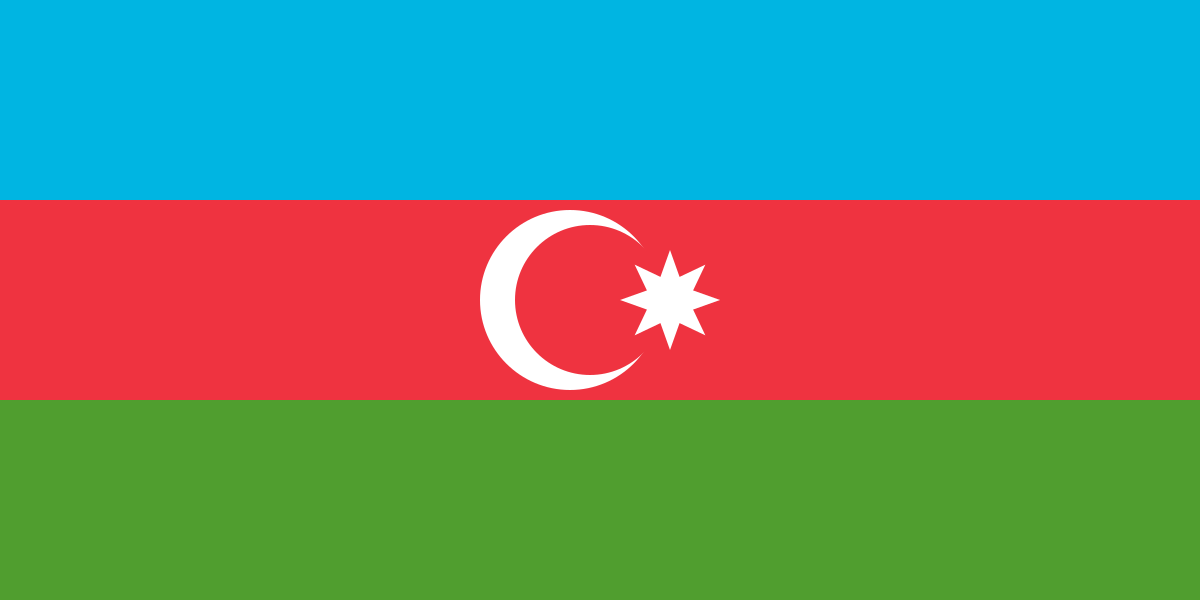
A Soviet and Azerbaijani party and state official who rose through the construction sector to become First Secretary of the Baku City Party Committee in 1983. In February 1988, as buses carrying Azerbaijani refugees expelled from Armenia converged on Baku, he ordered the city's access roads blocked; the measure kept violence out of Baku but diverted the bus convoys to Sumgait, where the pogrom erupted days later. After the dissolution of the USSR, he served as the first president of independent Azerbaijan's football association (1992–2003), steering the country into UEFA and FIFA membership.
Career timeline
1975–1977First Deputy Minister of Rural Construction, Azerbaijan SSR
1977–1981First Deputy Chairman, State Planning Committee, Azerbaijan SSR
1981Deputy Chairman, Council of Ministers, Azerbaijan SSR
1981–1983Secretary for Construction, Central Committee, Communist Party of Azerbaijan
1983–1988First Secretary, Baku City Party Committee
1989–1990Chairman, State Committee for Industrial Safety and Mining Supervision
1990–1991Secretary for Industry, Central Committee, Communist Party of Azerbaijan
1992–2003President, Association of Football Federations of Azerbaijan (AFFA)
The last Soviet leader caught between a renewed union and independence
He supported a new union treaty from the view that the federation should exist for the republics.
Ayaz Mutalibov was a politician who rose from the Soviet Azerbaijani bureaucracy to become the republic’s last Communist leader and its first president. At the 1991 Novo-Ogaryovo 9+1 talks, he supported a renewed union that would guarantee republican sovereignty, arguing that the federation should exist for the republics, and he took an active position on the status of autonomous republics. His government confronted the Nagorno-Karabakh war and mounting domestic struggles, which ultimately destroyed its political base. Ousted in 1992, he lived in exile in Moscow, returned to Azerbaijan in 2012, and died in Baku in 2022.
Career timeline
1964–1977Director of the Baku Refrigerator Factory, then general director of a state industrial combine
1977–1979Second secretary of the Narimanov District Party Committee in Baku
1979–1982Minister of Local Industry of the Azerbaijan SSR
1982–1989Chairman of the State Planning Committee and deputy chairman of the Council of Ministers of the Azerbaijan SSR
1989–1990Chairman of the Council of Ministers of the Azerbaijan SSR
1990–1991First secretary of the Azerbaijan Communist Party and president of Soviet Azerbaijan
1991–1992First president of Azerbaijan
1992–2012Exile in Moscow after his ouster, followed by a return in 2012
The highest-ranking KGB officer to defect, and the key source on the 1983 war scare
My colleagues in the PR Line regarded RYAN with some skepticism, yet none wanted to lose face at the Centre by contradicting the First Chief Directorate's assessment.
The highest-ranking KGB officer ever to defect to the West, a colonel of the First Chief Directorate who for eleven years from 1974 doubled as MI6 agent "Ovation". As London rezident he was the key source who relayed Operation RYAN and the Soviet leadership's alarm over Able Archer 83 to British and American intelligence, testimony widely credited with easing the nuclear danger of 1983. Betrayed by CIA mole Aldrich Ames, he was recalled to Moscow, drugged and interrogated, then smuggled out in the boot of a diplomatic car in 1985 and sentenced to death in absentia for treason.
Career timeline
1962Graduated MGIMO, joined Directorate S (illegals), First Chief Directorate
The Deputy Prosecutor General whose TV broadcast lit the fuse of the Sumgait pogrom
On 27 February 1988, on Central Television, he named the two youths killed in the Askeran clash as Azerbaijanis; that night the Sumgait pogrom erupted.
A Soviet military jurist of Belorussian birth, Alexander Katusev was appointed Deputy Prosecutor General of the USSR in 1987 and led high-profile corruption investigations in Uzbekistan. His name entered history on 27 February 1988, when he appeared on Central Television and named two Azerbaijani youths killed in a clash near Askeran, specifying their nationality; the broadcast became the immediate spark for the Sumgait pogrom that evening. As Chief Military Prosecutor (1989–1991), he investigated and debunked the Panfilov Twenty-Eight myth in his essay 'Another's Fame,' but was forced into retirement after the August coup.
Career timeline
1950sGraduated Dneprodzerzhinsk Metallurgical School, worker at Dnieper Metallurgical Combine
1965Graduated Kharkov Law Institute
1966Investigator, garrison procuracy, Transbaikal Military District
c. 1970s–1987Investigator, senior investigator, head of investigation departments, chief of Main Investigation Directorate, USSR Procuracy
1987–1989Deputy Prosecutor General of the USSR
1989–1991Chief Military Prosecutor and Deputy Prosecutor General of the USSR
The Georgian First Secretary who asked Moscow for troops, then resigned after 21 died
Patiashvili later recalled: 'Gorbachev phoned and said, in a tone that left no room for argument: The square must be cleared immediately, and the army will handle it. I understood he knew about the plan and supported it.'
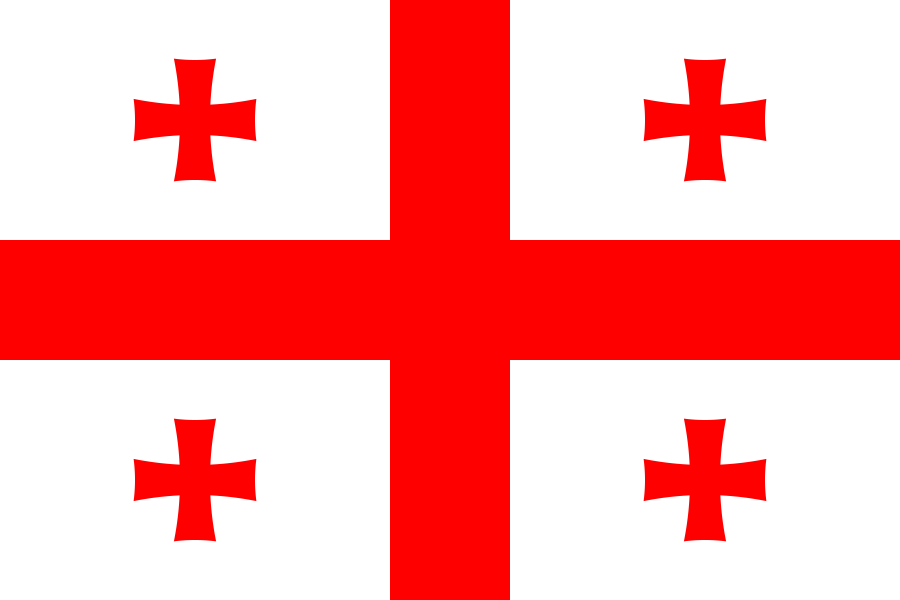
He succeeded Shevardnadze as First Secretary of the Georgian Communist Party in 1985, but dismantled most of his predecessor's reform experiments and drove the opposition underground. In April 1989, facing independence protests sparked by the Abkhaz autonomy dispute, he asked Moscow to send troops and on 8 April convened the republic's Defence Council, which decided to disperse the demonstrators by force. Before dawn the next day, Soviet troops armed with sapper shovels and poison gas descended on unarmed civilians, killing 21; Patiashvili accepted responsibility and resigned within two weeks. He remained in Georgian politics, twice ran for president against Shevardnadze, and supported the 2003 Rose Revolution, though he later criticized Saakashvili.
Career timeline
1965–1973Komsomol posts in Georgia, rising to First Secretary
1973–1974First Secretary, Gori District Party Committee
1974–1985Secretary for Agriculture, CP of Georgia
1985–1989.4First Secretary, CP of Georgia
1989–1991Director, scientific-production association and research institute
1995, 2000Presidential candidate, runner-up to Shevardnadze
The naval officer who mutinied for Leninist principles against the Brezhnev regime
In his final letter to his son before execution: "Be strong and believe that life is beautiful. Be positive and believe that the Revolution always wins."
A Soviet Navy captain 3rd rank and political officer (zampolit) who, in November 1975, led a mutiny aboard the anti-submarine frigate Storozhevoy. Denouncing the corruption and stagnation of the Brezhnev era, Sablin aimed to sail from Riga to Leningrad and broadcast a call for a return to Leninist principles and a new communist revolution. The mutiny was crushed by Soviet air attacks before reaching its goal. Sablin was convicted of treason and executed by firing squad. His action, one of the most dramatic acts of Leninist dissent from within the late Soviet military, later inspired Tom Clancy's The Hunt for Red October.
Career timeline
1939Born in Leningrad, son of a naval officer
1956–1960Attended M.V. Frunze Higher Naval School, graduated with distinction and joined CPSU
1960–1969Served as officer aboard destroyers and patrol ships in Northern and Black Sea Fleets
1963Sent letter to Khrushchev criticizing party corruption, reprimanded by Murmansk Party Committee
1969–1973Studied at V.I. Lenin Military-Political Academy, graduated with distinction
1973Assigned as zampolit of Baltic Fleet frigate Storozhevoy
1975.11.8–9Led Storozhevoy mutiny, sailing toward Leningrad; suppressed by Soviet air attacks
1976.7Sentenced to death for treason by Military Collegium of USSR Supreme Court
1976.8.3Executed by firing squad at Lefortovo Prison
1994Military Collegium of Russian Supreme Court partially rehabilitated, commuting treason to military offences
The highest-ranking general who sided with Yeltsin during the August coup, commanding the White House defense
"The army will not go against the people" (at a press conference during the August 1991 coup)
As chief of the Soviet Signal Troops and Deputy Chief of the General Staff, he also took part in the Chernobyl disaster response. During the August 1991 coup, he was the highest-ranking active-duty general to break with the State Committee for the State of Emergency (GKChP) and side with Boris Yeltsin, organizing the White House defense headquarters in Moscow; he was appointed RSFSR Defence Minister on 20 August and promoted to Army General on 24 August. In an ironic turn, he helped storm the same White House he had defended during the October 1993 constitutional crisis, and in 1997 was arrested and convicted on corruption charges.
Career timeline
1986Participates in Chernobyl disaster response
1987–1991Chief of Signal Troops, USSR Ministry of Defence / Deputy Chief of General Staff
1990Elected RSFSR People's Deputy
1991.01Chairman, RSFSR State Committee for Defense and Security
1991.08.20Appointed RSFSR Defence Minister; promoted to Army General on 24 August
1993–1997Deputy Minister of Defence, Russian Federation
Soviet Air Defence Forces lieutenant colonel who correctly dismissed the Oko false alarm and prevented nuclear war
The siren howled, but I just sat there for a few seconds, staring at the big, back-lit, red screen with the word 'launch' on it.
A Soviet Air Defence Forces lieutenant colonel. On 26 September 1983, while on duty at the Serpukhov-15 early-warning command centre, the Oko satellite system reported five US ICBMs had been launched, but Petrov judged that a first strike would involve hundreds of missiles, not five, and ground radar showed no confirmation, so he reported a system malfunction rather than an incoming attack. His decision prevented what could have become a Soviet retaliatory nuclear strike and earned him the title 'the man who saved the world.' He received neither disgrace nor reward for his actions, retired early in 1984, and lived in obscurity in a Moscow suburb until his death from pneumonia in 2017.
Career timeline
1957Entered Kiev Radio-Technical School of the Air Defence Forces
1957–1967Served in Air Defence Forces, radar system maintenance
1967–1972Studied at Kiev Higher Engineering Radio-Technical College
1973Assigned to Serpukhov-15 early-warning command centre
1983.09.26Dismissed Oko false alarm, prevented retaliatory nuclear strike
1984Retired as lieutenant colonel
1984–1990sWorked at the institute that developed the early-warning system
The last Soviet Chief of General Staff, undone by the August coup
On 22 August 1991, with the GKChP coup collapsing and Yazov under arrest, Moiseyev became acting Soviet Defence Minister for a single day. The next day, he too was dismissed.
The last Chief of the General Staff of the Soviet Armed Forces (1988–1991). A protégé of Dmitry Yazov who rose through the Far Eastern Military District to the military's second-highest post, Moiseyev directed the Afghanistan withdrawal and took part in arms control negotiations, but backed Yazov in the August 1991 coup and was dismissed after its collapse.
Career timeline
1958–1962Military service, graduated Far Eastern Tank School
1962–1972Tank platoon & company commander, GSFG & Carpathian MD
1972–1980Tank regiment commander, CO 50th & 27th Guards MRDs
1982–1985Deputy commander, then commander, 15th Army, Far Eastern MD
1985–1987Chief of Staff & 1st Deputy Commander, Far Eastern MD
1987–1988Commander, Far Eastern Military District
1988–1991Chief of the General Staff & 1st Deputy Minister of Defence
1991.8.22–23Acting Minister of Defence of the USSR
A Moscow party organizer at the Soviet Union's end
His life, he later recalled, was divided into a before and after the Communist Party ban.
Yuri Prokofyev was a Soviet party cadre who rose through Moscow's party and administrative organizations. As first secretary of the Moscow City Party Committee, he worked at the point where reform collided with the party's disintegration, and joined the Politburo in 1990. He was involved in the activity of the State Committee on the State of Emergency in 1991 without being a member, then turned to memoir writing and technology enterprises after the Soviet Union and the Communist Party were banned.
Career timeline
1957Pioneer leader at a Moscow school
1960Joined the Communist Party of the Soviet Union
1968Cadre in the Moscow City Party Committee's organizational work
1977–1985Secretary and first secretary of the Kuibyshev District Party Committee in Moscow
1986–1988Secretary of the Moscow City Executive Committee
1988–1989Secretary and second secretary of the Moscow City Party Committee
1989–1991First secretary of the Moscow City Party Committee
1990–1991Member of the CPSU Central Committee and Politburo
A Turkmen leader who turned late-Soviet rule into personal rule over an independent state
At the 1991 9+1 meetings, he weighed a reworked union against preserving Turkmenistan’s autonomy.
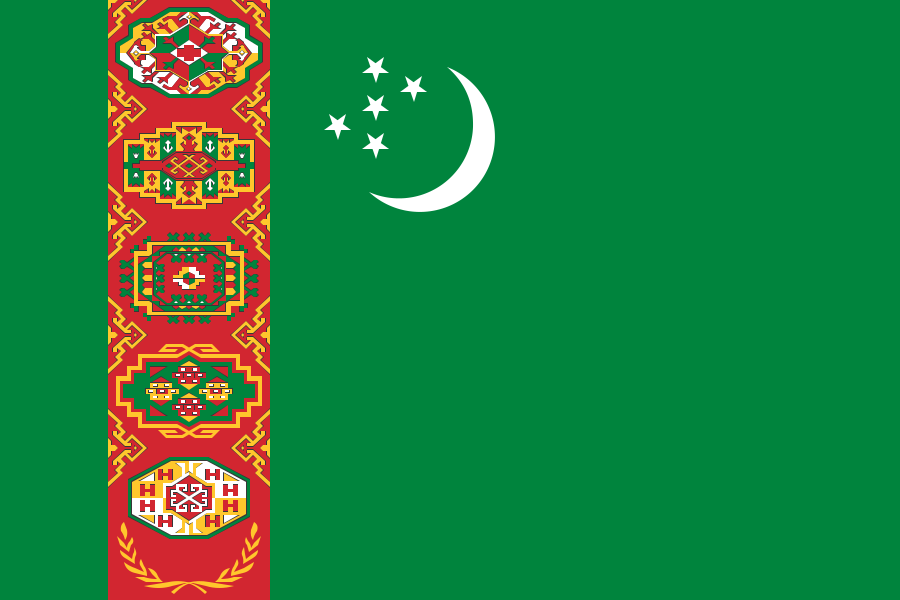
Saparmurat Niyazov was the Soviet-era party and government leader who became independent Turkmenistan’s first president. He led the Turkmen delegation in the 9+1 meetings during the 1991 New Union Treaty process, while the republic’s guarded autonomy limited his role in the negotiations themselves. After independence he invoked neutrality and state sovereignty while concentrating power in the presidency and using the Ruhnama and an extensive personality cult to organize public life. His rule remains a case of post-Soviet state formation fused with authoritarian consolidation.
Career timeline
1962Joined the Communist Party of the Soviet Union
1970–1980Cadre in the Communist Party of Turkmenistan Central Committee
1980–1984First Secretary of the Ashgabat City Party Committee
1985Chairman of the Council of Ministers of the Turkmen SSR
1985–1991First Secretary of the Communist Party of Turkmenistan
1990–1991Chairman of the Supreme Soviet of the Turkmen SSR
1990–2006President of Turkmenistan
1991Head of Turkmenistan’s delegation at the 9+1 New Union Treaty meetings
Ideology secretary of the pro-Moscow Lithuanian Communist Party who proclaimed the 'National Salvation Committee' in the Vilnius crackdown
On 13 January 1991, his recorded voice boomed from the loudspeakers of Soviet BMPs advancing on the Vilnius TV tower: 'Brother Lithuanians! The nationalist and separatist government, which confronted the people, has been overthrown!'
A farmer's son from southern Lithuania, Jermalavičius studied at Vilnius University and the Leningrad Higher Party School, then spent two decades as a researcher at the Party History Institute, publishing on atheism and religion. In 1990 he became ideology secretary of the pro-Moscow Lithuanian Communist Party (CPSU platform), fiercely opposing independence, and on 11 January 1991 he announced the creation of the 'National Salvation Committee of the Lithuanian SSR', which claimed to be the sole legitimate government, providing the political pretext for the Soviet military operation that killed 14 civilians two days later. Convicted in 1999 of anti-state organization and incitement to violently overthrow the government, he served eight years, then moved to Russia where he continued writing in defence of the Soviet system until his death.
Career timeline
1962Joined the CPSU
1970–1990Researcher, Institute of Party History, CPL CC
1990–1991Head of Ideological Department, CC, CPL (CPSU platform)
1994–2002Imprisoned for anti-state activities (8-year sentence)
2002–2012Professor, RSSU; Deputy Chairman, UCP-CPSU Council
An Estonian communist leader who chose to preserve the Soviet Union
In 1991, as Estonian independence approached, he joined the Politburo while backing the Soviet Union.
Lembit Annus was a Moscow-aligned Estonian communist leader who stood at the centre of the late Soviet conflict over national independence and preserving the Union. From December 1990 until the party was banned in August 1991, he was First Secretary of the Communist Party of Estonia on the CPSU platform, and in 1991 he joined the CPSU Politburo. After the party's dissolution, he remained active in communist politics as a Pravda correspondent and Tallinn municipal councillor.
Career timeline
1941Born in Kohtla-Järve, Estonian SSR
1963Joined the Communist Party of the Soviet Union
1983–1989Editor-in-chief of Eesti Kommunist
1990First Secretary of the Kalinin District Committee of the Communist Party of Estonia
1990–1991First Secretary of the Communist Party of Estonia on the CPSU platform
1991Member of the CPSU Politburo
1991–1999Estonia correspondent for Pravda and Tallinn City Council member
In his diploma performance as Hitler, Gubenko poured all his hatred for the man who killed his parents into the role. Lyubimov saw it and immediately brought him to the Taganka Theatre.
An actor and film director who rose from war orphan to People's Artist of the RSFSR. He was the first working arts professional to become Soviet Minister of Culture (1989–1991) since Anatoly Lunacharsky. After the USSR collapsed, he entered left-wing politics, serving as chair of the Duma's Culture Committee and deputy speaker of the Moscow City Duma, where he defended Soviet cultural heritage. Following the Taganka Theatre split, he founded and led the Sodruzhestvo Aktyorov Taganki until his death in 2020.
The air-defense general who ordered KAL 007 shot down, later commander-in-chief of the Russian Air Force
"I will always be convinced that I gave the right order": Kornukov on the KAL 007 shootdown.
Born the son of a Donetsk miner in the Ukrainian SSR, Anatoly Kornukov rose through the Soviet air-defence forces to become the general who, on 1 September 1983, ordered the shootdown of Korean Air Lines Flight 007 as it crossed Sakhalin. When his superiors refused to take responsibility, he directed the interceptor pilot Major Osipovich to destroy the target on his own authority, maintaining to his death that the order was justified under Soviet and international law. Neither rewarded nor punished for the incident, he kept rising and in 1998 became the first commander-in-chief of the unified Russian Air Force. The decision cost 269 civilian lives, and he later declared he would 'always be convinced that I gave the right order.'
Career timeline
1959Joined the Soviet armed forces, entered flight school
1964Qualified as fighter pilot, posted to 54th Guards Fighter Regiment
The last Soviet defence minister and final Marshal of Aviation
On 25 December 1991, as Gorbachev's nuclear briefcase was transferred to Yeltsin, Shaposhnikov told the press: "The nuclear button is in reliable hands."
A career officer who rose from fighter pilot to Commander-in-Chief of the Soviet Air Force over three decades, Shaposhnikov played a decisive role in the August 1991 coup when, as air force chief, he proposed to Defence Minister Yazov that troops be withdrawn from Moscow and the Emergency Committee be dissolved. After the coup's collapse Gorbachev appointed him the Soviet Union's last Defence Minister, and on 26 August 1991 he was promoted Marshal of Aviation, the final person in Soviet history to receive a rank bearing the word 'marshal.' He oversaw the transfer of nuclear command from Gorbachev to Yeltsin, served as CIS Joint Armed Forces Commander-in-Chief and later as Secretary of Russia's Security Council, before heading Aeroflot and advising Sukhoi.
Career timeline
1963Graduates Kharkov Higher Military Aviation School, commissioned as fighter pilot
1969Graduates Gagarin Air Force Academy
1985–1987Commander, Air Forces of the Odessa Military District
1987–1988Commander, Air Forces of the Group of Soviet Forces in Germany
1990–1991Commander-in-Chief of the Soviet Air Force and Deputy Minister of Defence
1991.8–1992.2Minister of Defence of the USSR (last)
The Soviet air force general who personally led 1,927 helicopter drops over the burning Chernobyl reactor
"Tons of graphite were burning inside the reactor. Firefighters were powerless. We decided to extinguish the hearth from helicopters."
Born to a Mokshan peasant family and trained at the Orenburg military aviation school, he flew reconnaissance missions in the 1968 Czechoslovakia invasion, the 1969 Sino-Soviet border conflict, and over Afghanistan in 1979. As chief of staff of the Kyiv Military District Air Force, he received the call about the Chernobyl explosion on 26 April 1986, flew immediately to the site, and for ten days led helicopter crews dumping 4,925 tons of sand, lead, and boron into the burning reactor from 200 metres, personally flying over the crater. He continued serving until 1998 despite radiation exposure, then spent his final years as a United Russia deputy in the State Duma.
Career timeline
1965–1970Pilot and flight commander, reconnaissance aviation regiment
1973–1979Squadron commander then reconnaissance regiment commander, Odessa and Turkestan Military Districts
1980–1983Commander of Air Force, 20th Guards Army; then Central Group of Forces
1985–1988Chief of staff, Kyiv Military District Air Force; leads Chernobyl aerial operation
1988–1989Commander of Air Force, Central Asian Military District
1989–1993Commander of Air Force, Moscow Military District
1993–1997Commander of Frontal Aviation, Russian Air Force
2014–2021Deputy, State Duma of the Russian Federation (United Russia)
The engineer who became the first person in Soviet history to run against a sitting General Secretary
At the First Congress in May 1989, he stood before the microphone and offered himself as a candidate against Gorbachev. 'To set a precedent,' he said. By 1,415 to 689, the assembly voted to keep his name off the ballot.
Born in Oryol in 1943, Obolensky was a geophysical engineer who spent twenty years at the Polar Geophysical Institute on the Kola Peninsula, where in 1987 he founded the first informal reform group in the region, the Voluntary Society for Assistance to Perestroika. Elected a People's Deputy of the USSR in 1989, he made history at the First Congress by putting forward his own candidacy for Chairman of the Supreme Soviet against Mikhail Gorbachev: the first alternative candidacy against a sitting General Secretary in Soviet history. After the August 1991 coup attempt, he was elected chairman of the parliamentary commission investigating it, and he opposed the dissolution of the USSR, regarding the Belovezha Accords as unconstitutional.
Career timeline
1960–1965Lathe operator in Oryol; Soviet Army service in East Germany
1971Graduated Leningrad Mining Institute, geophysical engineering
1971–1992Engineer and design engineer, Polar Geophysical Institute, Kola Science Centre
1987–1989Founded and chaired the Voluntary Society for Assistance to Perestroika (DOSP) in Apatity
1989–1992People's Deputy of the USSR (Leningrad Rural District No. 20)
1990–1994Co-chairman, later chairman, Social Democratic Party of Russia (SDPR)
1991Chairman, Parliamentary Commission investigating the August coup attempt
1993–1996President and editor-in-chief, TeleRadioCorporation Vostok, Oryol