First prime minister of the Kampuchean People's Revolutionary Party
Removed and arrested on 2 December 1981, he formally held the posts of prime minister and party general secretary until 5 December, when Heng Samrin became general secretary and Chan Sy acting prime minister.
A Cambodian politician who broke with the Khmer Rouge and cooperated with Vietnam. One of the founding leaders of the Kampuchean United Front for National Salvation in 1978, he led the building of party and administrative structures as the People's Revolutionary Party's general secretary after the 1979 regime change. He became prime minister in June 1981 but was removed and arrested under Vietnamese pressure that December and was held until 1992.
Career timeline
1950Joined the Khmer Issarak guerrilla struggle
1978Founding leader of the Kampuchean United Front for National Salvation
1979–1981General Secretary of the Kampuchean People's Revolutionary Party
1981.6.27–12.5Prime Minister of the People's Republic of Kampuchea
1981–1992Detained in Vietnam
2007Vice President of the Human Rights Party
2013–2016National Assembly member for Kampong Speu (Cambodia National Rescue Party)
Belarus's first prime minister; co-signed the Belovezh Accords and later testified the Russian delegation alone arrived with a plan
'Neither I, nor Shushkevich, nor Kravchuk, nor Fokin knew such a document would be prepared and signed': Kebich insisted only the Russian delegation arrived with a plan for the Belovezh Accords.
A mechanical engineer from the Belarusian Polytechnic Institute, he rose through Minsk factories into the Belarusian Communist Party apparatus and became Chairman of the BSSR Council of Ministers in 1990. In December 1991 he co-signed the Belovezh Accords alongside Shushkevich, formally dissolving the USSR; he later testified that the Russian delegation alone arrived with a prepared plan while the Belarusian and Ukrainian sides did not know such a document would be drafted, revealing the tension between spontaneity and premeditation at the meeting. He lost the 1994 presidential election overwhelmingly to Alexander Lukashenko and thereafter served as a parliamentary deputy supporting Lukashenko's pro-Russian and constitutional-revision agenda.
Career timeline
1958Graduated, Engineering Faculty, Belarusian Polytechnic Institute
1958–1973Engineer to deputy chief engineer, Minsk Automatic Lines Plant
1973–1980Chief engineer, director, then general director, Minsk Kirov Machine-Tool Plant
1980–1985Second Secretary, Minsk City Committee; department head, CC CPB; Second Secretary, Minsk Oblast Committee
1985–1990Deputy Chairman, BSSR Council of Ministers and Chairman, Gosplan BSSR
1990–1994Chairman, BSSR Council of Ministers / Prime Minister of Belarus
1996–2004Deputy, House of Representatives of Belarus
“The socialist revolution is the only choice possible for us in order to achieve rapid economic and cultural development in an autonomous, humane, and harmonious manner.”
Madagascar’s leader from 1975. His socialist charter and Second Republic promoted nationalization, planned investment and economic decolonization. Debt and weak production led to market-oriented adjustments in the 1980s amid political opposition.
Career timeline
1962Graduated from the French naval academy; commissioned as a naval officer
1972–1975Foreign minister under Ramanantsoa; renegotiated Franco-Malagasy agreements, left the CFA franc zone
1975Became head of state as chair of the Supreme Revolutionary Council
1975Elected president by referendum; established the Second Republic
1976Founded the ruling party AREMA; became its secretary-general
1982 / 1989Re-elected president
1991Signed the Panorama Convention, ceding most powers while remaining president
1993Lost the multiparty election to Albert Zafy; left office
1997Re-elected president; returned to office
2002Fled into exile in July after the disputed election
2003Sentenced in absentia to ten years' hard labor for embezzlement
Moscow's first elected mayor, who told the U.S. ambassador of the coming coup
On 20 June 1991 Popov handed U.S. Ambassador Jack Matlock a note warning of a coup and naming Pavlov, Kryuchkov, Yazov and Lukyanov; the warning reached Gorbachev via Washington, though Matlock later wrote in his memoirs that it may have been a false alarm.
Born in Moscow on 31 October 1936 to parents from the Azov Greek community, he graduated from Moscow State University's economics faculty, became a candidate of economic sciences in 1963, a doctor in 1970 and a professor in 1971. He headed the production management laboratory in 1967–1971 and the management department in 1971–1988, and served as dean of the economics faculty (sources differ on a 1977 or 1978 start), then edited Voprosy Ekonomiki in 1988–1990, popularizing the concept of the 'command-administrative system'. Elected a USSR People's Deputy in 1989, he co-chaired the Interregional Deputies Group with Sakharov, Yeltsin and others, chaired the Moscow City Council from 1990 and on 12 June 1991 became Moscow's first elected mayor with 65.3% of the vote.
Career timeline
1957, 1960–61Secretary of the Komsomol committee, Moscow State University
1959–71MSU economics faculty: graduate student → docent → head of management laboratory
1971–88Head of the management department, MSU economics faculty
1978–80Dean of the economics faculty, Moscow State University
At a Derg meeting he vowed of the aristocrats who called dark-skinned, kinky-haired people slave "Barias": "I shall soon make these ignoramuses stoop and grind corn!"
A leader of Ethiopia’s Derg, the military committee emerging from the 1974 revolution. He consolidated predominance after the 1977 power struggle and led military and party-state institutions. Land reform and state-led development proceeded amid political repression and prolonged war.
Career timeline
1957Graduated Holetta Military Academy, commissioned second lieutenant
1974Derg member (Third Division representative)
1974–1977Deputy chairman of the Derg
1977–1987Chairman of the Derg, head of the military regime
1984–1991General Secretary, Workers' Party of Ethiopia
1987–1991President, People's Democratic Republic of Ethiopia
A field enforcer of the Soviet Union's final crisis
After Black January, he personally led the Nagorno-Karabakh Organizing Committee as Moscow's man on the ground.
Viktor Polyanichko was a Soviet party organizer and political adviser who carried Moscow's policy into local power structures in Afghanistan and the South Caucasus. As Second Secretary of the Azerbaijan Communist Party, he sought to restore Baku's authority after Black January and led the Nagorno-Karabakh Organizing Committee, combining party administration with coercive force. He is remembered both as an attempted broker in a collapsing federation and as Moscow's hard-line intermediary in a conflict that deepened beyond Soviet control. After the Soviet Union's collapse he became head of an interim administration at deputy-prime-minister rank in Russia, and was assassinated in North Ossetia in 1993.
Career timeline
1959–1964First Secretary, Orsk City Komsomol Committee
Constitutional Assembly chairman and first elected mayor of Saint Petersburg
"Volodya, just don't turn to bronze" — last words to Putin, February 2000
Anatoly Sobchak was a legal scholar and democratic reformer who became the first democratically elected mayor of Saint Petersburg (1991–1996) and co-authored the 1993 Constitution of the Russian Federation as chairman of the Constitutional Assembly. A popular Leningrad State University law professor whose students included Vladimir Putin and Dmitry Medvedev, he was elected to the Congress of People's Deputies in 1989 and co-chaired the Inter-Regional Deputies Group alongside Andrei Sakharov and Boris Yeltsin. During the August 1991 coup he organized resistance in Leningrad, negotiating with the military commander to keep troops off the streets and rallying 200,000 citizens on Palace Square. Corruption allegations forced him into exile in Paris from 1997 until Putin, then prime minister, secured his return in 1999.
Career timeline
1989–1990USSR People's Deputy
1989–1990Co-chair, Inter-Regional Deputies Group (with Sakharov & Yeltsin)
The last Soviet premier and an August coup participant
Eight days after taking office, on the evening of 22 January 1991, Pavlov ordered 50- and 100-ruble notes exchanged for new bills within three days, with only 1,000 rubles per person swapped immediately. Days earlier he had publicly promised that no monetary reform would take place.
He graduated from the Moscow Finance Institute in 1958 and worked in the finance ministries of the RSFSR and the USSR, joining the CPSU in 1962 and heading Gosplan's finance, cost and price department from 1979 to 1986. He chaired the USSR State Committee on Prices from 1986 to 1989 and served as Minister of Finance until 14 January 1991, when Gorbachev appointed him premier as the Council of Ministers became the Cabinet of Ministers and its head was retitled Prime Minister. In August 1991 he was one of the organizers of the State Committee on the State of Emergency; on 22 August Gorbachev relieved him of the premiership, and he was arrested on 23 August and held at Matrosskaya Tishina prison, with the Supreme Soviet confirming his resignation on 28 August.
First and only Vice President of the USSR and the face of the August 1991 coup
To KGB chairman Kryuchkov during the August 1991 coup: 'Understand my character—if even one person dies, I won't be able to live.'
After serving as First Secretary of the Gorky Oblast Komsomol and chairman of the USSR Committee of Youth Organizations (1968–1980), Yanayev became VTsSPS chairman, a Politburo member and CC Secretary in 1990. That December Gorbachev forced through his election as the USSR's first vice president. In August 1991, as the face of the GKChP, he declared himself acting president citing Gorbachev's 'illness'. The coup failed within three days and he was arrested. Amnestied in 1994, he published the memoir Last Battle for the USSR and spent his remaining years in academia.
Career timeline
1959–1963Mechanised-agriculture detachment chief → Selkhoztekhnika branch manager, Gorky Oblast
1966–1968First Secretary, Gorky Oblast Komsomol
1968–1980Chairman, USSR Committee of Youth Organizations
An authoritarian state-builder who made sovereignty his political principle
Uzbekistan voted to remain in the Union in 1991, yet Karimov declared independence later that same year.
Islam Karimov was a politician who moved from economic administration in the Soviet system to become Uzbekistan’s first president. During the negotiations over the Union’s future, he placed Uzbekistan’s sovereignty and freedom of choice above preserving a common Soviet state, and after independence made that principle central to state-building. His government pursued industrial capacity and political consolidation, but hardened into authoritarian rule that restricted opposition and the press and responded harshly to Islamist movements and mass protest. Karimov is therefore remembered both as the founder of a sovereign post-Soviet Central Asian state and as a ruler who sacrificed political pluralism to preserve it.
Career timeline
1960–1966Mechanical engineer in Tashkent machinery and aircraft production
1966–1983Economic official in the Uzbek SSR State Planning Committee
1983–1986Minister of Finance of the Uzbek SSR
1986Chairman of the Uzbek SSR State Planning Committee and deputy chairman of its Council of Ministers
1986–1989First secretary of the Communist Party committee in Kashkadarya Region
1989–1991First secretary of the Central Committee of the Communist Party of Uzbekistan
1990–1991President of the Uzbek SSR
1991–2016First President of Uzbekistan
1991–1996Chairman of the People’s Democratic Party of Uzbekistan
The last Soviet leader caught between a renewed union and independence
He supported a new union treaty from the view that the federation should exist for the republics.
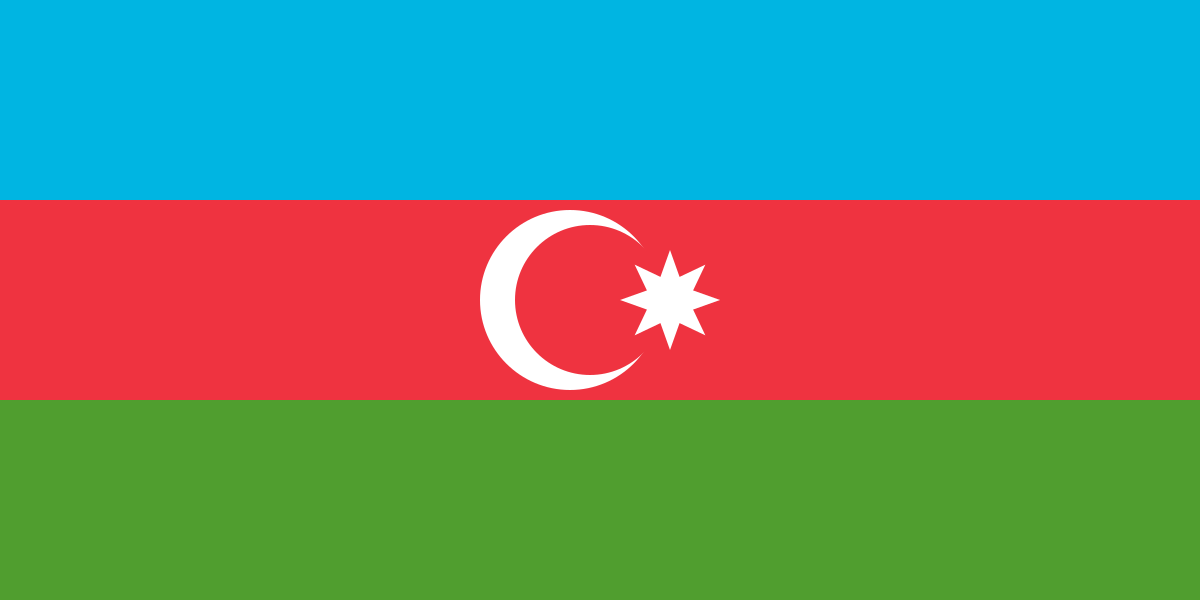
Ayaz Mutalibov was a politician who rose from the Soviet Azerbaijani bureaucracy to become the republic’s last Communist leader and its first president. At the 1991 Novo-Ogaryovo 9+1 talks, he supported a renewed union that would guarantee republican sovereignty, arguing that the federation should exist for the republics, and he took an active position on the status of autonomous republics. His government confronted the Nagorno-Karabakh war and mounting domestic struggles, which ultimately destroyed its political base. Ousted in 1992, he lived in exile in Moscow, returned to Azerbaijan in 2012, and died in Baku in 2022.
Career timeline
1964–1977Director of the Baku Refrigerator Factory, then general director of a state industrial combine
1977–1979Second secretary of the Narimanov District Party Committee in Baku
1979–1982Minister of Local Industry of the Azerbaijan SSR
1982–1989Chairman of the State Planning Committee and deputy chairman of the Council of Ministers of the Azerbaijan SSR
1989–1990Chairman of the Council of Ministers of the Azerbaijan SSR
1990–1991First secretary of the Azerbaijan Communist Party and president of Soviet Azerbaijan
1991–1992First president of Azerbaijan
1992–2012Exile in Moscow after his ouster, followed by a return in 2012
South Yemen's last head of state and the united republic's first prime minister
When the January 1986 gunfire broke out he was visiting India; he then negotiated a settlement in the USSR before returning to take the presidency.
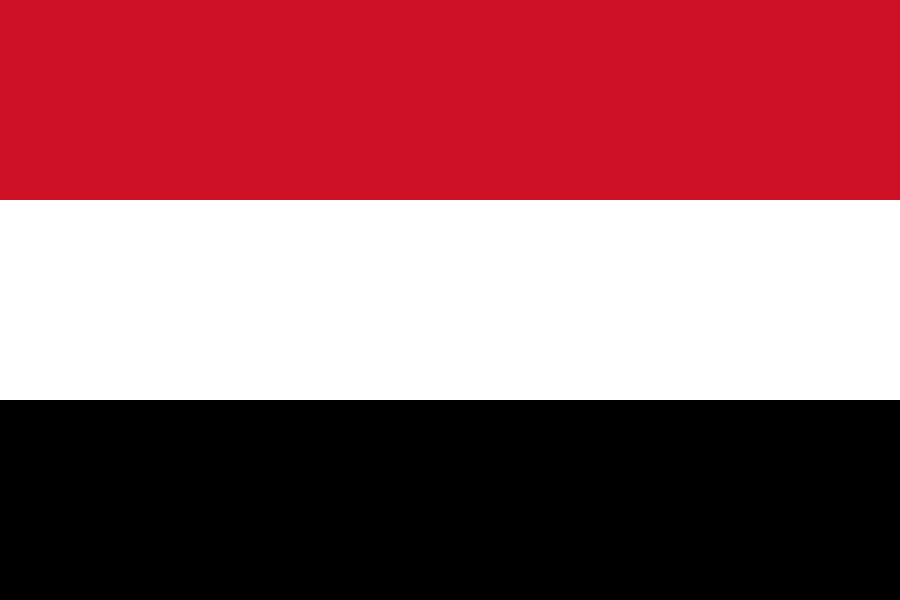
A Hadhrami electrical engineer who rose through the National Liberation Front to become a minister and prime minister of South Yemen. After the January 1986 Aden fighting, he became president and steadied the state; as South Yemen's last head of state he led the 1990 unification and became the first prime minister of united Yemen. In the 1994 civil war he served as premier of the breakaway southern government, then went into exile.
Career timeline
1960Joined the Arab Nationalist Movement
1963Joined the National Liberation Front (NLF)
1969–1978Minister of Public Works, Transport and Construction
1985–1986Prime Minister of the People's Democratic Republic of Yemen
1986–1990Chairman of the Presidium of the Supreme People's Council (head of state)
1990–1994First prime minister of the united Republic of Yemen
1994Prime minister of the secessionist Democratic Republic of Yemen
1994–2003In exile in Jordan, the UAE and Saudi Arabia
"Peace and stability in the SADC region are essential preconditions for our economic development and integration"
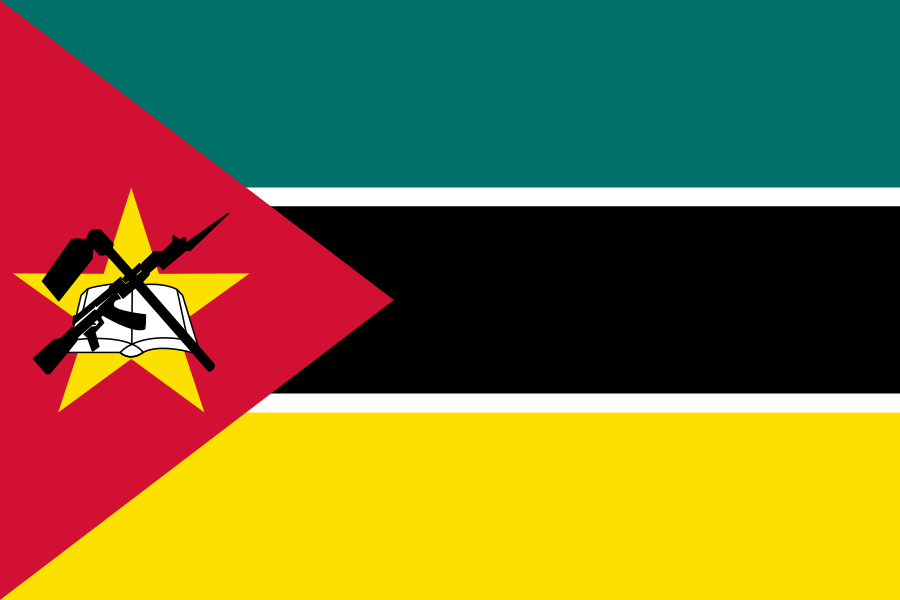
A FRELIMO leader and post-independence foreign minister, he succeeded Machel as president in 1986. He pursued the 1987 Economic Rehabilitation Program and later multiparty transition. The 1992 peace agreement marked a major turning point in ending war and rebuilding the economy.
Career timeline
1962Co-founded FRELIMO
1974Played a key role in negotiating the Lusaka Accord
1975Appointed Minister of Foreign Affairs
1986Became President and FRELIMO leader after Machel's death
The Georgian First Secretary who asked Moscow for troops, then resigned after 21 died
Patiashvili later recalled: 'Gorbachev phoned and said, in a tone that left no room for argument: The square must be cleared immediately, and the army will handle it. I understood he knew about the plan and supported it.'
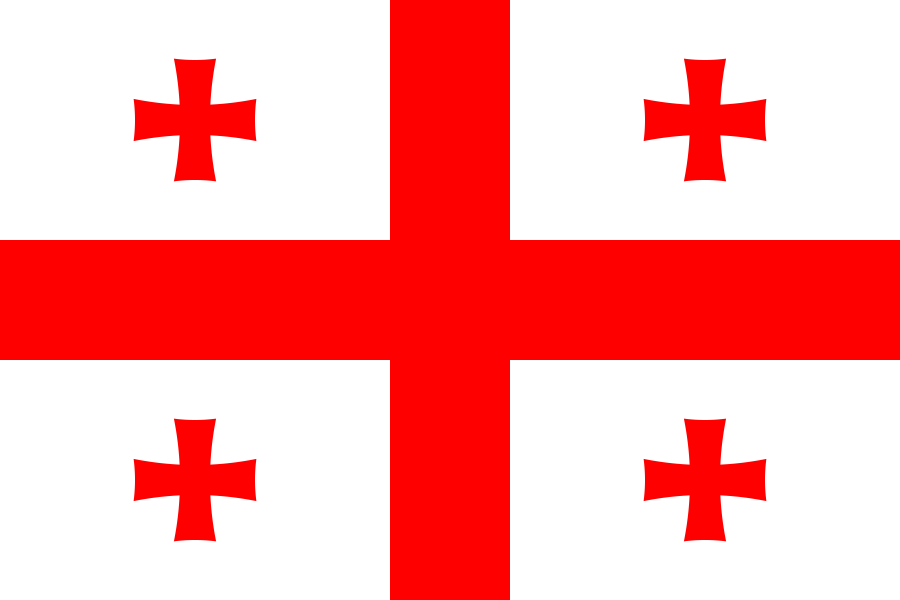
He succeeded Shevardnadze as First Secretary of the Georgian Communist Party in 1985, but dismantled most of his predecessor's reform experiments and drove the opposition underground. In April 1989, facing independence protests sparked by the Abkhaz autonomy dispute, he asked Moscow to send troops and on 8 April convened the republic's Defence Council, which decided to disperse the demonstrators by force. Before dawn the next day, Soviet troops armed with sapper shovels and poison gas descended on unarmed civilians, killing 21; Patiashvili accepted responsibility and resigned within two weeks. He remained in Georgian politics, twice ran for president against Shevardnadze, and supported the 2003 Rose Revolution, though he later criticized Saakashvili.
Career timeline
1965–1973Komsomol posts in Georgia, rising to First Secretary
1973–1974First Secretary, Gori District Party Committee
1974–1985Secretary for Agriculture, CP of Georgia
1985–1989.4First Secretary, CP of Georgia
1989–1991Director, scientific-production association and research institute
1995, 2000Presidential candidate, runner-up to Shevardnadze
A politician who moved from Soviet party leadership to Moldova's presidency
In the 1996 runoff, backed by left and centrist forces, he defeated Mircea Snegur to win the presidency.
Pyotr Luchinsky rose through the party apparatus of the Moldavian Soviet republic and became a link between late Soviet republican politics and the making of the independent Moldovan state. He became first secretary of the Communist Party of Moldova's Central Committee in 1989 and served on the CPSU Politburo from 1990 to 1991. After independence, he was ambassador to Russia and speaker of parliament before winning the 1996 presidential election and serving as Moldova's second president from 1997 to 2001. His career shows how Soviet institutional continuity and the adjustment of a new state's sovereignty and foreign orientation could converge in one politician.
Career timeline
1960–1971Instructor, department head, secretary and first secretary of the Moldavian Leninist Komsomol Central Committee
1971–1976Secretary of the Communist Party of Moldova Central Committee and member of its Politburo
1976–1978First secretary of the Communist Party's Chișinău City Committee
1978–1986Deputy chief of a department of the CPSU Central Committee
1986–1989Second secretary of the Communist Party of Tajikistan Central Committee
1989–1990First secretary of the Communist Party of Moldova Central Committee
1990–1991Secretary of the CPSU Central Committee and member of its Politburo
A Turkmen leader who turned late-Soviet rule into personal rule over an independent state
At the 1991 9+1 meetings, he weighed a reworked union against preserving Turkmenistan’s autonomy.
Saparmurat Niyazov was the Soviet-era party and government leader who became independent Turkmenistan’s first president. He led the Turkmen delegation in the 9+1 meetings during the 1991 New Union Treaty process, while the republic’s guarded autonomy limited his role in the negotiations themselves. After independence he invoked neutrality and state sovereignty while concentrating power in the presidency and using the Ruhnama and an extensive personality cult to organize public life. His rule remains a case of post-Soviet state formation fused with authoritarian consolidation.
Career timeline
1962Joined the Communist Party of the Soviet Union
1970–1980Cadre in the Communist Party of Turkmenistan Central Committee
1980–1984First Secretary of the Ashgabat City Party Committee
1985Chairman of the Council of Ministers of the Turkmen SSR
1985–1991First Secretary of the Communist Party of Turkmenistan
1990–1991Chairman of the Supreme Soviet of the Turkmen SSR
1990–2006President of Turkmenistan
1991Head of Turkmenistan’s delegation at the 9+1 New Union Treaty meetings
The Owando bishop who chaired the National Conference
The 1991 sovereign national conference declared itself sovereign, abolished the People's Republic, and adopted a Fundamental Act for the transition.
A Congolese Catholic bishop and Jesuit priest who led the dioceses of Nkayi and Owando. As one-party rule collapsed, he was elected president of the presidium of the 1991 sovereign national conference and chaired it. When the conference declared itself sovereign and abolished the People's Republic, he headed the transitional Supreme Council of the Republic (CSR), which replaced the national assembly and steered the constitutional transition.
Career timeline
1973Ordained priest in Brazzaville (Jesuit)
1983First bishop of the Diocese of Nkayi
1986–1990Apostolic administrator of Pointe-Noire
1990Bishop of Owando
1991President of the National Sovereign Conference presidium
1991Chairman of the transitional Supreme Council of the Republic (CSR)
2003–2006President of the Congolese Episcopal Conference
An Estonian communist leader who chose to preserve the Soviet Union
In 1991, as Estonian independence approached, he joined the Politburo while backing the Soviet Union.
Lembit Annus was a Moscow-aligned Estonian communist leader who stood at the centre of the late Soviet conflict over national independence and preserving the Union. From December 1990 until the party was banned in August 1991, he was First Secretary of the Communist Party of Estonia on the CPSU platform, and in 1991 he joined the CPSU Politburo. After the party's dissolution, he remained active in communist politics as a Pravda correspondent and Tallinn municipal councillor.
Career timeline
1941Born in Kohtla-Järve, Estonian SSR
1963Joined the Communist Party of the Soviet Union
1983–1989Editor-in-chief of Eesti Kommunist
1990First Secretary of the Kalinin District Committee of the Communist Party of Estonia
1990–1991First Secretary of the Communist Party of Estonia on the CPSU platform
1991Member of the CPSU Politburo
1991–1999Estonia correspondent for Pravda and Tallinn City Council member
“We want a market economy without any adjectives.”
Václav Klaus was a Czech economist and politician who represented a radical route from state socialism to a market economy after 1989. He founded the Civic Democratic Party, helped lead the dissolution of Czechoslovakia, and later served as Czech prime minister and president. He sympathized with the Prague Spring's political liberalization but rejected its economic Third Way, a position that shaped the transition's call for an unqualified market economy and the subsequent Czech conservative line. As president, he challenged European integration and climate policy while emphasizing national sovereignty and markets.
Career timeline
1963Graduated from the Prague University of Economics
1971–1986Staff positions at the State Bank of Czechoslovakia
1987–1989Analyst at the Institute for Prognostics of the Czechoslovak Academy of Sciences
1989–1991Finance Minister of Czechoslovakia
1991–2002Founding chairman of the Civic Democratic Party
The Communist Party secretary who led Latvia's Supreme Council through the restoration of independence
On 14 January 1991, General Kuzmin's ultimatum to the chairman of the Supreme Council was simple: repeal the laws Latvia had adopted, or the army would act. Gorbunovs did not repeal them, and a week later flew to Moscow to face Gorbachev.
A farmer's son from Pilda in eastern Latvia, he graduated from construction college, Riga Polytechnical Institute, and the Moscow Academy of Social Sciences, then rose through the Latvian Communist Party apparatus to become Central Committee secretary for ideology. He broke with the party's hard line in 1988 by backing the Latvian Popular Front, and as Chairman of the Supreme Council presided over the 4 May 1990 session that declared the Soviet Union an occupying power and began the transition to restored independence. During the January 1991 Barricades he stood firm against General Kuzmin's ultimatum, then flew to Moscow on 21 January to confront Gorbachev directly.
Career timeline
1959–1965Technician at Nīkrāce state farm, employee at Riga Agricultural Engineering Institute, Soviet Army service
1970–1974Senior lecturer at Riga Polytechnical Institute, Kirov district Komsomol first secretary
1974–1988Various posts in the Latvian Communist Party Central Committee, rising to secretary for ideology
1988–1990Chairman of the Presidium of the Supreme Soviet of the Latvian SSR
1990–1993Chairman of the Supreme Council of the Republic of Latvia, acting head of state after independence
1993–1995Speaker of the 5th Saeima
1995–2002Deputy Prime Minister, Minister for Environmental Protection and Regional Development, Minister for Transport
The Supreme Soviet chairman who stood with Yeltsin against the coup, then fell to Yeltsin's tanks
During the October 1993 siege of the White House, when Yeltsin offered safety guarantees, Khasbulatov replied: 'I need no guarantees, I can offer guarantees to Yeltsin myself.'
Ruslan Khasbulatov was a Chechen-born Soviet economist and Russian politician who became the last chairman of the RSFSR Supreme Soviet. On the day of the August 1991 coup, he was Yeltsin's closest ally: he personally drafted the appeal 'To the Citizens of Russia' and helped organize the defense of the White House. After the Soviet collapse, however, he turned the parliament into the center of opposition to Yeltsin's economic reforms and concentration of power, leading to the 1993 constitutional crisis in which he and Vice-President Rutskoy commanded the parliamentary resistance until tanks shelled the building and they were arrested. Amnestied in 1994, he left politics and returned to academia, teaching world economics at his alma mater.
Career timeline
1965Graduated from the Faculty of Law, Moscow State University
1970–1990Professor and head of the Department of International Economic Relations, Moscow Institute of National Economy (Plekhanov)
1990.03Elected RSFSR People's Deputy from the Grozny constituency
1990.06–1991.10First Deputy Chairman of the RSFSR Supreme Soviet
1991.07–1991.10Acting Chairman of the RSFSR Supreme Soviet
1991.10–1993.10Chairman of the RSFSR/Russian Federation Supreme Soviet
1994–2023Head of the Department of World Economics, Plekhanov Russian University of Economics
The engineer who became the first person in Soviet history to run against a sitting General Secretary
At the First Congress in May 1989, he stood before the microphone and offered himself as a candidate against Gorbachev. 'To set a precedent,' he said. By 1,415 to 689, the assembly voted to keep his name off the ballot.
Born in Oryol in 1943, Obolensky was a geophysical engineer who spent twenty years at the Polar Geophysical Institute on the Kola Peninsula, where in 1987 he founded the first informal reform group in the region, the Voluntary Society for Assistance to Perestroika. Elected a People's Deputy of the USSR in 1989, he made history at the First Congress by putting forward his own candidacy for Chairman of the Supreme Soviet against Mikhail Gorbachev: the first alternative candidacy against a sitting General Secretary in Soviet history. After the August 1991 coup attempt, he was elected chairman of the parliamentary commission investigating it, and he opposed the dissolution of the USSR, regarding the Belovezha Accords as unconstitutional.
Career timeline
1960–1965Lathe operator in Oryol; Soviet Army service in East Germany
1971Graduated Leningrad Mining Institute, geophysical engineering
1971–1992Engineer and design engineer, Polar Geophysical Institute, Kola Science Centre
1987–1989Founded and chaired the Voluntary Society for Assistance to Perestroika (DOSP) in Apatity
1989–1992People's Deputy of the USSR (Leningrad Rural District No. 20)
1990–1994Co-chairman, later chairman, Social Democratic Party of Russia (SDPR)
1991Chairman, Parliamentary Commission investigating the August coup attempt
1993–1996President and editor-in-chief, TeleRadioCorporation Vostok, Oryol
She tried to negotiate independence through pragmatism; her resignation removed the last obstacle to the military option
She wept before her cabinet. "It seems we have failed to achieve anything. We are doomed."
Lithuania's first post-independence prime minister (1990–1991), she led the country through the most dramatic ten months of the Soviet collapse. A founding member of Sąjūdis, she rose from deputy prime minister of the Lithuanian SSR to prime minister, and as the 'Amber Lady' (a name the Western press coined after her meetings with Bush, Thatcher, and Kohl) she gave the newborn republic a diplomatic presence. Unlike the uncompromising parliamentary chairman Vytautas Landsbergis, she was a pragmatist who sought negotiated exit, but on 8 January 1991 Gorbachev refused her request for a guarantee of no military action; she resigned the next day. Five days later Soviet forces killed 14 civilians in Vilnius. She narrowly lost the 2004 presidential runoff to Valdas Adamkus and later served as agriculture minister.
Career timeline
1965–1986Instructor and docent in industrial economics, Vilnius University
1986–1988Deputy director, Agricultural Economics Research Institute, Lithuanian SSR
1989–1990Deputy chair, Council of Ministers, Lithuanian SSR
1990.03–1991.01Prime Minister of the Republic of Lithuania
Electrician who became president as the leader of Solidarity
If somebody had told me that I would be the leader to bring down communism... I never would have believed them. That is why I am the happiest man in the whole galaxy.
A shipyard electrician in Gdańsk, he led the 1980 strike that founded the independent trade union Solidarity and forced the communist government to sign the Gdańsk Agreement. Imprisoned under martial law and awarded the 1983 Nobel Peace Prize, he served as the unofficial opposition leader at the 1989 Round Table talks that negotiated Poland's peaceful transition from one-party rule. Elected Poland's first president by popular vote in 1990, he steered the country toward a market economy and secured the withdrawal of Soviet troops, but lost reelection in 1995 and retired from politics. One labour activist's victory became the signal that cracked the Soviet bloc.