Shortly before his death he wrote to Yeltsin: 'Bury me at public expense — I have no savings.' The premier who ran the Soviet economy for five years lived his entire life in a three-room apartment, spending his salary on buses he donated to schools.
A practical economic manager from Dnipropetrovsk who succeeded Kosygin as Chairman of the Council of Ministers at age 75. An honest engineer far removed from political ambition, he served as premier under three general secretaries: Brezhnev, Andropov, and Chernenko. While he embodied the bureaucratic continuity of late stagnation, in 1984 he chaired a reform commission that explored enterprise autonomy and the concept of a 'socialist market,' laying groundwork for ideas later realised under perestroika.
A pragmatic national communist who navigated between Moscow and Estonia for 28 years
In July 1978, after 28 years at Estonia's helm, Käbin was dismissed by the Central Committee. His successor was Karl Vaino, born in Russia and barely fluent in Estonian — a moment that captured the Brezhnev centre's loss of confidence in a national cadre.
He led Soviet Estonia as First Secretary of the Communist Party of Estonia from 1950 to 1978 and subsequently served as Chairman of the Presidium of the Supreme Soviet of the Estonian SSR until 1983. Beginning as a hardline Stalinist, he gradually shifted toward a moderate, pragmatic course known as 'laveerimine' (maneuvering): balancing Moscow's demands with Estonian national interests. His 28-year tenure made him the longest-serving republican leader in Estonian SSR history, and as a CPSU Central Committee member (1952–1986) he represented Estonia's interests at the all-Union level. In the late 1970s, as Brezhnev-era Russification policies intensified, he came into conflict with the centre and was replaced in 1978 by Karl Vaino.
Career timeline
1941–1945Head of Press Sector, later First Deputy Head of Propaganda & Agitation Dept., EKP Central Committee
1946–1948Director, Institute of Party History under the EKP Central Committee
1948–1950Secretary for Propaganda and Agitation, EKP Central Committee
1950–1978First Secretary, Central Committee of the Communist Party of Estonia
1952–1986Member, CPSU Central Committee
1978–1983Chairman, Presidium of the Supreme Soviet of the Estonian SSR (head of state)
Last emperor of the Qing, puppet emperor of Manchukuo, and a “remoulded” citizen of the People’s Republic
Crowned China's last emperor before he was seven, he lost the throne to the 1911 revolution and was restored once in 1917. Through Manchukuo's chief executive and emperor to Soviet captivity in 1945, he was amnestied in 1959 and shown as a model of reeducation.
Enthroned at three as the Xuantong Emperor, he abdicated in the 1911 revolution. Expelled from the Forbidden City in 1924, he went to the Japanese concession in Tianjin and in 1932 became chief executive, then emperor, of Japan’s puppet state Manchukuo. Captured by the Soviets in 1945 and returned to China in 1950, he was “remoulded” at the Fushun war criminals’ prison and pardoned in 1959. He lived as a gardener and later a political-consultative delegate in Beijing and died of illness in 1967, early in the Cultural Revolution.
Career timeline
1908–1912Xuantong Emperor of the Qing
1934–1945Emperor of Manchukuo
1950–1959Prisoner at the Fushun war criminals’ management centre
From trace elements to federal politics: a Latvian agrochemist who chaired the Soviet of Nationalities
During the 1959 purge of Latvian national communists, Vilis Lācis backed Eduards Berklavs as his successor — but Moscow chose Peive instead. Appointed to break Latvia's autonomous line, he left the republic for good and spent the rest of his career as a science administrator in Moscow.
Born to Latvian peasant farmers, Peive was an agrochemist who pioneered research on trace elements in plant nutrition. After serving as rector of the Latvian Agricultural Academy and president of the Latvian Academy of Sciences, he simultaneously chaired the Soviet of Nationalities and the Latvian SSR Council of Ministers, a model Baltic cadre of the Khrushchev era. Chosen as head of government in 1959 over Eduards Berklavs during the purge of Latvian national communists, he later moved fully to Moscow and spent his final years at the USSR Academy of Sciences.
Career timeline
1929Graduates from Timiryazev Agricultural Academy, begins research at All-Union Flax Institute
1940Earns doctorate in agricultural sciences, joins the Bolshevik Party
1944–1950First rector of the Latvian Agricultural Academy
1951–1959President of the Latvian SSR Academy of Sciences
1958–1966Chairman of the Soviet of Nationalities, USSR Supreme Soviet
1959–1962Chairman of the Council of Ministers, Latvian SSR
1966–1971Chief academic secretary of the USSR Academy of Sciences, then academician-secretary of General Biology
1969Awarded Hero of Socialist Labour; also received Lenin Prize (1964) and multiple Orders of Lenin
First Secretary who ran the largest republican party in the USSR at the close of the Stalin era
Stalin ordered him to double Karaganda coal. 'I don't speak the language,' Melnikov said. 'Find an old akyn at the bazaar,' Stalin replied. 'He will help.' The akyn sang, miners dug, and Melnikov got him the Order of Lenin.
A mining engineer from the Donbas, he served at Stalingrad and then doubled Karaganda coking-coal output on Stalin's orders, earning the leader's trust. In 1949 he became First Secretary of the Ukrainian party, directing postwar reconstruction, the Sovietisation of Western Ukraine, and the drive against 'Ukrainian bourgeois nationalism'; his hard line in the anti-Semitic campaign broke his relationship with Khrushchev. Elected to the expanded CPSU Presidium in October 1952, he was dismissed in June 1953, weeks after Stalin's death, for 'distorting Leninist-Stalinist national policy' and demoted to ambassador in Romania. He rebuilt his career in industrial management, ending as chairman of the USSR State Committee for Industrial Safety (1966–1981).
Career timeline
1937–39Stalino (Donetsk) city and oblast party cadres
1939–41Second Secretary, Stalino Oblast Committee
1941–42Military Council, 66th Army; Battle of Stalingrad
1942–44First Secretary, Karaganda Oblast — coking-coal surge
1944–47First Secretary, Stalino Oblast Committee
1947–49Secretary, then Second Secretary, CP(b)U Central Committee
1949–53First Secretary of Ukraine; full member, CPSU Presidium (1952–53)
1953–55Soviet Ambassador to Romania
1955–57Minister of Coal Industry Enterprise Construction, USSR
1957–61First Deputy Chair, then Deputy Chair of Kazakh Council of Ministers and Gosplan chair
1961–66Chairman, Kazakh then RSFSR Gosgortekhnadzor
The 20-year formal head of state of the Russian republic under Brezhnev
"He had the firm administrative hand of an authoritative man and knew construction better than anyone." — Contemporary assessment
Mikhail Yasnov rose from leather worker and courier to the formal head of state of the Russian SFSR for nearly two decades. As Moscow City Executive Committee chairman (1950–1956), he directed the second reconstruction of the capital: completing the Stalinist high-rises, launching mass housing in the southwest, opening the metro ring line, and doubling residential construction. He served briefly as RSFSR premier (1956–1957), then spent nineteen years as Chairman of the RSFSR Supreme Soviet Presidium (1966–1985), the republic's ceremonial head of state throughout the Brezhnev era. A construction engineer who had directed Moscow's defensive fortifications during the Battle of Moscow, he was remembered by contemporaries as harsh but effective.
Career timeline
1918–1922Courier, People's Commissariat of Health RSFSR
1922–1928Leather factory worker
1925Graduated workers' faculty, Moscow State University; joined CPSU
1928–1930Military service, Red Army
1930–1938Managerial posts in Moscow construction trusts
1938–1949Deputy/First Deputy Chairman, Moscow City Executive Committee; directed defensive construction during Battle of Moscow
1949–1950Deputy Minister of Urban Construction, USSR
1950–1956Chairman, Moscow City Executive Committee; simultaneously Chairman of the Soviet of the Union (1950–1954)
1956–1957Chairman, Council of Ministers of the RSFSR
1957–1966First Deputy Chairman, Council of Ministers of the RSFSR
1966–1985Chairman, Presidium of the Supreme Soviet of the RSFSR (republican head of state)
After the Apollo 1 fire, he pressed President Johnson to let NASA lead the investigation and recovery.
James Webb was an American public administrator, not a scientist or engineer, who organized large-scale public work. As NASA administrator, he joined stable funding and political support for Apollo to a centralized system coordinating research centers, industry, and universities. While pursuing a crewed lunar landing, he also protected planetary programs such as Mariner and Pioneer and backed space-telescope research. After the Apollo 1 fire, he directed the agency’s response and defended its accountability before Congress while preserving the program’s continuity.
Career timeline
1928Graduated from the University of North Carolina
1936Earned a law degree and joined the District of Columbia bar
1936–1944Personnel director, secretary-treasurer, and vice president of Sperry Gyroscope
1946–1949Director of the U.S. Bureau of the Budget
1949–1952Undersecretary of State
1961–1968Administrator of NASA
1969Received the Presidential Medal of Freedom and published Space Age Management
The RSFSR premier who opposed the Crimea transfer and silently let Kim Il Sung consolidate one-man rule
After Kim Il Sung insisted on staying premier, Puzanov wrote: "I got the impression that Kim Il-sung himself also does not want to quit the premier's office. I offered no opinion on the subject."
A peasant's son who rose through state control agencies, Puzanov was tapped by Stalin in 1952 as RSFSR premier and candidate member of the CPSU CC Presidium. Dropped from the Presidium after Stalin's death and demoted in 1956 for opposing Khrushchev's Crimea transfer to Ukraine, he turned to diplomacy, serving as ambassador to North Korea, Yugoslavia, Bulgaria, and Afghanistan. In Pyongyang his failure to press collective-leadership demands on Kim Il Sung helped Kim consolidate one-man rule. In Kabul his dispatches portraying Hafizullah Amin as a tyrant swayed Moscow toward military intervention, and he was recalled on the eve of the Soviet invasion.
Career timeline
1924Chairman of Kandaurovo village soviet, deputy chairman of Puchezh volost executive committee
1930Graduated Plyos Agricultural Technical School; agronomist, Sereda district land department
1931–1933Deputy director, Ivanovo Oblast suburban farm trust
1934–1940Staff, Soviet Control Commission under USSR Sovnarkom
1940–1943Chief controller, USSR People's Commissariat of State Control
1943–1944Deputy People's Commissar of State Control, USSR
1944–1946Chairman, Kuibyshev Oblast Executive Committee
1946–1952First Secretary, Kuibyshev Oblast and City Party Committee
1952–1956Chairman, RSFSR Council of Ministers (Premier)
1952–1953Candidate member, CPSU CC Presidium (Politburo)
1956–1957First Deputy Chairman, RSFSR Council of Ministers
1957–1962Ambassador Extraordinary and Plenipotentiary to the DPRK
1962–1967Soviet Ambassador to Yugoslavia
1967–1972Soviet Ambassador to Bulgaria
1972–1979Soviet Ambassador to Afghanistan
1979–1980Staff, central apparatus of USSR Ministry of Foreign Affairs
Ho Chi Minh's closest lieutenant and Vietnam's longest-serving prime minister, governing for 32 years
In the late 1970s, Phạm Văn Đồng told a visitor: 'Waging a war is simple, but running a country is very difficult.'
A graduate of Ho Chi Minh's revolutionary training course in Guangzhou (1926), Phạm Văn Đồng spent his life on the front line of Vietnam's independence struggle. As head of the North Vietnamese delegation at the Geneva Conference (1954), he signed the accords that ended the First Indochina War; throughout the Vietnam War he served as North Vietnam's public face, leading diplomatic and press engagement with the world. As prime minister from 1955 to 1987 (32 years, the longest tenure in Vietnamese history) he directed the war effort, reunification, and postwar socialist construction, though his adherence to wartime command economics in peacetime deepened the country's economic crisis. A revolutionary whom Ho Chi Minh called 'my other self,' he was, alongside Võ Nguyên Giáp and Lê Duẩn, one of the architects of modern Vietnam.
Career timeline
1926Completed revolutionary training under Ho Chi Minh in Guangzhou; joined Vietnamese Revolutionary Youth League
1929–1936Arrested by French colonial authorities; imprisoned on Poulo Condore for 7 years
1940Fled to China with Võ Nguyên Giáp; joined Indochinese Communist Party
1945–1946First Finance Minister of the Democratic Republic of Vietnam
1949–1954Deputy Prime Minister and Foreign Minister; led DRV delegation at Geneva Conference
1955–1987Prime Minister of North Vietnam and reunified Vietnam (32 years)
The RSFSR premier who turned wartime Gorky into an arsenal
On 13 August 1949, Rodionov was arrested as he left Georgy Malenkov's office. He never saw freedom again.
A hands-on party official who rose from teaching and Komsomol work in the Gorky (now Nizhny Novgorod) region. As First Secretary of the Gorky Oblast Party Committee from 1940, he oversaw the region's war production throughout the Great Patriotic War. Serving simultaneously as chairman of the Gorky City Defense Committee and State Defense Committee (GKO) commissioner for munitions and combat vehicles, he helped turn Gorky into one of the USSR's principal arsenals. Appointed Chairman of the RSFSR Council of Ministers in 1946, he led the Russian republic's postwar reconstruction until he was caught in the Leningrad Affair: arrested in Georgy Malenkov's office in August 1949 and executed the following year on fabricated charges of a 'Russian separatist conspiracy.' He was posthumously rehabilitated in 1954.
Career timeline
1946–1949Chairman, RSFSR Council of Ministers
1946–1949Member, Orgburo of the CC VKP(b)
1941–1949Candidate member, CC VKP(b)
1941–1943Chairman, Gorky City Defense Committee; GKO commissioner for war production
A Cold War strategist who moved between nuclear buildup and arms control
During the 1982 Geneva talks, he took a “walk in the woods” with Yuli Kvitsinsky to explore a compromise.
Paul Nitze was an American diplomatic and defense official who shaped Cold War strategy and nuclear policy. As the principal author of NSC-68, he framed the long confrontation with the Soviet Union as a problem requiring military expansion, yet he also saw painstaking negotiation as necessary to manage the dangers of nuclear weapons. After participating in SALT, he led the Reagan administration’s INF negotiations and pursued a pragmatic line that treated credible deterrence and arms reduction as compatible rather than mutually exclusive. His legacy therefore joins the architecture of the arms race to the search for a negotiable order.
Career timeline
1944–1946Vice Chairman, U.S. Strategic Bombing Survey
1950–1953Director of Policy Planning, U.S. Department of State
1961–1963Assistant Secretary of Defense for International Security Affairs
1963–1967Secretary of the Navy
1967–1969Deputy Secretary of Defense
1969–1973U.S. delegation to SALT I
1981–1984Chief U.S. negotiator for the INF talks
1984–1989Special Advisor to the President and Secretary of State on Arms Control
A Cold War president caught between reform and war
In July 1968, he announced that the United States and the Soviet Union had agreed to begin talks on limiting strategic weapons.
Lyndon B. Johnson was a president whose congressional mastery joined an ambitious program of domestic reform to a strategy of Cold War containment. He expanded the Great Society through civil-rights and voting-rights laws, Medicare, education, and anti-poverty programs, while the escalation of the Vietnam War became the defining responsibility that overshadowed those achievements. He also pursued arms control within continued rivalry, using the 1967 Glassboro summit and the July 1968 agreement to begin strategic-arms discussions to open a path that later led to SALT. In his final year he combined peace efforts in Vietnam with arms-control diplomacy, but the agreements were completed by his successor.
Career timeline
1937–1949U.S. Representative from Texas's 10th district
First elected Marxist head of state; pursued the peaceful 'Chilean road to socialism' (copper, land, cybernetics) until the 1973 coup
“I am not going to resign! Placed in a historic transition, I will pay for loyalty to the people with my life.” — last radio address, La Moneda, 11 September 1973
The world's first democratically elected Marxist head of state. His 'Chilean road to socialism', nationalizing copper, redistributing land, and building the Cybersyn cybernetic planning system, was cut short by the 1973 military coup.
Career timeline
1932Medical degree, University of Chile
1933Co-founded the Socialist Party; arrested, six months imprisoned
1938–1942Minister of Health, Popular Front — first healthcare access for the poor
1945–1970Senator; President of the Senate (1966–1969)
1952, 1958, 1964Presidential candidacies for FRAP — three defeats
1970Elected president (36.6%) leading Popular Unity; inaugurated 24 October
1970–1973Copper nationalization, land reform, Cybersyn — the 'Chilean road'
1973.09.11Military coup — final radio address from La Moneda; took his own life
The RSFSR premier who rose in the Leningrad Affair's wake and fell at the 19th Party Congress
In October 1952, immediately after the 19th Party Congress, Chernousov was removed from the Orgburo and the RSFSR premiership. His next job was director of the Moscow Searchlight Plant.
A technocratic party official born in Syzran to a railway worker, Chernousov began in Komsomol and graduated from the Moscow Power Engineering Institute. From 1939 to 1948 he served as Second Secretary of the Moscow Oblast Committee under Alexander Shcherbakov, then was appointed RSFSR premier in March 1949 after Mikhail Rodionov was purged in the Leningrad Affair. Immediately after the 19th Party Congress in October 1952 he was stripped of all party posts and demoted to director of the Moscow Searchlight Plant; only after Stalin's death was he brought back as Deputy Minister of the Automobile Industry, ending his career quietly in Gosplan and Comecon.
Career timeline
1949–1952Chairman, RSFSR Council of Ministers
1949–1952Member, Orgburo of the CC VKP(b)
1948–1949Head, Dept. of Party, Trade Union & Komsomol Organs, CC VKP(b)
1939–19482nd Secretary, Moscow Oblast Committee VKP(b)
1939–1952Candidate member, CC VKP(b)
1938–19391st Secretary, Stalinsky District Committee, Moscow
1955–1957Deputy Minister, Automobile Industry USSR
The republic first secretary removed for investing in Ukrainian culture
Suslov shouted, "Your Cossacks are an archaism!" Shelest shot back: "Without those Cossacks you wouldn't be here; they defended the borders from nomadic hordes."
First Secretary of the Communist Party of Ukraine from 1963 to 1972, he steered the republic through the Khrushchev-to-Brezhnev transition and the 1968 Czechoslovak crisis. He channelled major funding into Ukrainian cultural heritage: the Khortytsia historical reserve, the Pyrohiv open-air museum of folk architecture, and the 26-volume 'History of Cities and Villages of the Ukrainian SSR.' Shelest advocated Ukrainian economic and cultural interests within the Soviet framework until Brezhnev's faction removed him in 1972 on charges of 'Ukrainian nationalism.' His fall crystallises the central tension in Soviet federalism between republican autonomy and central control.
Career timeline
1940–1954Party cadre in Kharkiv, Chelyabinsk, Saratov; director of Kyiv aircraft plant
1954–1957Second Secretary, Kyiv Oblast Party Committee
1957–1962First Secretary, Kyiv Oblast Party Committee
1963–1972First Secretary, CC of the Communist Party of Ukraine
1964–1973Member of the Politburo (Presidium), CPSU Central Committee
1972–1973Deputy Chairman, USSR Council of Ministers
1974–1984Head of design bureau at an aviation plant near Moscow
Architect of Pan-African Marxism who led sub-Saharan Africa's first independence
“We must unite now or perish.” — address to the Conference of African Heads of State, Addis Ababa, 1963
Ghana's independence leader, first prime minister and president. He secured sub-Saharan Africa's first independence in 1957. Through Nkrumaism, synthesizing scientific socialism with African tradition, he forged the intellectual foundation of the pan-African liberation movement.
Career timeline
1935–1945Studies in America — degrees in economics, theology, philosophy and education from Lincoln and Penn
1945Co-organizes the Fifth Pan-African Congress in Manchester
1947Returns to the Gold Coast as General Secretary of the UGCC
1949Founds the Convention People's Party; launches Positive Action campaign
1952–1957Prime Minister of the Gold Coast — negotiates independence
1957Ghana wins independence — sub-Saharan Africa's first; becomes first Prime Minister
1960–1966First President of Ghana — socialist construction and Pan-African diplomacy
1963Co-founds the Organization of African Unity
1962Awarded the Lenin Peace Prize
1965Publishes Neo-Colonialism: The Last Stage of Imperialism
1966.2Deposed by military coup while visiting Beijing
1966–1972Exile in Guinea — honorary co-president; continues theoretical writing
Afghan prince who overthrew his cousin to found a republic, then was killed five years later in the same palace by a communist coup
At the 1977 Moscow summit he told Brezhnev bluntly: 'We will never allow you to dictate to us how to run our country… Afghanistan shall remain poor, if necessary, but free in its acts and decisions.'
A Barakzai prince appointed prime minister by his cousin King Zahir Shah in 1953, Daoud Khan pursued a decade of Soviet-leaning modernization, earning the moniker 'Red Prince,' and pressed the Pashtunistan dispute to the brink of war with Pakistan. In 1973 he overthrew the monarchy in a bloodless coup backed by leftist army officers and declared himself the first president of the Republic of Afghanistan, but then purged the communists from his government, imposed a one-party constitution, and pivoted his foreign policy toward Iran, Saudi Arabia, and the West. He and 18 members of his family were shot dead by Khalqist army officers inside the Arg palace during the Saur Revolution of April 1978, a flashpoint that installed the PDPA regime and set the stage for the Soviet-Afghan War.
Career timeline
1934–1939Governor of Eastern and Kandahar provinces; Commander of Central Forces
1946–1951Minister of Defence, Interior Minister, Ambassador to France
1953–1963Prime Minister: Soviet-leaning modernization, Helmand Valley project, Pashtunistan dispute
The deputy premier who directed Soviet economic integration with the Eastern Bloc for 18 years
Over his 18-year tenure as deputy premier, Soviet trade within the Comecon bloc rose above one half of all foreign turnover.
A Moscow Aviation Institute graduate who rose from the aviation shop floor to direct development of the USSR's first electronic high-speed computer, winning the Stalin Prize first class in 1954. He served as inaugural minister of Instrument Making and Automation (1956), then built planning expertise at Gosplan in Ukraine and at the all-Union level. From 1962 to 1980 he was deputy chairman of the USSR Council of Ministers and simultaneously the permanent Soviet representative to Comecon (1962–1977). Across the Khrushchev, Kosygin, and Tikhonov governments, he was the key institutional architect of Soviet-bloc foreign economic integration.
Career timeline
1924–1932Turner, Kherson Petrovsky Plant
1934–1942Shop chief, deputy chief engineer at aviation plants
1942–1946Deputy head, Main Directorate, People's Commissariat of Aviation Industry
1948–1954Director, Moscow Calculating-Analytical Machines Plant and head of SKB-245
1954–1956First Deputy Minister of Machine Building and Instrument Making
1956–1957Minister of Instrument Making and Automation
1957–1958Deputy Chairman, Gosplan Ukrainian SSR — Minister
After workers rose against the 1976 price plan, it was withdrawn within a day.
Piotr Jaroszewicz was a communist politician and former military officer who connected Poland’s postwar state administration with economic management. He implemented Edward Gierek’s growth strategy, financed partly by Western credit, while rising consumption and debt deepened pressures on food supply and prices. His announcement of sharp food-price increases in 1976 helped provoke worker protests in Radom and Ursus; the government withdrew the plan, while the repression helped bring workers and intellectual opponents together in KOR. Removed as premier in 1980, he was murdered at home with his wife in 1992.
Career timeline
1929–1939Primary-school teacher and headmaster
1943–1945Political-education officer in the Polish forces in the USSR
1945–1952Senior command and political-education posts in the Polish Army
1952–1970Deputy Prime Minister of Poland
1954–1956Minister of Mining and Coal Mining
1956–1970Polish representative to Comecon and deputy chair of the Economic Committee
1970–1980Prime Minister of the Polish People’s Republic
1981–1992Retired from politics; interned after martial law in 1981
The Under Secretary who stopped an airstrike on Cuba with the Pearl Harbor analogy, then alone opposed escalation in Vietnam
This coming in there, a Pearl Harbor, just frightens the hell out of me as to what goes beyond... You go in there with a surprise attack. You put out all the missiles. This isn't the end. This is the beginning, I think.
Under Secretary of State (1961–1966) serving Presidents John F. Kennedy and Lyndon B. Johnson, he was the exceptional figure who opposed escalation at two defining Cold War junctures: the Cuban Missile Crisis and Vietnam. In October 1962 at EXCOMM, he called a surprise airstrike on Cuba 'a Pearl Harbor' and played the decisive role in swinging Robert Kennedy and the majority toward the naval blockade. Alone among Johnson's senior advisers, he warned in 1965 that sending combat troops would lead to hundreds of thousands more and an unwinnable war, and was proven right. After leaving government, he criticized America's pro-Israel tilt in the Middle East and, as Jean Monnet's collaborator in the 1950s, helped draft the Schuman Plan and the treaty creating the European Coal and Steel Community.
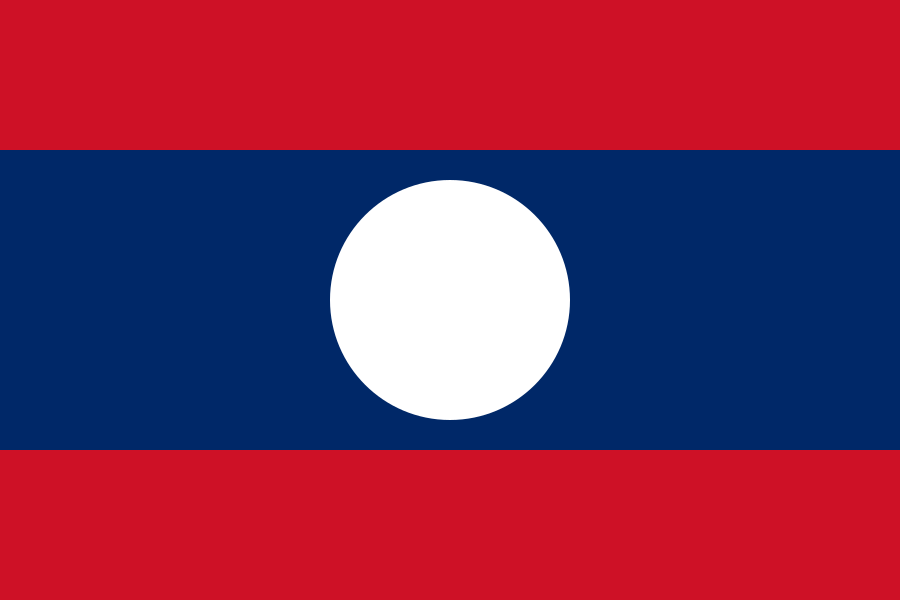
The prince who in 1949 told a U.S. diplomat that Laos was a 'classless, Buddhist country in which communist theories had no basis' later became the 'Red Prince' and first president of communist Laos.
A Lao royal and revolutionary leader associated with the Pathet Lao. He participated in coalition and national reconciliation institutions and became the Lao PDR’s first president in 1975. His role differed from Kaysone Phomvihane’s leadership of party and government.
Career timeline
1945Foreign minister of the Lao Issara government and commander-in-chief of the Lao liberation army
1950Founded and chaired the Lao Freedom Front (Pathet Lao)
1956Chairman of the Lao Patriotic Front (Neo Lao Hak Sat)
1957–1958Minister for Planning, Reconstruction and Urban Development
1962–1963Deputy Prime Minister and Minister of Economy and Planning
1974Presided over the National Political Consultative Council
1975–1991First president of the Lao PDR (Phoumi Vongvichit acting from 1986)
The non-Politburo power who was the institutional memory of the Soviet government for 25 years
In 1979 Brezhnev stalled his Hero of Socialist Labour — Smirtyukov was, he said, a key figure in the government's feud with the CC. Kosygin took it to the Politburo himself; Tikhonov and Shcherbitsky backed it, and the award passed.
He joined the Council of People's Commissars apparatus at 21 in 1930 and served in the Kremlin for 60 years until 1990, the living embodiment of the Soviet government machinery. As Mikoyan's assistant, he handled wartime Red Army supply for the State Defence Committee; from 1964 he served for 25 years as Administrator of Affairs of the Council of Ministers under Kosygin, Tikhonov, and Ryzhkov. Alone among non-Politburo officials, he received the most secret Politburo decisions, and Central Committee department heads were instructed to coordinate major plans with him. His institutional memory was the axis that kept the state running through every change of leadership.
Career timeline
1924–27Village soviet secretary, cooperative secretary, club manager
1927–31Moscow State University, faculty of Soviet law
1930–41Sovnarkom apparatus: senior referent, consultant, sector head
1941–46Deputy head of Sovnarkom Secretariat, assistant to Mikoyan on GKO supply
1946–53Deputy head, Council of Ministers Secretariat
1953–64Deputy Administrator of Affairs, Council of Ministers
1964–89Administrator of Affairs, Council of Ministers
The RSFSR premier who never stopped speaking bluntly to Brezhnev
“Voronov was a blunt man and told Brezhnev to his face everything he thought.” — Mikhail Smirtyukov, chief of staff of the USSR Council of Ministers
A hands-on party man who rose from electrician to RSFSR premier and full Politburo member. He backed Kosygin's reform and championed the 'zveno' autonomous work teams, but was blocked by Brezhnev and removed from the Politburo in 1973.
Career timeline
1929–37Worked as electrician and brigade leader; graduated Tomsk Industrial Institute
1937–48Party propaganda and organization work in Prokopyevsk and Chita
1948–55First Secretary, Chita Oblast Party Committee
1955–57Deputy Minister of Agriculture, USSR
1957–61First Secretary, Orenburg (Chkalov) Oblast Party Committee
1961–73Member of the Presidium/Politburo: candidate 1961, full 1961–73
1962–71Chairman of the RSFSR Council of Ministers (Premier)
1971–73Chairman of the USSR People's Control Committee
1973Agricultural reform plan (zveno) rejected by Brezhnev; removed from Politburo
A resistance survivor who became a guardian of the system
On Poznań radio on 29 June 1956, he warned that the people's government would chop off the hand of anyone raised against it.
Józef Cyrankiewicz was a prewar socialist activist and a leader of the resistance inside Auschwitz, yet after the war he became a central politician of the Soviet-aligned Polish People's Republic. As one of Poland's longest-serving prime ministers, he helped coordinate reconstruction and consolidate communist rule, including the absorption of the independent socialist tradition into the ruling party. His support for force against the Poznań workers in 1956 and against coastal workers in 1970 reveals the tension between his resistance past and his responsibility within the state he defended. Removed from power in 1970, he remained active in official peace organizations.
Career timeline
1931Joined the Polish Socialist Party and socialist youth movement
1935–1939Secretary of the Kraków District Workers' Committee of the Polish Socialist Party
1942–1945Imprisoned at Auschwitz and Mauthausen; active in camp resistance
1945–1948General Secretary of the Central Executive Committee of the Polish Socialist Party
1947–1952Chairman of the Council of Ministers of Poland
1954–1970Chairman of the Council of Ministers of Poland
1970–1972Chairman of the Council of State
1973–1986Chairman of the Polish Peace Committee and member of the World Peace Council