Sakharovsky's 13-year right hand and the short-lived PGU chief of early détente
Someone tipped off a Swiss resident that his phone was being tapped. The trace led to one man: PGU chief Mortin himself. He left for vacation that year and never returned to the Lubyanka.
A Soviet intelligence general who ran the day-to-day machinery of Cold War espionage as Aleksandr Sakharovsky's right hand for 13 years before becoming chief of the KGB First Chief Directorate in 1971. As chief he moved the PGU into the Yasenevo complex and expanded scientific-technical intelligence, overseeing Soviet foreign operations in early détente and the secret channel to Willy Brandt's government, until a single phone call warning a subordinate about a wiretap cost him his post within two and a half years and cleared the way for Vladimir Kryuchkov.
Career timeline
1937–1939Physics and mathematics teacher at a rural school
1939–1940Secretary of the district Komsomol committee
1940–1941Director of the district high school
1941–1942Head of the organizational department, district party committee
1942–1945Political officer in the active army; participated in the defense of Leningrad
1945–1947Studied Chinese and English at the Military-Diplomatic Academy of the Soviet Army
1947–1950Foreign intelligence officer on long-term posting abroad
1950–1954Worked in the CPSU Central Committee apparatus
1954–1958Deputy Head of the KGB First Chief Directorate (PGU)
1958–1971First Deputy Head of the KGB First Chief Directorate (PGU)
1966–1967Concurrently headed KGB School No. 101 (Higher Intelligence School)
1971–1974Head of the KGB First Chief Directorate (PGU)
1974–1975Head of the Directorate for Scientific-Technical Cooperation, State Committee on Science and Technology of the USSR Council of Ministers
1975–1982Senior Consultant, Group of Consultants under the Chairman of the KGB
The thinker who found a new continent in Marx: founder of structural Marxism
“Ideology 'hails' the individual — like a policeman shouting 'Hey, you there!' — and the moment one turns around, one becomes a subject.” — 'Ideology and Ideological State Apparatuses'
French Marxist philosopher who argued an 'epistemological break' separates Marx's scientific works from his early humanism, founding structural Marxism through concepts of ideological state apparatuses (ISAs) and overdetermination. As philosophy professor at the École Normale Supérieure, he taught a generation of French intellectuals: Derrida, Foucault, Bourdieu, and Badiou among them. He sought to fill the theoretical vacuum of Stalinism, and despite tensions with the Communist Party and lifelong mental illness, he pushed postwar Marxism to the center of philosophy. His strangling of his wife Hélène Rytmann during a psychotic episode in 1980 long overshadowed his intellectual legacy.
Career timeline
1945Enters ENS, studies under Gaston Bachelard
1948Appointed philosophy tutor at the ENS
1948Joins the French Communist Party (PCF)
1954Secrétaire de l'école littéraire at the ENS
1965Publishes For Marx and Reading Capital — founding structural Marxism
1968Hospitalized during May 68 — "Of what use is Althusser?" graffitied on walls
1970Publishes 'Ideology and Ideological State Apparatuses'
1976Openly opposes PCF's abandonment of the dictatorship of the proletariat
1980Strangles his wife Hélène Rytmann during a psychotic episode — declared unfit for trial
The Brezhnev-era republic-builder who led Ukraine for 17 years, linchpin of the Dnepr clan
"What fool invented this word perestroika? Why rebuild the house? We are fine! What is there to rebuild?" — Shcherbitsky on Gorbachev's reforms.
Rising through the party apparatus in the Dneprodzerzhinsk-Dnepropetrovsk industrial belt, he served as First Secretary of the Communist Party of Ukraine from 1972 to 1989 and sat on the CPSU Politburo for 18 years (1971–1989). Sharing Brezhnev's Dnepr network, he oversaw Ukraine's intensive industrialisation and economic expansion for 17 years, multiplying the republic's GDP more than fourfold. Briefly demoted for opposing Khrushchev's decentralisation schemes, he returned to power after Brezhnev's takeover. He drew criticism for the information blackout and the decision to proceed with the Kyiv May Day parade after the 1986 Chernobyl disaster, and in 1989 became the last old-guard republic leader replaced by Gorbachev.
Career timeline
1941–1945Chemical defence officer, Transcaucasian Front, demobilised as captain
1946–1952Party secretary at Dneprodzerzhinsk coke-chemical and metallurgical plants, city committee cadre
1952–1954First Secretary, Dneprodzerzhinsk City Party Committee
1955–1957First Secretary, Dnepropetrovsk Oblast Party Committee
1957–1961Secretary, CC of the Communist Party of Ukraine
1961–1963, 1965–1972Chairman, Council of Ministers, Ukrainian SSR
1972–1989First Secretary, CC of the Communist Party of Ukraine
Longest-serving GSFG commander who led the Soviet front-line force facing NATO for eight years
4 December 1941: a German tank group was about to encircle Western Front headquarters — Captain Ivanovsky's 27th Tank Battalion stopped the breakthrough and saved the command.
A tank officer who began the Great Patriotic War as a captain and ended it as a colonel at age 26, he fought from the defence of Moscow through to East Prussia. From 1972 to 1980 he served as Commander-in-Chief of the Group of Soviet Forces in Germany (GSFG) for eight years, the longest tenure in the post's history. He commanded the Warsaw Pact's most combat-ready formation at the very front line of the Cold War military standoff with NATO. After commanding the Belorussian Military District, he became Commander-in-Chief of the Soviet Ground Forces and Deputy Minister of Defence in 1985, overseeing the late Cold War conventional-force buildup, and was awarded Hero of the Soviet Union that same year for his wartime service and postwar contributions to military readiness.
Career timeline
1938–1939Tank platoon/company commander, Moscow Military District
1939–1940Participated in Western Belarus annexation and Soviet-Finnish War
1941–1945Tank battalion chief of staff/CO, intelligence/operations chief 2nd Tank Corps, CO 62nd Guards Heavy Tank Rgt (Western, Bryansk, Voronezh, 1st & 2nd Belorussian Fronts)
1946–1952Chief of intelligence & combat training, Guards Mechanized Army staff
The foreign-policy aide who served four Soviet General Secretaries
“Alexandrov is the closest equivalent to me that the Soviet system has.” — Ambassador Dobrynin to Henry Kissinger, 1972.
A graduate of Swedish philology, he began his diplomatic career as a TASS correspondent in Stockholm and later as an aide to Alexandra Kollontai at the Soviet mission in Sweden. From 1961, he served as Brezhnev's assistant for international affairs and went on to advise Andropov, Chernenko, and Gorbachev in succession, becoming the central behind-the-scenes figure in Soviet foreign policy through the détente era. He personally drafted Brezhnev's foreign-policy speeches, attended US–Soviet summits, and was present at the signing of the Helsinki Accords (1975), which he regarded as the greatest achievement of his career. After retiring in 1986, he published his memoir, From Kollontai to Gorbachev.
Career timeline
1940–1942TASS correspondent in Stockholm
1942–1947Assistant to A. M. Kollontai, USSR mission in Sweden
1947–1961Adviser to the Minister of Foreign Affairs
1961–1963Assistant to Brezhnev as Chairman of the Presidium of the Supreme Soviet
1963–1966Assistant for international affairs, Secretary/First Secretary of the CC CPSU
1966–1986Assistant for international affairs to the General Secretary of the CC CPSU
When Khrushchev appointed him KGB chairman in 1958, he added: "I have one more request: make sure I'm not bugged." Six years later, Shelepin used the KGB to cut Khrushchev's communications and pull him from power.
A Komsomol leader turned KGB chairman, he symbolized a generational reshuffle of the security organs. Later seen as a possible rival to Brezhnev, he was gradually pushed aside.
Career timeline
1952–1958First Secretary of Komsomol, representing the postwar youth-league generation
1958–1961KGB chairman, pushing a younger generation into the security apparatus
1961–1967CC secretary and party-state control chief, forming the Shelepin group
1964Participates in Khrushchev’s removal
1967–1975Gradually sidelined under Brezhnev as a potential rival
Soviet military scientist who designed the world's first operational anti-ballistic missile defense system
A few hours before his death, he told his wife: "I need to call the guys. I solved the problem — the one they gave me."
Soviet radiophysicist and pioneer of missile defense. After contributing to the S-25 Berkut and S-75 surface-to-air missile systems, he became Chief Designer of System A in 1956, the world's first operational anti-ballistic missile defense, and on March 4, 1961, achieved history's first successful intercept of a ballistic missile in flight. As General Designer of the A-35 and A-35M systems defending Moscow, he established the Soviet Union's strategic defensive edge, earning the Lenin Prize and the title Hero of Socialist Labor. In 1975, however, he was removed from his post amid conflicts with the leadership of the Ministry of Radio Industry, never seeing his system's final modernization through; in retirement he wrote his memoir Secret Zone, testifying to a body of work that history had nearly buried.
Career timeline
1942337th Separate Radio Battalion, Moscow PVO Army — assistant platoon leader, platoon leader, company engineer
1944–1950Budyonny Military Communications Academy — radar theory instructor, deputy department head
1950KB-1 — head of SHF sector, deputy technical head of tests for S-25 Berkut guidance radar
1953SKB-30 / KB-1 — head of special design bureau, began ABM work
1956Chief Designer of System A — world's first experimental ABM system
1958General Designer of the A-35 ABM system
1961OKB-30 (later OKB Vympel) — founding director and General Designer
1970TsNPO Vympel — deputy general director for science
1975TsNIIRES — first deputy director for science (removed from ABM work)
1979–198745th Central Research Institute, Ministry of Defense — scientific consultant
1987USSR Academy of Sciences, Department of Theoretical Problems — laboratory head
The last Soviet ambassador to watch the GDR dissolve
On the night of 9 November 1989, as the Berlin Wall came down, Kochemasov tried unsuccessfully to telephone Gorbachev, then Shevardnadze, for instructions. He did nothing.
Soviet politician and diplomat who served as Deputy Chairman of the RSFSR Council of Ministers for 21 years (1962–1983), overseeing cultural and social policy in the Russian republic, while also chairing the All-Russian Society for the Preservation of Historical and Cultural Monuments (1966–1983). Appointed Soviet ambassador to East Germany in 1983, he held this critical Cold War post through the fall of the Berlin Wall in November 1989, when he was unable to reach Mikhail Gorbachev or Eduard Shevardnadze for instructions. In April 1990 he delivered to East German Prime Minister Lothar de Maizière the Soviet 'Non-paper' setting out eleven conditions for German reunification, representing Moscow's interests as the GDR dissolved.
Career timeline
1946–1948First Secretary, Gorky Oblast Komsomol Committee
1949–1955Secretary, Komsomol Central Committee
1955–1960Counsellor / Minister-Counsellor, Soviet Embassy in the GDR
1961–1962Deputy / First Deputy Chairman, State Committee for Cultural Relations with Foreign Countries
1962–1983Deputy Chairman, RSFSR Council of Ministers
1966–1983Chairman, Presidium of the Central Council, All-Russian Society for the Preservation of Historical and Cultural Monuments
1966–1983Candidate Member, CC CPSU
1983–1990Ambassador Extraordinary and Plenipotentiary of the USSR to the GDR
Brezhnev-era chief price administrator who oversaw every official price in the USSR for 11 years
The man who set every price in the USSR for 11 years left behind a memoir titled The Magic of Numbers, or Russia Unclaimed.
As Chairman of the USSR State Committee for Prices (Goskomtsen) from 1975 to 1986, Nikolai Glushkov oversaw the entire system of wholesale and retail prices in the Soviet command economy for over a decade. Born into a peasant family in Vyatka Governorate, he began working as a village bookkeeper at age 14 and rose through financial management at the Norilsk mining-metallurgical combine, one of the largest Gulag-industrial complexes, before serving in the Krasnoyarsk Sovnarkhoz and as Deputy Minister of Non-Ferrous Metallurgy. His tenure at Goskomtsen coincided with the 'era of stagnation,' when official prices remained frozen for decades while repressed inflation and chronic shortages accumulated, making the management of this contradiction a politically sensitive task. After retirement, his posthumously published memoir bore the title The Magic of Numbers, or Russia Unclaimed.
Long-serving minister of missile and space industry
At a 1950s Kremlin meeting Beria ordered military rocket production to start within months. Afanasyev, then a young engineer, called this unrealistic and demanded more time; afterwards only one attendee spoke up for him. That arrest was Beria's first reaction appears only in English accounts.
Born 30 August 1918 in Klin, Moscow province, and a 1941 graduate of the Bauman Moscow Higher Technical School. During the war he worked at artillery plant No. 172 in Molotov (Perm) producing anti-tank shaped-charge shells, then rose through the Technical Directorate of the Ministry of Armaments and Ministry of Defence Industry as senior engineer, department head, deputy head and head. From 1957 to 1965 he chaired the Leningrad and then the RSFSR economic councils, serving as a deputy chairman of the RSFSR Council of Ministers. He was Minister of General Machine-Building from 2 March 1965 to 8 April 1983 and Minister of Heavy and Transport Machine-Building from 1983 to 1987. Twice a Hero of Socialist Labour, he sat on the CPSU Central Committee in 1961-1989 and in the USSR Supreme Soviet in 1962-1989. He died in Moscow on 13 May 2001.
Career timeline
1940s–1950sRises through artillery and missile-related industrial administration
1961–1965Coordinates rocket and space production in defense-industry state committees
1965–1983Minister of General Machine-Building, directing ballistic missiles, launch vehicles and satellites
1970sActs as a secret administrator of military space and strategic missile production
1983 이후Leaves the long-held space-industry ministry and remains a military-industrial elder
The MVD general who turned the Internal Troops into a mobile strike force and sealed Chernobyl
West of Kyiv in late 1943, Yakovlev's anti-tank battalion and two anti-tank rifle platoons ambushed fifty enemy tanks in a fire trap — destroying seventeen and stopping the assault cold.
Army General Ivan Yakovlev led the Soviet MVD Internal Troops for eighteen years, from 1968 to 1986. Born to a Cossack family in Stavropol, he joined the Red Army in 1939 and rose from lieutenant to major in the Great Patriotic War, earning six combat orders and surviving three wounds. As Internal Troops chief he transformed them from territorial paramilitaries into a mobile modern force with air and naval arms, special motorized police units, and regional commands, reforms that readied the force for the ethnic conflicts ahead. He personally directed over 15,000 troops sealing the Chernobyl exclusion zone in 1986. That December, after two MVD conscripts hijacked a Tu-134 in Ufa and killed several people, Yakovlev was dismissed and moved to the Group of General Inspectors, though he stayed active as a consultant to the Internal Troops command until his death.
Career timeline
1939–1940Graduated Kemerovo Mortar-Artillery School; fought in Soviet-Finnish War (wounded)
Korolev's key partner in shaping the R-7's packet design
On 21 August 1957, the R-7 whose design Kryukov helped shape finally completed its planned flight.
Sergei Kryukov was a Soviet rocket and space-technology designer who helped define the R-7's overall form and its packet arrangement of four strap-on blocks around a central stage. If Korolev directed the programme as chief designer, Kryukov turned its concept into an integrated structure and working design through the project department he led. He later directed automated interplanetary-station and launch-vehicle work at the Lavochkin bureau and Energia. His career shows that the space programme was built not by a lone genius but by specialised collective design and production systems.
Career timeline
1918–1940Born in Bakhchysarai; studied at the Stalingrad Mechanical Institute
1940–1945Supervised artillery production at the Barrikady and No. 526 factories
1946–1947Joined NII-88; studied German rocket technology and led its return shipment
1947–1956Rose from senior engineer to project-section leadership at OKB-1
1956–1961Head of Design Department 3 and chief designer of the R-7; Hero of Socialist Labour
1961–1970Deputy chief designer at OKB-1, then department head at TsKBEM
1970–1977Chief designer at the Lavochkin bureau; directed automated interplanetary-station work
1977–1996First deputy general designer and later scientific consultant at Energia
Architect of Soviet counterintelligence for 40 years, from SMERSH radio games to chief of the KGB Second Chief Directorate
Grigorenko personally organized and ran 181 SMERSH radio games — operations code-named 'Zagadka' (Riddle), 'Tuman' (Fog), and others — feeding disinformation to German command while penetrating Abwehr and Zeppelin agent networks.
Grigory Grigorenko was the backbone of Soviet counterintelligence for over forty years. During the Second World War he personally ran 181 radio games at SMERSH, deceiving the Abwehr and Zeppelin with disinformation operations, then rose through MGB and KGB counterintelligence departments. As chief of the KGB Second Chief Directorate from 1970 to 1983, he built the system that serially unmasked deep-cover CIA and Western agents, and from 1978 he served concurrently as Deputy Chairman of the KGB, becoming a key lieutenant of Yuri Andropov. His counterintelligence architecture paralyzed foreign intelligence stations in Moscow for years and remained the methodological foundation of Russian counterintelligence long after the Soviet collapse.
Career timeline
1940–1942NKVD Special Department operative; Southwestern Front and Battle of Stalingrad
1943–1946Senior operative, SMERSH 3rd Department; conducted 181 radio games
1954–1956First Deputy Representative of the KGB in Hungary
1962–1969Chief of Foreign Counterintelligence, PGU KGB
1970–1983Chief of the 2nd Chief Directorate, KGB
1978–1983Deputy Chairman of the KGB (concurrent with 2nd Chief Directorate)
1983–1989Deputy Minister of General Machine Building, USSR
Prisoner Shch-854, who told the world about the Archipelago
February 9, 1945, on the East Prussian front. An artillery captain decorated for pinpointing enemy batteries was arrested at his unit headquarters. The charge: mocking Stalin under the coded nickname 'Pakhan' in letters to a friend. The insignia were torn from his uniform, and he boarded a prison transport bound for the Lubyanka.
An artillery captain sentenced to eight years for mocking Stalin in a private letter. One Day in the Life of Ivan Denisovich (1962) made him the emblem of the thaw; The Gulag Archipelago earned him the Nobel Prize and deportation (1974) together. He returned in 1994 and died in Russia, outliving the system he had testified against by seventeen years.
Career timeline
1945–53Arrested over a censored letter; eight years in the camps
1953–56Exile in Kazakhstan; schoolteaching
1962One Day published with Khrushchev’s sanction
1970The Nobel Prize in Literature
1973–74The Gulag Archipelago in Paris; deportation
The merchant marine minister who conquered the Arctic with a nuclear icebreaker fleet
On 9 August 1977, the minister himself boarded the Arktika at the Murmansk pier. If it failed, he would carry the blame alone. Eight days later, a surface ship reached the North Pole for the first time in human history.
Born the son of a village blacksmith in Oryol Governorate, he grew into an engineer handling Arctic convoy cargo at the wartime Murmansk port. He turned the Sakhalin Shipping Company profitable, becoming the youngest head of a Soviet shipping company at 37, and rose to Minister of Merchant Marine in 1970. Over 16 years he transformed a subsidised sector into the fifth-largest foreign-currency earner among nearly 80 ministries, while expanding the nuclear icebreaker fleet from the single Lenin to eight vessels. In 1977 he personally boarded the nuclear icebreaker Arktika and led the world's first surface-ship voyage to the North Pole, earning the title Hero of Socialist Labour. Forced from office in 1986 after the Admiral Nakhimov passenger liner disaster, the Arctic route and icebreaker fleet he built remain the foundation of Russia's northern strategy today.
Career timeline
1942–1949Starts as shift mechanic at Murmansk port, rises to mechanization chief and chief engineer, responsible for restoring cargo operations under Arctic convoy bombing
1951–1955Kholmsk port chief → Korsakov port chief → head of Sakhalin Shipping Company, turning a loss-making enterprise profitable
1955–1960At 37, the youngest head of a Soviet shipping company, completes the turnaround of Sakhalin Shipping
1960–1962Head of Personnel, Ministry of Merchant Marine
1962–1966Deputy head, Transport & Communications Dept, CPSU Central Committee
1966–1970First Deputy Minister of Merchant Marine
1970–1986Minister of Merchant Marine: transforms subsidised sector into 5th-largest forex earner, expands nuclear icebreaker fleet from 1 to 8 vessels, opens year-round Arctic navigation
1977Personally leads Arktika North Pole expedition, awarded Hero of Socialist Labour
In December 1982, newly appointed interior minister, Fedorchuk held his first expanded collegium not at MVD headquarters but at the KGB building on Lubyanka. A colleague recalled: 'He had no intention of leaving.'
A military counterintelligence officer from a poor Ukrainian peasant family, he saw combat at Khalkhin Gol and in the defense of Moscow before rising through SMERSH and KGB military counterintelligence. From 1970 he led the Ukrainian KGB for twelve years (securing Brezhnev-era stability in the republic), and when Andropov became General Secretary, Fedorchuk briefly succeeded him as chairman of the Soviet KGB. Moved to the Interior Ministry after only seven months, he purged some 90,000 personnel on corruption charges before Gorbachev dismissed him in 1986.
Career timeline
1939–1970sBuilds a long security career in Ukraine and military counterintelligence
1970–1982Chairman of the Ukrainian KGB, commanding a republic-level security apparatus
1982Promoted to KGB chairman when Andropov becomes General Secretary
1982–1986Moved to interior minister and involved in discipline campaigns under Andropov and Chernenko
A fiscal realist who warned against abrupt prohibition
On April 4, 1985, Dementsev warned that cutting vodka production would cost the budget 4 billion rubles in 1986 and 15 to 16 billion by 1990.
Viktor Dementsev was an economic administrator who rose from regional finance offices to the upper ranks of Soviet financial management. In 1985 he publicly challenged the abrupt production cuts proposed for the anti-alcohol campaign, exposing the structural tension created by the state budget's reliance on alcohol revenue. His warning calculated not only lost income but also the likely growth of moonshine and resulting sugar shortages, making him a revealing witness to the campaign's fiscal and social contradictions.
Career timeline
1934–1939Accounting and district finance posts in Chita and Kamchatka
1944–1947Controller-auditor in Kamchatka regional audit bodies
1949–1962Regional finance chief and executive-committee deputy chair in Gorno-Altaysk and Yaroslavl
1962–1965Head of State Revenues and deputy finance minister of the RSFSR
1965–1973Deputy Minister of Finance of the USSR
1973–1986First Deputy Minister of Finance of the USSR
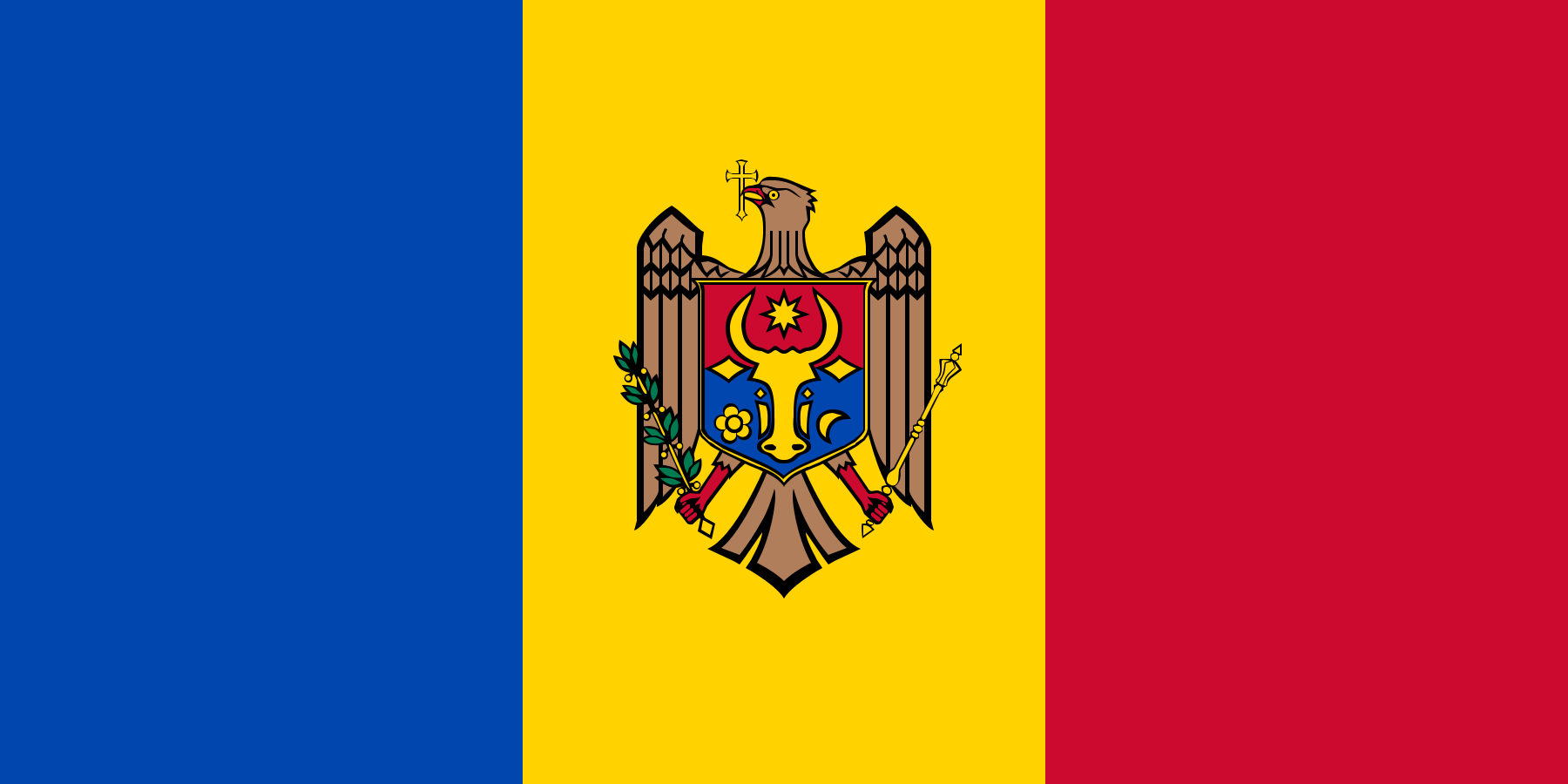
The republic first secretary who ruled Moldavia for nearly 20 years as Brezhnev's close ally
Of writer Ion Druță, forced to relocate to Moscow, Bodiul said publicly: 'If he returns home, I'll hang him on the first lamppost.'
He served nearly 20 years as First Secretary of the Communist Party of Moldavia, one of the longest-serving republican party chiefs in Soviet history. A close Brezhnev ally, he transformed agrarian Moldavia with new industries (machine-building, electronics, food processing) and built some of Europe's largest orchards and livestock complexes. Yet he also pursued aggressive Russification: suppressing Romanian, closing churches, and threatening writer Ion Druță with hanging. Elevated to Deputy Chairman of the USSR Council of Ministers in 1980, his 2003 Order of the Republic award provoked eight Moldovan writers to renounce their own medals in protest.
Career timeline
1937–1938Senior agronomist, collective farm
1942–1946Veterinary officer, Red Army (127th Guards Artillery Regt → 59th Guards Rifle Div → 10th Guards Rifle Corps)
1946–1951Agricultural aide and inspector, Moldavian SSR Council of Ministers
1951–1956First Secretary, Chișinău / Volontirovka / Olănești District Party Committees
1956–1959Higher Party School graduate; instructor, CC CPSU Org-Party Work Dept
1959–1961Second Secretary, CC of the Communist Party of Moldavia
1961–1980First Secretary, CC of the Communist Party of Moldavia
1980–1985Deputy Chairman, USSR Council of Ministers
From Ukrainian premier to USSR steel minister: a Dnieper-born technocrat who ran Soviet ferrous metallurgy for twenty years
"How are you not ashamed, Comrade Kazanets... you boast that you smelt more than the USA. But what about the quality of the metal? Only 40% of every ton becomes finished product — the rest goes out as slag and shavings!" — Brezhnev dressing him down at the 1972 Central Committee plenum.
A Ukrainian technocrat from a family of Dnieper river pilots, he started as an electrician and gained shop-floor experience at the Kuznetsk and Yenakiieve metallurgical combines. Handpicked by Khrushchev in 1953 at age 35 to head the Donetsk Oblast Party Committee, he rose to Second Secretary of the Ukrainian Communist Party CC in 1960 and served as Chairman of the Ukrainian SSR Council of Ministers from 1963 to 1965. When the Kosygin reforms re-established the USSR Ministry of Ferrous Metallurgy in 1965, he became its first minister and held the post for twenty years, making the Soviet Union the world's largest steel producer. He sat on the CPSU Central Committee throughout the Brezhnev era and retired just after Gorbachev came to power in 1985.
Career timeline
1937–1944Electrician, engineer, substation section head at Kuznetsk Metallurgical Combine; graduated Siberian Metallurgical Institute
1944–1952Shift chief, party committee deputy secretary, shop head at Yenakiieve Metallurgical Plant; party organiser from 1950
1952–1953First Secretary, Yenakiieve City Committee → Makiivka City Committee
1953–1960First Secretary, Donetsk Oblast Committee, Communist Party of Ukraine
1960–1963Second Secretary, CC of the Communist Party of Ukraine
1963–1965Chairman, Council of Ministers, Ukrainian SSR
1965–1985USSR Minister of Ferrous Metallurgy
1961–1986Member, CPSU Central Committee (candidate 1956–1961)
“I am certain of twelve, absolutely certain. If you stretch it, perhaps fifteen.”
Yevgeny Pepelyayev was a Soviet fighter pilot and regimental commander who carried experience from the Second World War and the Far East into the Korean War’s jet combat. He led the 196th Fighter Aviation Regiment from bases in Manchuria against United Nations air forces, becoming one of the war’s leading Soviet aces with 19 officially credited victories. Sources place his total between 19 and 23 because he reportedly assigned some victories to wingmen, leaving the ranking disputed alongside Nikolai Sutyagin. Awarded Hero of the Soviet Union in 1952, he later served in air-defence command and research before retiring in 1973.
Career timeline
1938Graduated from the 8th Military Pilots School; posted to the Far East
1943Training and operational flying with the 162nd Fighter Aviation Regiment on the Belorussian Front
1945Deputy commander of the 300th Fighter Aviation Regiment; served in the war against Japan
1949–1952Commander of the 196th Fighter Aviation Regiment
1951–1952Served in the Korean War, commanding MiG-15 formations
1958–1960Commander of the 133rd Fighter Aviation Division
1960–1973Chief of aviation of the 78th Air Defence Fighter Aviation Corps; served at the central command post, then retired
Father of electroslag welding who led Ukraine's Academy of Sciences for 58 years
“Science is the essence of my life, and the Academy is not merely my job but my only family.”
Boris Paton presided over the Ukrainian Academy of Sciences for 58 years, from 1962 until his death in 2020. A pioneer of electric welding, he led development of electroslag welding in the 1950s, enabling joints of unlimited thickness that transformed Soviet heavy industry. During WWII he helped accelerate tank production at the Krasnoye Sormovo plant in Gorky. He directed space welding research, producing devices cosmonauts used in orbit, and adapted the technology to medicine with a method for joining living tissues now widely used in surgery. Twice Hero of Socialist Labour and a CPSU Central Committee member, he warned against building the Chernobyl plant near Kyiv and defended Ukrainian scientific autonomy through the Soviet collapse.
A communist pioneer of armed resistance to the Occupation
“We’ve avenged Titi!”
Pierre Georges was a French communist and Resistance fighter whose early anti-fascist experience included service with the International Brigades in the Spanish Civil War. On 21 August 1941 he shot the German naval officer Alfons Moser at Paris’s Barbès metro station, an action that made the French Communist Party’s armed resistance visible while intensifying the occupiers’ hostage executions and repression. Under the names Frédo and later Colonel Fabien, he organised clandestine fighters and maquis units, then led the Colonne Fabien toward the eastern front after the Liberation of Paris. He was killed by a mine explosion in 1944, leaving a legacy that joins the decision to fight the Occupation to the severe reprisals that followed.
Career timeline
1936–1939International Brigades fighter in the Spanish Civil War
1939–1940Cadre of the French Communist youth movement
1940–1941Underground communist organiser in occupied France
1941–1942Military commissioner of the Organisation spéciale
1942–1943FTP maquis organiser in the Doubs
1943–1944FTP maquis commander across eastern and central France
1944FTP and FFI commander during and after the Liberation of Paris
1944Commander of the Colonne Fabien, killed on the eastern front
1941.08.21Shot German naval officer Alfons Moser at Barbès metro station
1944.12.27Killed by a mine explosion at Habsheim, Alsace
The GRU colonel who fed the West over 5,000 classified documents on Soviet missile weakness, exposing Khrushchev's strategic bluff
At a London safe house, Penkovsky tried on American and British army colonel's uniforms, photographed himself, and spoke of 'the day I'll wear one of these for real.'
A GRU colonel who, disillusioned with Khrushchev's leadership, approached MI6 and the CIA in 1961 and over 18 months fed the West more than 5,000 classified documents: Soviet ICBM capabilities, Cuban missile site layouts, and military doctrine. His intelligence confirmed to Kennedy that the Soviet missile arsenal was far weaker than Khrushchev claimed, providing the factual basis for the U.S. to stand firm during the Cuban Missile Crisis. Arrested by the KGB in October 1962, he was convicted in a televised show trial and executed by firing squad in May 1963.
Career timeline
1937–1939Graduated from 2nd Kiev Artillery School, commissioned as lieutenant
1939–1945Fought in Poland, Winter War, and the Eastern Front; twice wounded; adjutant to artillery commander, 1st Ukrainian Front
1945–1948Graduated Frunze Military Academy, promoted to colonel at age 30
1949–1953Graduated Military-Diplomatic Academy, assigned to GRU 4th (Middle East) Directorate
1955–1956Assistant military attaché in Turkey and GRU resident, recalled after misconduct
1960–1962Deputy chief of foreign relations at State Committee for Science and Technology, GRU cover post
1961.4–1962.10Double agent for MI6 and CIA; passed 5,000+ classified items in London, Paris, and Moscow
1963.5.11–16Convicted of treason and sentenced to death, executed five days later
The regime insider who fused political power with scientific prestige
“Together we fought, together we die!”
Elena Ceaușescu was a Romanian communist politician who exercised power alongside her husband, Nicolae Ceaușescu. She rose through the party and state leadership, where propaganda presented her as a symbol of women’s advancement and scientific achievement, while her position reinforced family rule and the personality cult. As the December 1989 uprising spread from Timișoara, she remained part of the regime’s ruling circle, fled with her husband on 22 December, and was captured. After a summary trial, the couple were executed together on 25 December.
Career timeline
1939–1947Communist activist and textile worker
1957–1967Chemical researcher, awarded engineering degree and doctorate
1972Member of the Romanian Communist Party Central Committee
1973–1974Member of the Political Executive Committee and its Permanent Bureau
1975–1989Deputy in the Great National Assembly and senior party-state leader
1980–1989First Deputy Prime Minister of Romania
1989.12Captured in the revolution and executed alongside her husband