From Izvestia editor to Soviet of the Union chairman: a Brezhnev-era media mandarin who became the face of the supreme legislature
When Andropov took power after Brezhnev's death, Tolkunov — who had once worked alongside him in the Central Committee — asked to return to newspaper work. Andropov offered him Pravda; Tolkunov chose Izvestia instead.
A Soviet journalist and state leader born into a railway worker's family who began as a Pravda reporter in 1938. During World War II he served as a war correspondent across multiple fronts, and from the early 1960s worked in the CPSU Central Committee's department for relations with socialist countries, managing the party's external propaganda line. Appointed editor-in-chief of Izvestia in 1965, he led the paper for 11 years before being transferred to head the Novosti Press Agency in 1976, then returned to Izvestia in 1983 when his old CC colleague Andropov came to power. Elected Chairman of the Soviet of the Union in 1984, he served until 1988 as the institutional head of the USSR's supreme legislative body.
Career timeline
1938–1939Reporter, Pravda information dept → literary contributor, assistant to editor-in-chief
The Chernobyl commander who built Siberia's oil empire
At 10 a.m. on 27 April 1986, Shcherbina opened the government commission meeting in Pripyat with a single sentence: 'We begin the evacuation.' Thirty-two hours after the explosion, an entire city of 50,000 boarded buses.
The architect of the West Siberian oil and gas complex that made the USSR the world's top hydrocarbon producer. As Tyumen party chief and Minister of Oil and Gas Construction, he drove pipelines, cities, and railways through taiga and permafrost. As Deputy Premier, he personally chaired the government commissions for the Chernobyl disaster (1986) and Armenian earthquake (1988), remaining on site even as radiation exposure deteriorated his health.
Career timeline
1939Volunteered for Winter War, 316th Ski Squadron
1942–1944Komsomol Secretary, Kharkov Oblast
1951–1961Secretary → 2nd Secretary, Irkutsk Oblast CPSU
1961–1973First Secretary, Tyumen Oblast CPSU
1973–1984Minister of Construction of Oil & Gas Industry, USSR
1984–1989Deputy Chairman, USSR Council of Ministers (fuel & energy)
1986Chairman, Chernobyl disaster government commission
1988Chairman, Armenian earthquake relief commission
The deputy interior minister who arrested Dubček and handed him to the Soviets
At the 1987 May Day parade in Bratislava, a student threw two eggs at Šalgovič as he stood on the reviewing stand. He had to leave the platform and hand his soiled jacket to a bodyguard.
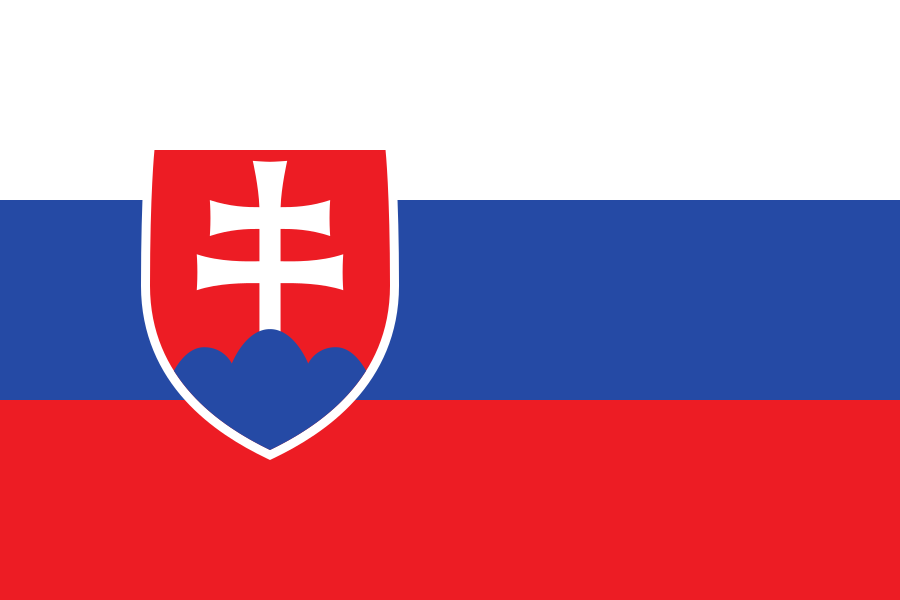
A Slovak security officer and politician in Czechoslovakia. During the war he deserted from the pro-Nazi Slovak army to the Soviets and served in the Czechoslovak corps; after the war he joined the StB and took part in political repression. In June 1968 Dubček, considering him a personal friend, appointed him deputy interior minister with oversight of the StB. Šalgovič instead coordinated with the KGB, drew up arrest lists for the reformers, and on 21 August handed Dubček and his colleagues to the Soviet occupiers. Under 'normalization' he was shunted to the ceremonial post of chairman of the Slovak National Council (1975–1989); after the Velvet Revolution he hanged himself in the basement of his home.
Career timeline
1943Deserted from Slovak army to Soviet partisans
1945–1951Czechoslovak army counter-intelligence; ally of Bedřich Reicin
1950–1962Member, KSČ Central Committee
1962–1968Vice-chair, KSS Central Control and Auditing Commission
1968.6–8Deputy interior minister and StB head; planned suppression of Prague Spring
In the first weeks after Auschwitz was liberated, Vorontsov's images of survivors and the camp turned immediate observation into international evidence.
Alexander Vorontsov was a Soviet documentary cameraman and director whose work carried the experience of war into recorded images. In the first weeks after the liberation of Auschwitz, he filmed survivors and the camp with the 1st Ukrainian Front crew, contributing footage to the film Osventsim and to Soviet evidence presented at Nuremberg. After the war he continued as a cameraman and director at the Central Studio for Documentary Films, linking frontline record-making to the institutions of peacetime Soviet cinema.
Career timeline
1939–1941Mechanic and assistant cameraman at Mosfilm
1942Graduated from the camera department of VGIK
1942Joined the Red Army; cameraman at the Novosibirsk newsreel studio
1943–1945Frontline cameraman with the 1st Ukrainian Front film group
1945Cameraman for Osventsim
1945–1989Cameraman and director at the Central Studio for Documentary Films
Everyone fled. He stayed with the radio. 'I heard the whistle of a 50-kilo shell. Our side started hammering them!' Four tanks burned, two disabled.
Born to a Smolensk peasant family, he served as an artillery officer in the Great Patriotic War and earned the title Hero of the Soviet Union for calling artillery fire onto his own position. Rising through Soviet foreign trade institutions (trade adviser in the US, head of currency administration, and Deputy Minister of Foreign Trade), he chaired Gosbank from 1976 to 1986, managing the planned economy's monetary and credit system through the Brezhnev years. He left office amid early perestroika financial-reform pressures and the fallout from his daughter's defection to the West.
Career timeline
1947–1950Completes All-Union Academy of Foreign Trade, earns PhD with dissertation on British banks
1950–1967Rises through Foreign Trade Ministry research institutes and currency administration; trade adviser in the US
1967–1976Deputy Minister of Foreign Trade, coordinating Soviet foreign settlements and currency policy
1976–1986Gosbank Chairman, managing payments, credit and currency issuance in the planned economy
1986Leaves office amid early perestroika financial reforms and the fallout from his daughter's defection
The National Security Advisor who chose not to wake the president on the first night of the Cuban Missile Crisis
Ray Cline's voice on the phone: 'Those things we've been worrying about, it looks as though we've really got something.' Bundy asked, 'You're sure?'
National Security Advisor (1961–1966) under Kennedy and Johnson, and a key architect of the Vietnam War escalation. On the evening of October 15, 1962, the CIA informed him of Soviet missile bases in Cuba; he decided to wait until morning to tell the president, fearing that a hastily called nighttime meeting would blow secrecy. After leaving government in 1966, he served as president of the Ford Foundation and, in his later years, helped lead the campaign to renounce first use of nuclear weapons.
Career timeline
1940AB in Mathematics, Yale University
1943–1946US Army intelligence officer
1949–1953Professor of Government, Harvard University
1953–1961Dean of the Faculty of Arts and Sciences, Harvard
1961–1966US National Security Advisor
1966–1979President, Ford Foundation
1979–1989Professor of History, New York University
CC department head who directed the Soviet chemical industry
"Without the chemical industry, not a single national task can be solved at an optimal level," he declared in his 1973 book, justifying full-spectrum chemicalization as a party line.
A graduate of the Moscow Institute of Chemical Machine Building, Bushuyev rose from Gosplan engineer to a figure who straddled central planning and party supervision of the Soviet chemical industry. As head of the Chemical Industry Department of the CPSU Central Committee from 1965 to 1976, he directed from the party line the Kosygin-era modernization drive: a massive expansion of synthetic rubber, plastics, mineral fertilizers, and petrochemicals. He simultaneously served on the Central Auditing Commission (1966–1981), overseeing party finances and documentation, and was a three-term deputy to the RSFSR Supreme Soviet. His 1973 book The Chemical Industry in Light of the Decisions of the 24th Party Congress became a standard party reference for chemical-industry policy under Brezhnev.
Career timeline
1941Graduated Moscow Institute of Chemical Machine Building
1942–1950sEngineer → senior engineer, State Planning Commission (Gosplan)
1947Joined the VKP(b)
1950s–1965Sector head → deputy department head, Gosplan under the USSR Council of Ministers
1965–1976Head of the Chemical Industry Department, CPSU Central Committee
1966–1981Member of the Central Auditing Commission, CPSU
1967–1980Deputy to the Supreme Soviet of the RSFSR (7th, 8th, 9th convocations)
The quiet gatekeeper who controlled Brezhnev's paper flow
Tsukanov's 'rule of three nails': 'I hang Brezhnev's orders on an imaginary first nail. If he insists, it moves to the second. Only at the third nail do I start making calls — and barely a tenth ever get carried out.'
A metallurgical engineer by training, Tsukanov served as Leonid Brezhnev's senior assistant for nearly two decades and was a pivotal figure in the party apparatus. Having attended the same Dneprodzerzhinsk Metallurgical Institute that Brezhnev graduated from, he joined the Central Committee apparatus in 1958 and effectively ran the General Secretary's secretariat for Brezhnev's entire tenure. He filtered Politburo materials and directives, controlling the information flow that reached the General Secretary, and managed the vast bureaucratic workload through a distinctive pragmatism encapsulated in his 'rule of three nails.' Quiet and unassuming on the surface, he was one of the few people who met Brezhnev daily and wielded enormous behind-the-scenes influence in stagnation-era Soviet politics.
Career timeline
1937–1958Worked at ferrous metallurgy enterprises in Dnepropetrovsk and Chelyabinsk regions; chief engineer at Dzerzhinsky Metallurgical Plant in Dneprodzerzhinsk
1958–1960Apparatus of the CC CPSU
1960–1963Apparatus of the Presidium of the Supreme Soviet of the USSR
1963–1964Assistant to the Secretary of the CC CPSU
1964–1966Assistant to the First Secretary of the CC CPSU (Brezhnev)
1966–1983Assistant to the General Secretary of the CC CPSU (Brezhnev, then briefly Andropov)
1983–1985First Deputy Head, CC CPSU Department for Work with Foreign Cadres
From Stalin's interpreter to UN ambassador, the Soviet diplomat who weathered Cold War crises with wit
Doused in red paint by Maoist protesters in the Security Council chamber, Troyanovsky looked up calmly and said, 'Better red than dead.'
Oleg Troyanovsky was a Soviet diplomat who rose from Stalin's interpreter to Khrushchev's foreign policy adviser, then served as ambassador to Japan, Permanent Representative to the UN, and ambassador to China across four decades at the forefront of Soviet diplomacy. The son of the first Soviet ambassador to the United States, he spent his adolescence in Washington and brought an unusual bicultural fluency to his work, beginning with the 1945 London Conference that established the Nuremberg Tribunal. During his ten years at the UN he navigated the twin crises of the Afghanistan invasion and the KAL 007 shootdown with a composure and wit that earned Western respect: encapsulated by his deadpan retort when doused with red paint by Maoist protesters: 'Better red than dead.'
Career timeline
1941–1944Red Army, Military Institute of Foreign Languages
1944–1947Attaché in London, interpreter for Stalin
Czechoslovak economist who designed a 'third way' between plan and market
At the December 1967 Central Committee plenum, Šik became the first to openly demand Antonín Novotný's resignation, declaring that economic reform was impossible without political change, two decades before Gorbachev.
A Czechoslovak economist and politician who was the architect of the Prague Spring's economic reforms. His 1964 book on socialist commodity relations outlined a New Economic Model combining planning with market mechanisms, and in December 1967 he publicly denounced the Novotný regime before the Central Committee, arguing that economic reform was impossible without political change. Appointed deputy premier in Dubček's 1968 cabinet, he was on holiday in Yugoslavia when Warsaw Pact tanks rolled into Prague and spent the rest of his life in Swiss exile, theorizing a 'third way' between capitalism and Soviet-style socialism.
Career timeline
1940Joined the Communist Party and the anti-Nazi resistance
1940~1945Imprisoned at Mauthausen concentration camp
1961Director, Economics Institute, Czechoslovak Academy of Sciences
1962Member, Central Committee of the KSČ
1968.04~1968.12Deputy Premier and coordinator of economic reforms
1970~1990Professor of Economics, University of St. Gallen
The defense industry minister who ran Soviet conventional arms production from late Brezhnev through perestroika
In July 1941, the 22-year-old Finogenov reached Kovrov's Plant No. 2 after a seven-day train ride. He went straight to the shop floor and did not leave the factory for two months. 'They put me on the breech — the most critical part of the ShVAK cannon.'
A wartime arms production administrator who at 22 was assigned to the Degtyaryov plant and led the output of ShVAK aircraft cannons and PTRD anti-tank rifles, later rising to plant director after managing postwar conversion to motorcycle production. As director (1954–1960), he built the serial production system for S-75 surface-to-air missile guidance units and the USSR's first anti-tank guided missile, the Shmel. In 1979 he succeeded Sergei Zverev as Minister of Defense Industry, directing all Soviet artillery, small arms, ammunition, and optics production for a decade that spanned the Afghan war and perestroika. Hero of Socialist Labor (1976), laureate of the Lenin Prize (1982) and two State Prizes (1979, 1989).
Career timeline
1941Assigned as shift master at Plant No. 2 (Degtyaryov) in Kovrov — ShVAK aircraft cannon production
A missile-defence builder who disclosed a Cold War false alarm
His memoirs turned Petrov’s false-alarm judgment from a military secret into a public episode of Cold War history.
Yuri Votintsev was a Soviet artillery officer who moved from combat command in the Second World War into organizing air-defence and missile-and-space defence systems. As the first commander of the missile and space defence forces created in 1967, he joined military command with the construction of a new technical field. In 1983 he was the direct superior who first received Stanislav Petrov’s false-alarm report, and his later memoirs made the episode public, bringing Petrov’s judgment to wider attention. His account also shows the system’s contradiction: Petrov was praised, yet reprimanded over the military diary.
Career timeline
1936–1938Studied at artillery schools in Leningrad and Sumy
1938–1942Instructor and battery commander at artillery schools in Tbilisi and Penza
1943–1945Command and staff service with the 295th Mortar Regiment at the front
1959–1963Commander of the Turkestan and 30th Independent Air Defence Corps
1963–1967Commander of the 12th Independent Air Defence Army
1967–1986First commander of the Missile and Space Defence Forces
1984Awarded the title Hero of Socialist Labour
1993–2005Wrote memoirs and worked in a Moscow veterans’ organization
From Sichuan’s farm reforms to general secretary, the reformer who opposed martial law in 1989 and died under house arrest
Premier 1980-1987 and general secretary from 1987, in charge of political reform; he lost power over the 1989 Tiananmen Square protests and lived under house arrest until his death
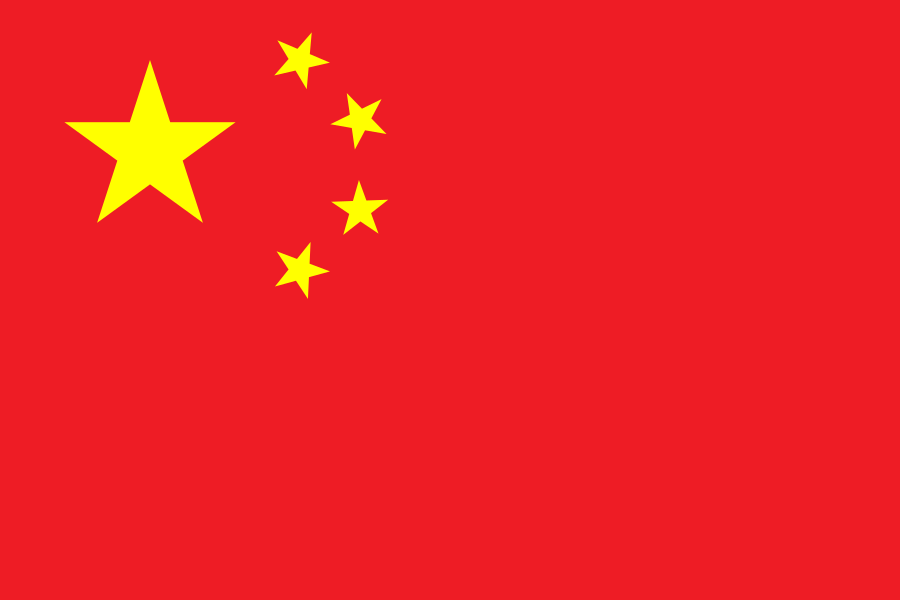
From Henan, he was a provincial cadre in Guangdong until purged in the Cultural Revolution, returned as Sichuan first secretary in 1975 and, with household contracting and enterprise autonomy, earned the saying “If you want to eat, look for Ziyang”. Premier from 1980 and general secretary from 1987, he pushed price reform and plans for political reform. In May 1989 he opposed martial law against the student protests, told students in the square “We have come too late”, and fell; he remained under house arrest in Beijing until his death in 2005. His secretly recorded memoirs were published posthumously in Hong Kong.
Career timeline
1975–1980First Secretary of the Sichuan Party Committee
1980–1987Premier of the State Council
1987–1989General Secretary of the Central Committee
Stalin's son-in-law who criticized Lysenko, recanted, then built Rostov University over 31 years as rector
Stalin at the Politburo, turning on Yuri Zhdanov: "What, don't you know that our entire agriculture rests on Lysenko?"
Son of Andrei Zhdanov and briefly Stalin's son-in-law, Yuri Zhdanov was appointed head of the CC Science Department at age 28 in 1947, becoming a key science-policy official in late Stalinism. In April 1948 he publicly criticized Lysenko's theories (Stalin summoned him to the Politburo with the rebuke "Don't you know our entire agriculture rests on Lysenko?") and Zhdanov was forced to publish a humiliating recantation in Pravda. He took part in the 1950 antisemitic campaign against Jewish scientists, yet after Stalin's death he rebuilt his career as rector of Rostov State University (1957–1988), transforming it over 31 years into one of the USSR's top universities. An organic chemist with over 800 publications, he discovered acylotropy and chaired the North Caucasus Scientific Center.
Career timeline
1941–1945Instructor and literary propagandist, Main Political Directorate, Red Army
1947–1948Head of the Science Department, Agitprop Directorate, CC VKP(b)
1948–1950Head of the Science Sector, Agitprop Department, CC VKP(b)
1950–1952Head of Science and Higher Education Department, CC VKP(b)/CPSU
1952–1953Head of Natural and Technical Sciences and Higher Education Dept, CC CPSU
1952–1956Member of the CPSU Central Committee
1953–1957Assistant, docent, professor, Rostov State University; Head of Science and Culture, Rostov obkom
Secret planner of the Cuban Missile Crisis deployment and last Chief of Staff of the Warsaw Pact Joint Armed Forces
In the early planning of Operation Anadyr, only five officers on the General Staff were privy to the secret. The plans were handwritten — every page — to deny knowledge of the operation to even a single secretary.
A Soviet General of the Army whose Cold War career ran from the General Staff operations directorate to high coalition command. As a senior operations officer in 1962, he drafted the initial plan for Operation Anadyr, the secret deployment of nuclear missiles to Cuba, and served on the ground during the crisis as the defence minister's personal representative to the Soviet force. He later commanded the Leningrad Military District (1973–1976) and served as Chief of Staff of the Warsaw Pact Joint Armed Forces from 1976 to 1989, the alliance's final peacetime holder of that post. After retirement, he co-authored the joint US–Soviet memoir Operation Anadyr (1994), disclosing the inner workings of the crisis from both sides.
Career timeline
1939–1940Tank platoon commander, 39th Light Tank Brigade; fought in the Winter War
1941–1945Operations officer and General Staff representative on Western, Bryansk, Kalinin, and Southern Fronts
1960–1965Chief and deputy chief of operations, Main Operations Directorate, General Staff
1962Planned Operation Anadyr; deployed to Cuba as representative of the Minister of Defence
1965–1968Commander, 7th Guards Army, Transcaucasus Military District
1973–1976Commander, Leningrad Military District
1976–1989Chief of Staff, Warsaw Pact Joint Armed Forces
1989–1992General Inspectors Group, USSR Ministry of Defence
The physicist who built the dosimetry for F-1's first criticality and founded the Soviet reactor radiation safety system
In 1944, demobilized after his third serious wound, Dubovsky appeared before Kurchatov on crutches. Kurchatov asked, "How will you work in that condition?" A month later Dubovsky returned without the crutches, using only a cane, and was hired at Laboratory No. 2.
A Soviet nuclear physicist from Kharkov University. Demobilized after being wounded at the front, he joined Kurchatov's Laboratory No. 2 in 1944, where he carried out radiation dosimetry measurements and gamma-ray shielding experiments during the assembly of the F-1 reactor, built neutron counters from scratch, and performed the plutonium accumulation calculations. He was one of the handful who remained in the control room when F-1 went critical on 25 December 1946; he went on to found the Soviet reactor radiation safety system and directed the physical startups of the Obninsk nuclear power plant (1954) and the Mayak plutonium production reactors.
Career timeline
1940Graduated Kharkov University, Faculty of Physics and Mathematics; worked at Kharkov Institute of Physics and Technology
1941–1943Front-line service, infantry battalion commander; demobilized after three wounds
Korolev's right hand who led the R-7 through design, mass production, and every successive variant
The 24-year-old lieutenant who lost his left arm in the fighting north of Vyborg in July 1944 was, thirteen years later, the lead designer of the world's first intercontinental ballistic missile, the R-7.
Appointed by Korolev as lead designer of the R-7, he directed the design of the 'Semyorka' and was then dispatched to Kuibyshev (Samara) to organize serial production of the R-7 family at the aviation plant there. In 1974 he founded the Central Specialized Design Bureau (TsSKB), spun off from OKB-1, as its first head and general designer, developing the Vostok, Molniya, and Soyuz launchers alongside reconnaissance and scientific satellite families. Across design, mass production, and successive variants of the R-7, his life's work built the spine of space transport from Sputnik to the Soyuz rockets of today.
Career timeline
1946–1951Engineer-constructor, NII-88 → OKB-1
1951–1958Lead designer, OKB-1: R-5 and R-7 ICBM
1958–1961Deputy chief designer, OKB-1; led R-7 serial production at Plant No. 1, Kuibyshev
The ambassador whose 24 years in Washington made him the hidden circuit of Soviet–American diplomacy
On the night of October 27, 1962, a secret meeting with Robert Kennedy. The Soviets would withdraw their missiles from Cuba; in an unpublicized assurance, the Americans would quietly remove their missiles from Turkey.
Soviet ambassador to the United States from 1962 to 1986, 24 years that made him the indispensable circuit of Cold War diplomacy. His secret backchannel with Robert Kennedy resolved the Cuban Missile Crisis, and his extraordinary relationship with Henry Kissinger drove détente and the SALT agreements.
Career timeline
1944Entered Higher Diplomatic School, part of the 'Stalin call-up' into diplomacy
1946Joined Foreign Ministry, served under Molotov and Gromyko
1952–1957Counsellor at the Soviet Embassy in Washington
1957–1959UN Deputy Secretary-General
1960–1962Head of the Foreign Ministry's Americas Department
1962–1986Ambassador to the US — served under six American presidents over 24 years
1986–1988CC Secretary and head of the International Department
The small-arms designer who became the face of Soviet defence industry: father of the AK-47
Six months before his death, to the Russian Orthodox Patriarch: "If my rifle claimed people's lives, can it be that I … a Christian and an Orthodox believer, was to blame for their deaths?"
The Soviet Union's defining small-arms designer and one of history's most consequential weapons engineers. Born into a kulak-deported peasant family, self-taught, Kalashnikov turned soldiers' frustration with unreliable rifles into the AK-47, adopted in 1949. It grew into a family (AKM, RPK, PK, AK-74) whose simplicity and low cost made it the most distributed infantry weapon on earth. He spent his postwar career at Izhevsk Machine-Building Plant, rising from sergeant to lieutenant general and serving six terms in the Supreme Soviet. Twice a Hero of Socialist Labour and winner of the Stalin, Lenin, and State prizes, he embodied Soviet military-industrial technocracy: a state-honoured designer who never grew rich. In old age he wrote the Orthodox Patriarch of his spiritual pain over the deaths his weapons caused, while insisting the AK was a weapon of defence.
Career timeline
1938–1941Tank mechanic and commander, Red Army; severely wounded at Bryansk
1942–1949Small-arms designer, Central Firing Range of GAU, Red Army
1949AK-47 adopted by Soviet Army; Stalin Prize 1st Class; moved to Izhevsk
The builder who transformed Kirghizia from an agrarian to an industrial republic across the Khrushchev-Brezhnev era
In his later memoirs, he wrote of the project that was both his greatest legacy and his heaviest burden: "The Toktogul Hydroelectric Station — my pride and my pain."
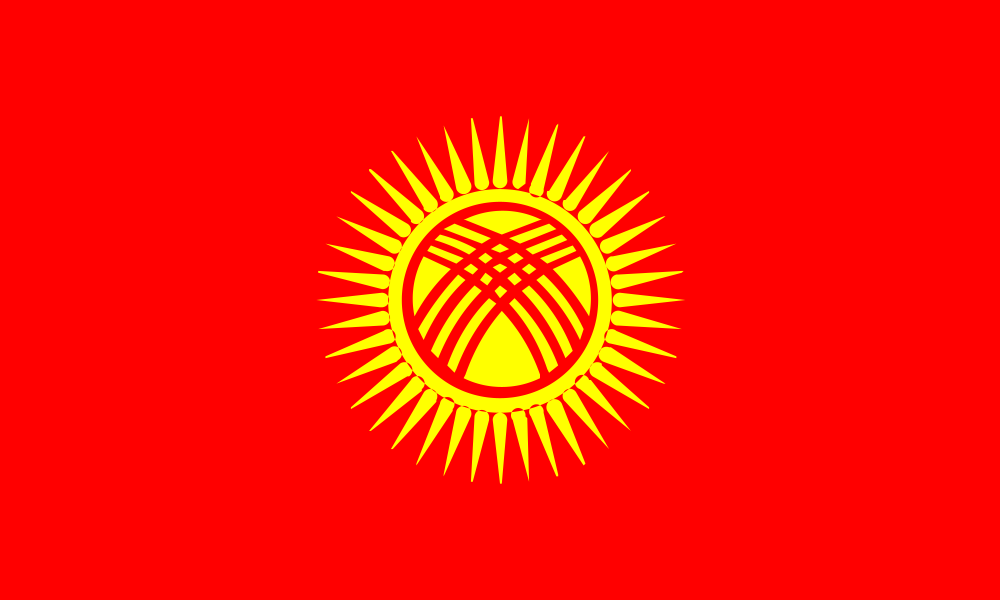
Born to a poor peasant family and beginning as a schoolteacher, this Kyrgyz politician spent ten years (1945–1955) as an instructor at the CPSU Central Committee in Moscow, gaining the all-Union party apprenticeship that would define his career. As First Secretary of the Communist Party of Kirghizia from 1961 to 1985, he oversaw the construction of 150 large industrial facilities, including the Naryn hydroelectric cascade, Toktogul HPP, and Manas International Airport, and delivered over 510,000 new apartments. Gross industrial output rose fivefold and electricity generation twelvefold, transforming the republic from agrarian to industrial. A full member of the CPSU Central Committee (1961–1986), he also served in the parliament of independent Kyrgyzstan (1993–2005) after retirement.
Career timeline
1937–1939Teacher and head of studies, Kochkor secondary school
1941–1942Deputy head, Propaganda and Agitation Dept., Kochkor District Party Committee
1942–1943Instructor, Propaganda and Agitation Dept., CC CP of Kirghizia
1945–1955Instructor, CPSU Central Committee (Moscow)
1955–1956Editor-in-chief, republican daily Sovettik Kyrgyzstan
1956–1958Head, Propaganda and Agitation Dept., CC CP of Kirghizia
1958–1961First Secretary, Frunze City Party Committee
1959–1961Chairman, Supreme Soviet of the Kirghiz SSR
1961–1985First Secretary, CC CP of Kirghizia
1961–1986Member, CPSU Central Committee
1993–2005Deputy, Jogorku Kenesh (Parliament) of the Kyrgyz Republic
From US-educated anthropologist to founder of Mozambique's liberation front
“Although I loved university life above all, I decided to devote the rest of my life to the war of liberation of my country, until it receives independence!”
A Mozambican anthropologist who earned his PhD in the United States, he gave up an academic career to fuse rival liberation groups into the Mozambican Liberation Front (FRELIMO). As its first president he launched the 1964 armed struggle and set the movement toward a socialist line, leading it until his assassination in 1969, six years before independence.
Career timeline
1953BA in anthropology and sociology, Oberlin College
1955MA, Northwestern University
1957–1961Research officer, UN Trusteeship Department; field research across Africa
1960PhD in anthropology, Northwestern University, under Melville J. Herskovits
1961–1963Assistant professor, Syracuse University; helped develop East African Studies Program
1962FRELIMO founded; elected first president
1964Launches armed liberation struggle against Portuguese colonial rule (25 September)
1968Second FRELIMO Congress adopts socialist line, protracted war strategy; re-elected president
1969.2.3Assassinated by letter bomb in Dar es Salaam, Tanzania
A career diplomat who worked the front lines of détente
On March 4, 1974, he presented his credentials as the U.S. ambassador to Moscow.
Walter Stoessel was a career American diplomat whose work centered on the Soviet Union and Europe during the Cold War. As ambassador in Moscow from 1974 to 1976, he represented Washington on the ground during détente and the negotiations surrounding the Helsinki process. He later served as ambassador to West Germany and Deputy Secretary of State.
Career timeline
1942–1944Served in the U.S. Army
1947–1953Worked on Eastern European and Soviet affairs at the State Department
1963–1965Deputy Chief of Mission, U.S. Embassy in Moscow
1968–1972U.S. Ambassador to Poland
1972–1974Assistant Secretary of State for European and Canadian Affairs
Top Allied fighter ace who scored 64 victories and was never downed by an enemy
«Bravery without tempering is a blank shot» — from his memoir Loyalty to the Fatherland.
The highest-scoring Allied fighter ace of the Second World War, with 64 solo victories across 330 sorties and 120 dogfights (and never shot down). A crack marksman, he habitually closed to 200–300 metres before firing. In February 1945 he became the first Soviet pilot to down a Messerschmitt Me 262 jet. Barred from combat flying in Korea, he commanded the 324th Fighter Aviation Division (1951–1952), whose pilots claimed 216 kills for the loss of only 27 MiG-15s. After serving as deputy commander of VVS Moscow Military District (1964–1971), he was promoted to Marshal of Aviation in 1985 and, at the 1990 Congress of People's Deputies, read the 'Appeal of Heroes' denouncing attacks on the armed forces.
Career timeline
1940Joined Red Army; graduated Chuhuiv Military Aviation School, retained as instructor
1943–1945Pilot → squadron commander → deputy commander 176th Guards Fighter Regiment. 64 victories, thrice Hero of the Soviet Union
1949Graduated Air Force Academy, Monino
1951–1952Commander, 324th Fighter Aviation Division, Korean War (call sign 'Krylov')
1956Graduated Voroshilov Higher Military Academy
1964–19711st Deputy Commander, Air Forces of Moscow Military District
1971–19781st Deputy Chief, Combat Training Directorate of the Air Force
In December 1975 he proclaimed the abolition of the monarchy and the establishment of the Lao People's Democratic Republic before the National Congress of People's Representatives.
Lao People’s Revolutionary Party leader and prime minister after the republic’s establishment in 1975. He maintained close Vietnamese ties and led state reorganization and market-oriented reforms in the 1980s. He became president in 1991.
Career timeline
1942Joined the Indochinese Communist Party
1947Led resistance in northeastern Laos, organized armed forces
1949Founded the Lao People's Liberation Army
1950Minister of Defense of the Resistance Government
1955General Secretary of the Lao People's Revolutionary Party
1975First Prime Minister of the Lao People's Democratic Republic
1986Announced the 'new economic mechanism' (chin thanakan mai) reforms