The last Minister of Foreign Trade, who inherited a 27-year incumbent's post only to see the ministry itself abolished on his watch
In October 1985, Aristov succeeded Nikolai Patolichev—who had run Soviet foreign trade for 27 years—as Minister of Foreign Trade; just two years and three months later, perestroika reforms abolished the ministry itself.
A Soviet party-state official and diplomat. Starting as an engineer at Leningrad's Svetlana factory, he rose through the party apparatus to become First Secretary of the Leningrad City Committee (1971–1978). He then pivoted to diplomacy, serving as ambassador to Poland (1978–1983) and deputy foreign minister (1983–1985) before being appointed Minister of Foreign Trade in 1985, succeeding Nikolai Patolichev after his 27-year tenure. Under perestroika reforms, however, the Ministry of Foreign Trade was abolished in January 1988 and merged into the new Ministry of Foreign Economic Relations, making Aristov the last holder of the office. He finished his career as ambassador to Finland (1988–1992), witnessing the Soviet collapse from Helsinki and briefly continuing as Russian Federation ambassador.
Career timeline
1941–1942Bookkeeper, '1st of May' kolkhoz, Yaroslavl oblast
The dissident biologist who argued the archives contain no evidence Stalin planned a Jewish deportation
After his 1970 release from the psychiatric hospital: "No honest and principled scholar can be sure of his safety if such grounds can lead to repression in the form of indefinite confinement in a psychiatric hospital."
A Soviet biologist and dissident historian. Born in Tbilisi, he studied at the Timiryazev Agricultural Academy and researched the molecular mechanisms of aging. In 1962 he wrote a samizdat manuscript exposing Trofim Lysenko's pseudoscience, published in the US in 1969 as The Rise and Fall of T.D. Lysenko, which brought international attention to the corruption of Soviet biology. In 1970 he was forcibly confined in a psychiatric hospital and released after protests by Sakharov, Solzhenitsyn, and others; in 1973, while on a scientific visit to London, he was stripped of his Soviet citizenship and spent the rest of his life in exile. His late work Stalin and the Jewish Problem (2003) argued that no archival documents support the claim that the Doctors' Plot was meant to trigger a mass deportation of Soviet Jews.
Career timeline
1925Born in Tbilisi (Tiflis), named after French socialist leader Jean Jaurès
1943Drafted into the Red Army, seriously wounded on the Taman Peninsula and discharged
1950Graduated from Timiryazev Agricultural Academy; Candidate of Biological Sciences
1962Dismissed from Timiryazev Academy over samizdat manuscript criticizing Lysenko's pseudoscience
1963–1969Head of molecular radiobiology lab, Institute of Medical Radiology, Obninsk
1970Forcibly confined in Kaluga psychiatric hospital; released after protests by Sakharov, Solzhenitsyn, and others
1973Stripped of Soviet citizenship while on research leave in London; remained in exile in Britain
1990–1992Soviet citizenship restored by Gorbachev; joined Chernobyl exclusion zone radiobiological expeditions
Architect of KGB ideological counterintelligence, 45-year Chekist under 12 chiefs
"We in the KGB contributed quite a bit to perestroika because without it the Soviet Union could not move ahead."
Bobkov served 45 years in Soviet state security under twelve chiefs, designing the KGB's ideological counterintelligence apparatus as head of the Fifth Directorate to surveil and suppress dissidents, religious activists, and nationalists. In old age he acknowledged responsibility for exiling Sakharov, and after the Soviet collapse he ran security analysis for oligarch Vladimir Gusinsky's Most Group.
Career timeline
1942–1945Red Army, Western & Baltic fronts, wounded twice
1946Graduated Leningrad SMERSH school, MGB central apparatus
1956Dept. chief, KGB 4th Directorate (ideological counterintelligence)
1961Deputy chief, KGB 2nd Chief Directorate (counterintelligence)
1969–1983Chief, KGB 5th Chief Directorate (ideological → constitutional)
He worried that the Malta Summit was premature, yet ultimately helped make it happen.
Brent Scowcroft was a former U.S. Air Force officer and national-security official whose realist approach emphasized disciplined policy coordination between presidents, diplomats, and military leaders. As national security adviser to Gerald Ford and George H. W. Bush, he helped manage arms policy and European diplomacy during the final years of the Cold War. He initially regarded the 1989 Malta Summit as premature because it might raise expectations without producing results, but then helped the administration navigate the meeting and the rapid transformation of U.S.-Soviet relations. In later years he continued to favor alliances and international institutions, criticizing the Iraq invasion and unilateralism.
Career timeline
1947Graduated from West Point and commissioned as a U.S. Air Force second lieutenant
1953Earned an M.A. in international relations from Columbia University
1967Earned a Ph.D. in international relations from Columbia University
1972–1973Military Assistant to President Richard Nixon
1973–1975Deputy Assistant to the President for National Security Affairs
1975–1977National Security Adviser to President Gerald Ford
1989–1993National Security Adviser to President George H. W. Bush
2001–2005Chairman of the President's Foreign Intelligence Advisory Board
The British economic historian who built the seven-volume chronicle of Soviet industrialisation
In his final volume he wrote: "While my view of Soviet history has changed… when the details of history are in conflict with preconceived ideas, the latter should give way… I remain on the Left, believing… that a better organization of society is possible."
A British economic historian. He co-authored Foundations of a Planned Economy with E. H. Carr and carried Carr's work forward into the 1930s, completing the seven-volume The Industrialisation of Soviet Russia. In The Years of Hunger (2004), co-authored with Stephen Wheatcroft, he used post-Soviet archives to estimate famine deaths at 5.5–6.5 million and argued the famine was not a planned genocide but the result of procurement-first policy, harvest failure, and belated leadership response. A member of the Communist Party of Great Britain in his youth, he left after the 1956 Soviet invasion of Hungary and remained on the Left, holding that 'a better organization of society is possible.'
Career timeline
1943–1946RAF radio communications service
1950BA, SSEES, University of London
1954PhD, University of Birmingham (Soviet budgetary system)
1954–1956Assistant lecturer, Institute of Soviet Studies, Glasgow
From Let History Judge: "I have never betrayed either my convictions or the ideals of my youth. In this I see my father's influence; he was able to instill in me his commitment to socialism, though my ideas about socialism have of course changed. I could not have written my books other than out of deep conviction."
Soviet Marxist historian and communist publicist. From the 1960s he participated actively in the dissident movement, editing the samizdat journal Political Diary. His magnum opus, Let History Judge (nearly two decades in the making), subjected Stalinism to a meticulous, source-based Marxist critique and led to his expulsion from the CPSU in 1969. He never abandoned his socialist convictions; reinstated in 1989, he served as a People's Deputy, Supreme Soviet member, and Central Committee member. He authored over 35 books, pioneering a tradition of self-critical Marxist historiography within the socialist movement.
Career timeline
1925Born in Tiflis, named after Indian communist M. N. Roy
1946–1951Graduated with honors from the Philosophy Faculty of Leningrad State University; Komsomol secretary
1958Candidate of Pedagogical Sciences, Moscow State Pedagogical Institute
1960sEdited the samizdat journal Political Diary; active in dissident circles
1969Expelled from the CPSU for Let History Judge
1970Co-signed open letter with Sakharov and Turchin to the Brezhnev leadership on democratization
1989–1991People's Deputy of the USSR, Supreme Soviet member; reinstated in CPSU, Central Committee member
1991–2002Co-chairman of the Socialist Party of Working People of the Russian Federation
The ideology cadre who drafted the Action Programme, then served normalization to the end
In early 1968, in his Questions of Peace and Socialism office in Prague, Auersperg set the drafting group to work: Mlynář, Richta, Šik, and the others writing the Action Programme chapter by chapter.
A KSČ ideology cadre who personally wrote Part V of the Action Programme and led the working group that produced the defining document of the Prague Spring. He built his career as Antonín Novotný's secretariat chief, then as head of the party's Ideological Department from 1965, where he enforced censorship over culture and scholarship with a hard hand. In early 1968 he hosted the drafting team in his Questions of Peace and Socialism office and delivered the text adopted on 5 April. After the Warsaw Pact invasion, he broadcast for the pro-Soviet radio from Dresden and served Husák's normalization regime as head of international politics and, ultimately, as ambassador to the Netherlands.
Career timeline
1949–1954Assistant, Faculty of International Relations, University of Political and Social Sciences, Prague
1956Consultant for international questions, ÚV KSČ
1963–1964Head of secretariat of First Secretary Antonín Novotný
1965–1968Head of Ideological Department, ÚV KSČ; candidate member of ÚV
1969–1974Chief of International Politics Department, ÚV KSČ; full member of ÚV
1971–1986Deputy, Chamber of Nations, Federal Assembly
1974–1986KSČ representative, editorial board of Questions of Peace and Socialism
1986–1987Ambassador of Czechoslovakia to the Netherlands
Soviet submarine officer who refused to launch a nuclear torpedo and prevented nuclear war
Thomas Blanton, director of the U.S. National Security Archive, called Arkhipov "the man who saved the world."
Soviet Navy vice admiral. During the Cuban Missile Crisis of 1962, as chief of staff of the 69th Submarine Brigade aboard submarine B-59, he alone refused to authorize a nuclear torpedo launch when the captain and political officer had both consented, preventing a likely nuclear exchange. He had previously served aboard the nuclear submarine K-19 during its 1961 reactor coolant accident, suffering radiation exposure while helping to avert a meltdown. He later commanded the 69th Brigade and the 37th Submarine Division, and served as head of the Caspian Higher Naval School from 1975 to 1985.
Career timeline
1945Served in Soviet–Japanese War on Pacific Fleet minesweeper (cadet)
1947Graduated from Caspian Higher Naval School
1961Executive officer of nuclear submarine K-19 during reactor coolant accident
1961–1964Chief of Staff, 69th Submarine Brigade, Northern Fleet
Author and technical director of the 'Shelter' that encased Chernobyl's ruined Reactor 4
He personally climbed into a 'bathyscaphe' suspended from a crane hook to survey the ruined reactor.
A Soviet nuclear construction engineer from Tambov, he joined VNIPIET in 1953 after graduating from the Leningrad Institute of Civil Engineering and spent his entire career at that one institute. He led the project to remediate the 1957 Kyshtym disaster, and in 1986 became the author and technical director of the 'Shelter' (Sarcophagus) that sealed Chernobyl's Reactor 4 in just 206 days: he personally surveyed the ruined reactor suspended in a 'bathyscaphe' from a crane hook and devised engineering solutions without world precedent. He later served as general director of VNIPIET (1989–1998), contributing to the recovery from the Arzamas explosion and the Kirovakan earthquake.
Career timeline
1953Joined VNIPIET as an engineer
1957Led the Kyshtym (Chelyabinsk-65) accident remediation project
1985–1989Chief engineer, VNIPIET
1986Author and technical director, 'Shelter' (Sarcophagus) project, Chernobyl Reactor 4
1989–1998General director, VNIPIET
1996Awarded Honoured Builder of the Russian Federation
A non-dogmatic Marxist who reflected on the Prague Spring
He argued that the Prague Spring was buried again after 1989, following its burial under the Husák regime.
Karel Kosík was a Czech philosopher who reworked Marxism as a philosophy of human praxis and concrete historicity. His major work, Dialectics of the Concrete (1963), placed Marx in dialogue with Heideggerian phenomenology and earned international recognition. A leading intellectual of democratic socialism during the Prague Spring, he was expelled from the Communist Party and excluded from university life during normalization. After 1989, he argued that the memory and emancipatory promise of the reform had been buried first by the Husák regime and again by the neoliberal order, making him central to debates over the event’s legacy.
Career timeline
1943–1944Joined the left-wing underground resistance Předvoj and edited an illegal journal
1944–1945Arrested by the Gestapo and imprisoned in Theresienstadt concentration camp
1953–1968Researcher at the Czechoslovak Academy of Sciences Institute of Philosophy
1963Published Dialectics of the Concrete
1968–1969Professor of philosophy at Charles University and member of the Communist Party Central Committee
1970–1989Dissident intellectual, excluded from university life after expulsion from the Communist Party
1990–1992Lectured in philosophy at Charles University
1992–2003Researched and wrote at the Czech Academy of Sciences Institute of Philosophy
He read Spain’s revolution not as a side episode of the war, but as a defeated social revolution.
Pierre Broué was a French Trotskyist historian and teachers’ activist who studied communism and twentieth-century revolutionary movements. His 1961 history of the Spanish Revolution and Civil War, written with Émile Témime, interpreted the defeat of the revolutionary process through the clash of class forces inside the Republic and Stalinist policy. He combined political commitment with archival and editorial work on Trotsky and the Trotskyist movement.
Career timeline
1944Joined the Parti communiste internationaliste and entered the Trotskyist movement
1953Completed an early historical study of a historian of the French Revolution
1960–1965Taught history and geography in secondary schools
1961Published La Révolution et la guerre d’Espagne with Émile Témime
1965–1975Taught contemporary history at Grenoble’s institute of political studies and organized in the OCI
1972Published Révolution en Allemagne, 1917–1923
1977Founded the Institut Léon Trotsky
1997Published Histoire de l’Internationale communiste, 1919–1943
Poland's last communist prime minister, rejected by voters in the 1989 election
At the Gdańsk shipyard in 1983, surrounded by Solidarity workers, when Wałęsa said 'Let's talk as Pole to Pole,' Rakowski replied: 'Let's talk as doctor to doctor.'
A reformist politician of the Polish United Workers' Party (PZPR) and editor-in-chief of the weekly Polityka for 24 years, he was one of Poland's most visible communist intellectuals. Becoming prime minister in October 1988, he pushed through the Round Table talks and market-oriented economic reforms (the Wilczek Law), but on 4 June 1989 he stood on the uncontested National List and still fell short of the 50% threshold, a defeat that became the symbol of the regime's collapse. After the electoral debacle he served as the PZPR's last First Secretary and presided over the party's dissolution in January 1990.
Career timeline
1958Editor-in-chief of Polityka
1972–1989Member of the Sejm
1981–1985Deputy prime minister in Jaruzelski cabinet
1988–1989Prime Minister of the Polish People's Republic
1989Defeated on National List in 4 June election
1989–1990Last First Secretary of the PZPR, presides over dissolution
Engineer-turned-minister who led the modernization of Soviet communications infrastructure
When the Ekran direct satellite broadcasting system went live in 1981, viewers in the remotest corners of Siberia and the Far East could watch Moscow television with nothing more than a simple antenna. Shamshin received the Lenin Prize for the achievement.
A communications engineer by training, he led development of Orbita, the world's first satellite TV distribution network, and the direct-broadcast Ekran system, then served as USSR Minister of Communications from 1980 to 1989, building the Unified Automated Communications Network that brought television to the vast majority of Soviet homes. After leaving office he chaired the board of Rostelecom, helping to carry Russia's telecommunications industry through the transition.
Career timeline
1949Engineer, lead designer, and senior researcher at NII-100, Ministry of Communications
1958Laboratory head at NIIDAR, contributing to the ultra-long-range ballistic missile detection radar system
1965Deputy Director for Science, NII Radio (NIIR) — led development of Orbita and Ekran satellite systems
1968Deputy Minister of Communications of the USSR
1976First Deputy Minister of Communications of the USSR
1980–1989Minister of Communications of the USSR
1992–1997Chairman of the Board, Moscow Long-Distance and International Telephone (OJSC)
A historian who traced revolutionary pluralism and the making of Stalinism
Against models of communism as an immutable system, Daniels argued that the movement was an evolutionary product of circumstances.
Robert Vincent Daniels was an American historian and educator who traced competing possibilities within the Russian Revolution and Soviet politics. His landmark book The Conscience of the Revolution examined early Communist pluralism, resisting the idea that Stalin’s collectivization and concentration of power were inevitable outcomes of the revolution. Daniels distinguished the Opposition’s industrialization program from Stalin’s violent implementation, while cautioning against exaggerating foreign-policy differences between the factions. His later scholarship and textbooks brought debates in Soviet history to generations of students.
Career timeline
1926–1946Born; served in the U.S. Navy and earned an A.B. in economics from Harvard
1950Earned a Harvard Ph.D. in history
1950년대Taught at Bennington College and Indiana University
1956–1988Professor of history at the University of Vermont
1960Published The Conscience of the Revolution
1967Published Red October
1973–1982Democratic member of the Vermont State Senate
1992President of the American Association for the Advancement of Slavic Studies
Stalin's only daughter and the Kremlin's first insider witness to defect to the West
In a 2010 interview she said of her father: "He broke my life" — when he refused to let her study literature and when he had Aleksei Kapler arrested.
The only daughter of Joseph Stalin, she defected to the United States via India in 1967 and caused an international sensation with the first insider memoir of Kremlin life. Twenty Letters to a Friend (1967) exposed her father's private character and the world of the Soviet ruling elite; she returned to the USSR in 1984, left again in 1986, and spent her life unable to escape Stalin's shadow.
Career timeline
1949Graduated History Faculty, Moscow State University
1954Awarded Candidate of Philological Sciences degree
1956–1967Researcher and translator, Institute of World Literature
1967Defected to the US via India; published Twenty Letters to a Friend
1978Naturalized US citizen as Lana Peters
1984–1986Returned to the USSR, then left again for the United States
The last RSFSR premier who tried not to break Russia away
October 1989, at the CC CPSU meeting on the RSFSR political system: "Creating a separate Russian Communist Party is the path to splitting the Soviet Union." He directly opposed Gorbachev's plan.
A Soviet institutional figure who rose from aviation plant engineer to first secretary of the Kuibyshev and Voronezh regions. Sidelined as ambassador to Cuba under late Brezhnev, he was politically revived when Andropov sent him to Krasnodar to purge corruption. In 1983 he became chairman of the RSFSR Council of Ministers and a full Politburo member, leading the Russian republic's government for five years; immediately after Chernobyl he served as deputy chairman of the government commission dealing with the disaster. In 1988 he moved to chairman of the RSFSR Supreme Soviet Presidium, but when Gorbachev pushed for a separate Russian Communist Party in the final years of perestroika, Vorotnikov openly opposed it, defending the RSFSR within the union framework to the end.
Career timeline
1942–60Kuibyshev aviation plant: engineer → party committee secretary
The Czech writer who declared 'not one human question has been solved in twenty years' and authored the 'Two Thousand Words' manifesto
When Vaculík declared at the 1967 Writers' Congress that 'not one human question has been solved in the last twenty years,' the party delegation walked out and the audience erupted in long applause.
A Czech writer and Communist Party member who was expelled after his speech at the 1967 Fourth Congress of Czechoslovak Writers openly indicted the Novotný regime, declaring that 'not one human question has been solved in the last twenty years.' In June 1968 his manifesto 'Two Thousand Words' called on citizens to press for deeper reform through their own initiative, becoming a defining text of the Prague Spring and a pretext for Soviet intervention. Banned from publishing after the invasion, he founded the samizdat series Edice Petlice (Padlock Editions), which circulated works by banned writers including Václav Havel and Ivan Klíma for seventeen years. A Charter 77 signatory, he continued his criticism of the regime and, after 1989, wrote a weekly column for Lidové noviny until his death in 2015.
Career timeline
1945–1967Member, Communist Party of Czechoslovakia
1959–1965Editor, youth programming, Czechoslovak Radio
1965–1969Editor, Literární noviny (later Literární listy)
1967Expelled from the KSČ after his speech at the Fourth Congress of Czechoslovak Writers
1968Authored and published the 'Two Thousand Words' manifesto
1969–1989Banned from official publication; underground samizdat activity
1973–1990Founder and operator of Edice Petlice (Padlock Editions) samizdat press
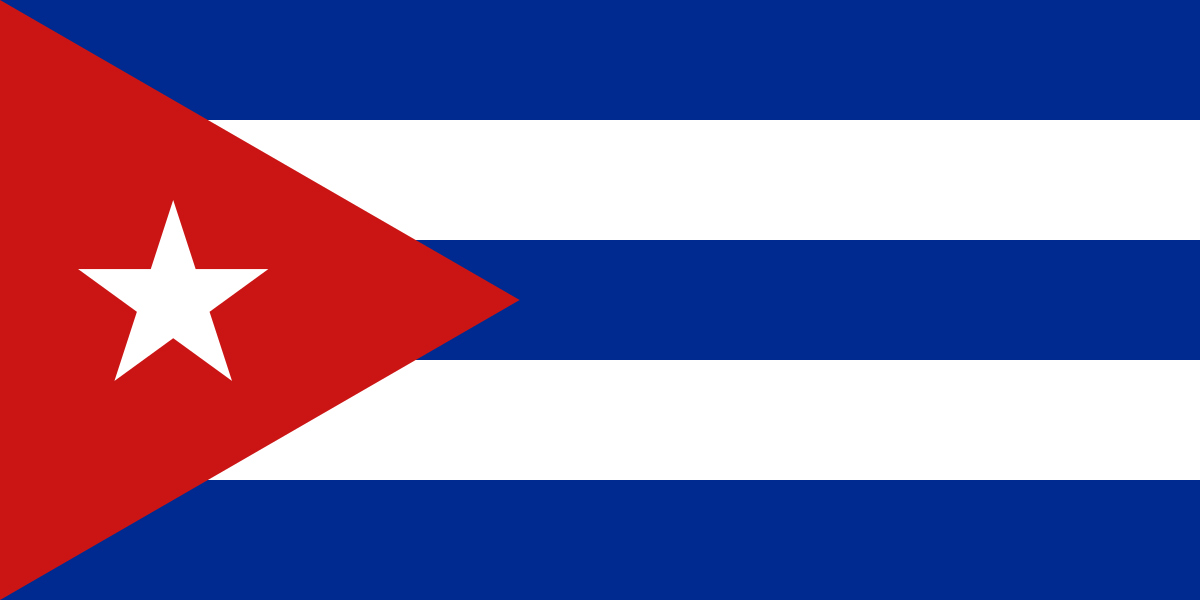
Leader of the hemisphere's first socialist revolution: forty-seven years against imperialism
“History will absolve me.” — courtroom speech after Moncada, 1953
Leader of Latin America's first successful socialist revolution. He opened the struggle against the Batista dictatorship with the 1953 Moncada attack, seized power through guerrilla war in 1959, and defended socialist Cuba for forty-seven years against US blockade and pressure.
Career timeline
1953The Moncada attack — 'History will absolve me'
1954Clandestinely published his courtroom defense as History Will Absolve Me
1956–1959Lands from the Granma; guerrilla war in the Sierra Maestra
1959Overthrows Batista; the revolutionary government
1961–1962Repels the Bay of Pigs invasion; the Missile Crisis
In October 1985 Gorbachev unveiled Gosagroprom, merging six agricultural ministries, confessing he had "carried this idea for many years." A month later Murakhovsky was named its chairman — yet within six months he conceded the reform had failed.
A wartime veteran who joined the Red Army at 15 and fought in the defense of Novorossiysk and the Manchurian operation. As Mikhail Gorbachev's handpicked successor as First Secretary of Stavropol Krai (1978–1985), he drove agricultural and industrial growth that earned him the title Hero of Socialist Labor. When Gorbachev became General Secretary, he brought Murakhovsky to Moscow as First Deputy Premier and the inaugural chairman of Gosagroprom, merging six agricultural ministries into a single super-agency. The bureaucratic behemoth proved inefficient, and the agency was abolished in 1989 along with Murakhovsky's departure.
The Soviet Union's foremost Germany expert who opposed Gorbachev's concessions during reunification negotiations
“In the early 1980s, West Germany offered an interest-free credit of 100 billion marks just for the withdrawal of Soviet troops and the GDR leaving the Warsaw Pact. Gorbachev accepted 14 billion at Arkhyz.” — on the price of German reunification
The Soviet Union's foremost expert on Germany, Falin began his diplomatic career as a speechwriter for Khrushchev and Gromyko before serving as ambassador to West Germany (1971–1978). As head of the CPSU International Department (1988–1991) and CC Secretary (1990–1991), he ran a parallel foreign-policy apparatus alongside the Foreign Ministry. He was the most prominent voice in the Soviet leadership opposing Gorbachev's rapid concessions during German reunification talks, and in 1989 co-formulated the Falin-Kvitsinsky doctrine, which sought to replace declining Soviet military influence in Eastern Europe with energy dependency. He later argued Moscow could have demanded up to 100 billion marks in return for accepting a unified Germany in NATO.
Career timeline
1950–1952Soviet Control Commission in Germany
1952–1958Committee of Information, USSR Foreign Ministry
1959–1971Head of 3rd European (German) Dept, MFA; adviser to Gromyko; Khrushchev speechwriter
1971–1978Ambassador of the USSR to West Germany
1978–1982First Deputy Chief, International Information Dept, CC CPSU
1983–1986Political observer, Izvestia (in disgrace)
1986–1988Chairman, Novosti Press Agency (APN)
1988–1991Head of the International Department, CC CPSU
1990–1991Secretary of the CC CPSU
1992–2000Professor, Institute for Peace Research and Security Policy, University of Hamburg
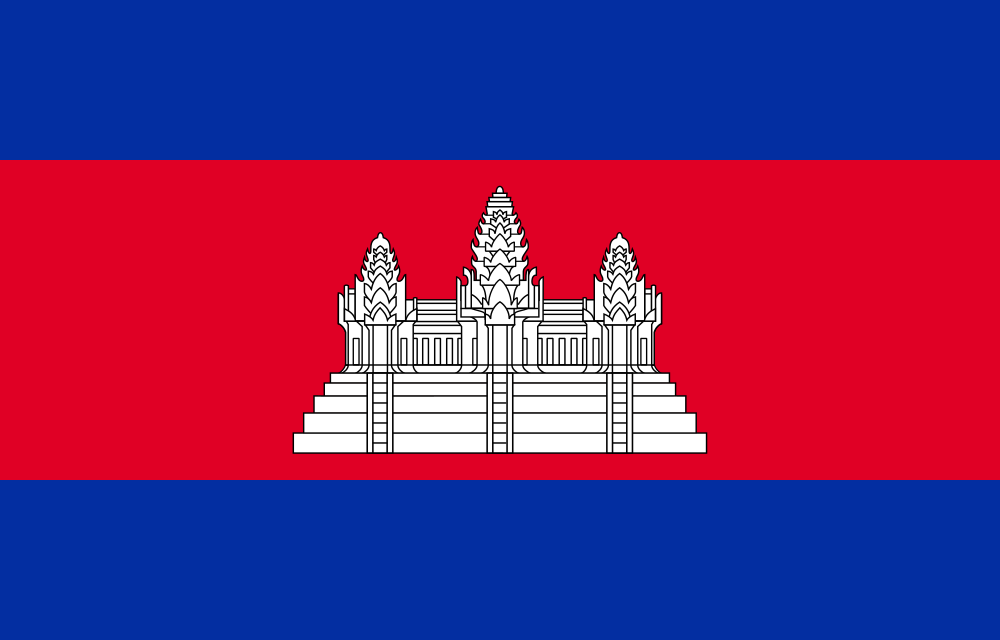
Convicted of genocide against the Cham and Vietnamese in November 2018, he died on 4 August 2019 while serving his sentence and his appeal was pending; the Supreme Court Chamber found no legal grounds to annul the judgment and let the trial findings stand.
Cambodian revolutionary and chief ideologist of the Communist Party of Kampuchea (Khmer Rouge), serving as its Deputy Secretary. Known as 'Brother Number Two' to Pol Pot, he chaired the People's Representative Assembly and briefly served as acting Prime Minister of Democratic Kampuchea. Convicted of crimes against humanity in 2014, he was given a life sentence on 16 November 2018 for genocide against the Vietnamese and Cham and grave breaches of the Geneva Conventions.
Career timeline
1960–1998Deputy Secretary and chief ideologist of the Communist Party of Kampuchea
1970Played a major role in negotiating North Vietnamese entry into Cambodia
1976–1979Chairman of the People's Representative Assembly of Democratic Kampuchea and briefly acting Prime Minister
1998Surrendered to Cambodian government forces in December
2007Arrested on 19 September
2014Sentenced to life for crimes against humanity in Case 002/01 on 7 August, upheld on appeal on 23 November 2016
2018Convicted in Case 002/02 on 16 November of genocide against the Cham and Vietnamese, with the life sentences merged into one
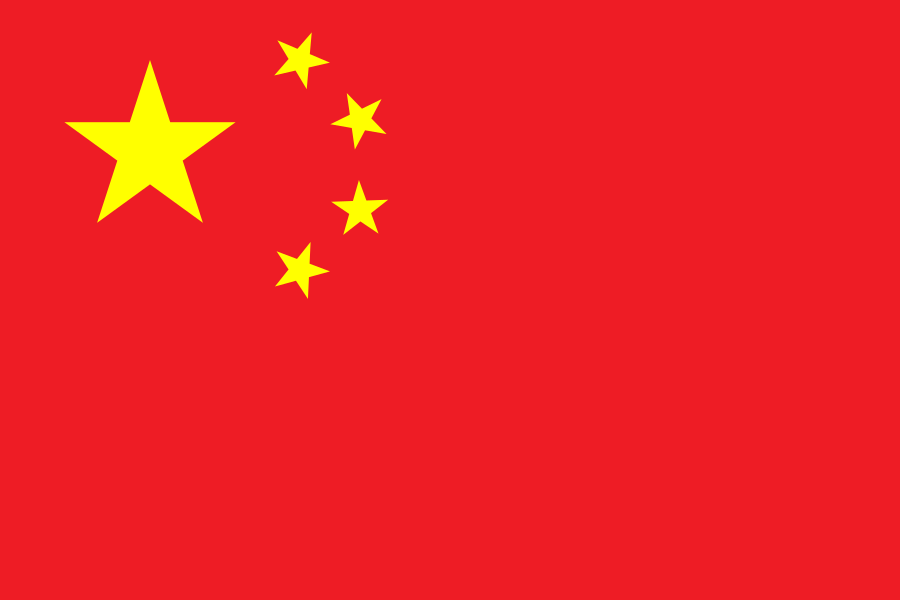
The “core” plucked from Shanghai in 1989 who led post-Tiananmen China into the market economy and the “Three Represents”
The compromise leader plucked from Shanghai after the 1989 Tiananmen crackdown, he became the "core" of the third generation and steered the party toward a market economy.
An electrical engineer from Jiangsu who trained at a Soviet car plant, he became mayor of Shanghai in 1985 and its party secretary in 1987. In 1989 he closed the liberal World Economic Herald and defused the Shanghai protests without major bloodshed, and in June was chosen to replace Zhao Ziyang as general secretary. After Deng Xiaoping’s southern tour in 1992 he made the “socialist market economy” the party’s goal and oversaw state-enterprise reform, WTO accession and the return of Hong Kong. Stepping down as general secretary in 2002 and Military Commission chairman in 2004, he left the “Three Represents”, which opened the party to private entrepreneurs. He died of leukaemia in 2022.
Career timeline
1989–2002General Secretary of the Central Committee
1993–2003President of the People’s Republic of China
A Belarusian party leader who combined agricultural development with late-Soviet reform
He called himself a “progressive conservative” who restrained innovation pursued merely for its own sake.
An agricultural specialist by training, Yefrem Sokolov rose through local administration and party work to become a practical leader of Soviet Belarus. He expanded the Brest region's productive infrastructure through large livestock complexes and road construction, receiving the title Hero of Socialist Labour in 1986. During perestroika he called for clearer ownership rules and wider republican economic authority, and ordered the publication of maps showing radioactive contamination in Belarus after the Chernobyl disaster, while describing himself as a progressive conservative wary of innovation for its own sake. He left the republican party leadership in 1990 and briefly served on the CPSU Politburo that year.
Career timeline
1944–1950Served in the Red Army's 5th Separate Reserve Sapper Regiment
1956–1958Agronomist and agricultural inspector in Brest Region
1958–1961Second secretary of the Ivanovo district party committee
1961–1965First secretary of the Urlyut yub district party committee and other posts in the Kazakh SSR
1969–1977Deputy head and head of the agricultural department of the Communist Party of Belarus Central Committee
1977–1987First secretary of the Brest Regional Party Committee
1987–1990First secretary of the Communist Party of Belarus Central Committee
1990Member of the CPSU Central Committee Politburo
His name 'Rafiq' means 'comrade' in Arabic. When Gorbachev elevated him to chairman of the Soviet of Nationalities, Ukrainian Komsomol leader Valeriy Tsybukh dubbed him 'Gorbachev's personal Rafiq.'
Born the son of a farm laborer, he rose through the Tashkent city party and the republic foreign ministry to become First Secretary of the Uzbek Communist Party in 1988. Tasked with stabilizing the republic after the Rashidov cotton scandal, he earned Gorbachev's confidence and was elevated the following year to chairman of the Soviet of Nationalities. An Uzbek who reached the highest federal tier, he presided over the multinational Union's final parliament as the state itself dissolved around him.
Career timeline
1950s–1970sRises through Uzbek republic diplomatic and party administration
1986–1988First Secretary of the Uzbek Communist Party after Rashidov, managing the post-scandal republic
1989–1991Chairman of the Soviet of Nationalities, the last representative line during the Union’s collapse
1991His office disappears amid the August coup and dissolution of the Union
1991 이후Lives in Russia after 1991 as a late-Soviet republic elite figure