The editor who built the political economy of socialism as a discipline
Summer 1949: removed from Bolshevik magazine by Central Committee decree for calling Voznesensky's War Economy of the USSR a 'major Marxist-Leninist work.'
Soviet economist, corresponding member of the Academy of Sciences. As editor-in-chief of Voprosy Ekonomiki (1957–1965), he institutionalized the political economy of socialism as a discipline. His 1929 grain market study provided the theoretical basis for collectivization.
Career timeline
1903Born in Minsk, son of a doctor (Jewish family)
1924Graduated from Plekhanov Institute of National Economy
1927Joined the All-Union Communist Party (Bolsheviks)
1928–1931Head of price sector, Gosplan; helped draft the first and second five-year plans
1931–1936Institute of Economics, Communist Academy; head of Soviet trade section
1933–1937Head of trade turnover and national economic balance departments, TSUNKHU
1939–1949Institute of Economics, USSR Academy of Sciences; editorial board, Bolshevik magazine
1949Dismissed from Bolshevik and Higher Party School for praising Voznesensky's book
1957–1965Editor-in-chief, Voprosy Ekonomiki
1960Elected corresponding member, USSR Academy of Sciences (political economy)
1965–1971Director, Institute of Economics, USSR Academy of Sciences
The Marshal who planned the liberation of Ukraine and the Balkans, then commanded the Strategic Rocket Forces
On 19 October 1964, Marshal Biryuzov was flying to Belgrade — the city whose liberation he had helped plan twenty years earlier. In dense fog, his Il-18 struck Mount Avala, killing all aboard. He met his end in the skies above the city he had freed.
Born to a working-class family in Ryazan, Biryuzov volunteered for the Red Army in 1922. Wounded five times in the first year of the German invasion while leading his division in combat, he later served as Tolbukhin's chief of staff on the Southern, 4th Ukrainian, and 3rd Ukrainian fronts, planning the offensives that liberated Ukraine, Bulgaria, and Yugoslavia. After the war he commanded the Air Defence Forces, then the Strategic Rocket Forces, and became Chief of the General Staff in 1963. He died in a plane crash on Mount Avala while en route to the 20th anniversary of Belgrade's liberation; Tito made him People's Hero of Yugoslavia posthumously.
Career timeline
1922Volunteered for the Red Army; infantry and machine-gun courses
1926Graduated VTsIK Combined Military School; platoon commander
1937Graduated Frunze Academy; chief of staff, 30th Rifle Division
1939–1942CO, 132nd Rifle Division — wounded 5 times in a year; Smolensk and Moscow
1942–1943Chief of Staff, 2nd Guards Army — Operation Saturn after Stalingrad
1943–1944Chief of Staff, Southern/4th Ukrainian Front — Donbass and Crimea liberation
1944Chief of Staff, 3rd Ukrainian Front — Jassy-Kishinev and Belgrade offensives
1944–1946CO, 37th Army; head of Soviet military mission to Bulgaria
1955–1962C-in-C, Soviet Air Defence Forces; Marshal of the Soviet Union (1955)
1962–1963C-in-C, Strategic Rocket Forces
1963–1964Chief of the General Staff and First Deputy Minister of Defence
The Bashkir-born financial technocrat who ran Gosbank through the Kosygin reform
Stripped of his party card and placed under criminal investigation for the sole offence of going hunting with an 'enemy of the people,' he was cleared only when the Bashkir Central Executive Committee itself intervened.
Born into a working-class Ufa family, he began working at eleven and entered state service as a Bashkir tax agent in 1923, staying in finance for life. After the Leningrad Financial-Economic Institute and heading Ufa finance departments, he became RSFSR Deputy Finance Commissar in 1940, RSFSR Finance Commissar the next year, and postwar served as Deputy and First Deputy USSR Minister of Finance under Zverev and Garbuzov. Appointed Gosbank Chairman in August 1963, he executed the credit and settlement side of Kosygin's 1965 reform (profit indicators, sovkhoz khozraschet, guaranteed kolkhoz pay (1966)) and created Gosbank RSFSR. In 1937 he was briefly accused of ties to an 'enemy of the people' because the two had gone hunting together, but the Bashkir Central Executive Committee intervened to reinstate him.
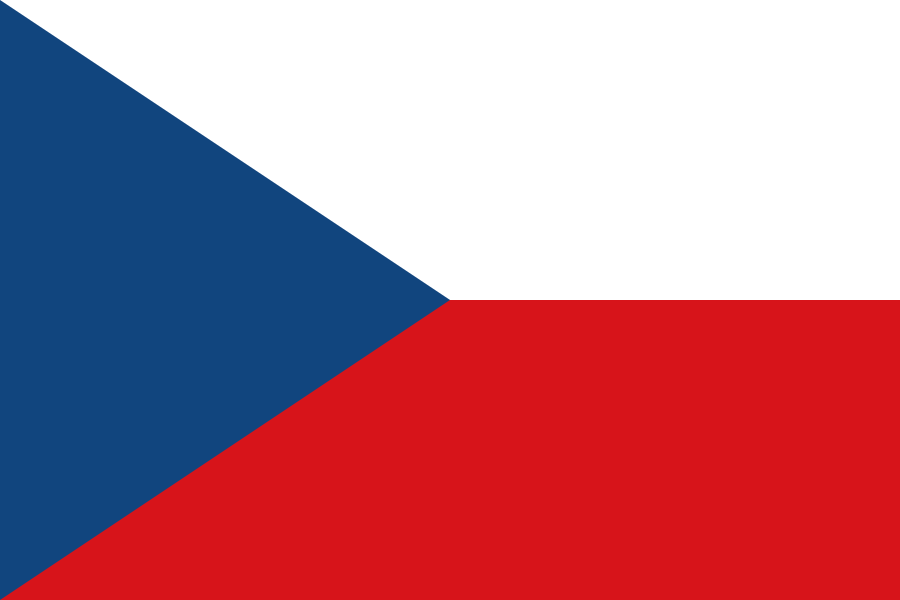
The Czechoslovak leader whose Stalinist orthodoxy was swept aside by the Prague Spring reform movement
In an impromptu interview after the 1965 May Day parade, Novotný declared, "Meat will be shortly!" (Maso bude vbrzku!). Across the country, Czechs asked, "Where on the map is this 'Shortly'?" — and the nation laughed.
A locksmith and KSČ charter member from 1921, Novotný rose through the party apparatus during the Slánský purge and emerged from the succession struggle after Gottwald's death to rule Czechoslovakia for fifteen years as First Secretary (1953–1968) and President (1957–1968). His regime enforced Stalinist orthodoxy (central planning, censorship, and a refusal to reckon with the show trials of the 1950s) even as economic stagnation and Slovak resentment eroded its foundations. His forced resignation in January 1968, replaced by Alexander Dubček, removed the greatest obstacle to reform and directly precipitated the Prague Spring. Reelected to the Central Committee under normalization in 1971, he died in Prague in 1975 without recovering real influence.
Career timeline
1921Charter member of the Communist Party of Czechoslovakia (KSČ)
1937–1938Secretary of the KSČ Regional Committee in Hodonín
1941–1945Arrested for underground resistance; imprisoned at Mauthausen
1945–1951First Secretary of the KSČ Prague City Committee
1951–1953Member of the KSČ Political Secretariat; Deputy Prime Minister
1953–1968First Secretary of the KSČ Central Committee
1957–1968President of Czechoslovakia
1971Reelected to the KSČ Central Committee under normalization
Twice Hero of the Soviet Union who took Mount Sapun and stormed Königsberg
"The enemy is strong and cunning," Pyotr Koshevoy taught his men. "So you must be more cunning, smarter — find the weak spots and deliver unexpected, powerful blows."
A Soviet military commander born to a Ukrainian peasant family who volunteered for the Red Army at fifteen. During the Great Patriotic War he led forces at Tikhvin, Stalingrad, the Crimea, and East Prussia, earning the title Hero of the Soviet Union twice, for the recapture of Mount Sapun and the storming of Königsberg. After the war he commanded the Siberian and Kiev Military Districts before becoming commander-in-chief of the Group of Soviet Forces in Germany in 1965, and was promoted to Marshal of the Soviet Union in 1968. His tenure included committing GSFG units to the Warsaw Pact invasion of Czechoslovakia, and he worked to sharpen the Group's combat readiness until his dismissal in 1969. He served as a candidate member of the CPSU Central Committee from 1961 to 1971.
Career timeline
1920Volunteered for the Red Army, served in 8th Red Cossack Cavalry Division
1927Graduated Ukrainian Cavalry School, appointed platoon commander
1939Graduated Frunze Military Academy, chief of staff of 15th Cavalry Division
1940Commander of 65th Rifle Division (Transbaikal Military District)
1941–1942Led 65th Rifle Division in Tikhvin and Lyuban operations
1942–1943Commander of 24th Guards Rifle Division at Stalingrad and North Caucasus
1943–1944Commander of 63rd Rifle Corps — Donbass, Melitopol, Crimean offensives, took Mount Sapun
1944First Hero of the Soviet Union awarded (16 May)
1944–1945Commander of 71st Rifle Corps, then 36th Guards Rifle Corps — East Prussian Offensive, took Königsberg
1945Second Hero of the Soviet Union awarded (19 April), commanded 3rd Belorussian Front regiment at Victory Parade
1946–1948Commander of 6th Guards Army, then completed Voroshilov Higher Military Academy courses
1948–1954Commander of 5th Army (Far East)
1954–1955Commander of 11th Guards Army (Baltic Military District)
1955–1957First Deputy Commander-in-Chief, Group of Soviet Forces in Germany
1957–1960Commander of Siberian Military District
1960–1965Commander of Kiev Military District
1961–1971Candidate member, CPSU Central Committee
1965–1969Commander-in-Chief, Group of Soviet Forces in Germany
1968Promoted Marshal of the Soviet Union (15 April)
1969–1976Inspector General, Group of Inspectors General, Ministry of Defence
The premier who tried to plant profit inside the plan
September 11, 1969: with border clashes threatening all-out war, Kosygin lands at Beijing Airport. For three and a half hours he sits across from Zhou Enlai, defusing the tension and agreeing to resume border talks — a single airport meeting that pulled the Sino-Soviet confrontation back from the brink.
The technocrat who ran the 'Road of Life' supply line into besieged Leningrad and became the longest-serving premier in Soviet history (16 years). In 1965 he launched profit-and-autonomy reforms that produced the postwar record growth of the Eighth Five-Year Plan (1966–1970), but after the Prague Spring Brezhnev eclipsed him and the reform was quietly dismantled. He also shaped foreign policy: mediating the Indo-Pakistani war at Tashkent (1966) and meeting Zhou Enlai in Beijing after the Damansky clashes. In 1979 he was the sole Politburo member to oppose the invasion of Afghanistan ('troops, never') and died two months after losing office.
Career timeline
1939–40Commissar of the Textile Industry
1941–42Leningrad evacuation board; runs the Road of Life
1943–46Premier of the Russian republic
1949Survives the Leningrad Affair purge
1964–80Chairman of the Council of Ministers
1965Launches the profit-and-autonomy economic reform
1966–70The Eighth Five-Year Plan, the best postwar numbers
Marshal of Aviation who led the 17th Air Army to Prague and commanded Soviet Air Defence Forces
On 30 October 1961, a Tu-95V of Sudets' Long-Range Aviation dropped the 50-megaton Tsar Bomba over Novaya Zemlya — the most powerful nuclear weapon ever detonated. The shockwave circled the globe several times.
A Soviet Marshal of Aviation who commanded the 17th Air Army through the Kursk, Dnieper-Carpathian, Jassy-Kishinev, and Prague offensives, earning the title Hero of the Soviet Union in 1945. Post-war, as Chief of Main Staff and Deputy C-in-C of the Air Force (1946–1949), he drove the transition to jets; as Commanding General of Long-Range Aviation (1955–1962), he led the introduction of Tu-95K missile carriers and Tu-22 supersonic bombers and oversaw the Tsar Bomba drop in 1961. As C-in-C of PVO Strany and Deputy Minister of Defence (1962–1966), he expanded low-altitude air defence and directed PVO support for Operation Anadyr during the Cuban Missile Crisis. He was among the few Soviet commanders also named People's Hero of Yugoslavia and Hero of the Mongolian People's Republic.
Career timeline
1941–1942Commander, Air Forces of the 51st Army, then Volga Military District
1942–1943Commander, 1st Bomber Aviation Corps
1943–1946Commander, 17th Air Army
1946–1949Chief of Main Staff and Deputy C-in-C of the Soviet Air Force
1953–1955Commander, 26th Air Army
1955–1962Commanding General, Long-Range Aviation
1962–1966C-in-C of PVO Strany · Deputy Minister of Defence
1966–1981Inspector, Group of Inspectors General, Ministry of Defence
The Soviet Nobel physicist who discovered the Cherenkov effect
"It is hard to judge what there was more of in life — luck, misfortune, happiness… But one thing I know for certain: there was a great deal of overcoming."
In 1934 an experimental physicist saw a blue glow in a bottle of radioactive solution and opened a new chapter in particle physics. Working under Vavilov, Cherenkov identified the emission (now known as Cherenkov radiation) produced when charged particles pass through a medium faster than light travels in it; Tamm and Frank supplied the theory. The discovery led to the Cherenkov detector, a standard tool of particle physics that flew aboard Sputnik 3, and earned the three the 1958 Nobel Prize in Physics. He spent his career at the Lebedev Physical Institute (FIAN), where he founded and directed the High-Energy Physics Department, and contributed to synchrotron construction and photo-nuclear research.
Career timeline
1928Graduates Voronezh State University, Physics and Mathematics
1930Senior researcher at the Lebedev Physical Institute (FIAN)
1934Discovers the Cherenkov effect
1940Doctor of Physico-Mathematical Sciences
1946Stalin Prize 1st class; joins the CPSU
1948Professor at Moscow Power Engineering Institute (MEI)
1951Stalin Prize 2nd class; professor at MIFI
1958Nobel Prize in Physics, shared with Tamm and Frank
1959Head of the photo-meson processes laboratory, FIAN
1964Corresponding member, USSR Academy of Sciences
Founder of Soviet non-ferrous metallurgy and Gosplan chairman
When Guinness certified his 46-year ministerial record in 1988, Lomako had already been retired for two years, living quietly in Moscow.
A metallurgical engineer who founded the Soviet non-ferrous metallurgy industry and served 46 years in ministerial posts. He built the foundations of the aluminium and titanium industries, supplied uranium for the atomic bomb project during the war, and as Gosplan chairman led the recentralization of the planned economy.
Career timeline
1937–1939Director of the Kolchugino non-ferrous metals processing plant
1939–1940Deputy Commissar, head of aluminium, magnesium and electrode industry
1940–1948Commissar then Minister of Non-Ferrous Metallurgy; wartime evacuation and uranium supply
1948–1950First Deputy Minister of the Metallurgical Industry under the merged ministry
1950–1953, 1954–1957Minister of Non-Ferrous Metallurgy, expanding aluminium and rare-metal production
1957–1961Chairman of the Krasnoyarsk Sovnarkhoz, managing regional economic reform
1962–1965Deputy Premier and Gosplan chairman, leading planning recentralization
1965–1986Minister of Non-Ferrous Metallurgy under Brezhnev, launching diamond and titanium production
Chief political commissar of the post-Stalin Soviet military who helped bring down Zhukov
Zheltov, once Zhukov's own military council commissar, became the marshal's fiercest denouncer at the October 1957 Central Committee plenum.
General-Colonel Aleksei Zheltov headed GlavPUR, the Main Political Directorate of the Soviet Army and Navy, from 1953 to 1958. He was the chief political commissar of the armed forces during the early post-Stalin transition. He served on the military councils of the Karelian, Don, Southwestern, and 3rd Ukrainian fronts during the war, directing party-political work at Stalingrad and in the liberation of Ukraine and the Balkans. In 1957 he was among the most active participants in the anti-Zhukov campaign, helping Khrushchev remove the marshal and eliminate the last independent power centre in the military. After heading the CPSU Central Committee's Administrative Department, overseeing the military, KGB, MVD, procuracy, and judiciary, he directed the Lenin Military-Political Academy for twelve years.
Career timeline
1924–1927Joined Red Army, graduated 2nd Moscow Infantry School, platoon commander
1937–1939Commissar, 24th Rifle Division → Military Council, Volga Military District
1941–1944Military Council, Far Eastern, Karelian, Don, Southwestern, and 3rd Ukrainian Fronts
1945–1950Military Council, Central Group of Forces; Deputy Supreme Commissar in Austria
1951–1953Head, Main Personnel Directorate, Soviet Army
1953–1958Head, Main Political Directorate (GlavPUR), Soviet Army and Navy
1958–1959Head, Administrative Department, CPSU Central Committee
1959–1971Head, Lenin Military-Political Academy
1971–1991Consultant, Group of General Inspectors; Chairman, War Veterans Committee (1981–87)
"We have no other figures. Comrade Starovsky is a very cautious man. I take my figures from him. This is our all-Union bookkeeping. I trust him." — Khrushchev, CPSU Presidium, 19 August 1964.
Headed the Central Statistical Administration (TsSU) of the USSR from 1940 to 1975, overseeing all Soviet state statistics for 35 years, the longest tenure of any statistical chief. Beginning with the 1939 census, he managed every postwar Soviet population and economic census, producing the foundational data on which Gosplan built the national economic plans. A Doctor of Economics and corresponding member of the Academy of Sciences, he laid the methodological groundwork for Soviet mathematical statistics and was the only statistical authority Khrushchev ever publicly declared he trusted. Yet in the 1960s he played a decisive role in blocking Glushkov's OGAS computer-network project, defending the existing punched-card system, a controversial turning point in Soviet information-technology history.
Career timeline
1919–1923Clerk and statistician, Ust-Sysolsk District Statistical Bureau
1924–1926Statistician, VSNKh USSR; graduated Faculty of Soviet Law, Moscow State University
1926–1930Statistician and researcher, TsSU USSR; postgraduate studies, RANION Institute of Economics
1931–1937Researcher, deputy head of personnel, TsUNKhU, Gosplan USSR
1937–1939Deputy head, All-Union Census Bureau, TsUNKhU
1940–1941Head of TsUNKhU, Gosplan USSR
1941–1948Head of TsSU, Gosplan USSR — Deputy Chairman of Gosplan
1948–1975Head of TsSU under USSR Council of Ministers (ministerial rank from 1957)
The national communist who returned in the Polish October of 1956 to test a 'Polish road to socialism'
To the Politburo, October 1956 — 'You can govern a nation with bayonets, but whoever realizes that possibility also realizes that he has lost everything.'
A worker who joined the Polish Communist Party and led its underground during the Nazi occupation, helping create the People's Guard and the National Council. Purged in 1948 for 'nationalist deviation' and imprisoned in 1951, he returned as First Secretary in the 1956 workers' and intellectuals' uprising, dismantling collective farms, encouraging workers' councils, and easing censorship. He negotiated Khrushchev down from military intervention and temporarily secured a space for Polish sovereignty, but his reform coalition collapsed with the 1968 anti-intellectual and anti-Semitic campaign and support for the invasion of Czechoslovakia. Price rises and a workers' strike-wave forced him out in December 1970.
Career timeline
1926Joins the Communist Party of Poland
1934–35Studies at the International Lenin School, Moscow
1943–48General Secretary, Polish Workers' Party
1948–51Purged for 'nationalist deviation'; arrested 1951
1954–56Released, rehabilitated; returns in the Polish October
1956–70First Secretary, Polish United Workers' Party
1970.12Heart attack and resignation amid price-rise strikes
Architect of the Soviet ocean-going fishing fleet, felled by the 'fish mafia' scandal
In the 1978 'fish mafia' case his deputy Rytov was sentenced to death and shot, but Brezhnev personally intervened — Ishkov was simply sent into retirement, untouched.
Soviet statesman who led the USSR's fishing industry for nearly four decades across multiple ministerial tenures (1940–1950, 1954–1979), making him the longest-serving fisheries minister in Soviet history. Under his leadership the Soviet Union built a massive ocean-going fleet of factory trawlers, expanded operations from the Arctic to the Antarctic, and raised the annual catch from 1.3 million tons to over 9 million, becoming the world's leading fishing power. He championed the BMRT large freezer trawler, the Okean retail chain, and the professional holiday Fisherman's Day. His career ended in the late-1970s 'fish mafia' corruption scandal: his deputy Vladimir Rytov was executed, but Ishkov was protected by Brezhnev's personal intervention and retired with his honors intact.
Career timeline
1930–1939Management posts, Azov-Black Sea & Volga-Caspian state fishery trusts
1939–1940Deputy People's Commissar of Fish Industry USSR
1940–1946People's Commissar → Minister of Fish Industry USSR
1946–1948Minister of Fish Industry of Western Regions USSR
1948–1950Minister of Fish Industry USSR
1950–1954Deputy Minister / basin administration chief
1954–1957Minister of Fish Industry USSR
1957–1965Fisheries chief, Gosplan / State Committee (ministerial rank)
In August 1943, Serov organized Stalin's only wartime trip to the front and spent three days alone with him. Of all the generals, it was this artilleryman-turned-security officer whom Stalin entrusted with his safety.
An artillery officer who entered the NKVD in 1939, he served as NKVD chief of Ukraine and wartime deputy People's Commissar of Internal Affairs. He participated in the capture of Berlin and witnessed the German surrender, later administering civilian affairs in the Soviet occupation zone. After helping arrest Beria in 1953, he gained Khrushchev's trust and became the KGB's first chairman, spearheading mass rehabilitations of Stalin-era victims and reshaping the security apparatus during de-Stalinization. He personally directed the suppression of the 1956 Hungarian Uprising, then led the GRU until his downfall in the Penkovsky spy affair of 1963, which cost him every rank, post, and the Hero of the Soviet Union title.
Career timeline
1939–1941Involved in annexation and deportation work in western Ukraine and the Baltic region
1941–1945Performs NKVD security and rear-area control work during the war
1953–1954Participates in security reorganization after Beria’s fall
1954–1958First KGB chairman, reshaping security organs during de-Stalinization
1958–1963Heads the GRU and later falls after the Penkovsky affair
Khrushchev-era Leningrad party boss who proposed removing Stalin's body from the Mausoleum and stumbled over the apparatus's loyalty test
Into the silence after Khrushchev offered to resign, Spiridonov rose: 'Comrades, we must support Nikita Sergeyevich's wish.' Khrushchev's face went pale, and within days Spiridonov lost every major party post.
A Soviet party and state leader of peasant origin who rose from factory mechanic to enterprise director and then to the pinnacle of Leningrad's party apparatus. Succeeding Frol Kozlov as First Secretary of the Leningrad Regional Committee in 1957, he drove a massive housing construction campaign, the so-called Khrushchevkas, while expanding Leningrad's scientific and defence-industrial base. At the 22nd Party Congress in 1961, as head of the Leningrad delegation, he formally proposed removing Stalin's body from the Lenin Mausoleum, giving Khrushchev's de-Stalinisation its most dramatic public moment. Briefly elevated to Secretary of the Central Committee, he committed a fatal political misstep at a Presidium meeting by earnestly supporting Khrushchev's feigned offer to resign, and was shunted aside to the ceremonial chairmanship of the Soviet of the Union from 1962 to 1970.
The political economist who opened Khrushchev's economic debate, and institutional founder of Soviet sociology
'All formations arose spontaneously — only the socialist formation came into being through organized mass action. Might not all our problems stem from this?' — at a closed institute meeting, recalled by V.A. Yadov
Economist of the Khrushchev thaw. He placed Liberman's 1962 article in Pravda, triggering the economic reform debate, and founded the first Soviet sociological institute. Edited Kommunist and Pravda; removed for his liberal orientation.
Career timeline
1926Graduates from Kharkov Institute of National Economy
1925–1943Works in Ukrainian SSR commissariats of agriculture and justice, then teaches political economy in Kharkov
1940Candidate of Economic Sciences degree; supervisor Ostrovityanov, opponent Shepilov
1943–1949Secretary of Kharkov Oblast Party Committee in Khrushchev's Ukrainian apparatus
1950–1952Director, Institute of Economics, Ukrainian SSR Academy of Sciences; head of social sciences division
1952–1955Head of CC departments for economic/historical sciences and science/culture
1955–1958Editor-in-chief of Kommunist, the party theoretical journal of the Khrushchev thaw
1958–1964Editor-in-chief of Problems of Peace and Socialism (Prague), hub of the Eurocommunist network
1962With Khrushchev's backing, places Liberman's article in Pravda, triggering the all-union reform debate
1964–1965Editor-in-chief of Pravda; removed after attempting to publish Solzhenitsyn
1965–1967Academician-Secretary of the Economics Department, USSR Academy of Sciences
1967–1971Vice-President of the Academy of Sciences and founding director of ICSI, the first Soviet sociological institute
1972Forced to resign; ICSI restructured for 'excessive liberalism,' leading researchers dismissed
1971–1993Member of the Academy Presidium; edits the standard political economy textbook
An automation scientist who pressed technology toward economic reform
"It is time to leave outdated forms of economic management based on directive norms and move to a simpler, cheaper, and more effective economic regulation of enterprises."
Vadim Trapeznikov was an electrical engineer and automation scientist who sought to change Soviet production technology and management together. He argued that automation could not take root while enterprises were bound by rigid plan indicators, and in 1964 he published a Pravda article criticizing directive economic management. The intervention connected automation research to the organization of enterprise activity and broadened the intellectual climate in which the Kosygin reform moved from debate toward implementation.
Career timeline
1928–1933Researcher, All-Union Electrotechnical Institute
1933–1938Chief engineer of automation workshops, Orgenergo
1938–1941Head of the automation laboratory, Central Research Institute of the Cotton Industry
1941–1951Researcher and laboratory head, Institute of Automation and Telemechanics
1951–1987Director, Institute of Automation and Telemechanics
1960–1990Full member of the USSR Academy of Sciences; head of general control problems at Moscow State University
1965–1978First deputy chairman, State Committee for Science and Technology
The party international chief who managed the communist line abroad
In 1984, Ponomarev pulled from his safe a 1968 memo in which Zagladin had warned what invading Czechoslovakia would do to the international communist movement — a warning Ponomarev had brushed aside at the time. "You were right, Vadim Valentinovich!" he said. Then he put the paper back in the safe.
A Soviet politician and ideologue who joined the party at 14 in 1919. For over 30 years, from the Khrushchev Thaw to the eve of perestroika, he headed the Central Committee International Department, managing ties with communist parties and national-liberation movements worldwide. Becoming a CC Secretary in 1961 and a candidate Politburo member in 1972, he was a key architect of Soviet foreign policy. If the Foreign Ministry handled state-to-state diplomacy, Ponomarev ran party-to-party diplomacy and ideology networks, sustaining the CPSU's international reach. A rare anti-Stalinist within the Brezhnev-era leadership, he left office in 1986 after 31 years as Gorbachev's reforms reshaped Soviet foreign policy.
Career timeline
1930s–1943Works in Comintern structures and learns the machinery of international communist networks
1943–1955After Comintern’s dissolution, manages foreign communist-party relations in the CC apparatus
1955–1986Head of the CC International Department, managing ties with communist parties and national-liberation movements
1960s–1970sDefends Moscow’s line amid the Sino-Soviet split and Eurocommunism
1986 이후Leaves office as Gorbachev changes Soviet foreign and party policy
Khrushchev’s theoretician who became “Shepilov who joined them”
June 1957 Presidium. Khrushchev cut off Shepilov's criticism: "How long did you study?" Shepilov: "Gymnasium, secondary school, three years at the Institute of Red Professors, four years of university." "I studied two winters with a priest — for a sack of potatoes." "Then why do you claim to know everything?!"
An economist who led the USSR's first political economy textbook, a rare intellectual in the party. Exempt from service, he volunteered in 1941 and finished the war as a major general. Rising through Agitprop and Pravda, he became a key Khrushchev theoretician, crafting the ideological language of de-Stalinization. As foreign minister in 1956 he opened Third World diplomacy during Suez. But he joined the Anti-Party Group the next year and fell under the mocking tag 'Shepilov who joined them.' He spent decades in obscurity in Kyrgyzstan and the state archive; his memoir The Unjoined brought posthumous reappraisal.
Career timeline
1926Graduates from Moscow State University law faculty; works in the Yakutsk prosecution service
1931–1933Studies at the Institute of Red Professors; works on agrarian and Marxist economics
1937–1941Scientific secretary at the Academy of Sciences Institute of Economics; teaches and researches economics
1941–1946Wartime political officer, ending the war as a major general
1946–1949Works in military propaganda and the party Propaganda and Agitation apparatus
1949–1952Heads the Central Committee Propaganda Department in late Stalinism
1952–1956Editor-in-chief of Pravda and party theoretician from late Stalin to early Khrushchev
1955–1956Central Committee secretary and theoretician for Khrushchev’s line
1956–1957Foreign minister during the Suez crisis and the opening to the Third World
1957Falls after joining the Anti-Party Group
1957–1960Sent to the Kyrgyz Academy of Sciences Institute of Economics
1960–1982Works in the Soviet state archive, politically sidelined
Shortly before his death he wrote to Yeltsin: 'Bury me at public expense — I have no savings.' The premier who ran the Soviet economy for five years lived his entire life in a three-room apartment, spending his salary on buses he donated to schools.
A practical economic manager from Dnipropetrovsk who succeeded Kosygin as Chairman of the Council of Ministers at age 75. An honest engineer far removed from political ambition, he served as premier under three general secretaries: Brezhnev, Andropov, and Chernenko. While he embodied the bureaucratic continuity of late stagnation, in 1984 he chaired a reform commission that explored enterprise autonomy and the concept of a 'socialist market,' laying groundwork for ideas later realised under perestroika.
A pragmatic national communist who navigated between Moscow and Estonia for 28 years
In July 1978, after 28 years at Estonia's helm, Käbin was dismissed by the Central Committee. His successor was Karl Vaino, born in Russia and barely fluent in Estonian — a moment that captured the Brezhnev centre's loss of confidence in a national cadre.
He led Soviet Estonia as First Secretary of the Communist Party of Estonia from 1950 to 1978 and subsequently served as Chairman of the Presidium of the Supreme Soviet of the Estonian SSR until 1983. Beginning as a hardline Stalinist, he gradually shifted toward a moderate, pragmatic course known as 'laveerimine' (maneuvering): balancing Moscow's demands with Estonian national interests. His 28-year tenure made him the longest-serving republican leader in Estonian SSR history, and as a CPSU Central Committee member (1952–1986) he represented Estonia's interests at the all-Union level. In the late 1970s, as Brezhnev-era Russification policies intensified, he came into conflict with the centre and was replaced in 1978 by Karl Vaino.
Career timeline
1941–1945Head of Press Sector, later First Deputy Head of Propaganda & Agitation Dept., EKP Central Committee
1946–1948Director, Institute of Party History under the EKP Central Committee
1948–1950Secretary for Propaganda and Agitation, EKP Central Committee
1950–1978First Secretary, Central Committee of the Communist Party of Estonia
1952–1986Member, CPSU Central Committee
1978–1983Chairman, Presidium of the Supreme Soviet of the Estonian SSR (head of state)
Guardian of the Arctic convoys as Northern Fleet commander, architect of Soviet naval power projection in the Atlantic
On 17 June 1941, after German reconnaissance flights intensified over Northern Fleet bases, Golovko raised combat readiness to No. 2 on his own authority. When the invasion came four days later, the fleet was already at its wartime stations.
Soviet admiral who commanded the Northern Fleet throughout the war against Nazi Germany. Of Terek Cossack origin, he joined the navy through the Komsomol mobilization of 1925, graduated from the Frunze Naval School, and served as an advisor at the Cartagena naval base during the Spanish Civil War. Appointed Northern Fleet commander in 1940 at age 34, he acted on his own authority on 17 June 1941, five days before Barbarossa, raising the fleet to higher combat readiness after observing a surge in German reconnaissance flights; throughout the war he directed the defence of Murmansk, escorted Arctic convoys, and secured the Allies' northern supply lifeline. After the war, as Chief of the Main Naval Staff and First Deputy Commander-in-Chief of the Navy, he built up the fleet's blue-water operational capability, and in 1955 he led the Soviet Navy's first postwar goodwill visit to Britain.
Career timeline
1925Joined Navy through Komsomol mobilisation
1928Graduated Frunze Higher Naval School
1937–1938Spanish Civil War: advisor, Cartagena naval base
1938–1939Commander, Caspian Flotilla, then Amur Flotilla
1940–1946Commander, Northern Fleet
1947–1950Chief, Main Naval Staff & Dep. C-in-C Navy
1952–1956Commander, 4th Fleet, then Baltic Fleet
1956–1962First Deputy Commander-in-Chief, Soviet Navy
From trace elements to federal politics: a Latvian agrochemist who chaired the Soviet of Nationalities
During the 1959 purge of Latvian national communists, Vilis Lācis backed Eduards Berklavs as his successor — but Moscow chose Peive instead. Appointed to break Latvia's autonomous line, he left the republic for good and spent the rest of his career as a science administrator in Moscow.
Born to Latvian peasant farmers, Peive was an agrochemist who pioneered research on trace elements in plant nutrition. After serving as rector of the Latvian Agricultural Academy and president of the Latvian Academy of Sciences, he simultaneously chaired the Soviet of Nationalities and the Latvian SSR Council of Ministers, a model Baltic cadre of the Khrushchev era. Chosen as head of government in 1959 over Eduards Berklavs during the purge of Latvian national communists, he later moved fully to Moscow and spent his final years at the USSR Academy of Sciences.
Career timeline
1929Graduates from Timiryazev Agricultural Academy, begins research at All-Union Flax Institute
1940Earns doctorate in agricultural sciences, joins the Bolshevik Party
1944–1950First rector of the Latvian Agricultural Academy
1951–1959President of the Latvian SSR Academy of Sciences
1958–1966Chairman of the Soviet of Nationalities, USSR Supreme Soviet
1959–1962Chairman of the Council of Ministers, Latvian SSR
1966–1971Chief academic secretary of the USSR Academy of Sciences, then academician-secretary of General Biology
1969Awarded Hero of Socialist Labour; also received Lenin Prize (1964) and multiple Orders of Lenin
Khrushchev's civilian interior minister who tried and failed to dismantle the informant system
In 1959 Dudorov signed an order to phase out the militsiya's informant and agent-provocateur system — a nearly unique attempt in Soviet police history. It was blocked almost immediately and buried when he was dismissed the following year.
A civilian interior minister appointed by Khrushchev to displace the Stalin-era NKVD veterans, serving as head of the MVD from 1956 to 1960. A chemical engineer by training, he rose through construction and industrial bureaucracy before leading the CPSU Central Committee's Construction Department in 1954. As minister, he attempted to reorganize the Gulag into smaller correctional colonies and, in 1959, sought to phase out agent-provocateur and informant methods in the militsiya, an effort that failed. His tenure coincided with the rapid decline of the MVD's standing after the KGB split, and he left office when the all-union MVD was abolished in 1960.
Career timeline
1922–1929Apprentice then master at the Kalinin Crystal Factory, Moscow
1929–1934Student at Moscow Chemical-Technological Institute (Mendeleev Institute)
1934–1937Head of the Triplex shop at the Avtosteklo factory, Moscow
1937–1949Production, party committee, and administrative posts in the heavy industry and construction materials commissariats
1950–1952Head of Construction Department, Moscow City Party Committee; then Deputy Chairman of Moscow City Executive Committee
1954–1956Head of Construction Department, CPSU Central Committee
1956–1960USSR Minister of Internal Affairs (MVD): Gulag reorganisation, attempt to abolish militsiya informant system
1960–1972General Commissioner for the 1967 World Exhibition; then head of Glavmospromstroymaterialy