The people's democracies with their reformers and dissidents, decolonization and national liberation, Cold War statesmen and anti-communist regimes, 1956, 1968, 1989 and after.
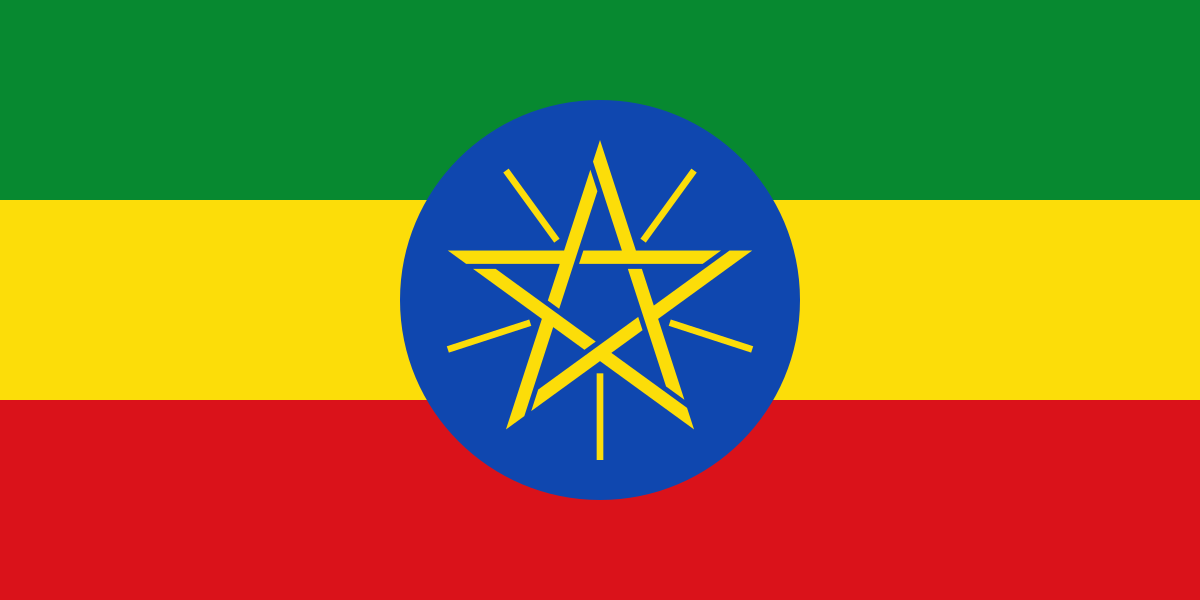
Ethiopian Marxist leader of MEISON and drafter of the Derg's national-democratic program
His August 1977 arrest and subsequent disappearance mark the Derg's turn from the EPRP onto its own former MEISON collaborators. His death around 1979 is reported by several sources but unconfirmed in date and circumstance.
Ethiopian Marxist politician who led and chaired the All-Ethiopia Socialist Movement (MEISON). Born in Arjo, Welega (Oromia); he studied in France in the early 1960s, taking a Marxism closer to the Soviet model, and after the revolution began he returned and co-founded the Progressive Book Store with Negede Gobeze. In December 1975 the Derg secretly created the Provisional Office for Mass Organizational Affairs (POMOA) and made him chairman; he drafted the Program for the National Democratic Revolution, announced by Mengistu on 20 April 1976. He was captured outside Addis Ababa on 26 August 1977 and held in the Old Gebbi, and Human Rights Watch records that he disappeared after several months in prison. His reported death around 1979 remains unconfirmed in date and circumstance. Also known as Haile Fida Kuma, he is remembered as the 'Father of Qubee Afaan Oromo'.
Career timeline
1968Helped found MEISON at the 8th ESUE congress and organized and led the Oromo students' study group in Europe
1973Published the Oromo grammar Hirmaata Dubbi Afaan Oromoo in Paris, written in qubee
1974–1975Returned to Ethiopia and co-founded the Progressive Book Store with Negede Gobeze
1975.12Appointed chairman of the Derg's secretly created Provisional Office for Mass Organizational Affairs (POMOA)
1976.4Drafted the Program of National Democratic Revolution, whose adoption Mengistu announced on 20 April
1977.8Went underground with the MEISON leadership, was captured on 26 August and detained in the Old Gebbi
Designer of Angolan economic planning and MPLA theorist
Appointed economy minister in November 1975 and, from 1976, minister of the plan and second deputy prime minister, he was a designer of Angolan economic planning. He gave up his government and party posts after the repression of 27 May 1977.
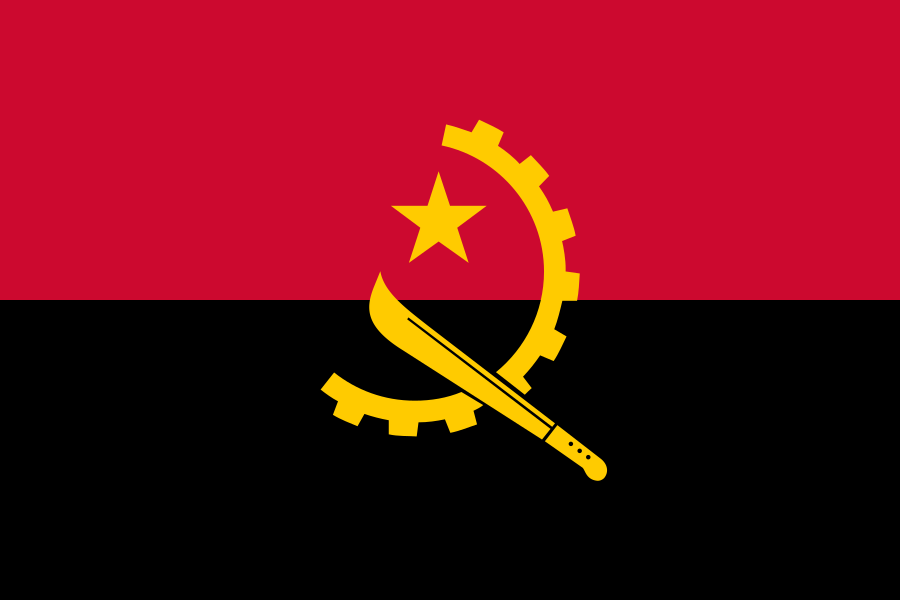
Carlos Alberto da Rocha Oliveira Dilolwa (2 December 1939, Sumbe – 16 November 1996, Luanda) was an Angolan economist, anticolonial activist and university professor, and a theorist of socialist economics counted among the MPLA's leading intellectuals. He joined the MPLA in 1961 under the influence of Viriato da Cruz, adopting the war name Dilolwa, and founded and taught at the 1st Revolutionary Instruction Centre at Dolisie before being sent to East Berlin in 1963 to study economics. In 1974 he entered the MPLA Central Committee and Political Bureau and joined the 'delegation of 26' received in Luanda on 8 November 1974. Appointed economy minister in November 1975, he served from 1976 as minister of the plan and second deputy prime minister. He gave up his government and party posts after the repression of 27 May 1977 and from November 1978 taught at the Faculty of Economics in Luanda.
Career timeline
1961Joined the MPLA and adopted the war name Dilolwa
1963Sent to East Berlin to study economics and finance
1974Member of the MPLA Central Committee and Political Bureau; joined the 'delegation of 26' to Luanda
1975–1978Economy minister (1975), then minister of the plan and second deputy prime minister (1976–1978)
1978–1996Professor at the Faculty of Economics, Luanda; researcher and writer on politics and economics
Sentenced to death by Ali Nasir Muhammad in the January 1986 clashes, he survived and rose to General Secretary of the Yemeni Socialist Party.
A South Yemeni revolutionary who led the People's Democratic Republic of Yemen through its final years as General Secretary of the Yemeni Socialist Party. An ally of Abdul Fattah Ismail, he survived the January 1986 fighting in Aden, and after Ali Nasir Muhammad's forces were defeated he took over the party and state. He became the first vice-president of unified Yemen in 1990, but resigned in 1993 and proclaimed the short-lived Democratic Republic of Yemen during the 1994 civil war; in exile he led the southern independence movement al-Hirak.
Career timeline
1963Joined the NLF and founded its local committee in Mukalla
1967–1969Minister of Defense
1978Elected Politburo member and Central Committee secretary at the YSP founding congress
1986–1990General Secretary of the YSP, South Yemen's last leader
1990–1993Vice-president of unified Yemen
1994President of the Democratic Republic of Yemen (21 May to 7 July), exiled to Oman after its failure
2009–Leader of the southern independence movement, al-Hirak
South Yemen's last head of state and the united republic's first prime minister
When the January 1986 gunfire broke out he was visiting India; he then negotiated a settlement in the USSR before returning to take the presidency.
A Hadhrami electrical engineer who rose through the National Liberation Front to become a minister and prime minister of South Yemen. After the January 1986 Aden fighting, he became president and steadied the state; as South Yemen's last head of state he led the 1990 unification and became the first prime minister of united Yemen. In the 1994 civil war he served as premier of the breakaway southern government, then went into exile.
Career timeline
1960Joined the Arab Nationalist Movement
1963Joined the National Liberation Front (NLF)
1969–1978Minister of Public Works, Transport and Construction
1985–1986Prime Minister of the People's Democratic Republic of Yemen
1986–1990Chairman of the Presidium of the Supreme People's Council (head of state)
1990–1994First prime minister of the united Republic of Yemen
1994Prime minister of the secessionist Democratic Republic of Yemen
1994–2003In exile in Jordan, the UAE and Saudi Arabia
"Peace and stability in the SADC region are essential preconditions for our economic development and integration"
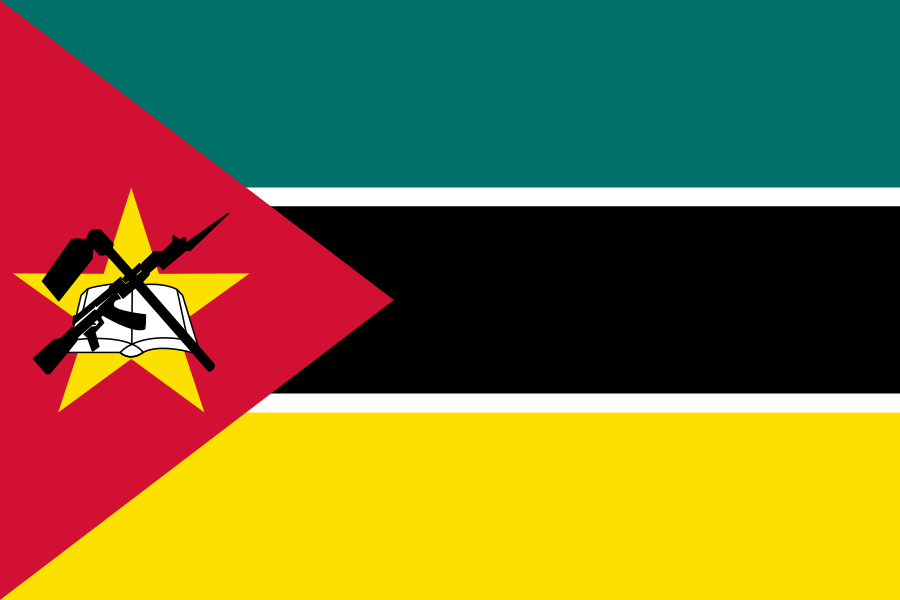
A FRELIMO leader and post-independence foreign minister, he succeeded Machel as president in 1986. He pursued the 1987 Economic Rehabilitation Program and later multiparty transition. The 1992 peace agreement marked a major turning point in ending war and rebuilding the economy.
Career timeline
1962Co-founded FRELIMO
1974Played a key role in negotiating the Lusaka Accord
1975Appointed Minister of Foreign Affairs
1986Became President and FRELIMO leader after Machel's death
A Turkmen leader who turned late-Soviet rule into personal rule over an independent state
At the 1991 9+1 meetings, he weighed a reworked union against preserving Turkmenistan’s autonomy.
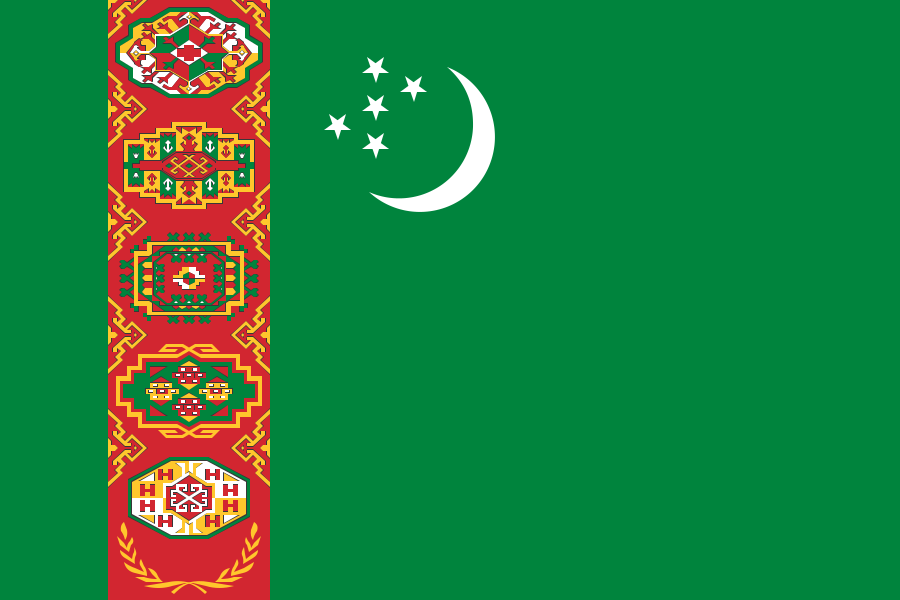
Saparmurat Niyazov was the Soviet-era party and government leader who became independent Turkmenistan’s first president. He led the Turkmen delegation in the 9+1 meetings during the 1991 New Union Treaty process, while the republic’s guarded autonomy limited his role in the negotiations themselves. After independence he invoked neutrality and state sovereignty while concentrating power in the presidency and using the Ruhnama and an extensive personality cult to organize public life. His rule remains a case of post-Soviet state formation fused with authoritarian consolidation.
Career timeline
1962Joined the Communist Party of the Soviet Union
1970–1980Cadre in the Communist Party of Turkmenistan Central Committee
1980–1984First Secretary of the Ashgabat City Party Committee
1985Chairman of the Council of Ministers of the Turkmen SSR
1985–1991First Secretary of the Communist Party of Turkmenistan
1990–1991Chairman of the Supreme Soviet of the Turkmen SSR
1990–2006President of Turkmenistan
1991Head of Turkmenistan’s delegation at the 9+1 New Union Treaty meetings
Religion
Affiliation unconfirmed
1941–2008
○ Natural death
The Owando bishop who chaired the National Conference
The 1991 sovereign national conference declared itself sovereign, abolished the People's Republic, and adopted a Fundamental Act for the transition.
A Congolese Catholic bishop and Jesuit priest who led the dioceses of Nkayi and Owando. As one-party rule collapsed, he was elected president of the presidium of the 1991 sovereign national conference and chaired it. When the conference declared itself sovereign and abolished the People's Republic, he headed the transitional Supreme Council of the Republic (CSR), which replaced the national assembly and steered the constitutional transition.
Career timeline
1973Ordained priest in Brazzaville (Jesuit)
1983First bishop of the Diocese of Nkayi
1986–1990Apostolic administrator of Pointe-Noire
1990Bishop of Owando
1991President of the National Sovereign Conference presidium
1991Chairman of the transitional Supreme Council of the Republic (CSR)
2003–2006President of the Congolese Episcopal Conference
A historian who carried the memory of 1956 into diplomacy
At fifteen, he took part in the 1956 Revolution without a weapon.
Géza Jeszenszky is a historian who experienced the 1956 Revolution and a statesman who helped shape Hungary’s diplomacy during the transition from state socialism. He estimated that about 350 people were executed after the revolution, contributing to public memory of the repression’s scale. As a scholar he wrote on international-relations history and Hungary’s image abroad, while as a founding member of the Hungarian Democratic Forum he pursued new relations with the West.
Career timeline
1941Born in Budapest
1961–1966Studied history and English at Eötvös Loránd University
1976–2011Taught international-relations history at the Budapest University of Economics and Corvinus University
1987–1988Took part in Lakitelek and helped found the Hungarian Democratic Forum
1990–1994Hungarian Minister of Foreign Affairs
1998–2002Hungarian Ambassador to the United States
2011–2014Hungarian Ambassador to Norway and Iceland
The successor between a Soviet birth record and the Paektu myth
One sentence at the 25 April 1992 military parade: "Glory to the heroic soldiers of the Korean People's Army!" — his only recorded public utterance in 17 years of rule.
Consolidated as successor from the 1970s, he inherited power after Kim Il Sung's death in 1994 and led the DPRK for 17 years through post-Soviet isolation, economic crisis, and the nuclear confrontation with the United States.
Career timeline
1941/1942Divergent Soviet and DPRK birth narratives
1964–1974Rose through the Workers’ Party Central Committee
1980Consolidated as successor at the Sixth Party Congress
1991–1994Supreme Commander and prepared succession to state power
“We want a market economy without any adjectives.”
Václav Klaus was a Czech economist and politician who represented a radical route from state socialism to a market economy after 1989. He founded the Civic Democratic Party, helped lead the dissolution of Czechoslovakia, and later served as Czech prime minister and president. He sympathized with the Prague Spring's political liberalization but rejected its economic Third Way, a position that shaped the transition's call for an unqualified market economy and the subsequent Czech conservative line. As president, he challenged European integration and climate policy while emphasizing national sovereignty and markets.
Career timeline
1963Graduated from the Prague University of Economics
1971–1986Staff positions at the State Bank of Czechoslovakia
1987–1989Analyst at the Institute for Prognostics of the Czechoslovak Academy of Sciences
1989–1991Finance Minister of Czechoslovakia
1991–2002Founding chairman of the Civic Democratic Party
Guyanese Marxist historian who demonstrated how Europe underdeveloped Africa, scholar-activist of the Pan-African revolution
"For the only great men among the unfree and the oppressed are those who struggle to destroy the oppressor." — How Europe Underdeveloped Africa (1972)
A Guyanese Marxist historian and Pan-African activist, Rodney reshaped Third World historiography with How Europe Underdeveloped Africa (1972), arguing that the slave trade, colonialism, and the capitalist world system structurally produced Africa's underdevelopment. From the Dar es Salaam and West Indies campuses he helped build a decolonised social science, and in Guyana he pursued a socialist politics grounded in multiracial working-class solidarity.
Career timeline
1963BA History (first-class honours), University College of the West Indies
1966PhD African History, SOAS, University of London
1966–1974Lecturer then associate professor, University of Dar es Salaam & UWI Mona
1968Banned from Jamaica by Hugh Shearer government; Rodney Riots erupt
1972Publishes How Europe Underdeveloped Africa
1974–1980Returns to Guyana; active in the Working People's Alliance
1979Arrested on arson charges; dismissed for lack of evidence
South Yemen's defence minister, shot in the January 1986 Aden violence
On 13 January 1986 guards of Ali Nasir Muhammad opened fire on opposition Politburo members in the Central Committee meeting hall; he was killed there.
A South Yemeni soldier and politician who served as a Politburo member of the Yemeni Socialist Party and as minister of defence. He joined the National Liberation Front against British colonial rule, rose through the army after independence, and after the party split sided with the al-Tugma faction that supported Abdul Fattah Ismail. He was killed on 13 January 1986 when Ali Nasir Muhammad's guards opened fire on opposition Politburo members at the Central Committee meeting hall in Aden; his death was one of the triggers of the civil war that followed.
Career timeline
1963년대Joined the National Liberation Front against British colonial rule
1967 이후Rose through the armed forces of the new state after independence; commanded the 22nd Infantry Brigade
1978Already a senior figure in the party when the Yemeni Socialist Party was founded
1979.08.11Dismissed as Minister of Interior during an intra-party struggle
1980.10.16–1981.08.30Minister of Interior (some sources date this 1980–1982)
1981.08.30–1986.01.13Minister of Defense, retained in the eighth government formed in February 1985 under Haidar al-Attas (some sources date it from 1982)
1986.01.13Killed by gunfire at the Central Committee meeting hall in Aden
The SACP leader who kept the revolutionary flame alive after laying down arms
“We are negotiating to create better conditions for socialism. I am a communist.” — Interview shortly before his assassination, 1993
General Secretary of the South African Communist Party and Chief of Staff of Umkhonto we Sizwe, he led the left wing of the liberation movement from armed struggle through the turn to negotiations. His assassination by a far-right immigrant in 1993 nearly derailed South Africa's democratic transition, but instead galvanized the final agreement on the 1994 elections.
Career timeline
1957Joined ANC Youth League at age 15
1959–1961Studied English, Latin and classics at Fort Hare University
1961Joined the South African Communist Party
1962Joined Umkhonto we Sizwe (MK)
1963Arrested; fled to Lesotho; adopted the name Chris
1967–1969Zimbabwean War of Liberation: joint MK-ZIPRA operations
1969Co-signed the 'Hani Memorandum' criticizing ANC/MK leadership
1974Elected to ANC National Executive Committee
1982MK Chief of Staff; directed guerrilla operations from Lusaka
1990Returned permanently to South Africa after ANC unbanning
1991.12Elected SACP General Secretary, succeeding Joe Slovo
1993.4.10Shot dead outside his Boksburg home by a far-right immigrant
Yemeni socialist politician and advocate of unity and pluralism
On 28 December 2002 he was shot dead in Sanaa minutes after addressing the Islah party's conference; he was deputy secretary-general of the Yemeni Socialist Party.
Born in 1942 in the village of Kuhal in Yemen's Ibb province, he studied Islamic law in Dhamar and Sanaa and took part in the defence of Sanaa during the seventy-day siege. He helped found the Yemeni Revolutionary Democratic Party in 1968, was imprisoned for three years after the events of August 1968 in Sanaa, moved to Aden in 1971 and was elected to the Politburo in 1972. A founder of the Yemeni Socialist Party in 1978, he served as minister of culture and tourism in unified Yemen and became a leading advocate of human rights, political pluralism and the opposition coalition.
Career timeline
1960Joined the Arab Nationalists' Movement
1968Co-founder and Central Committee member, Yemeni Revolutionary Democratic Party
1972Elected to the Politburo of the Yemeni Socialist Party
1978Founding member of the Yemeni Socialist Party
1993Minister of culture and tourism of unified Yemen
2002Deputy secretary-general of the Yemeni Socialist Party
Took over as president after Neto's death in 1979 and remained in office until 2017. He led the first round of the 1992 multiparty election, but no runoff was held, and the civil war ended after Savimbi's death in 2002.
He succeeded Neto as Angolan president in 1979. Educated in the USSR, he had served as planning minister. He led the MPLA state amid civil war and oil dependence and favored a pragmatic approach recognizing a role for private enterprise.
Career timeline
1961Joined the MPLA amid colonial repression; went into exile in Congo-Brazzaville
1975First minister of foreign affairs after independence
1978First deputy prime minister and minister of planning
1979Elected MPLA president; became president of Angola
1980President of the one-party People's Assembly
1992Elected president in multiparty election, defeating Savimbi
Our country will not be totally independent until our people are free of the yoke of poverty.
A military leader of the Congolese Labour Party who became president in 1979 after serving as defense minister. He led the one-party state and oil-financed development. The 1991 National Conference and multiparty transition changed the power structure of his first presidency.
Career timeline
1968Took part in the coup that brought Ngouabi to power; founding member of the National Revolution Council
1973Director of State Security
1975Minister of Defense and Security (aged 32)
1977First vice-president of the PCT Military Committee
1979President of the People's Republic of Congo
1986–1987Chairman of the Organization of African Unity
1997Returned to power in the Second Civil War; sworn in as president
2002Won the presidency under the new constitution (89.4%)
From border controller to the officer who ordered the Wall opened
“That’s why I gave my people the order: Open the barrier!”
Harald Jäger was a border-control officer who served the East German Ministry for State Security, enforcing the state’s travel controls and intelligence work. On 9 November 1989, without clear direction from his superiors, he faced a growing crowd and the danger of violence at Bornholmer Straße. He belonged to the machinery of control, yet that night he ordered the barrier opened, allowing thousands of East German citizens into West Berlin. He later acknowledged both the GDR’s inner contradictions and the freedom brought by the Wall’s fall.
Career timeline
1943Born in Bautzen
1961Volunteered for the German Border Police
1964–1989Served in the Ministry for State Security passport-control units
1976–1981Studied at the Stasi Law College and earned a law degree
1989Deputy commander at the Bornholmer Straße crossing
1989.11.09Ordered the Bornholmer Straße barrier opened without authorization
Electrician who became president as the leader of Solidarity
If somebody had told me that I would be the leader to bring down communism... I never would have believed them. That is why I am the happiest man in the whole galaxy.
A shipyard electrician in Gdańsk, he led the 1980 strike that founded the independent trade union Solidarity and forced the communist government to sign the Gdańsk Agreement. Imprisoned under martial law and awarded the 1983 Nobel Peace Prize, he served as the unofficial opposition leader at the 1989 Round Table talks that negotiated Poland's peaceful transition from one-party rule. Elected Poland's first president by popular vote in 1990, he steered the country toward a market economy and secured the withdrawal of Soviet troops, but lost reelection in 1995 and retired from politics. One labour activist's victory became the signal that cracked the Soviet bloc.
Marxist feminist philosopher who theorised the prison-industrial complex, co-founder of Critical Resistance
"I now declare publicly before the court, before the people of this country that I am innocent of all charges which have been leveled against me by the state of California." — courtroom declaration, 5 January 1971
American Marxist-feminist philosopher and foundational theorist of prison abolition. Joining CPUSA in 1968, she ran for Vice President in 1980 and 1984. Her 1970 arrest and sixteen-month imprisonment, ending in full acquittal, sparked a global solidarity campaign. Her landmark Women, Race & Class (1981) established intersectional analysis of race, gender and class; she went on to theorise the prison-industrial complex. In 1997 she co-founded Critical Resistance to advance abolition democracy. Distinguished Professor Emerita at UC Santa Cruz, she has stood at the crossroads of radical thought and practice for over five decades.
Career timeline
1944Born in Birmingham, Alabama; raised in the 'Dynamite Hill' Black middle-class neighbourhood
1965Graduates Brandeis magna cum laude; studies under Herbert Marcuse
1968Joins CPUSA; directs political education for Black Panther Party's LA chapter
1969Appointed assistant professor of philosophy at UCLA; fired for CPUSA membership, reinstated by court order
1970–1972Arrested, placed on FBI Ten Most Wanted list; acquitted of all charges after 16 months' imprisonment
1979Awarded the Lenin Peace Prize by the Soviet Union
1980, 1984CPUSA vice-presidential candidate, running mate of Gus Hall
1981Publishes Women, Race & Class, a classic of intersectional analysis
1991Leaves CPUSA; co-founds Committees of Correspondence for Democracy and Socialism
1991–2008Professor of History of Consciousness and Feminist Studies at UC Santa Cruz; retires as Distinguished Professor Emerita in 2008
1997Co-founds Critical Resistance, institutional anchor of the prison abolition movement
2003Publishes Are Prisons Obsolete?, a popular manifesto for abolition democracy
A Solidarity leader beaten while linking workers’ and farmers’ demands
“You have to call them and try to persuade them to leave the building. It is very important and very urgent.”
Jan Rulewski was a Polish trade-union leader and democracy activist who headed Solidarity in the Bydgoszcz region. In 1981 he made farmers’ demand for an independent union a union-wide issue, and on 19 March he was beaten by militia during a session of the provincial council. The incident helped Solidarity organize a nationwide warning strike and exposed the tensions that preceded martial law. He was later interned under martial law and served in parliament after Poland’s democratic transition.
Career timeline
1944Born in Bydgoszcz
1965–1969Expelled from the Military University of Technology, then imprisoned after an attempted escape
1979Graduated in mechanical engineering from the Academy of Technology and Agriculture in Bydgoszcz
1980–1981Chair of Solidarity’s Bydgoszcz region
1981–1984Interned after martial law, then released under amnesty in 1984
The Caribbean revolutionary who cut illiteracy from 35% to 5% and declared 'we are not in anybody's backyard'
“We are not in anybody's backyard, and we are definitely not for sale.” — Hunter College, New York, August 1983
Grenadian revolutionary and Prime Minister of the People's Revolutionary Government (1979–1983). After studying law in London, he returned to lead the New JEWEL Movement (NJM), toppling the corrupt Gairy regime in 1979. In power, he reduced illiteracy from 35% to 5%, unemployment from 50% to 14%, and introduced free healthcare, equal pay, and paid maternity leave. He built an international airport with Cuban cooperation and held fast to an anti-imperialist line: 'We are not in anybody's backyard, and we are definitely not for sale.' Executed in a 1983 internal coup by Deputy PM Bernard Coard, his death triggered the US invasion of Grenada.
Career timeline
1944Born on Aruba, then a Dutch colony
1963–1969Studied law in London; called to the Bar at Gray's Inn
1970Returned to Grenada; gained fame defending striking nurses
1973Co-founded the New JEWEL Movement (NJM); Joint Coordinating Secretary
1973–1974'Bloody Sunday' arrest and beating; father shot dead on 'Bloody Monday'
1976–1979Leader of the Opposition against Gairy's dictatorship
1979.3Revolution deposed Gairy; became Prime Minister of the PRG
1979–1983Slashed illiteracy and unemployment; free healthcare, women's rights; built airport with Cuba
1983.10.19Arrested and executed by firing squad in Bernard Coard's coup
The radical MPLA interior minister who sought Soviet backing only to die in a failed coup
At the 1977 Central Committee he declared, 'As for me, I am the revolution incarnate,' demanding the immediate resignation of the leadership.
Nito Alves was the first interior minister of Angola and leader of the radical 'Nitista' faction within the MPLA. A guerrilla commander in the Dembos region during the independence war, he won the interior ministry at independence and used it to plant loyalists throughout the new state apparatus. In March 1976 he led Angola's delegation to the 25th Congress of the Soviet Communist Party, presenting himself as head of the 'purely Marxist-Leninist wing' to win Soviet backing, which pushed Neto's leadership to adopt Marxism-Leninism formally. After the failed coup of May 1977 he was captured and shot by firing squad.
Career timeline
1967Commander of the Centre of Revolutionary Instruction
1971Supreme regional commander in Dembos
1974Returned to Luanda; built 'People's Power' mass organizations
1975.11Appointed Minister of the Interior
1976.03Led the delegation to the 25th CPSU Congress
1976.10Dismissed; Ministry of the Interior abolished
1977.05Expelled from MPLA; abortive coup of 27 May
1977.07Arrested (7th), executed by firing squad (14th)
The dissident strategist who negotiated a peaceful transition with communist power
A revolution for a constitution, not a paradise. An anti-utopian revolution. Because utopias lead to the guillotine and the gulag.
Raised in a communist family in Warsaw, he became a dissident after his imprisonment in the 1968 political crisis. As a strategist for the Workers' Defence Committee (KOR) and Solidarity, he participated in the 1989 Round Table talks, then as the founding editor of Gazeta Wyborcza led the election campaign and proposed the 'Your President, Our Prime Minister' formula that enabled a peaceful division of power with the communists. He later withdrew from politics to remain an influential journalist and liberal democratic voice.
Career timeline
1968Imprisoned for dissident activity
1977Active in Workers' Defence Committee (KOR)
1980–1989Solidarity adviser, re-imprisoned under martial law
1989Round Table negotiator, founding editor of Gazeta Wyborcza
1989.07Proposes 'Your President, Our Prime Minister' formula
A peasant leader who carried Rural Solidarity into pluralist politics
On 19 March 1981 in Bydgoszcz, he was beaten and taken to hospital during the crackdown on the farmers’ demand to legalize Rural Solidarity.
Roman Bartoszcze was a Polish farmer and opposition leader who carried the struggle to legalize an independent farmers' union into the agrarian politics of the post-communist era. He led the 1981 Bydgoszcz occupation that secured Rural Solidarity's registration and was interned under martial law, then became the first leader of the revived Polish People's Party and ran for president in 1990, before losing the party leadership in 1991 and founding a smaller conservative peasant party.
Career timeline
1969Chair of a local branch of the Union of Rural Youth
1980Leader in the Rural Solidarity movement
1981Leader of the national strike committee of Rural Solidarity