
The Social Democrat who led a divided state into being
In April 1946, he was elected co-chairman of the newly founded Socialist Unity Party alongside Wilhelm Pieck.
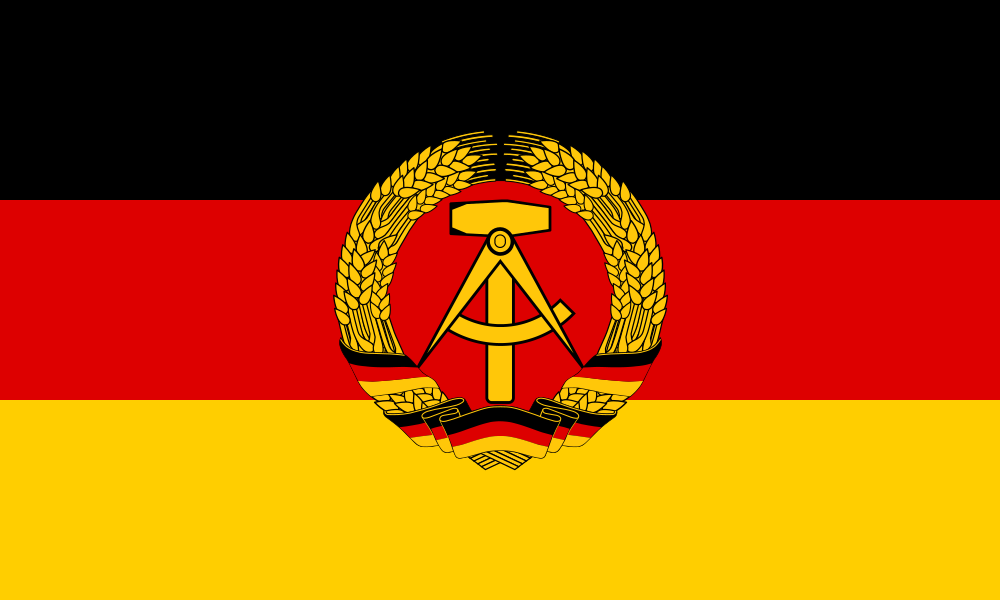
Otto Grotewohl was a Weimar-era Social Democratic politician who voted against Hitler’s Enabling Act and later led the postwar SPD in the Soviet occupation zone. Initially cautious, he helped drive the merger with the Communist Party under Soviet occupation authorities, becoming the SED’s co-chairman in 1946. The merger created the political foundation of East Germany, but it also followed the suppression of free choice within the SPD. As the GDR’s first head of government from 1949, Grotewohl helped build the new state while operating within the limits imposed by Soviet power.
Activities and affiliations
Career Timeline
- 1912Joined the Social Democratic Party of Germany
- 1920–1926Member of the Brunswick state parliament
- 1922–1924Brunswick Minister of Justice and Public Education
- 1925–1933Member of the Reichstag
- 1945–1946Chairman of the SPD Central Committee in the Soviet occupation zone
- 1946–1950Co-chairman of the Socialist Unity Party of Germany
- 1949–1964Chairman of the Council of Ministers of the GDR
- 1960–1964Withdrew from active politics because of severe illness
- 1964Died in East Berlin
Related historical events
- 1944–1949The People's Democracies of Eastern EuropeSocial Democratic leader of the mergerLeading the Social Democrats of the Soviet zone, he signed the merger in April 1946 and became the first prime minister of the German Democratic Republic in 1949.
- 1961The Building of the Berlin WallFirst prime minister of the GDRHe served as co-chair when the SED was created through the forced merger of the SPD and KPD.
Under Nazism: the Enabling Act vote and life underground
On 23 March 1933 Grotewohl voted with the Social Democratic caucus against Hitler's Enabling Act, the constitutional amendment that allowed laws to be enacted without the Reichstag's approval and which passed. After the Nazi seizure of power he was removed from his Reichstag mandate and, like other Social Democrats, subjected to persecution. He was beaten and arrested or taken into custody several times and was eventually forced to leave Brunswick, moving first to Hamburg and from 1938 living in Berlin, where he worked as a greengrocer and industrial representative.
In Berlin he joined a resistance group centred on Erich Gniffke, an SPD politician he had known from Brunswick. The group, however, served above all to maintain contact and the economic survival of its members rather than to carry out active resistance to Nazi rule.
In August 1938 Grotewohl was again beaten and arrested and charged with high treason before the People's Court. He spent seven months in pre-trial detention before being released on 4 March 1939, when the proceedings against him were discontinued. After Georg Elser's attempted assassination of Hitler on 8 November 1939 he was arrested once more and held for about eight weeks. Following his release he worked as a clerk in Berlin while devoting increasing time to painting.
After the 20 July 1944 plot against Hitler he feared arrest again, but because he was by then living off the grid the Gestapo was unable to locate him. He spent the closing months of the war in this way and lived through the Battle of Berlin.