The 'African Che' who traded the state Mercedes fleet for Renault 5s
“While revolutionaries as individuals can be murdered, you cannot kill ideas.” — speech a week before his assassination, 1987
A Marxist pan-Africanist revolutionary of Burkina Faso. Taking power at thirty-three in 1983, he renamed the country 'land of upright people' and drove mass vaccination, literacy and women's-rights campaigns. He rejected IMF structural adjustment and was assassinated in the 1987 coup of his comrade Blaise Compaoré.
Activities and affiliations
Career Timeline
- 1983Takes power at thirty-three; the National Council of the Revolution
- 1983–1987Vaccination, literacy, reforestation and women's-rights campaigns
- 1984Renames the country Burkina Faso, 'land of upright people'
- 1987.7The Addis Ababa speech: Africa must repudiate its debt
- 1987.10Assassinated in the coup of his comrade Compaoré
- 1987Delivered Women’s Liberation and the African Freedom Struggle on International Women’s Day
"Silmi-mossi" — the roots of a revolutionary who crossed ethnic boundaries
Thomas Isidore Noël Sankara was born on 21 December 1949 in Yako, a small town in the north of Upper Volta, then part of French West Africa. He was the third of ten children. His father, Sambo Joseph Sankara, was of the Mossi people and served as a medic in the Senegalese Rifle Division during the Second World War; captured by German forces in 1940, he remained a prisoner until the war's end. His mother, Marguerite Kinda, was Fulani.
Under the Mossi caste system, a child whose father was not Mossi was classified as 'silmi-mossi,' a third-class person. From birth Sankara stood on the margins of the ethnic hierarchy, an experience that would later fuel his hatred of all forms of tribal discrimination and privilege.
Raised in a Catholic family, he attended primary school in Gaoua and continued his studies in Bobo-Dioulasso, the country's second city. His parents wanted him to become a priest. Because most of Upper Volta's population was Muslim, the young Sankara also became familiar with the Quran; as an adult he would quote both Bible and Quran in his speeches.
Choosing the military path, Sankara passed through the military academy in Ouagadougou and the EMIA officers' school in Yaoundé, Cameroon, before entering the military academy at Antsirabe, Madagascar in 1970. There he first encountered Marx and Lenin, and witnessed the 1971–72 popular uprisings against the Tsiranana dictatorship, experiences that awakened his revolutionary consciousness. Returning home in 1972, he attracted attention as a charismatic officer who played guitar in the jazz band 'Tout-à-Coup Jazz' and rode a motorcycle.
"We are heirs of all the world's revolutions" — intellectual formation and political thought
Thomas Sankara's political thought was not a simple import of Marxism-Leninism. Starting from Africa's concrete conditions, he built an original revolutionary worldview that synthesized imperialism critique, dependency theory, and pan-Africanism.
His political awakening began at the Antsirabe military academy in Madagascar in 1970. There he first encountered Marx and Lenin and witnessed the 1971–72 popular uprisings against the Tsiranana dictatorship. 'There I saw the fire of revolution,' he later recalled. Discussions with French leftist professors gave him a language for anti-imperialist critique.
The core theoretical axis of Sankara's thought was the dependency theory of Egyptian economist Samir Amin, particularly his concept of 'auto-centered development' and 'delinking' from the global capitalist system. Amin was a personal friend and intellectual mentor. Sankara translated these concepts into policy through rejection of IMF and World Bank loans, food self-sufficiency, and the 'consommons burkinabè' campaign.
He also drew deeply from Kwame Nkrumah's pan-Africanism, Amílcar Cabral's national liberation theory, and Frantz Fanon's decolonial thought. As he declared at the UN in 1984, he positioned the Burkinabè revolution as heir to 'the American Revolution, the French Revolution of 1789, and the October Revolution of 1917.' This was not empty rhetoric: he envisioned a universal emancipation beyond the colonial experience.
The most original feature of Sankara's thought was his focus on the peasantry. Independently of Mao and Amin, he argued that the agent of African revolution was not the urban proletariat but the peasant masses. 'We have almost no factories, but land is everywhere.' This was the theoretical foundation for his agricultural reform, land redistribution, and food self-sufficiency policies.
His written corpus is substantial. Women's Liberation and the African Freedom Struggle (1987), We Are Heirs of the World's Revolutions (1984), and dozens of major speeches constitute not mere propaganda but systematic theory-building. Paroles et actes, published posthumously in Paris (1988), remains the essential collection of his intellectual legacy. An avid reader of both the Bible and the Quran, he skillfully wove religious language with revolutionary rhetoric. Sankara's thought continues to resonate in twenty-first-century pan-Africanist movements, anti-austerity struggles, and postcolonial critical theory.
"There are seven million people like me in this country" — the symbolic politics of the poorest president
From his first day in power, Thomas Sankara turned the leader's own lifestyle into a weapon of revolution. He donated his entire presidential salary of $2,000 a month to an orphan fund and lived solely on his army captain's pay of $450. He banned the display of his portrait in public places and government offices, saying: 'There are seven million people like me in this country.'
He refused to install an air conditioner in his office because he was 'ashamed before people who cannot afford such luxury.' He sold the government's entire Mercedes fleet and replaced it with Renault 5s, then the cheapest car available in France. Ministers were stripped of personal chauffeurs and banned from flying first class. In place of expensive Western suits, he required civil servants to wear Faso Dan Fani, a locally woven cotton tunic. Every New Year senior officials were obliged to donate a month's salary to social welfare funds.
His austerity was not theatre but strategy. Sankara believed that if Burkina Faso was to become self-reliant without foreign aid, its leadership had to embody a 'revolutionary asceticism' from the top down. Arriving at his first cabinet meeting on a bicycle in 1981, flying economy class on international trips: every gesture conveyed the same message. He defined the public servant as 'a servant of the people' and used symbolic acts to sever the culture of the neo-colonial elite.
After his assassination, an inventory of his personal property was made public: one old Peugeot, a refrigerator with a broken freezer, three guitars, and four bicycles. That was the sum total of possessions belonging to the man who had led a revolution for four years. Sankara's image as 'the poorest president' transcended propaganda; it remains one of the most radical alternatives to the luxury and extraction of post-independence African ruling elites.
"Africa for the Africans" — the pan-African revolutionary network and comrades across the continent
Thomas Sankara's pan-Africanism was never mere rhetoric. He pursued a concrete political project to build a revolutionary bloc across the African continent.
His closest comrade was Jerry Rawlings of Ghana. Rawlings, who had taken power in 1981, shared Sankara's anti-imperialist outlook, and the two became the twin pillars of West Africa's progressive camp. The two countries routinely shared intelligence; after Sankara's death, Rawlings mourned that 'Africa has lost its bravest son.'
Sankara also maintained close ties with Muammar Gaddafi of Libya. Libya provided military support during the 1983 coup, and Gaddafi's 'Third International Theory' shared some common ground with Sankara's self-reliant path. Yet Sankara remained wary of Gaddafi's mercurial diplomacy, and the relationship fluctuated between strategic cooperation and tension.
He openly backed the African National Congress (ANC) in its struggle against apartheid South Africa and supported SWAPO in Namibia and the Polisario Front in Western Sahara. In 1986 Burkina Faso became one of the few African states to host an ANC mission in its capital, Ouagadougou.
On the platforms of the Non-Aligned Movement and the Organisation of African Unity (OAU), Sankara carried the message that 'another Africa is possible.' He confronted pro-French African leaders (Félix Houphouët-Boigny of Ivory Coast, Hassan II of Morocco) championing African self-determination and economic sovereignty. Their hostility crystallised at the 1986 Yamoussoukro summit, where Sankara faced collective pressure to roll back his reforms.
His network extended beyond the level of states to youth, labour, and peasant movements across the continent. 'The Burkinabè revolution,' Sankara declared, 'is not an experiment for one country; it is a touchstone for the entire continent.' During his four years in power, Ouagadougou became the informal capital of Africa's progressive movements, and long after his assassination, that spirit survived in the continent's discourse of resistance.
"Woe to those who gag the people" — the path to the 1983 revolution
Thomas Sankara did not come to power through a simple military putsch. The uprising of 4 August 1983 was the product of two years of political radicalization, open defiance, and popular mobilization.
At the military academy in Antsirabe, Madagascar (1970–72), Sankara studied Marx and Lenin and witnessed two popular insurrections against the authoritarian regime of President Tsiranana, experiences that forged his revolutionary outlook. Back home, he fought in the brief Agacher Strip War against Mali (1974), which he later called 'useless and unjust.' In 1976, posted to the commando training center at Pô, he gathered like-minded radical junior officers including Blaise Compaoré and formed the clandestine 'Group of Communist Officers' (Regroupement des officiers communistes).
In September 1981 the military ruler Colonel Saye Zerbo brought Sankara into government as Secretary of State for Information. Sankara arrived at his first cabinet meeting on a bicycle, an early trademark. But on 21 April 1982, protesting the regime's crackdown on the press and trade unions, he resigned live on national television with the words: 'Woe to those who gag the people!' The broadcast stunned the nation.
After a further coup in November 1982, the new head of state Major Jean-Baptiste Ouédraogo named Sankara Prime Minister in January 1983 to calm popular unrest. But following a visit by Jean-Christophe Mitterrand, son of the French president and his father's Africa adviser, Sankara was deemed 'too radical,' dismissed on 15 May, and placed under house arrest. Fellow officers Henri Zongo and Boukary Lingani were also detained.
The arrest ignited an uprising in the poor neighborhoods of Ouagadougou. Though suppressed, it fatally weakened the regime. Two months later, on 4 August, Compaoré led the capital garrison in a mutiny that freed Sankara. The thirty-three-year-old captain became Chairman of the National Council of the Revolution (CNR) and proclaimed a 'Democratic and Popular Revolution.' An attempted counter-coup by right-wing officers was crushed within days. The four-year radical experiment had begun.
"Where have we come from and where are we going?" — the Political Orientation Speech of 1983, theoretical foundation of the Burkinabè revolution
On 2 October 1983, less than two months after taking power, Thomas Sankara addressed the nation by radio with a speech that would define the ideological character of his revolution. The 'Political Orientation Speech' (Discours d'Orientation Politique, DOP) was no mere inaugural declaration. It answered, in Sankara's own framing, the question 'Where have we come from, and where are we going?' It became the theoretical foundation of the Burkinabè revolution.
The draft was written primarily by the young intellectual Valère Somé, a member of the Marxist organisation ULCR (Union de Luttes Communistes Reconstruite). Sankara summoned Somé by car and the two worked on the text until 4 a.m. on the day it was delivered. Blaise Compaoré also took part; the trade union leader Soumane Touré was invited but declined to contribute. The foreign policy section was added hastily and remained sketchy compared with the detailed domestic analysis. The recording was made in the very room (the Conseil de l'Entente building) where Sankara would be assassinated four years later.
The core of the speech was a meticulous class analysis of Voltaic society. Sankara sorted enemies from friends. The enemies were: (1) the state bureaucracy bourgeoisie: those who had used their political monopoly for illicit enrichment; (2) the commercial bourgeoisie: traders tied to imperialism; and (3) reactionary feudal-traditional forces: the chiefs and their structures of pre-modern exploitation. The friends were: (1) the working class: 'a genuinely revolutionary class that has everything to gain and nothing to lose'; (2) the petty bourgeoisie: a vacillating but largely progressive middle layer of intellectuals, lower civil servants and students; (3) the peasantry: numerically the main force of the revolution yet bound by backward productive relations; and (4) the lumpenproletariat: declassed elements without work who, if given something useful to do by the revolution, 'can become its fervent defenders.'
The DOP established the 'Democratic and Popular Revolution' (Révolution Démocratique et Populaire, RDP) as the official line of the Burkinabè revolution. It claimed descent from all the world's revolutions (the French, the American, the October Revolution) while attempting to construct a revolutionary theory adapted to African conditions. The speech served as the reference point for every reform of the following four years and defined the ideological identity of the Sankara regime. Today it is recognised as one of the most important primary documents of African Marxist theory. After Sankara's assassination in 1987, Compaoré discarded every principle of the DOP, but the text continues to be read and cited in resistance movements across the continent.
"Power in the people's hands, not the barrel of a gun" — Committees for the Defense of the Revolution and Popular Revolutionary Tribunals
The institutional backbone of the Sankara revolution rested on two mass organizations. Created in 1983 and modelled on Cuba's Committees for the Defense of the Revolution, Burkina Faso's CDRs (Comités de Défense de la Révolution) were grassroots revolutionary cells established in every workplace and village. By 1986 they had enrolled some 2.9 million people, a substantial share of the adult population, forming a vast nationwide network.
The CDRs were never meant to be mere surveillance bodies. Sankara conceived them as a 'platform for popular mobilization,' endowing them with administrative, economic, and judicial functions. Each CDR was responsible for local sanitation, encouraging production, monitoring budget expenditure, and political education. They were also intended as a counterweight to prevent the army from monopolizing power. Together with the national people's service SERNAPO, the CDRs formed a dual check on a military that had staged repeated coups for decades.
Paired with the CDRs were the Popular Revolutionary Tribunals (Tribunaux populaires de la Révolution, TPRs), launched in October 1983. Composed of magistrates, soldiers, and CDR representatives, the TPRs put former high officials on public trial for corruption, tax evasion, and 'counter-revolutionary' activity. Defendants were denied lawyers, and the assets of public officials faced open scrutiny. Former President Colonel Saye Zerbo was sentenced to 15 years in May 1984 (released August 1985; the conviction was annulled in 1997).
Sankara himself acknowledged the tribunals' flaws. In a 1985 speech he criticized how they 'sometimes degenerated into settling private scores' and sought to correct institutional abuse through the 'three struggles' campaign. Sentences were generally light and often suspended: the TPRs were, at root, a forum for public demonstration trials and revolutionary moral education.
Critics dismissed the CDRs as gangs of thugs and the TPRs as 'show trials.' Trade unions and the independent press came under CDR scrutiny, and in some localities CDRs clashed with unionists. Yet for supporters, these two institutions represented an experiment without precedent in Africa: an attempt to organize not just taxpayers and voters, but a 'sovereign people' that would monitor and judge its fellow citizens.
After Sankara's assassination on 15 October 1987, Compaoré immediately abolished both the CDRs and the TPRs. Some CDR units mounted armed resistance for several days after the president's death. Though the two institutions lasted barely four years, they remain the clearest institutional expression of Sankara's radical vision: a revolution not from above, but one where power would be exercised from below.
"Pioneer, dare to fight!" — The Pioneers of the Revolution and youth political education
"The revolution begins with children." Upon taking power in 1983, Thomas Sankara created the Pioneers of the Revolution (Pionniers de la Révolution), a youth organisation modelled on the Soviet Lenin Pioneers and China's Young Pioneers. Children in red scarves and yellow berets were the seeds of the new society his Democratic and Popular Revolution envisioned.
The Pioneers' education was no mere extracurricular activity. Beyond the regular school curriculum, in separate sessions three days a week, children learned about capitalism as 'the exploitation of man by man,' studied the struggles against apartheid in South Africa and for Palestine, and examined the structures of imperialism. Every Pioneer had to plant trees: ecological education was integral to revolutionary education in a country threatened by the advancing Sahara. The movement had its own salute: 'Pioneer! Dare to fight, know how to win! Live a revolutionary, die a revolutionary. Arms in hand! Homeland or death, we shall succeed!'
The organisation operated through the schools. Dynamic and revolutionary teachers were selected, trained in the capital Ouagadougou, then sent back to choose students for the programme. Sankara personally oversaw it, and former Pioneers attest that 'had it continued for ten more years it would have covered every child in the country.' The Pioneers were affiliated with the Committees for the Defense of the Revolution (CDRs) and were mobilised for community campaigns and rallies.
After the 1987 coup the Pioneers were immediately disbanded. But the seeds did not die. Among the leaders of Le Balai Citoyen (the citizens' movement instrumental in the 2014 uprising that toppled Blaise Compaoré) was musician Sams'K Le Jah, who has said he 'received his political education as a teenager in Sankara's pioneer youth movement.' Reggae artist Ocean Passamde Sawadogo, who toured the protest sites during the uprising, first donned the red scarf as a Pioneer at age three. He says: 'I make engaged music because I was a Pioneer. If Sankara hadn't died we would have been the future leaders of this country.'
"Our peasants are no longer slaves of the chiefs" — abolition of chieftaincy and the destruction of feudal vestiges
One of the first decisions of the Sankara revolutionary government was to abolish the centuries-old system of tribal chieftaincy. Traditional power structures, above all the Mossi kingdom, had survived colonial rule intact: chiefs extracted tribute and forced labor from peasants, ruling as petty kings in their localities.
Sankara's government immediately stripped chiefs of their privileges and property and banned the payment of tribute and compulsory labor. This was not merely an administrative reform; it was a class struggle aimed at dismantling feudal relations of production. Declaring that 'the chief can no longer seize a share of the peasant's harvest,' Sankara abolished traditional land tenure and redistributed land to the peasants who tilled it.
The results were dramatic. Wheat yields more than doubled, from 1,700 to 3,800 kilograms per hectare, and within three years Burkina Faso achieved food self-sufficiency. Freed from chiefly exactions, peasant producers drove a surge in agricultural productivity. Cotton and textile production also rose sharply. 'Let us produce for ourselves and consume what we produce' became a guiding slogan of the revolution's drive to escape food-aid dependency.
The abolition of chieftaincy also provoked the sharpest domestic resistance to the revolution. The traditional ruling stratum organized rural discontent against the government, forming part of the social base that would later underpin Compaoré's coup. Despite pressure from France and neighboring states, Sankara refused to retreat from the destruction of feudal vestiges.
"No revolution without women's emancipation" — gender equality and domestic reform
Thomas Sankara placed women's issues at the center of his revolution in ways unprecedented in Africa. Declaring that 'women are the judges of our revolution,' he appointed a significant number of women to his cabinet, encouraged women to join the army, and created a women's motorcycle guard unit.
On day one his government banned female genital mutilation, forced marriages, and polygamy. In 1984 he inaugurated a 'Day of Solidarity': men were encouraged to cook, clean, do laundry, and go to market, experiencing firsthand what he called 'the delights of women's daily life.' It was symbolic theater, but the message was unmistakable.
The reforms went far further. In November 1984 the 'Vaccination Commando' campaign immunized 2.5 million children in fifteen days, and infant mortality fell from 280 to 145 per 1,000 live births. To halt the advancing Sahara, his government created 7,000 tree nurseries and planted ten million trees. Operation Alpha, a mass literacy drive, taught reading and writing in nine local languages.
Sankara lived on his army captain's salary of $450 a month, donating the presidential salary of $2,000 to an orphan fund. He sold the government Mercedes fleet and bought Renault 5s, the cheapest cars available. Civil servants were required to swap Western suits for locally woven cotton tunics. After his death his worldly possessions amounted to an old Peugeot, a broken refrigerator, three guitars, and four bicycles. He was a president who banned his own portrait, saying: 'There are seven million people like me in this country.'
"Let us feed ourselves" — agrarian revolution and food sovereignty
Thomas Sankara's agrarian reform was not merely about raising yields. It was a political project to restore Burkinabè peasants' control over their own labour and land.
In August 1984 his government nationalised all land. The old system, where chiefs and large landowners decided who could farm, was abolished, and cultivation rights were redistributed to those who actually worked the soil. The principle was simple: 'The land belongs to those who till it.'
The results came fast. Wheat yields doubled from 1,700 to 3,800 kilograms per hectare in three years. Between 1983 and 1986 total cereal production rose by 75 percent. UN analysts declared Burkinabè agriculture productive enough to be 'food self-sufficient.' Within four years, a country notorious for famine and chronic food shortages was feeding itself.
This was achieved through volunteer labour and collective organisation. In the Sourou Valley a dam was built within months, almost entirely by the voluntary effort of local residents. Irrigated land expanded by 25 percent in three years, and fertiliser use increased by 56 percent. In village after village the Committees for the Defence of the Revolution (CDRs) organised collective work to build cereal banks, enabling farmers to store harvests and wait for favourable market prices. The old cycle, selling surplus grain cheaply to middlemen for lack of storage, then buying it back at double the price, was broken.
Sankara's agricultural policy relied on internal resources, not foreign aid. In his five-year plan (1986–1990), 71 percent of productive-sector investment was allocated to agriculture, livestock, fisheries and forestry. Hundreds of tractors were imported for large-scale cooperative projects. At the same time, the government ran a campaign ('Let us produce for ourselves, and consume what we produce') encouraging Burkinabè to eat locally grown sorghum, millet and maize instead of European rice and wheat.
Underpinning the agrarian revolution was Sankara's distinctive peasant-centred thinking. Though a Marxist, he viewed the peasantry not as a mere ally but as the subject of revolution. 'The first front of the Burkinabè revolution is the wheat field' was not rhetoric but policy. This peasant-centred perspective, developed independently of both Mao Zedong and Samir Amin, was a hallmark of his thought and would later influence peasant movements in several African countries.
"Africa for the Africans" — anti-imperialist foreign policy and international solidarity
Thomas Sankara's foreign policy was rooted in a total rejection of colonialism and neo-colonialism. In his October 1984 address to the UN General Assembly he declared 'Africa for the Africans, Burkina for the Burkinabè,' demanding abolition of the great-power veto and a New International Economic Order. He denounced the US invasion of Grenada and openly backed the right to self-determination of Western Sahara, Palestine, the Nicaraguan Sandinistas, and the South African ANC. Washington responded with trade sanctions.
Sankara emerged as an active leader of the Non-Aligned Movement. He forged a special bond with Cuba: in 1986 he sent 600 young Burkinabè to Cuba for training as doctors and engineers, and Fidel Castro visited Burkina Faso in 1987. He worked closely with Jerry Rawlings in Ghana and Muammar Gaddafi in Libya, and visited the Soviet Union in October 1986.
With France and its allies, however, he was unsparing. When President François Mitterrand visited Burkina Faso in November 1986, Sankara publicly rebuked France for hosting South Africa's apartheid leader P.W. Botha and UNITA chief Jonas Savimbi, men he called 'covered in blood from head to toe.' France cut its aid to Burkina Faso by 80 percent between 1983 and 1985. Pro-French African leaders such as Félix Houphouët-Boigny of Ivory Coast and Hassan II of Morocco treated him with open hostility, leaving Sankara relatively isolated in West Africa.
The Agacher Strip War with Mali in December 1985 marked the sharpest crisis. Malian forces launched a surprise attack across the border, and five days of fighting killed more than 100 Burkinabè and some 40 Malians. Suspicion lingered that the war was part of a wider plot to bring down Sankara's government. After a ceasefire the International Court of Justice divided the disputed territory, and the Burkinabè government subsequently muted its public calls for revolution abroad.
"Pickaxes, not guns" — transforming the army into a productive force
In postcolonial Africa, armies were usually busy staging coups or enjoying privileges. Sankara set out to break this praetorian cycle. To transform the army from an enemy of the people into an instrument of the people. This was the core of his military reform.
From his days at the Antsirabe military academy in Madagascar, Sankara had been absorbed by the question of the army's socio-economic role. The academy's curriculum, which taught officer cadets agriculture and civil engineering alongside tactics, left a lasting impression. 'A soldier should not only hold a gun, but build a country' was the conviction he carried from his twenties.
Once in power, Sankara pursued military reform through two mechanisms. The first was SERNAPO (Service National et Populaire), a national service corps in which young people received military training alongside literacy, agriculture and construction skills, blurring the line between soldier and civilian. SERNAPO brigades travelled the country building schools, health posts, roads and dams. The Sourou Valley dam was completed almost entirely by SERNAPO volunteer labour in a matter of months.
The second was putting the regular army itself to productive work. Soldiers helped peasants at harvest, graded roads and dug wells. 'Our soldiers do military training in the morning and plant sweet potatoes in the afternoon,' Sankara said. Officers' privileges were dismantled. The central army commissary, which had sold scarce imported goods to officers at cut-rate prices, was turned into the country's first supermarket, open to all.
Sankara inscribed this philosophy in the new national coat of arms: a crossed AK-47 and hoe beneath the motto 'Fatherland or death, we shall conquer.' The emblem was no mere symbol. It declared that the army would no longer be a parasite on the people's back but a comrade sweating alongside them.
This reform provoked fierce resistance within the military. Officers stripped of privilege, especially senior ranks who had enjoyed the commissary's perks, came to see Sankara as an enemy of the army. When Blaise Compaoré mounted his coup in October 1987, disaffected officers of exactly this kind filled his ranks. Four years was all the revolution had before the gun turned back on the revolutionary.
"Let us produce for ourselves" — economic self-reliance, land reform and the war on corruption
Thomas Sankara's "Democratic and Popular Revolution" centered on economic sovereignty. It meant breaking external dependency by mobilizing internal resources. "He who feeds you dictates his will." Sankara translated this maxim into policy.
Upon taking power, his government nationalized land and mineral resources, stripped tribal chiefs of their privileges, and redistributed large estates to the peasants who worked them. Wheat yields doubled from 1,700 to 3,800 kg per hectare, and within three years the country achieved food self-sufficiency. Cotton production surged, providing the basis for a domestic textile industry.
Rejecting IMF and World Bank loans, Sankara built over 700 km of roads and railways without foreign financing, along with brick factories and housing. Under the "consommons burkinabè" (let's consume Burkinabè) campaign, fruit and vegetable imports were banned and civil servants were required to wear locally woven cotton tunics instead of Western suits. The central army commissary became the country's first public supermarket.
The fight against corruption proceeded through Popular Revolutionary Tribunals (TPR). Former ministers and senior officials faced public trial for embezzlement, tax evasion, and "counter-revolutionary" activity. Sentences were generally light, but the symbolic effect of piercing official impunity was considerable. Critics note the tribunals sometimes devolved into instruments for settling personal scores.
Day-to-day execution of the revolution fell to Cuban-style Committees for the Defense of the Revolution (CDR). Organized at the village level, the CDRs handled security, sanitation, political education, and budget oversight, and armed a people's militia to counterbalance the military. The National Service (SERNAPO) combined military training with literacy and agricultural instruction for conscripted youth.
Sankara donated his $2,000 presidential salary to an orphan fund and lived on his army captain's pay of $450 a month. He dismissed half his cabinet to collective farms, saying they would "be more useful there." The first Five-Year Plan, launched in 1986, aimed at 15 percent GDP growth, yet contained its own contradiction: 79 percent of planned investment had to come from external sources.
Ten million trees planted, 2.5 million children vaccinated, a literacy campaign in nine local languages. All of this happened without foreign loans. Sankara's four years were both proof that a poor nation could act without aid, and an experiment revealing the external backlash such an attempt would provoke.
"Fatherland or death, we shall conquer" — the cultural revolution that rewrote a nation's name, flag, and anthem
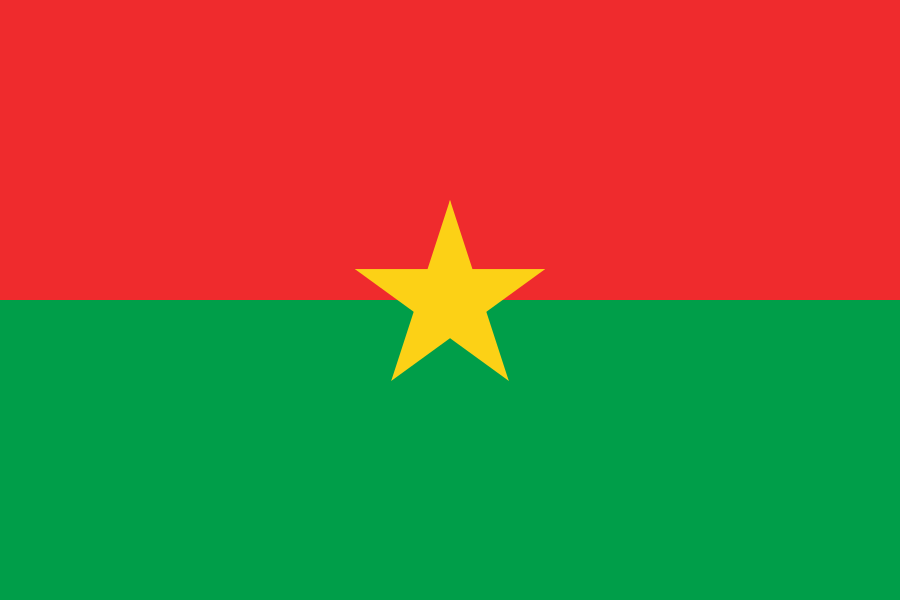
On 4 August 1984, the first anniversary of his accession, Sankara abolished 'Upper Volta', the name French colonial geography had imposed, and proclaimed 'Burkina Faso.' Combining the Mooré word burkina (upright people) and the Dyula word faso (fatherland), the new name means 'land of upright people.' That same day a new flag was raised: red for revolution, green for agriculture, the central gold star for the light guiding liberation. The coat of arms crossed a Kalashnikov and a hoe: defense and labor, the soldier-peasant alliance. Its motto: 'La Patrie ou la Mort, nous vaincrons' (Fatherland or death, we shall conquer).
Sankara wrote the new national anthem himself. A jazz guitarist, he composed both lyrics and melody of 'Le Ditanyè', the Anthem of Victory. Its opening line ('Against the humiliating bondage of a thousand years') sweeps through colonial history before landing on the 'one single night' of 4 August that 'drew together the history of an entire people.'
The wholesale reinvention of name, flag, and anthem was no mere symbolic substitution. It was the cultural dimension of revolutionary sovereignty: uprooting colonial identity at its foundations. The message: political independence remains incomplete without the decolonization of the mind.
"Cuba is our closest comrade" — the revolutionary alliance with Castro
Thomas Sankara found in the Cuban Revolution a direct model for Burkina Faso's own. He regarded Fidel Castro as a personal mentor and comrade, and the two revolutionary leaders forged a firm bond through Sankara's two visits to Cuba in 1984 and 1986 and Castro's visit to Burkina Faso in 1987. In 1984 Castro awarded Sankara Cuba's highest honour, the Order of José Martí.
Cooperation went far beyond symbolic solidarity, extending to concrete institutional transfer. The Committees for the Defense of the Revolution (CDRs) that Sankara built in every village, handling security, hygiene, political education and budget oversight, were modelled directly on Cuba's neighbourhood organisations and became the grassroots backbone of the revolution. Cuban medical personnel took part in the 1984 Vaccination Commando, helping immunise 2.5 million children in fifteen days, while Cuban teachers and technicians assisted with literacy and agricultural training.
The most ambitious collaboration was a human-capacity programme launched in 1986. Sankara selected 600 young Burkinabè and sent them to Cuba for free training in medicine, agronomy, welding, geology and other fields. Many later returned to become the backbone of the country's health and agricultural systems. For Sankara, Cuba was not merely a donor. It was proof that a poor island nation, under imperialist blockade, could still achieve universal healthcare and education. It was the living map of the road Burkina Faso meant to travel.
"Our White House is in Black Harlem" — the 1984 Harlem speech and the African diaspora
In October 1984 Thomas Sankara travelled to New York to address the UN General Assembly. But the platform he valued no less than the diplomatic stage was Harlem, uptown Manhattan.
On 2 October he opened an exhibition of Burkinabè art at the Harriet Tubman School in Harlem. The following evening, 3 October, he stood before more than 500 people at a rally organized by the Patrice Lumumba Coalition. After watching a Black ballet performance he said: 'A moment ago, as I watched your ballet, I really thought I was in Africa.' Then: 'This is why, as I have always said, and I'll say it again: our White House is in Black Harlem.'
The line brought the crowd to its feet in prolonged applause. It was more than rhetoric. Sankara was linking the Burkinabè revolution to the Black liberation struggle inside the United States, recognizing Harlem as a legitimate theatre of revolution no less than any West African capital.
At the UN General Assembly the following day, 4 October, he spoke in the same spirit: 'I speak on behalf of those millions of human beings who are in ghettos because their skin is black… Not far from here is Harlem. Its inhabitants suffer the same as we do.' The UN address and the Harlem speech formed a pair: a political act that placed the summit of world diplomacy and the autonomous Black neighbourhood on the same plane of political voice.
Sankara's Harlem moment revealed a pan-Africanism that spanned not just the geographic continent but the entire Black Atlantic. He had already connected with the Grenadian revolution of Maurice Bishop, and in 1986 he called the Burkinabè revolution 'the heritage of all Black people everywhere.' This diaspora politics survived his 1987 assassination as a core strand of Sankarisme, continually invoked by the 21st-century Black Lives Matter movement and the African diaspora left.
2.5 million in 15 days — the 'Vaccination Commando' and the public health revolution
In November 1984, during the first year of the Sankara government, Burkina Faso mounted a public health operation without precedent in African history. Dubbed the 'Vaccination Commando' (Commando de vaccination), the campaign immunized 2.5 million children under five against measles, meningitis and yellow fever in just fifteen days. Cuban medical volunteers and local health workers swept across the entire country, reaching 77% of the target child population.
The operation was more than a medical drive. For Sankara, public health was a pillar of the revolution. 'Without a healthy people there can be no productive economy and no sovereign nation,' he believed. When he took power, Burkina Faso's infant mortality rate stood at 280 per 1,000 live births, among the highest in the world. After the Vaccination Commando it plummeted to 145.
The Sankara government did not stop there. It routinized polio, tetanus, pertussis and diphtheria vaccination; mounted campaigns against river blindness (onchocerciasis); and built a network of primary-care clinics in rural areas where no health infrastructure had existed. All of this was financed from domestic resources and Cuban solidarity aid, without an IMF loan.
Research presented at the 2023 American Economic Association annual meeting confirmed the campaign's long-term effects. The vaccinated cohort showed significantly higher employment rates and agricultural productivity in adulthood, and higher primary-school completion rates, than the unvaccinated control group. The authors characterized the three-week Sankara-era operation as 'a policy experiment demonstrating that childhood interventions in low-income settings can yield lifetime economic gains.'
In a sub-Saharan country, in its first year of revolution, carried out on its own terms: this public health operation remains an object of study for health economists and a symbol of Global South health sovereignty.
"Democracy is not the ballot paper" — Sankara's revolutionary democracy and the CDR vision of direct popular power
Thomas Sankara mounted a fundamental critique of Western-style multiparty electoral democracy. In a country where barely 2 percent of the population was literate, he called the ballot paper "a rape and theft of the consciousness of the people." His alternative: direct democracy from below through the Committees for the Defense of the Revolution (CDRs).
In a 1985 interview, Sankara explained: "Democracy only exists when the people have the opportunity to erect safeguards against any form of power exercised by one man or a group of men." The CDRs were organized at the village, workplace, and school level, charged with administrative oversight, sanitation, local budget control, political education, and militia training. For Sankara the CDRs were not administrative appendages but the channel through which the people would directly seize state power.
This vision came with tensions. Feudal chiefs sometimes got themselves elected as CDR delegates, and Sankara admitted: "Sometimes we too practice ultra-democracy." In dialogue with a French graduate student he insisted that democracy must be understood as a real power relationship, not a formal procedure. "You don't build a revolution the way you fill in a form at the post office, crossing out the unnecessary and ticking the boxes."
On the question of a vanguard party, Sankara also took an independent line. "We want the party, if it is to come, to be the will of the people. If the people don't need it, there's no reason to impose it." He kept his distance from the classical Marxist-Leninist party model, declaring that he would copy neither Cuba, the USSR, Korea, Algeria, nor Libya. "The Burkinabè revolution would be yet another model. Why shouldn't we be the ones to set the example?" The radical experiment lasted only four years, but his question (what does democracy from below actually mean?) would echo through Africa's progressive movements long after his death.
"The desert does not advance — we retreat" — the Three Struggles and the ecological revolution
Thomas Sankara understood Sahelian desertification not as a mere environmental problem but as the ecological legacy of colonialism. Under French colonial rule, indiscriminate logging and the forced cultivation of cash crops had depleted the soil, and this degradation now operated as a neo-colonial mechanism that structured African peasant poverty, so went his analysis.
In response, his government created roughly 7,000 tree nurseries and planted over ten million trees during its first four years, building a 'Green Belt' to halt the Sahara's southward march, a pioneering experiment that anticipated the continent-wide Great Green Wall initiative.
In April 1985 Sankara launched the 'Three Struggles' (les trois luttes) campaign through the Committees for the Defense of the Revolution (CDRs): ① halt destructive logging and bush fires, ② promote the use of gas (to reduce wood-cutting for fuel), and ③ end poaching. The campaign moved beyond consciousness-raising: village-level CDRs were assigned direct responsibility for forest monitoring and tree-planting, turning ecological defense into a mass practice.
His government also pushed forward dam and reservoir projects to expand irrigation infrastructure, and environmental education was integrated into the regular school curriculum. 'When we destroy the forest, we destroy ourselves,' Sankara insisted, spreading the message that ecological self-reliance was the material foundation of political sovereignty.
For a Marxist head of state in the 1980s, this was a strikingly ecology-centered vision of development. While most socialist states of the era were absorbed in heavy-industry-first developmentalism, Sankara tied the regenerative capacity of land, water and forests directly to the sustainability of the revolution. In today's terms it was a pioneering practice of eco-socialism.
"You cannot carry out fundamental change without a certain amount of madness" — the philosophy of revolutionary creativity
One of Thomas Sankara's most original intellectual contributions to revolutionary politics was the concept of 'a certain amount of madness' (une certaine dose de folie). In a 1985 interview with Swiss journalist Jean-Philippe Rapp, he declared:
'You cannot carry out fundamental change without a certain amount of madness. In this case, it comes from nonconformity, the courage to turn your back on the old formulas, the courage to invent the future. It took the madmen of yesterday for us to be able to act with extreme clarity today. I want to be one of those madmen. We must dare to invent the future.'
This 'madness' was neither impulse nor recklessness. It was a political imagination that rejected the conditions of Western development aid, renamed a country, and believed peasants could feed their own nation. At a time when the world treated African poverty as inevitable, Sankara reframed the very claim that self-reliant development was possible as 'madness.' He embraced that madness as revolutionary method.
Elsewhere he insisted that 'everything man is capable of imagining, he can create,' and he made this conviction the national vision in the speech launching the five-year plan. The philosophy saturated his policies: the Vaccination Commando that immunized 2.5 million in fifteen days, the 'Battle of the Rails' that laid over 700 km of track without foreign capital, and the symbolic politics of selling the presidential Mercedes fleet for Renault 5s.
Sankara's concept of 'madness' was revived in Burkina Faso's 2014 popular uprising and has been reappraised in scholarship as an alternative political philosophy challenging the Western-centric 'African leadership crisis' discourse. His 'madness' was, ultimately, another name for the revolutionary will to refuse existing reality and create new possibilities.
"We walk our own path" — North Korea, Juche, and the politics of self-reliance
Thomas Sankara cultivated a distinctive relationship with the Democratic People's Republic of Korea (DPRK), visiting Pyongyang twice. His first visit came on 13 March 1983 as Prime Minister; the second, on 3 September 1985, was as President for a summit with Kim Il Sung, who presented him with a handgun. The two countries signed a military cooperation accord that year.
North Korea had begun providing military equipment to Upper Volta in the mid-1970s. Under Sankara the 1983 accord expanded arms and technical assistance, and a North Korean chargé d'affaires resided in Ouagadougou. Agricultural and infrastructure aid accompanied the military cooperation.
The relationship went beyond weapons: Sankara was drawn to the Juche idea, above all its concept of self-reliance, a nation depending on its own resources and labour rather than foreign capital. He banned IMF and World Bank loans, made food self-sufficiency the revolution's core economic goal, and declared 'Let us produce for ourselves.' This shared a philosophical resonance with Pyongyang's ideology, even if Sankara's Marxism was eclectic and independently forged.
The DPRK connection sat within Sankara's broader non-aligned foreign policy. Moscow viewed his independent line with suspicion; Sankara had declared publicly that 'a Marxist-Leninist is not Moscow's proxy.' The Pyongyang relationship was part of this autonomous diplomacy, alongside alliances with Cuba, Libya, and Ghana under Jerry Rawlings.
After Sankara's assassination the relationship persisted under Blaise Compaoré, who visited Pyongyang in September 1988. North Korea completed five small water reservoirs in Burkina Faso in the late 1990s. In March 2023, decades later, Burkina Faso's military government formally re-established diplomatic relations with the DPRK. The seed of self-reliance Sankara planted outlived regimes and eras.
"A Marxist-Leninist is not Moscow's proxy" — the strained relationship with the USSR and the Eastern Bloc
Thomas Sankara was a Marxist-Leninist but never Moscow's proxy. Having studied Marx and Lenin at the Antsirabe military academy in Madagascar, he insisted that 'scientific truth is universal, but models cannot be copied.' His regime maintained a non-aligned posture, at times openly criticizing the USSR. A 1985 editorial titled 'The Proletarian Spirit' condemned Soviet foreign aid policies as another form of imperialism, and he also denounced the Soviet invasion of Afghanistan. The pro-Soviet Patriotic League for Development (LIPAD) was removed from government in 1984.
Yet relations existed. Since establishing diplomatic ties in 1967, the USSR had provided military training and equipment, and Sankara's Burkina Faso forged an especially close bond with Cuba, a key Soviet ally. In 1986, some 600 young Burkinabè were sent to Cuba for medical and technical training; Fidel Castro visited Burkina Faso in 1987. For Sankara, Cuba was the 'model of Third World revolution,' while the Soviet Union was a superpower to be engaged but watched warily.
In October 1986, Sankara made his only state visit to the USSR. Welcomed at Vnukovo Airport by Andrei Gromyko, Chairman of the Presidium of the Supreme Soviet, he held talks with General Secretary Mikhail Gorbachev and signed a Soviet-Burkinabé declaration of cooperation. He laid a wreath at the Lenin Mausoleum, toured Lenin's Kremlin office, and traveled to Leningrad (the Smolny Institute, the Hermitage, the Piskaryov Memorial) and to Frunze in Soviet Kyrgyzstan, visiting an agricultural machinery plant, a stud farm, and the Cosmonaut Training Center at Star City. He planted a tree on the Alley of Friendship, a ritual of socialist internationalism.
But the visit signified dialogue and practical benefit, not ideological submission. Sankara pursued military and economic cooperation without adopting the Soviet line. By the time he was assassinated in October 1987, Gorbachev's Kremlin was consumed by perestroika and glasnost and paid little attention to Africa. Burkina Faso's debt to the USSR amounted to a modest 4.3 million rubles; after the Soviet collapse in 1991, Russia inherited the claim. Sankara's independent Marxism-Leninism remains a symbol of ideological sovereignty in Cold War-era African revolutionary movements.
The "Christmas War" — the 1985 Agacher Strip conflict with Mali
On Christmas Day, 25 December 1985, Malian forces launched a surprise armored and air assault on the Agacher Strip in northern Burkina Faso, plunging Sankara's regime into its first full-scale war. Mali justified the attack on the pretext that Burkinabé census-takers had crossed the border. Outgunned and outmatched in heavy weaponry, Burkina Faso's forces were pushed back, and the border villages fell under Malian occupation.
Burkinabé troops resorted to guerrilla tactics to stall advancing Malian tanks. Malian air force strikes on the market in Ouahigouya caused significant civilian casualties. In five days of fighting, between roughly 140 and 300 people on both sides were killed. A ceasefire was brokered on 30 December by Ivorian President Félix Houphouët-Boigny.
The war exposed the military vulnerability of Sankara's revolutionary regime and had significant political consequences. Afterwards Sankara muted his calls for revolution abroad and adopted a more moderate diplomatic tone. In 1986 the International Court of Justice partitioned the Agacher Strip between the two countries, and Burkina Faso accepted the ruling. The conflict fit a wider pattern of international pressure against Sankara's government by France and allied regional regimes. It remained the emblematic episode of the military and diplomatic isolation his revolution faced until his assassination two years later.
"AIDS is as terrible an enemy as imperialism" — the first African leader to officially recognize the epidemic
In the mid-1980s most African governments either denied the existence of AIDS or met it with silence. Fearing stigma, damage to tourism, and religious taboo, leaders refused to publicly acknowledge the epidemic. Thomas Sankara walked the opposite path.
His government became the first in Africa to officially recognize AIDS as a major public-health threat. Declaring that 'AIDS is as terrible an enemy as imperialism,' Sankara launched public-awareness campaigns and sex education to slow the spread of the disease. In 1986 he lifted all restrictions on contraception, dramatically expanding access to condoms and birth control, a policy almost without precedent on the continent at the time.
This approach dovetailed with Sankara's wider women's-emancipation and public-health revolution. Family planning, STI prevention, and maternal health were woven into a single integrated public-health framework. Together with the bans on female genital mutilation, forced marriage, and polygamy, expanded contraceptive access was a concrete measure to guarantee women's bodily autonomy.
After Sankara's assassination the Compaoré regime abandoned most of these pioneering health policies, and Burkina Faso's AIDS response fell years behind, like much of the rest of Africa. Sankara's preemptive campaign was later reassessed by international health bodies as a model of early epidemic response, and it remains a brief but trailblazing chapter in the history of African public health.
"The purification of cinema is a requirement of our struggle" — FESPACO and film as a weapon of cultural liberation
Thomas Sankara regarded cinema not as entertainment but as a strategic tool for consciousness-raising and cultural liberation. The four years of his revolutionary government marked the emergence of Burkina Faso as the epicenter of the pan-African film movement.
The Pan-African Film and Television Festival of Ouagadougou (FESPACO), founded in 1969, had languished before Sankara under the distribution monopoly of two French companies, COMACICO and SECMA. French censorship and financial control meant African filmmakers could not put their own languages and realities on screen. When Ousmane Sembène set out to shoot Mandabi in Wolof, French producers demanded he switch to French and add erotic scenes.
Sankara's government nationalized the film industry and poured state resources into FESPACO. The 1985 festival theme was 'Cinema and the Liberation of Peoples'; in 1987 it was 'Cinema and Cultural Identity.' Sankara personally presided over the opening and closing ceremonies and met individually with filmmakers from across the continent, pledging funding and production support. He told journalists: 'The purification of cinema is a requirement of our struggle. We must conquer our screens, reconquer our culture, to spread the messages that are going to serve the people's interests.'
During the 1985 festival the whole nation was engaged in the 'Battle of the Rails' (laying a railway to the country's largest manganese deposit). Filmmakers joined the workers and volunteers on site, pickaxes in hand. Banners across Ouagadougou proclaimed 'Free the African Screens!' and 'FESPACO 85, weapon of the liberation for peoples.' Cuban and Latin American delegations attended, screening their own films on national liberation.
Sankara personally invited Mauritanian director Med Hondo, who had been abused by French production monopolies during pre-production of his epic Sarraounia, for a drink and promised him government funding. The film was shot entirely in Burkina Faso and premiered at FESPACO 1987. It was a landmark: an African state directly financing a major pan-African film production.
After the 1987 coup, the Compaoré regime diluted FESPACO's anti-colonial character and reversed the nationalization of cinema. But the two festivals of 1985 and 1987 endure as an immortal legacy in African film history: the realization of Sankara's vision that cinema is an extension of the liberation struggle itself.
"The revolutionary word cuts sharper than the sword" — Sankara as orator, writer and revolutionary author
Thomas Sankara was not merely a politician who spoke well. He was an original revolutionary writer who wove together Marxist analysis, African oral tradition, Mossi proverbs, and biting satire. Though he spoke in French, the imagery and rhythm of his rhetoric grew from the soil of the Voltaic plateau.
Sankara's speeches were not improvised on the spot. He wrote most of them himself, and over four years in power he delivered more than 200 major addresses. His comrade Valérie Somé sometimes provided ideological drafts, but the final text always passed through Sankara's own hands. 'Will you be a revolutionary, or a parrot that speaks well?' This was a question he put to young officers, and the standard he set for himself.
Five volumes of his speeches have been published posthumously in English, French, Spanish, Farsi and Arabic, reaching a global readership. Thomas Sankara Speaks (1988) is the definitive collection spanning the entire Burkinabè revolution. We Are Heirs of the World's Revolutions distills his anti-imperialist philosophy around the landmark October 1984 UN General Assembly address. Women's Liberation and the African Freedom Struggle (1987) preserves his monumental International Women's Day speech of 8 March 1987, a text that framed gender emancipation as central to class struggle and national liberation.
His rhetoric was never abstract propaganda. 'Let us produce for ourselves, grow what we eat, weave what we wear.' This ability to translate the concrete acts of production and consumption into the language of revolution was the core of Sankara's art. He could overwhelm audiences with statistics while also delivering compressed maxims like 'Hunger is not a natural disaster. It is an organized crime.'
The national anthem Une Seule Nuit ('One Single Night'), which he wrote himself, and the coinage of 'Burkina Faso', fusing the Mossi burkina ('upright people') with the Dyula faso ('fatherland'), were products of the same linguistic sensibility: political acts that erased the colonial legacy at the level of language while forging a pan-ethnic national identity.
Nearly four decades after his death, his speeches are read and quoted not only across Africa but in social movements in Latin America, South Asia and Europe. Pathfinder Press publishes his works in the same series as Che Guevara, Malcolm X, and Fidel Castro: a mark that Sankara has entered the canon of Marxist revolutionary literature. The revolution fell to bullets, but the revolutionary word has outlived the sword.
"Debt is the cause of poverty, not its consequence" — the Addis Ababa speech
In July 1987 the Organization of African Unity met in Addis Ababa. The agenda was Africa's debt crisis. The mood was about how to accommodate IMF and World Bank structural adjustment.
Thomas Sankara, thirty-three years old, took the podium and said something else.
'Let us not repay the debt. Not because we cannot, but because we need not.' His logic was simple: the colonial powers had looted Africa for sums many times larger than the loans they extended. 'The debt we owe should have been their compensation for pillage.'
He continued: 'To say that poverty causes debt is a lie. Debt causes poverty.' Debt service was consuming the budgets African states needed for schools, hospitals and clean water. 'Repudiating debt is one of the few sovereign acts left to us.'
The hall went silent. France and the United States were furious. That October Sankara was assassinated in the coup of his comrade Blaise Compaoré. French complicity remains under investigation.
His logic would echo through the Global South's debt-cancellation movements for decades. Thirty years after his death, the question he posed remains open: who owes whom?
"The comrade I loved most pulled the trigger" — Blaise Compaoré, from brother to betrayer
The bond between Thomas Sankara and Blaise Compaoré was the deepest human relationship of the Burkinabè revolution, until the gunfire of 15 October 1987.
The two met in 1976 during an advanced officer training course in Morocco. Both were paratroop officers in their twenties with radical political convictions. Back home, when Sankara became commander of the commando training centre at Pô, he gathered like-minded comrades including Compaoré and formed the clandestine 'Group of Communist Officers' (ROC), soon joined by Henri Zongo and Jean-Baptiste Boukary Lingani.
They also formed a jazz band, Tout-à-Coup Jazz: Sankara on guitar, Compaoré on vocals. Fellow band member Abdoulaye Cissé later recalled: 'Sankara was a skilled musician; Compaoré just sang.' The band rehearsed more than it performed, but 'every concert was magical.' The musical friendship became one more emblem of the revolution to come.
In May 1983, when Sankara was dismissed and placed under house arrest by the Ouédraogo regime, Compaoré acted. He led the commando unit from Pô to the capital, where on 4 August the Ouagadougou garrison mutinied under his command, freeing Sankara. The coup made the 33-year-old Sankara president. Compaoré became the number two of the regime, serving as Minister of State and holding the justice portfolio, the quiet pillar of the revolution.
The contrast in temperaments was stark. Sankara was the charismatic orator and public face; Compaoré was reserved and self-effacing. Encyclopædia Britannica described Compaoré as 'content to leave the public business of politics to the more charismatic Sankara.' For four years this complementary partnership was the engine of the revolutionary government.
By 1987 cracks had opened. Disagreements over security matters and strategic direction (especially how to handle the mounting tensions with France, Ivory Coast and other neighbours) deepened. Sankara's radical self-reliance and his curtailment of military privileges alienated more and more officers, and Compaoré became the alternative pole around which discontent gathered.
On 15 October 1987 Compaoré struck. Troops under his command stormed the Conseil de l'Entente building and killed Sankara and twelve comrades. Compaoré immediately called the death an 'accident' and professed, until the end, to be a Sankara loyalist. He ruled for twenty-seven years, reversing every reform. In 2022 a military tribunal sentenced Compaoré to life imprisonment.
"It's me they want" — the twelve comrades who fell with Sankara
At 4 p.m. on 15 October 1987, a meeting was due to begin at the Conseil de l'Entente building in Ouagadougou to discuss the creation of a unified party. Thomas Sankara arrived in his black Renault 5, wearing a red tracksuit: Thursday was 'mass sport' day. Inside, six close collaborators waited.
The meeting had barely begun when gunfire erupted. An armed hit squad had surrounded the building and killed the bodyguards. Sankara rose and said: 'Don't move. It's me they want.' He walked out onto the porch with his hands raised. He was shot dead immediately. One by one, the others were forced out through the single door and gunned down. Alouna Traoré, the sole survivor, lay among the fallen. He heard one of the attackers say, 'There's one who isn't dead,' but instead of being executed, he was led to another room and released the next morning. He still does not know why he was spared.
The twelve who fell with Sankara were: Five meeting participants: Paulin Babou Bamouni (director of presidential press, journalist), Bonaventure Compaoré (presidential staff), Frédéric Kiemdé (legal advisor to the presidency), Adjutant Christophe Saba (permanent secretary of the CNR, a trusted aide), and Patrice Zagré (philosophy professor). Five bodyguards: Emmanuel Bationo, Abdoulaye Gouem, Wallilaye Ouédraogo, Hamado Sawadogo, and Noufou Sawadogo. Der Somda, Sankara's driver, and Paténéma Soré, a gendarme who had come to deliver mail, also died.
They were not a cabinet. A journalist, a lawyer, a philosopher, bodyguards, a driver, a mail courier: the many faces of a revolution built together. In 2025, on the very site of the Conseil de l'Entente, a mausoleum was opened. It is not the grave of one man but the resting place of thirteen: all who dreamed and fell together.
"Revolutionaries can be murdered, ideas cannot" — the 1987 coup and the 34-year wait for justice
On the afternoon of 15 October 1987, Thomas Sankara was meeting with twelve close aides at the Conseil de l'Entente building in Ouagadougou. Around 4 p.m., armed troops commanded by Blaise Compaoré stormed the premises. According to Halouna Traoré, the sole survivor, the hit squad identified and shot Sankara first, then opened fire on everyone present. Sankara was hit by multiple bullets in the back. His body was hastily buried in an unmarked grave at the Dagnoën cemetery; his wife Mariam and two children fled the country.
Compaoré seized power immediately, declaring that Sankara had 'jeopardized foreign relations with France and Ivory Coast.' Sankara's nationalizations were reversed, the IMF and World Bank were welcomed back, and the austerity policies scrapped. Some Committees for the Defense of the Revolution mounted armed resistance for several days after the president's death.
Compaoré ruled for 27 years, during which any investigation into the assassination was thoroughly blocked. Only after his fall in the 2014 popular uprising could the truth begin to surface. On African Liberation Day, 25 May 2015, the remains of Sankara and his twelve companions were exhumed. The autopsy confirmed Sankara's body was riddled with more than a dozen bullets: from Kalashnikov rifles, pistols, and G3 automatic rifles.
In 2017 French President Emmanuel Macron promised to declassify documents on the assassination. In April 2021 the French Communist newspaper L'Humanité published documents suggesting the involvement of France's DGSE intelligence service. That October, thirty-four years after the killing, the trial opened before a military tribunal in Ouagadougou. Compaoré and his security chief Hyacinthe Kafondo were tried in absentia. On 6 April 2022 the tribunal sentenced Compaoré, Kafondo, and Gilbert Diendéré to life imprisonment, with eight others receiving sentences of three to twenty years and three acquitted.
In 2025 Sankara and his fallen comrades were reinterred in a mausoleum built on the site of the Conseil de l'Entente. His words from a Che Guevara commemoration one week before his own death ('While revolutionaries as individuals can be murdered, you cannot kill ideas') became his epitaph and the symbol of a truth-and-justice struggle spanning nearly four decades.
"I am still his wife" — Mariam Sankara, 34 years of exile and return
Thomas Sankara married Mariam Sereme in 1979. She was a university graduate from Dakar, Senegal, and they met in Ouagadougou. Sons Philippe (born 1980) and Auguste (born 1982) gave the revolutionary's household a brief season of domestic peace.
During Sankara's four years in power Mariam was rarely seen in public. True to her husband's austere principles, the presidential family lived without privilege. She later recalled: 'We were not poor. We simply lived like everyone else.'
On 15 October 1987 everything collapsed. The day of Compaoré's coup, Mariam fled across the border with her two young sons. She spent the next twenty years in exile in Montpellier, France. The Compaoré regime erased Sankara's name, and Mariam waged a lonely struggle to restore her husband's honour. In 1997 she filed a criminal complaint in a Burkinabè court over his murder; it was ignored for fifteen years.
In 2007 she set foot in Ouagadougou for the first time in two decades, to attend the twentieth-anniversary commemoration of Sankara's death. Thousands gathered at the airport, chanting 'Mariam! Mariam!'
When the popular uprising of 2014 toppled Compaoré, Mariam issued a statement: 'I congratulate the Burkinabè people on their victory. Fatherland or death, we shall overcome.' She attended the 2021 assassination trial in person to testify and watched the life sentences handed down in 2022. As of 2025 she still lives in France, saying simply: 'I am still his wife.'
"Sankara is not dead" — posthumous legacy and 21st-century revival
Thomas Sankara's body was destroyed on 15 October 1987, but his ghost has haunted Burkina Faso and the wider African continent for nearly four decades.
Blaise Compaoré reversed Sankara's nationalizations, returned to the IMF fold, and suppressed open references to his predecessor. Yet even he could not entirely disown the political legacy. Throughout his 27-year rule, Compaoré styled himself as Sankara's 'successor'; in 2007, at the 20th-anniversary commemoration, he invoked 'national reconciliation' in an attempt to absorb the legacy into his own regime. But in the poor neighborhoods and university campuses of Burkina Faso, Sankara remained a living symbol of anti-dictatorship struggle.
When the popular uprising of October 2014 finally toppled Compaoré, protesters carried Sankara's portraits and chanted his speeches. 'Sankara is not dead' (Sankara n'est pas mort) became a street cry. The uprising opened the path to truth and justice: exhumation in 2015, the trial of 2021–2022, and the mausoleum reinterment in 2025.
Beyond Burkina Faso, Sankara's thought became a central reference point for pan-African movements. From South Africa's #FeesMustFall to Senegal's Y'en a marre and the DRC's LUCHA, young African activists have translated Sankara's anti-imperialism, women's emancipation, and economic self-reliance into their own idioms of struggle. The term 'Sankarism' has taken root in both academic discourse and grassroots organizing as a distinct ideological current.
Captain Ibrahim Traoré, who seized power in yet another coup in 2022, openly claims Sankara as his 'ideological mentor.' His policies (expelling French troops, abrogating military accords with the former colonial power, nationalizing resources, and promoting domestically woven cotton) represent a contemporary reenactment of the Sankarist playbook. In 2023 the Burkinabè government formally proclaimed Sankara a 'national hero,' and Ouagadougou's Boulevard Charles de Gaulle was renamed Boulevard Capitaine Thomas Sankara.
Sankara's legacy is not a fossilized past but an active force. His words from the week before his death ('While revolutionaries as individuals can be murdered, you cannot kill ideas') were not mere rhetoric. They are a prophecy being tested in real time across 21st-century Africa.
"Sankarism" — the birth of an ideology and its continental legacy
Thomas Sankara never named his political line as a single '-ism.' He studied Marx and Lenin yet refused the label 'communist,' pursuing instead a distinctive practical synthesis encompassing Christian ethics, pan-Africanism, anti-imperialism, feminism, and ecology. He was a revolutionary of action rather than a theoretician.
The term 'Sankarism' (also written Sankaraism) first appeared only weeks after his assassination, coined by the Sankarist Movement formed in Paris by Burkinabè exiles. It has since become a label for the diverse currents, across Burkina Faso and beyond, that claim his political legacy. The spectrum is extraordinarily broad. As Burkinabè opposition politician Bénéwendé Stanislas Sankara (no relation) noted in 2001, there is 'a strong political dissonance among Sankarists due to a lack of definition of the concept.' Indeed, self-identified Sankarist parties range from communists to moderate socialists, nationalists, and populists, sometimes fiercely at odds with one another.
Yet Sankarism remained the principal ideological engine of Burkina Faso's opposition throughout Compaoré's 27-year dictatorship. In the popular uprisings of 2011 and 2014, Sankara's portrait and slogans were central symbols, and the 2014 revolution was widely called 'Revolution 2.0.' After Ibrahim Traoré's 2022 takeover, Burkina Faso's government pivoted back toward a Sankarist orientation. Interim prime minister Apollinaire J. Kyélem de Tambèla, whom Sankara had personally invited to join his cabinet, declared that 'Burkina Faso cannot be developed outside the path set by Thomas Sankara.'
Sankarism has spread well beyond Burkina Faso. South Africa's Economic Freedom Fighters (EFF), the radical-left party founded by Julius Malema in 2013, calls itself a 'proudly Sankarist formation.' Senegalese hip-hop artist Didier Awadi named his label 'Studio Sankara.' It is rare in modern African history for one figure's political practice to crystallize into a named ideological tradition that crosses borders and generations. Sankarism remains fluid and contested. But its very openness is what sustains its vitality within African progressive politics.