
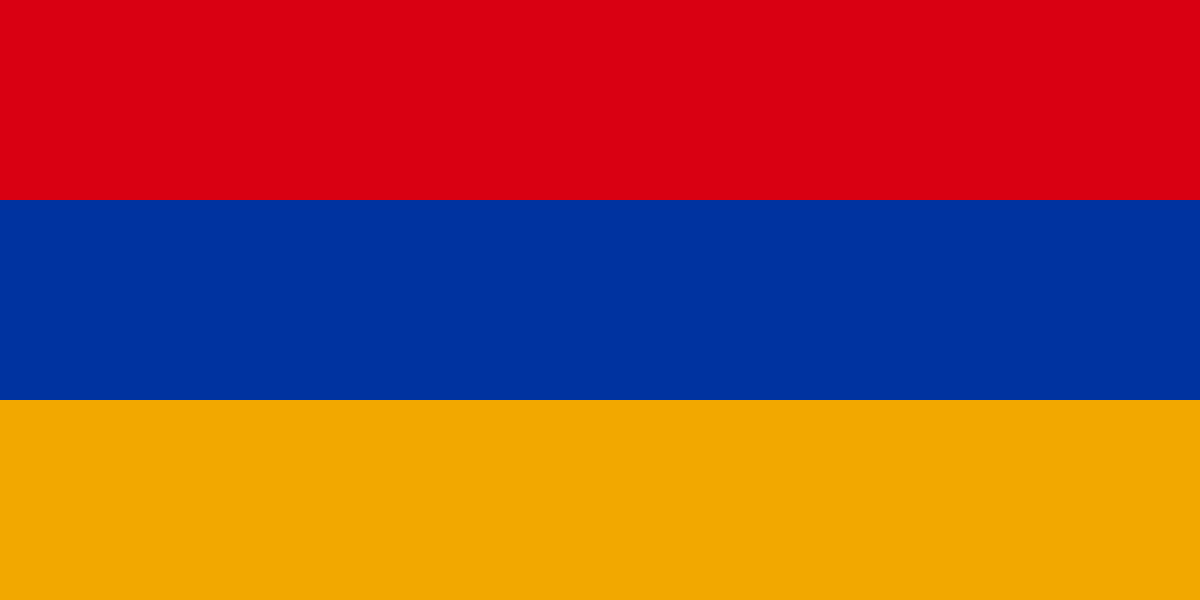
Stalin's air adviser at Tehran and Yalta. The Red Army's only Armenian Marshal of Aviation, executed 1950
When the Baku evacuation ship was sunk, Armenak — unable to swim — was pulled from the water by Sergei Khudyakov. After Khudyakov was killed in a White raid, Armenak took his weapons and coat, led the unit to safety, and wore the dead man's name for the rest of his life.
Born into an Armenian family in Karabakh, he worked in the Baku oilfields, joined the Bolsheviks, and fought as a cavalry commander in the Civil War, adopting the name of his friend Sergei Khudyakov, who saved him from drowning before falling in battle. With honours from the Zhukovsky Air Academy, he rose to command the VVS of the Western Front during the defence of Moscow, then helped pioneer the air army reorganization that concentrated Soviet air power. As deputy commander of the VVS he coordinated aviation at Kursk and the Dnieper, was promoted Marshal of Aviation in 1944, and served as Stalin's aviation adviser at Tehran and Yalta. In the 1945 Manchurian offensive he commanded the 12th Air Army, overseeing the airborne capture of Emperor Pu Yi and the seizure of Manchukuo's gold reserves, only to be arrested that December on fabricated charges and executed in 1950.
Activities and affiliations
- 1918–1922 Military command · Soviet Union · Military and defence
Career Timeline
- 1918–1922Red Guards of Baku; defended Tsaritsyn; cavalry squadron CO, Transcaucasian Front
- 1928–1936COS cavalry regiment; graduated Zhukovsky Air Academy with honours
- 1937–1941Air Staff ops & logistics; COS VVS Western Front; CO VVS Western Front (Battle of Moscow)
- 1942–1943COS Red Army VVS → CO 1st Air Army; air army reorganization
- 1943–1944Deputy CO & COS VVS; coordinated air at Kursk & Dnieper; Marshal of Aviation (Aug 1944)
- 1943–1945Military aviation adviser at Tehran (1943) and Yalta (1945) conferences
- 1945CO 12th Air Army, Manchuria — airborne capture of Pu Yi & Manchukuo gold reserves
- 1945–1954Arrested Dec 1945; executed 18 Apr 1950; rehabilitated 18 Aug 1954; rank restored 1965
Related historical events
- 1918–1922The Civil War and Foreign InterventionRed Guard organizer
- 1941–1945The Great Patriotic War1st Air Army Commander
- 1945.02–08The Yalta and Potsdam ConferencesStalin’s aviation adviserHe attended the Yalta Conference as Stalin’s aviation adviser.
- 1945.08The Soviet Entry into the War against JapanCommander of the 12th Air ArmyIn the 1945 Manchurian operation, he commanded the 12th Air Army and oversaw the capture of Pu Yi and seizure of gold reserves.
The Life Behind the Name: Khanferyants, Khudyakov, and Khanferyants Again
The name Khudyakov was a personal choice. Reversing it was an act of state power.
In the early 1920s, when the Baku evacuation steamer was sunk by a British gunboat, Armenak Khanferyants lost the comrade who had pulled him, an unable swimmer, from the water. Taking up the dead man's weapons and clothing, Khanferyants led the encircled unit to safety and carried his name for the rest of his life. The account is widely known through the work of the military historian Clement Harutyunyan, who recorded it. His early life is documented under an Armenian name, his military career under a Russian one.
The sentence of 18 April 1950 also made the name an instrument of punishment. When the Chief Military Prosecutor's Office opened its review in August 1954, the resulting official document named him for the first time as Armenak Artemovich Khanferyants. On 18 August 1954 the Military Collegium of the Supreme Court of the Soviet Union annulled the 1950 verdict on newly discovered circumstances and closed the case for absence of an offence. A decree of the Presidium of the Supreme Soviet on 6 July 1965 posthumously restored him to the rank of Marshal of Aviation and to rights over his awards; a party commission subsequently restored his party membership.
His own name was restored earlier and more fully than his family's standing. On 13 January 1951 his wife Varvara and young son Sergei were arrested as family members of a traitor to the motherland and exiled to Krasnoyarsk Krai, returning to Moscow only under the amnesty decree of 27 March 1953 after Stalin's death. The record stops short of suggesting the repression ended with its individual victim; it reached the whole household.
Today his name survives in two commemorative landscapes. Since 2005 Armenia's military aviation institute has borne Khanferyants's name, and a principal street of Yerevan's Avan district bears Khudyakov's. In his home village of Mets Tagher a statue and a house museum were established; after the area passed under Azerbaijani control in November 2020, satellite imagery from July 2021 indicates the statue outside the museum has been destroyed. Two names, two states of memory, both shaped by partition and conflict.