
Ukrainian nationalist leader who commanded the Sich Riflemen and built the UVO and OUN
Rotterdam, 23 May 1938: a Ukrainian-style box of chocolates handed over by his trusted contact Pavel Sudoplatov concealed a time bomb made in Moscow.
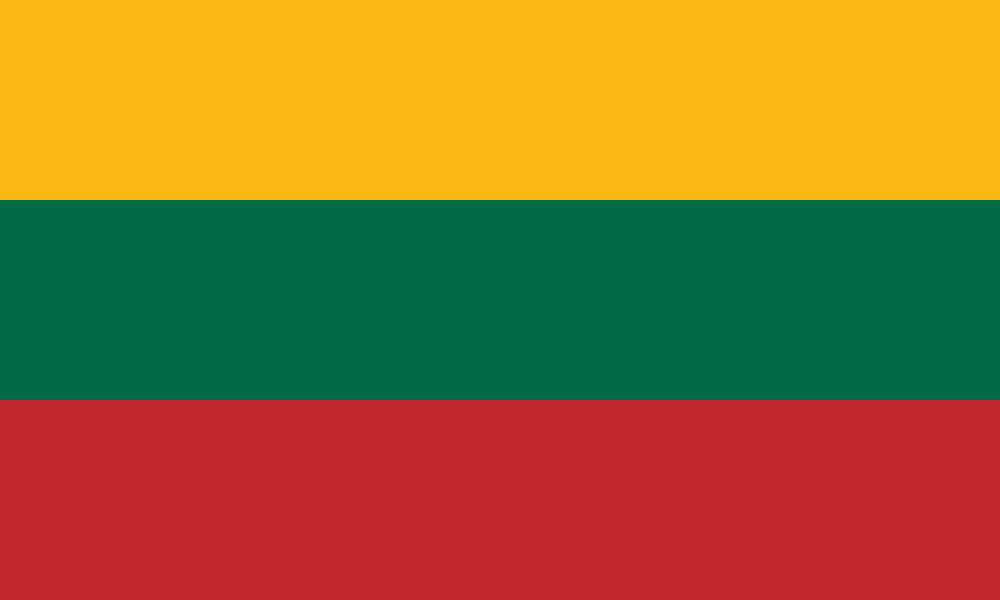
A Ukrainian military and political leader from Zashkiv in Austrian Galicia. After captivity in Russia during the First World War, he organized the Sich Riflemen in Kyiv in 1917 and became a leading commander of the Army of the Ukrainian People’s Republic. Following defeat in the independence war, he led the Ukrainian Military Organization (UVO) in exile and united several nationalist groups into the Organization of Ukrainian Nationalists (OUN) in Vienna in 1929, becoming its first leader. He connected émigré organizations across Europe and North America and sought international support for Ukrainian independence, but was assassinated in Rotterdam in 1938 by a bomb delivered by NKVD operative Pavel Sudoplatov, who had infiltrated the OUN. In 1929 he obtained Lithuanian citizenship and a passport, giving his émigré activity a legal basis, while his national and political identity and the aim of his movement remained consistently Ukrainian independence.
Activities and affiliations
Career Timeline
- 1914–1915Served in the Austro-Hungarian army; captured by Russia after the Battle of Makivka
- 1917–1920Organized and commanded the Sich Riflemen of the Ukrainian People’s Republic
- 1920–1929Cofounded and led the Ukrainian Military Organization (UVO)
- 1929–1938Founding leader of the Organization of Ukrainian Nationalists (OUN)
- 1938.05Assassinated in Rotterdam in Pavel Sudoplatov’s bombing operation
Related historical events
- 1914–1918First World WarAustro-Hungarian army servicemanHe served in the Austro-Hungarian army during the First World War.
- 1917–1921Ukraine’s revolution and warsCommander in the Ukrainian People’s Republic ArmyHe organized the Sich Riflemen in Kyiv in 1917 and fought as a leading commander in the Ukrainian People’s Republic Army.
1929–1938: Building the OUN and the Rotterdam assassination
At the Congress of Ukrainian Nationalists in Vienna in early 1929, the Ukrainian Military Organization (UVO) and several younger nationalist groups united as the Organization of Ukrainian Nationalists (OUN). Elected its first leader, Konovalets joined the officer generation of the defeated Ukrainian People’s Republic to the younger underground movement in Polish-ruled western Ukraine. He built networks and publishing operations across Europe, supported Ukrainian organizations in North America, and tried to place the question of Ukrainian independence before the League of Nations.
As the OUN sought to establish an underground network in Soviet Ukraine, Moscow prepared a long-term operation to eliminate Konovalets. Pavel Sudoplatov, an NKVD operative fluent in Ukrainian, posed as a contact from an anti-Soviet underground and gained the OUN leader’s confidence. On 23 May 1938, at the restaurant of Rotterdam’s Hotel Atlanta, Sudoplatov handed him a Ukrainian-decorated box of chocolates containing a position-triggered explosive. Konovalets was killed by the blast shortly after leaving the restaurant.
His death created a leadership vacuum in the OUN. Tensions over succession grew around Andrii Melnyk and Stepan Bandera and culminated in the 1940 split between OUN-M and OUN-B. The Rotterdam assassination therefore reshaped not only Soviet foreign operations but also the later organizational course of Ukrainian nationalism.