'Grandmother of the Russian Revolution' who endured 44 years of prison and exile; co-founder of the Socialist Revolutionary Party
"Mr. Kennan, we may die in exile, and our children may die in exile, and our children's children may die in exile, but something will come of it at last" — to George Kennan in Siberia, 1885.
Born into the nobility, she helped free her family's serfs in 1861, then joined the 1874 'Going to the People' movement. At the 1878 Trial of the 193 she became the first woman sentenced to katorga for a political crime, enduring 22 years in prison and Siberian exile that brought international fame through George Kennan's writings. Released in 1896, she co-founded the Socialist Revolutionary Party with Grigory Gershuni and led creation of its Combat Organization, then raised funds on a 1904 U.S. tour where she was dubbed 'Babushka.' After the February Revolution she returned as the symbolic elder of the Provisional Government and chaired the Pre-Parliament, but opposed the Bolshevik takeover and backed the White cause. Exiled in 1918, she died in Czechoslovakia.
Career timeline
1861Helped free serfs on family estate; opened school, library, and cooperative bank for peasants
1873–1874Formed radical commune in Kiev; joined 'Going to the People,' propagandizing in villages with false passports
1874–1878Arrested; held in St. Petersburg House of Preliminary Detention; convicted at Trial of the 193 — first woman sentenced to katorga (5 years, Kara mines)
1878–1896Served katorga at Kara, exiled to Barguzin and Selenginsk; recaptured after 1881 escape, 4 more years katorga; 22 years imprisonment/exile; interviewed by George Kennan
1896–1901Released under Nicholas II coronation amnesty; with Grigory Gershuni revived populist movement in Minsk, laid groundwork for SR Party
1901–1903Co-founded Socialist Revolutionary Party; toured Russia illegally with Gershuni building organization; led creation of SR Combat Organization
1903–1905Fled to Geneva; attended 1904 Amsterdam Congress of the Second International; toured U.S. raising ~$10,000; nicknamed 'Babushka'
1905–1910Returned to Russia for the 1905 Revolution; betrayed by Yevno Azef in 1908, arrested and held in Peter and Paul Fortress
1910–1917Sentenced to Siberian exile for life; 1913 escape attempt failed 7 miles from Irkutsk; solitary confinement in Yakutsk; U.S. protests secured return to Irkutsk
1917Returned to Petrograd after February Revolution, welcomed by Kerensky; chaired Pre-Parliament as oldest member; opposed Bolshevik takeover, appealed for Czechoslovak Legion intervention
1918–1934Exiled via Vladivostok and Japan to U.S.; lobbied for White intervention; settled in Czechoslovakia via Paris; organized Carpatho-Russian Labor Party; died near Prague
The great unifier of the Russian revolutionary movement, from the Chaikovtsy to the Left SRs
'I have complete discord with Lenin... I no longer believe in Lenin' — in 1919, on the eve of exile, breaking with the Bolsheviks after half a century of shared struggle.
Mark Natanson was a pivotal organizer who built the institutional backbone of the Russian revolutionary movement across half a century: co-founding the Circle of Tchaikovsky, Land and Liberty, and the People's Rights Party, and serving on the Central Committee of the Socialist Revolutionary Party. Known as the 'Ivan Kalita of the revolution' for his talent in unifying dispersed circles, he stood with Lenin as an internationalist at the Zimmerwald and Kienthal conferences during the First World War. In 1917 he led the formation of the Left SRs and later the Party of Revolutionary Communism, backing the Bolsheviks through the October Revolution, but grew disillusioned as the regime turned toward one-party dictatorship, leaving the words 'I no longer believe in Lenin' before fleeing into exile.
Career timeline
1871Co-founder, Circle of Tchaikovsky
1876Organized Kazan Square demonstration with Plekhanov; co-founder, Land and Liberty
1893Founder, People's Rights Party (Народное право)
1906Elected to Central Committee, Socialist Revolutionary Party
1915–1916Participated in Zimmerwald and Kienthal conferences
The Okhrana's paid informant who led the revolution's terrorist vanguard
In June 1902, Azef reported to the Okhrana that he had donated 500 rubles to terrorist operations, writing that it was 'necessary to strengthen my position in the party.' He was keeping books for both sides at once.
As head of the Socialist Revolutionary Party's Combat Organization, he orchestrated the assassinations of Interior Minister Plehve (1904) and Grand Duke Sergei Alexandrovich (1905), reaching the apex of revolutionary terror, while simultaneously working as a paid informant for the Okhrana from 1893 onward, delivering dozens of comrades to arrest and execution. He succeeded Gershuni and commanded Boris Savinkov as his deputy, reshaping the Combat Organization into a centralized, disciplined elite unit; the trust he earned through successful assassinations became the currency of his betrayals. Exposed by Vladimir Burtsev in 1908, he fled to Germany, leaving the SR Party devastated, and remains the darkest point of contact between the revolutionary movement and the Tsarist secret police.
Career timeline
1893–1899Studied electrical engineering in Germany; began informing for the Okhrana
1899Returned to Russia, joined Socialist Revolutionary circles
1901–1902Co-founded the unified SR Party; joined Combat Organization as Gershuni's deputy
1903–1908Head of the SR Combat Organization
1904Organized assassination of Interior Minister Plehve
1905Organized assassination of Grand Duke Sergei Alexandrovich
1906Ordered the assassination of Father Gapon
1908Exposed by Burtsev; fled to Germany
1909–1918Lived in Berlin under the alias Alexander Neumayr
The 'Tiger of the Revolution' who founded the SR Combat Organization
Arrested in Kiev in May 1903, Gershuni did not resist — instead he kissed his handcuffs and leg irons before the watching gendarmes, a gesture that entered revolutionary legend.
A co-founder of the Socialist Revolutionary Party and the founder and first leader of its Combat Organization, he masterminded the political assassinations that shook the Russian Empire in 1902–1903, beginning with Interior Minister Sipyagin. Born to a Jewish family, he was a pharmacist and bacteriologist who ran cultural-enlightenment schools in Minsk before the limits of legal methods drove him to become a full-time revolutionary; as the 'Tiger of the Revolution' he became the Empire's most wanted man. Arrested in 1903 and sentenced to death, commuted to life at hard labor, he escaped the Akatuy katorga in 1906 hidden in a barrel of sauerkraut, traveling through China, Japan, and the United States to return to Europe, where he died before learning that his deputy and successor Yevno Azef was an Okhrana spy.
Career timeline
1895–1897Pharmacy studies at Kiev University; first arrest for student activism
1898–1900Opened bacteriological lab in Minsk; founded schools and cultural programs; joined and led the Workers' Party
1901–1902United dispersed SR circles into a single Socialist Revolutionary Party; founded the Combat Organization
1902–1903As first head of the Combat Organization, organized assassinations of Sipyagin and Bogdanovich, and the attempt on Obolensky
1903–1904Arrested in Kiev; held at Peter and Paul Fortress; death sentence commuted to life imprisonment
1904–1906Imprisoned at Shlisselburg Fortress, then transferred to Akatuy katorga
1906Escaped Akatuy hidden in a sauerkraut barrel; traveled via China, Japan, and US to Europe
1907–1908Elected to SR Central Committee; chaired Tammerfors party congress; died in Zurich
Founder and chief theoretician of the Socialist Revolutionary Party
18 January 1918, Tauride Palace. Elected Chairman, Chernov opened Russia's first — and last — democratically elected parliament. After Bolshevik deputies walked out, the Assembly passed the land socialization law. At 4:40 a.m., the armed guard approached: 'The guard is tired. Please close the session.' Chernov scheduled the next meeting and gavelled the session closed. It never reconvened.
He fused narodnik agrarianism with Marxism to make land socialization the PSR's core program, serving as its chief theoretician. Elected chairman of the Constituent Assembly in 1917; after the Bolsheviks dissolved it, he spent 32 years in exile answering with his pen.
Career timeline
1890sActive in narodnik circles; arrested 1894, held at Petropavlovsk Fortress
1900Co-founded the Agrarian-Socialist League; illegal peasant propaganda
1902Co-founded the PSR; Central Committee member; editor of Revolutionary Russia
1905–1907Chaired First PSR Congress; led SR faction in Second Duma; re-emigrated after crackdown
1917.05–08Minister of Agriculture, Provisional Government; reform deadlock fueled peasant unrest
1918.01Elected Chairman of the Constituent Assembly; passed land law; dissolved by Bolsheviks
1918–1920Anti-Bolshevik struggle; Samara KOMUCH; underground in Moscow
1920–1952Exile in Estonia, Germany, France, US; wrote memoirs Before the Storm
The poet-bomber who stayed his hand seeing the Grand Duchess and children: the 'ethical terrorist' behind Camus' Les Justes
At his trial: "I am not a defendant, I am your prisoner. We are two warring camps. Learn to look the advancing revolution right in the face."
A Socialist-Revolutionary Combat Organization member and poet, who assassinated Tsar Nicholas II's uncle Grand Duke Sergei Alexandrovich with a bomb in the Moscow Kremlin on 4 February 1905. Two days earlier, seeing the Grand Duke's wife and young nephews in the carriage, he had refused his throw: an act that earned him the name 'ethical terrorist' and later inspired Albert Camus' play Les Justes. He had cut his teeth in the Petersburg Union of Struggle, broken with the Social Democrats over their rejection of direct action, and joined the SR Combat Organization under Evno Azef, taking part in the surveillance for the Plehve assassination. At his trial he told the court to 'learn to look the advancing revolution right in the face'; he was hanged at Schlisselburg at twenty-seven.
Career timeline
1897–1899Studied at Moscow and St. Petersburg Universities; joined Petersburg Union of Struggle for the Liberation of the Working Class (1898)
1899Exiled to Ekaterinoslav for leading a student strike
1902Arrested in Berlin carrying revolutionary literature, handed over to Russia, exiled to Yaroslavl
1903Joined the SR Combat Organization in Geneva under Evno Azef
1904Participated in surveillance for the assassination of Interior Minister Plehve
1905.02.04Assassinated Grand Duke Sergei Alexandrovich with a bomb in the Moscow Kremlin
1905.04.05Delivered denunciation of tsarism at Senate special tribunal; sentenced to death
SR Party founder who chaired the last unified anti-Bolshevik government, overthrown by Kolchak
Trotsky called him 'the complete caricature of a statesman. A really charming teacher of language in a ladies' seminary in Oryol — that is really all you can say about him.'
A founder and right-wing leader of the Socialist Revolutionary Party, he led the SR faction in the 1905 St. Petersburg Soviet and served as Minister of the Interior and chairman of the Pre-Parliament in Kerensky's Provisional Government. During the Civil War, as the culmination of efforts to unite the anti-Bolshevik camp, he was elected chairman of the Provisional All-Russian Government (Ufa Directory) at the Ufa State Conference. Arrested and expelled by Kolchak's coup in November 1918, he continued émigré journalistic work in Paris and New York. His political trajectory encapsulates the collapse of democratic socialism in the Russian Revolution, crushed between armed extremes.
Career timeline
1905SR faction leader, vice-chairman of the St. Petersburg Soviet
1907Elected to SR Central Committee; exiled to Obdorsk, escaped abroad
1907–1917Edited SR newspaper Znamya Truda in Paris exile
1917Chairman of All-Russian Soviet of Peasants' Deputies; Minister of Interior
1917Chairman of the All-Russian Democratic Conference and Pre-Parliament
1918Chairman, Ufa State Conference; headed the Provisional All-Russian Government
1918–1940Émigré political work in Paris; Freemasonry; published Sovremennye Zapiski
1940–1943Published Za Svobodu (For Freedom) in New York
Terrorist, Counter-Revolutionary: the Black Horse of the Revolution
At his 1924 trial: 'I am Savinkov, of the Plehve and Grand Duke Sergei assassinations. All my life I worked for the people, yet now I am charged with bearing arms against the workers' and peasants' power.'
Revolutionary and novelist who led the SR Combat Organization, directing assassinations of high-ranking tsarist officials. His The Pale Horse (1909) novelized the psychology of terrorism. After the October Revolution he led anti-Bolshevik armed struggle, was arrested in an OGPU trap, and died at Lubyanka.
Career timeline
1903Joined SR Combat Organization
1904Organized assassination of Interior Minister Plehve
1905Directed assassination of Grand Duke Sergei
1909Published The Pale Horse — a psychological anatomy of terrorism
1917.04Returned to Russia, appointed Commissar of the 7th Army
1917.07Assistant Minister of War — mediated between Kerensky and Kornilov
1917.08Dismissed from all posts and expelled from SR party over Kornilov affair
1918Founded Union for Defense of Motherland and Freedom, led anti-Bolshevik uprisings
1920–1921Organized Russian units fighting alongside Poland against the Bolsheviks
1924Lured back to USSR by OGPU's Operation Trust, arrested
1925Died in Lubyanka prison (official: suicide by defenestration; suspected: OGPU murder)
A Socialist Revolutionary who defended democratic socialism through exile and testimony
Arriving at his place of exile, Russkoye Ustye, Zenzinov wrote in his diary: 'This is, of course, Russia, but Russia of the 17th, perhaps 16th century.'
Vladimir Zenzinov was a member of the Socialist-Revolutionary Party's Central Committee and a journalist who turned three Siberian exiles into pioneering ethnographic and ornithological study of the Arctic. In 1918 he backed the democratic alternative of the Samara Constituent Assembly committee and the Ufa Directory between Bolshevik power and Kolchak's military rule, before the Omsk coup banished him, and he spent his last decades recording the revolution and civil war in Paris and New York.
Career timeline
1903Joined the Socialist-Revolutionary Party
1905–1906Worked on the SR Central Committee; took part in the Moscow uprising
1917Member of the Petrograd Soviet executive and the All-Russian Central Executive Committee
1917–1918Deputy to the Constituent Assembly; member of its Samara committee
1918Member of the Ufa Directory
1918–1919Arrested after the Omsk coup and exiled to China
1919–1939Worked in émigré socialist journalism in Europe
1940–1953Worked as an émigré journalist and memoirist in New York
The orator ground away between revolution and counter-revolution
In March 1917, taking the rostrum of the Petrograd Soviet to announce his acceptance of the Justice Ministry, he cried: "I cannot live without the people. In the moment you begin to doubt me, then kill me!" The workers and soldiers filling the hall erupted in wild applause.
The face of the Provisional Government and its last premier. In August 1917 he armed even the jailed Bolsheviks to stop Kornilov; in October, no army anywhere would come to save him. The story of his escaping in a dress is a Soviet fabrication. He spent half a century in exile lecturing on what had gone wrong, and died in New York.
Career timeline
1912–1917Duma deputy (Trudovik); famed defence lawyer in political trials
1917.03Justice Minister: amnesty, abolition of the death penalty
1917.05War Minister: the failed June offensive
1917.07–10Premier: the Kornilov affair; overthrown in October
1918–1970Exile in Paris and New York: writing and lecturing
Combat commander of the Moscow uprising and founding leader of the Maximalist SRs
His last words on the way to the gallows in Taganka Prison: "Tell mother that I died calmly."
One of the founding leaders of the Union of Socialists-Revolutionaries-Maximalists (SSRM), the radical left faction that split from the PSR in 1906. During the December 1905 Moscow armed uprising he commanded a combat druzhina on the Kazan Railway and fought at Chistye Prudy and Presnya, leading the spectacular expropriation of 875,000 rubles from the Moscow Mutual Credit Society in March 1906. A Moscow University natural-sciences student arrested in 1904, he was freed by the October Manifesto amnesty and immediately returned to armed struggle; rejecting the PSR's two-stage revolution, he demanded immediate full socialization and a 'Toilers' Republic'. Wounded resisting arrest in August 1906, he was tried by field court martial and hanged at Taganka Prison at the age of 24.
Career timeline
1903–1904Entered Moscow University natural sciences faculty; joined the PSR
1904Arrested for agitation in Moscow; sentenced to 7 years
1905.10Freed under the October Manifesto amnesty
1905.12Moscow uprising — commanded Kazan Railway druzhina; fought at Chistye Prudy and Presnya
1906.03Led Moscow Mutual Credit Society expropriation (875,000 rubles)
1906Co-founded Union of Socialists-Revolutionaries-Maximalists (SSRM)
1906.08–09Wounded resisting arrest near Aquarium Garden; court-martialed and hanged at Taganka Prison
SR Combat Organization veteran who chaired the first-convocation VTsIK in 1917
Arrested in 1907 and sentenced to eight years of katorga, he was settled in Usolye, Irkutsk province, where he joined the anti-war internationalist 'Siberian Zimmerwaldists.'
Born in Moscow into a Jewish tea-merchant family, he followed his elder brother Mikhail Gots into the Socialist Revolutionary Party and joined its Combat Organization in 1906. Arrested in 1907 and sentenced to eight years of katorga, he was settled in Usolye, Irkutsk province, in 1915. Back in Petrograd in 1917, he led the SR faction in the Petrograd Soviet and was elected chairman of the VTsIK at the First Congress of Soviets. Opposing the October Revolution, he led the Committee for Salvation of the Homeland and Revolution; at the 1922 SR trial he was the main defendant and received a death sentence, commuted in 1924, followed by exile to Ulyanovsk in 1925. Rearrested in 1937, he was sentenced to 25 years in 1939 and died in 1940 in a Krasnoyarsk labour camp.
Career timeline
1906Joined the SR Combat Organization; participated in terror planning
1907Arrested; sentenced to 8 years hard labour (katorga)
1915–1917Settlement in Usolye, Irkutsk; joined the Siberian Zimmerwaldist group
1917.03–06SR faction leader in the Petrograd Soviet; Executive Committee member
1917.06–10Chairman of the VTsIK (1st All-Russian Congress of Soviets)
1917.10–1918Chairman, Committee for Salvation of Homeland and Revolution; led the junker uprising
1918–1920Organized SR armed detachments; fought on two fronts against Bolsheviks and Whites
1922Main defendant at the SR show trial; sentenced to death, commuted
1925–1937Exiled to Simbirsk (Ulyanovsk); economic planning work
1937–1940Rearrested during the Great Purge; sentenced to 25 years on 20 June 1939; died in 1940 in a Krasnoyarsk labour camp
Author of 'Notes on the Revolution' and agrarian economist in whose apartment the Bolshevik CC voted for armed uprising
"Sukhanov is one of the best representatives of the petty bourgeoisie" — Lenin, Sept 1, 1917
Born Nikolai Gimmer. A founding member of the Petrograd Soviet Executive Committee after the February Revolution, he belonged to the Menshevik-Internationalists, opposing the war and the Provisional Government while arguing for a united socialist coalition. His seven-volume memoir 'Notes on the Revolution' remains one of the most vivid primary sources on 1917. On October 10, 1917, the Bolshevik CC met in his Petrograd apartment and resolved on armed uprising. Sentenced to 10 years at the 1931 Menshevik Trial and shot on false charges in 1940; posthumously rehabilitated.
Career timeline
1903–1905Joined SR Party; arrested 1904 in Taganka Prison; freed Oct 1905, took part in Moscow December armed uprising
1911–1913Exiled 3 years to Arkhangelsk; compiled agricultural census data
1914–1917Editor of 'Sovremennik' and 'Letopis'; anti-war internationalist; Feb 1917 founding member of Petrograd Soviet Executive Committee, launched first 'Izvestiya'
1917–1918Menshevik-Internationalist; editor of 'Novaya Zhizn'; VTsIK member 2nd–4th convocations; expelled June 1918
1919–1923Wrote and published 7-volume memoir 'Notes on the Revolution' (Записки о революции)
1920–1929Left Menshevik Party; worked in trade agencies & Agrarian Institute; Communist Academy member; 1928 speech opposing forced collectivization
1931Sentenced to 10 years at Menshevik Trial; imprisoned in Verkhneuralsk political isolator
1940Sentenced to death June 29; shot same day in Omsk prison
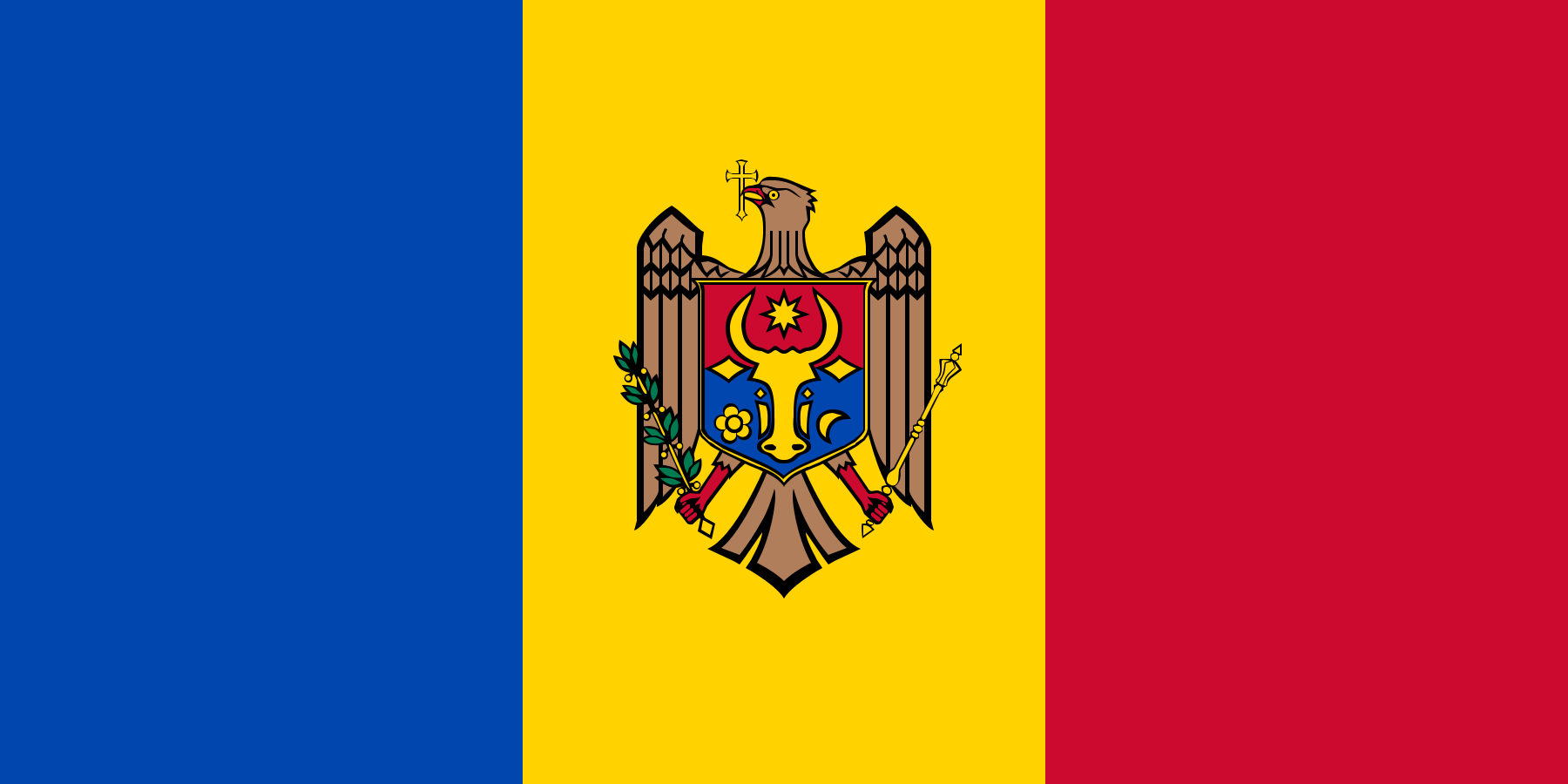
Bessarabian politician who presided over Sfatul Țării and the Moldavian Democratic Republic and saw through its union with Romania
Born to a peasant family in Răzeni, Bessarabia, in 1884, he graduated from the Chișinău seminary and Saint Petersburg University and worked as a physicist at the Meteorological Observatory. After the February Revolution he joined the Socialist Revolutionary Party and sat in the Petrograd Soviet, and Kerensky sent him to Bessarabia as the Provisional Government’s representative. At first he said Bessarabia should remain part of Russia, but as president of Sfatul Țării and of the Moldavian Democratic Republic he steered the vote for union with Romania in April 1918. After the union he became Minister of State for Bessarabia; in 1923 he took his wing of the Bessarabian Peasants’ Party into the National Liberal Party, and he later served as minister of health, of the interior and of communications and as vice-president of the Council of Ministers. He died of a heart attack in 1940.
Career timeline
1915Physicist at the Meteorological Observatory, Saint Petersburg
1917Member of the Petrograd Soviet (Socialist Revolutionary Party)
1917Assistant Government Commissioner of Bessarabia
1917–1918President of Sfatul Țării and of the Moldavian Democratic Republic
1918–1920Romanian Minister of State for Bessarabia
1927–1928Romanian Minister of Health and Social Protection
1933Romanian Minister of the Interior (Duca cabinet)
1936Vice-President of the Romanian Council of Ministers
Bessarabian Socialist Revolutionary who headed the first government of the Moldavian Democratic Republic and put land reform first
Born in Tănătari, Bessarabia, in 1884, he graduated from the Chișinău seminary and the Faculty of Letters in Saint Petersburg and taught. A Socialist Revolutionary, he returned to Bessarabia in 1917 with Inculeț at Kerensky’s urging and was elected chairman of the governorate peasants’ soviet and to the Russian Constituent Assembly. In December 1917 he became President of the Council of Directors General, the Moldavian Democratic Republic’s first government, and Director General for Agriculture, putting land reform first. His view that the republic should bear the majority people’s name prevailed; he put the entry of Romanian troops to a vote, yet protested their presence, fearing they would be used to block land reform. He voted for union but resigned amid charges of a pro-Russian stance, and later sat in the Romanian Senate. He fled to Bucharest in 1940 and died there in 1971.
Career timeline
1917Chairman of the Bessarabian Governorate Soviet of Peasants’ Deputies
1917Member of the Russian Constituent Assembly
1917–1918President of the Council of Directors General and Director General for Agriculture
The man whose name became the rebellion: SR leader of the Tambov 'Antonovshchina,' the largest peasant uprising against Bolshevik rule
'Power was not torn from the hands of the tsarist executioners to be handed over to a handful of executioner-communists' — from a leaflet distributed during the uprising
A Socialist Revolutionary militant who served a twenty-year katorga sentence in the Schlisselburg Fortress under the Tsar for armed expropriations. Freed by the February Revolution, he became chief of the Kirsanov district militia, but the Bolsheviks' grain requisitioning and local repression drove him underground in 1918. In August 1920 he seized leadership of the Tambov peasant uprising, building a partisan army of roughly twenty regiments and an alternative government based on Unions of the Working Peasantry: the revolt was so identified with him that it became known as the 'Antonovshchina.' He was killed in a firefight with GPU forces alongside his brother Dmitri in June 1922.
Career timeline
1905Joined the SR Party; participated in armed expropriations
SR leader imprisoned by both Tsar and Bolsheviks, who became founder of Harvard's sociology department
In an open letter written from the Cheka basement in Veliky Ustyug in 1918 while awaiting execution, Sorokin renounced his SR party membership and declared an end to his political activity.
A leading figure in the Socialist Revolutionary Party (SR) during the Russian Revolution, Sorokin served as secretary to Prime Minister Kerensky and was elected to the Constituent Assembly. Imprisoned three times by the Tsarist regime, he was sentenced to death by the Bolsheviks after 1917 and exiled in 1922 on the 'philosophers' ship.' In the United States he founded Harvard's department of sociology in 1930, becoming one of the 20th century's most important sociologists through his work on social stratification, social mobility, and the cyclical theory of sociocultural dynamics in his magnum opus Social and Cultural Dynamics.
Career timeline
1906Joined SR party; arrested and imprisoned in Kineshma
1909–1914Graduated from St. Petersburg University, Faculty of Law, in criminology
1917SR leader, secretary to PM Kerensky, Constituent Assembly deputy
1919–1922Professor at Petrograd University; founded Russia's first sociology department
1922Exiled from Soviet Russia ('philosophers' ship')
1924–1930Professor at University of Minnesota
1930–1959Professor at Harvard; founded and chaired sociology department
1965President of the American Sociological Association
The SR activist who shot Lenin, believing him a 'traitor to the revolution'
At her Cheka interrogation: 'Today I shot Lenin. I did it on my own. I consider him a traitor to the Revolution. I favoured the Constituent Assembly and am still for it.'
Born into a Jewish teacher's family in Volhynia, Fanny Kaplan took up anarchism at 15 and was arrested at 16 for a bomb plot against the governor of Kiev, earning a life sentence to Siberian hard labour. During eleven years in prison she went blind and partially recovered, and under Maria Spiridonova's influence joined the Socialist Revolutionary Party. Freed by the February Revolution of 1917, she came to see Lenin as a traitor to the revolution after the Bolsheviks dissolved the Constituent Assembly, and on 30 August 1918 fired three shots at him outside Moscow's Michelson factory. The attempt, along with the same-day assassination of Moisei Uritsky, triggered the Red Terror; Kaplan was shot in the Kremlin four days later.
Career timeline
1906Arrested in Kiev for a bomb plot targeting Governor Sukhomlinov
1907–1917Served life sentence at Maltsev and Akatuy prisons, Nerchinsk katorga; went blind and partially recovered
1917Released under Provisional Government amnesty after February Revolution; resumed SR activity
1918.08.30Fired three shots from a Browning pistol at Lenin outside Moscow's Michelson factory, wounding him seriously
1918.09.03Shot in the Kremlin by Pavel Malkov after Cheka interrogation
Peasant-born officer who commanded the United Partisan Army of Tambov and chaired the Union of Working Peasantry
Born in the village of Inokovka in Kirsanov district, Tambov province, he was conscripted in 1904 during the Russo-Japanese War and stayed on for extended service in St Petersburg. In the First World War he fought in Galicia, winning the full set of four St George Crosses and four St George Medals; he was commissioned in 1915 and made lieutenant in 1917. After the Treaty of Brest-Litovsk he returned home, worked in the local militia and in 1918 formed a partisan detachment. In June 1920 he took command of the 2nd Insurgent Army and in November of the United Partisan Army of the Tambov region, while also chairing the Union of Working Peasantry. The Russian-language source says he was killed in a clash near the village of Bogoslovka on 28 February 1921; the English-language source places his death around June 1921.
Career timeline
1904Conscripted during the Russo-Japanese War; extended service
1915Commissioned as an officer
1917Lieutenant
1918Formed a partisan detachment at Inokovka
1920Commander of the 2nd Insurgent Army (June); commander of the United Partisan Army of Tambov and chairman of the Union of Working Peasantry (November)