The last Politburo member who tried to save the USSR and went to prison for it
Attributed to Shenin after the coup's defeat and reported according to media data, the GKChP members made the main mistake: having said 'A,' they did not say 'B' and all the rest of the alphabet.
Born in 1937 in Stalingrad Oblast, he was convicted in 1958 of violating safety rules after two workers died at his construction site, receiving a one-and-a-half-year sentence and being released early after nine and a half months. He joined the CPSU in 1962 and served as First Secretary of the Achinsk city committee (1974-1977), party adviser in Afghanistan (1977-1983), first secretary of the Krasnoyarsk kraikom (1987-1990). As CC secretary and Politburo member from 1990 he oversaw organizational-party work and was called the third man in the CPSU after Gorbachev and Ivashko, supported the GKChP and on 18 August 1991 flew to Gorbachev at Foros, and was arrested on 23 August 1991. Released on health grounds in October 1992 and amnestied in February 1994, he died aged 71 on 28 May 2009.
Career timeline
1962Joined the CPSU
1974–1977First Secretary, Achinsk City Party Committee
1977–1983Second Secretary, Khakass Obkom → Party adviser, Afghanistan
1985–1987First Secretary, Khakass Oblast Committee
1987–1990First Secretary, Krasnoyarsk Krai Committee
1990–1991Politburo member & CC Secretary, organizational-party work
Soviet Union
Soviet communism
1937–2010
↓ Arrested · amnestied 1994
First and only Vice President of the USSR and the face of the August 1991 coup
To KGB chairman Kryuchkov during the August 1991 coup: 'Understand my character—if even one person dies, I won't be able to live.'
After serving as First Secretary of the Gorky Oblast Komsomol and chairman of the USSR Committee of Youth Organizations (1968–1980), Yanayev became VTsSPS chairman, a Politburo member and CC Secretary in 1990. That December Gorbachev forced through his election as the USSR's first vice president. In August 1991, as the face of the GKChP, he declared himself acting president citing Gorbachev's 'illness'. The coup failed within three days and he was arrested. Amnestied in 1994, he published the memoir Last Battle for the USSR and spent his remaining years in academia.
Career timeline
1959–1963Mechanised-agriculture detachment chief → Selkhoztekhnika branch manager, Gorky Oblast
1966–1968First Secretary, Gorky Oblast Komsomol
1968–1980Chairman, USSR Committee of Youth Organizations
The chief engineer who refused to believe the reactor was destroyed and kept pumping water into its ruins
He smashed his glasses and cut his wrists with the shards, forcing the court to postpone his trial.
Nikolai Fomin was a Soviet nuclear engineer who joined the Chernobyl plant in 1972 and rose to chief engineer in 1981. Arriving at the plant shortly after the April 26, 1986 explosion, he refused to accept reports that the reactor was destroyed and ordered water to be pumped into the wreckage of Unit 4 for hours, while sending a subordinate on a reconnaissance mission that delivered a fatal radiation dose. Arrested after the disaster, he was sentenced to 10 years but was released early after a pre-trial suicide attempt and subsequent confinement in a psychiatric hospital; he later worked at the Kalinin Nuclear Power Plant before retiring.
Career timeline
1972Started at Chernobyl NPP
1981–1986Chief Engineer, Chernobyl NPP
1987Sentenced to 10 years; imprisoned
1988Transferred to psychiatric hospital; released early
At the launch pad: "Hey, sky! Take off your hat!" — quoting Mayakovsky, June 16, 1963.
The first woman to fly solo in space: aboard Vostok-6 in 1963, the textile-worker 'Chaika' orbited Earth 49 times over 71 hours alone, a symbol of proletarian women's liberation through science. Later became the first woman general in Russian military history.
Career timeline
1954–1960Tire factory and textile mill worker; graduated evening and technical schools
1959–1961Parachute training at Yaroslavl aeroclub (90 jumps)
1962.03Selected for women's cosmonaut group (5 candidates)
1963.06.16–19Vostok-6: first woman in space, 71-hour solo flight
1966–1989USSR Supreme Soviet deputy; Presidium member 1974–89
1968–1987Chairwoman, Committee of Soviet Women
1969Graduated Zhukovsky Academy with honors; Candidate of Technical Sciences, professor
1971–1990Member, CPSU Central Committee
1987–1992Chair, Union of Soviet Societies for Friendship Abroad
A field enforcer of the Soviet Union's final crisis
After Black January, he personally led the Nagorno-Karabakh Organizing Committee as Moscow's man on the ground.
Viktor Polyanichko was a Soviet party organizer and political adviser who carried Moscow's policy into local power structures in Afghanistan and the South Caucasus. As Second Secretary of the Azerbaijan Communist Party, he sought to restore Baku's authority after Black January and led the Nagorno-Karabakh Organizing Committee, combining party administration with coercive force. He is remembered both as an attempted broker in a collapsing federation and as Moscow's hard-line intermediary in a conflict that deepened beyond Soviet control. After the Soviet Union's collapse he became head of an interim administration at deputy-prime-minister rank in Russia, and was assassinated in North Ossetia in 1993.
Career timeline
1959–1964First Secretary, Orsk City Komsomol Committee
Soviet Union
Soviet communism
1937–2010
↓ Dismissed 1991 · illness
The last Gosplan generation
Amid the 1998 financial crisis, Yeltsin offered him the premiership. Maslyukov refused: "I'm ready to work as Primakov's first deputy." The last steward of the Soviet planned economy chose the work he could do over the power he could seize.
Born in Leninabad, Tajikistan, he trained as an engineer and rose through Izhevsk defense plants to become a core technocrat of Soviet military industry. As Gosplan chairman (1988–1991) and Politburo member (1989–1990), he was the last steward of the planned economy. After the USSR's collapse, he served as First Deputy Prime Minister under Yevgeny Primakov (1998–1999), managing the response to the 1998 financial crisis, and later as a Communist Party deputy in the State Duma until his death in 2010, a rare figure who bridged the Soviet planning elite and post-Soviet industrial politics.
Career timeline
1960s–1970sRises as a technocrat in defense industry and state planning organs
1980sWorks in military-industrial and planning bodies in late Soviet industrial policy
1988–1991Chairman of Gosplan during the dismantling of the planned economy
after 1991Continues in Russian politics and economic administration after 1991
1998–1999Participates in Russian crisis-era economic policy
An economist who carried price theory into the transition to a market economy
Through the 500 Days programme, he pushed his research on price formation toward a plan for transforming the Soviet economy into a market.
Nikolai Petrakov was a Soviet economist who used mathematical analysis to study price formation and the balancing of costs, output, and incomes in a planned economy. He pursued market mechanisms and price reform, and in 1990 joined Stanislav Shatalin and Grigory Yavlinsky as a co-author of the 500 Days programme. The programme sought to move the Soviet economy toward a market through privatization, price liberalization, and a transfer of authority to the republics, placing Petrakov’s research and policy work at the junction of economic modelling and urgent political choice. He later founded the Institute for Market Problems and led research on market transition and economic policy.
Career timeline
1959Graduated from the Faculty of Economics, Moscow State University
1963Earned a Candidate of Economic Sciences degree for research on industrial profitability and pricing
1970–1989Professor of economics at Moscow State University
1972Earned a Doctor of Economic Sciences degree for research on pricing in a planned economy
1984–1990Corresponding member, then full member, of the USSR Academy of Sciences
1990Economic aide to the General Secretary of the CPSU Central Committee, then to the President of the USSR
1990Co-author of the Shatalin-Yavlinsky 500 Days programme
1990–2014Founder and first director of the Russian Academy of Sciences Institute for Market Problems
Architect of women's and family policy in the perestroika era, the fourth woman ever on the Politburo
“I simply refuse to be limited. I would not tolerate it for a minute.” — pushing back against being pigeonholed as the Politburo's 'woman's issues' token
Galina Semyonova was one of only four women in Soviet history to serve as a full member of the CPSU Politburo. As a Central Committee secretary in the late Gorbachev period, she was responsible for family, women's, and demographic policy. For a decade from 1981, she edited Krestyanka (Peasant Woman), transforming the magazine's content toward fashion, family, and culture and raising its circulation from 6 million to 22 million, connecting with the daily lives of millions of Soviet women. Elevated to the Politburo and Secretariat at the 28th Party Congress in 1990, she drove Central Committee resolutions to improve women's social standing and pushed for a new State Committee on Family and Women's Affairs. During the August 1991 coup, she was one of the few in the party leadership who refused to recognize the authority of the GKChP putschists.
Soviet Union
Soviet communism
1937–2022
○ Natural causes
The last KGB chairman, appointed to dismantle it
"The traditions of chekism must be eradicated, must cease to exist as an ideology" — the last chairman of the KGB, in his 1992 memoir Deliverance from the KGB.
A construction engineer turned Gorbachev loyalist, Bakatin served as Soviet interior minister (1988–1990) and, after the failed August 1991 coup, as the last chairman of the KGB. Appointed to succeed coup-plotter Vladimir Kryuchkov, he stripped foreign intelligence, communications, and border troops from the agency and restructured the remainder into a smaller presidential security service. His handover of KGB listening-device blueprints from the US embassy in Moscow to American officials in December 1991 brought furious charges of treason from Russian conservatives.
Career timeline
1960–1973Construction engineer and manager, Kemerovo
1973–1985Party posts in Kemerovo; CPSU Central Committee inspector
1985–1987First Secretary, Kirov Oblast Committee
1987–1988First Secretary, Kemerovo Oblast Committee
1988–1990Minister of Internal Affairs of the USSR
1991.03–08Member, Security Council under the President of the USSR
1991.08–11Chairman of the KGB (last)
1991.11–1992.01Head, Inter-republican Security Service (MSB)
The last-generation secretary who rebuilt the Russian Communist Party
On 25 October 1991 Kuptsov met Yeltsin at the Kremlin and urged him to rescind the ban on the Russian Communist Party. Yeltsin refused; Kuptsov then spent a year and a half as the underground First Secretary, steering the party to its reconstituting congress.
A metallurgical engineer who rose from a Vologda collective farm and steel mill through the party ranks, he served as First Secretary of the Vologda Regional Committee (1985–1990). In 1990 he was brought to Moscow as a CPSU Central Committee Secretary, heading the department for socio-political organizations and helping found the Communist Party of the RSFSR. Elected its First Secretary in August 1991 to replace the hardline Ivan Polozkov, he refused to endorse the GKChP coup but was nonetheless investigated for 'complicity.' After Yeltsin banned the party, Kuptsov kept its organizational skeleton alive underground and steered the February 1993 reconstituting congress that became the CPRF, then served eleven years as Zyuganov's first deputy chairman while the new Russian Communist Party consolidated.
Career timeline
1955–1958Collective farm worker, reading-room manager, and military service, Vologda Oblast
1958–1974Rolling-mill operator, foreman, and party committee secretary, Cherepovets Metallurgical Plant
1974–1979First Secretary, Cherepovets City Party Committee
1979–1984First Secretary, Vologda City Party Committee
1984–1985Second Secretary, Vologda Regional Party Committee
1985–1990First Secretary, Vologda Regional Party Committee
1989–1991People's Deputy of the USSR
1990–1991CPSU CC Secretary for socio-political organizations
1991.08–11First Secretary, CP RSFSR Central Committee
1993–2004First Deputy Chairman, CPRF Central Committee
1995–2011Deputy, State Duma of the Russian Federation (2nd–5th convocations)
Technocrat who ran Soviet heavy machine-building in its late decades
When Ustinov ordered mortar production at his plant, his minister Afanasyev warned: 'Make one and I hand you to the prosecutor.' Velichko organized a 'heroic storm,' delivered them, and recalled it as 'nervous, not to say absurd, conditions.'
A technocrat who rose from lathe operator to director of Leningrad's Bolshevik plant, Velichko served as minister for energy, heavy, and transport machine-building (1975–1991) and First Deputy Chairman of the USSR Council of Ministers (1991). His ministries built the Atommash nuclear complex, reactor systems for over a dozen nuclear plants, ICBM ground equipment, and the Buran shuttle launch complex. When other industrial ministries faltered in the late 1980s, his proved resilient enough that the government twice consolidated troubled ministries under his leadership. After the Soviet collapse he remained an industrial elder, chairing Tyazhenergomash and advising on Russian industrial policy.
Gorbachev's last agriculture Politburo member: operational chief of perestroika farm policy
In August 1991, when the GKChP was formed, Stroev refused to recognise it — one of the few perestroika-era Politburo members who did not side with the coup.
Stroev began as a collective-farm shepherd in the Oryol countryside and graduated from the Michurinsk Horticultural Institute, a classic Soviet agricultural technocrat. Over three decades he rose through the Oryol party apparatus to become oblast first secretary in 1985, and in 1989 Gorbachev brought him to Moscow as Central Committee Secretary for Agriculture, adding Politburo membership in 1990. As the operational chief of perestroika farm policy, he oversaw the reorganisation of the agro-industrial complex and the response to a deepening food crisis, and he refused to endorse the GKChP during the August 1991 coup. After the Soviet collapse he reinvented himself as a post-Soviet regional heavyweight, serving as governor of Oryol Oblast (1993–2009) and chairman of the Federation Council (1996–2001).
Career timeline
1973–1984Secretary for Agriculture, Oryol Oblast Party Committee
1984–1985Instructor, CPSU Central Committee
1985–1989First Secretary, Oryol Oblast Party Committee
1986–1991Member, CPSU Central Committee
1989–1991CPSU Central Committee Secretary (Agriculture)
Soviet Union
Soviet communism
1938–2010
○ Natural causes
Last Soviet gas minister who turned his ministry into Gazprom
When the Orsk party committee sought to pull him from the factory floor into the apparatus, Chernomyrdin later recalled: 'I felt I was a production man and wanted to stay at my native factory. But life decided otherwise.' He considered himself a production man, not a party functionary, all his life.
Born into an Orenburg Cossack family, Chernomyrdin rose from mechanic at the Orsk oil refinery to director of the Orenburg gas-processing plant, and in 1985 became the Soviet Union's Minister of the Gas Industry. While minister he also served on the CPSU Central Committee (1986–1990) and as a deputy in both the USSR and RSFSR Supreme Soviets, emerging as a central figure in late-Soviet energy administration. In 1989 he abolished his own ministry and transformed it into Gazprom, the state gas concern that would become the world's largest gas monopoly, a pioneering conversion of a Soviet planned-economy ministry into a state-owned corporation that became the cornerstone of Russia's post-Soviet economy.
Career timeline
1960–1973Mechanic and operator at Orsk refinery, deputy chief engineer and director of Orenburg gas-processing plant
1973–1982Industrial administrator in Orsk party committee and CPSU CC heavy industry department
1982–1985Deputy Minister of Gas Industry of the USSR, head of Tyumengazprom
1985–1989Minister of Gas Industry of the USSR
1989–1992Founded state gas concern Gazprom, first chairman of the board
1984–1990Deputy of USSR and RSFSR Supreme Soviets, member of CPSU Central Committee
An authoritarian state-builder who made sovereignty his political principle
Uzbekistan voted to remain in the Union in 1991, yet Karimov declared independence later that same year.
Islam Karimov was a politician who moved from economic administration in the Soviet system to become Uzbekistan’s first president. During the negotiations over the Union’s future, he placed Uzbekistan’s sovereignty and freedom of choice above preserving a common Soviet state, and after independence made that principle central to state-building. His government pursued industrial capacity and political consolidation, but hardened into authoritarian rule that restricted opposition and the press and responded harshly to Islamist movements and mass protest. Karimov is therefore remembered both as the founder of a sovereign post-Soviet Central Asian state and as a ruler who sacrificed political pluralism to preserve it.
Career timeline
1960–1966Mechanical engineer in Tashkent machinery and aircraft production
1966–1983Economic official in the Uzbek SSR State Planning Committee
1983–1986Minister of Finance of the Uzbek SSR
1986Chairman of the Uzbek SSR State Planning Committee and deputy chairman of its Council of Ministers
1986–1989First secretary of the Communist Party committee in Kashkadarya Region
1989–1991First secretary of the Central Committee of the Communist Party of Uzbekistan
1990–1991President of the Uzbek SSR
1991–2016First President of Uzbekistan
1991–1996Chairman of the People’s Democratic Party of Uzbekistan
The Leningrad chemistry lecturer whose 'I Cannot Forsake My Principles' became the manifesto of anti-perestroika forces
"Our media are lying about Stalin now. They are blackening our history."
A Leningrad chemist and CPSU member who, on 13 March 1988, published 'I Cannot Forsake My Principles' in Sovetskaya Rossiya, a full-throated defense of Stalin and an attack on perestroika. The article, drafted with the backing of Central Committee secretary Yegor Ligachev, was denounced by Pravda as the 'manifesto of anti-perestroika forces' and became the shock that drove Gorbachev to radicalize political reform ahead of the 19th Party Conference. After 1991 she founded the All-Union Communist Party of Bolsheviks (VKPB) and served as its general secretary, but neither she nor her party ever gained significant traction in post-Soviet Russia.
Career timeline
1961Graduated Leningrad Technological Institute as chemical engineer
1966Joined the CPSU
1972–1988Assistant, then senior lecturer in physical chemistry, Leningrad Technological Institute
1979–1981Expelled from CPSU; reinstated after Party Control Committee review
1988.03Published 'I Cannot Forsake My Principles' in Sovetskaya Rossiya
1989Founded Yedinstvo (Unity) society; chair of its Coordinating Council
1991–2020Founded All-Union Communist Party of Bolsheviks (VKPB); General Secretary
The Georgian First Secretary who asked Moscow for troops, then resigned after 21 died
Patiashvili later recalled: 'Gorbachev phoned and said, in a tone that left no room for argument: The square must be cleared immediately, and the army will handle it. I understood he knew about the plan and supported it.'
He succeeded Shevardnadze as First Secretary of the Georgian Communist Party in 1985, but dismantled most of his predecessor's reform experiments and drove the opposition underground. In April 1989, facing independence protests sparked by the Abkhaz autonomy dispute, he asked Moscow to send troops and on 8 April convened the republic's Defence Council, which decided to disperse the demonstrators by force. Before dawn the next day, Soviet troops armed with sapper shovels and poison gas descended on unarmed civilians, killing 21; Patiashvili accepted responsibility and resigned within two weeks. He remained in Georgian politics, twice ran for president against Shevardnadze, and supported the 2003 Rose Revolution, though he later criticized Saakashvili.
Career timeline
1965–1973Komsomol posts in Georgia, rising to First Secretary
1973–1974First Secretary, Gori District Party Committee
1974–1985Secretary for Agriculture, CP of Georgia
1985–1989.04First Secretary, CP of Georgia
1989–1991Director, scientific-production association and research institute
1995Presidential candidate, runner-up to Shevardnadze
2000Presidential candidate, runner-up to Shevardnadze
The naval officer who mutinied for Leninist principles against the Brezhnev regime
In his final letter to his son before execution: "Be strong and believe that life is beautiful. Be positive and believe that the Revolution always wins."
A Soviet Navy captain 3rd rank and political officer (zampolit) who, in November 1975, led a mutiny aboard the anti-submarine frigate Storozhevoy. Denouncing the corruption and stagnation of the Brezhnev era, Sablin aimed to sail from Riga to Leningrad and broadcast a call for a return to Leninist principles and a new communist revolution. The mutiny was crushed by Soviet air attacks before reaching its goal. Sablin was convicted of treason and executed by firing squad. His action, one of the most dramatic acts of Leninist dissent from within the late Soviet military, later inspired Tom Clancy's The Hunt for Red October.
Career timeline
1939Born in Leningrad, son of a naval officer
1956–1960Attended M.V. Frunze Higher Naval School, graduated with distinction and joined CPSU
1960–1969Served as officer aboard destroyers and patrol ships in Northern and Black Sea Fleets
1963Sent letter to Khrushchev criticizing party corruption, reprimanded by Murmansk Party Committee
1969–1973Studied at V.I. Lenin Military-Political Academy, graduated with distinction
1973Assigned as zampolit of Baltic Fleet frigate Storozhevoy
1975.11.08–09Led Storozhevoy mutiny, sailing toward Leningrad; suppressed by Soviet air attacks
1976.07Sentenced to death for treason by Military Collegium of USSR Supreme Court
1976.08.03Executed by firing squad at Lefortovo Prison
1994Military Collegium of Russian Supreme Court partially rehabilitated, commuting treason to military offences
The highest-ranking general who sided with Yeltsin during the August coup, commanding the White House defense
"The army will not go against the people" (at a press conference during the August 1991 coup)
As chief of the Soviet Signal Troops and Deputy Chief of the General Staff, he also took part in the Chernobyl disaster response. During the August 1991 coup, he was the highest-ranking active-duty general to break with the State Committee for the State of Emergency (GKChP) and side with Boris Yeltsin, organizing the White House defense headquarters in Moscow; he was appointed RSFSR Defence Minister on 20 August and promoted to Army General on 24 August. In an ironic turn, he helped storm the same White House he had defended during the October 1993 constitutional crisis, and in 1997 was arrested and convicted on corruption charges.
Career timeline
1986Participates in Chernobyl disaster response
1987–1991Chief of Signal Troops, USSR Ministry of Defence / Deputy Chief of General Staff
1990Elected RSFSR People's Deputy
1991.01Chairman, RSFSR State Committee for Defense and Security
1991.08.20Appointed RSFSR Defence Minister; promoted to Army General on 24 August
1993–1997Deputy Minister of Defence, Russian Federation
The Sąjūdis philosopher who launched the 2-million-signature campaign demanding Red Army withdrawal
After a long while of hesitation, I made up my mind to see 'what makes socialism.' After a few years it was absolutely clear.
Lithuanian philosopher and politician who taught philosophy at Vilnius University and edited the cultural journal Kultūros barai. He joined the Lithuanian Communist Party in 1973 but broke with it during perestroika; as a founding member of Sąjūdis (1988), he became the movement's theorist and launched a 2-million-signature campaign demanding the withdrawal of the Red Army from Lithuania. He was a central figure in the trilateral planning of the Baltic Way with the Estonian and Latvian popular fronts, and served as deputy prime minister (1990–1991) in the Landsbergis-Prunskienė cabinet. After independence he founded the Lithuanian Centre Union, served in the Seimas (1992–2000), and opposed EU membership as a surrender of sovereignty.
Career timeline
1957–1962Studied philosophy, Vilnius University
1965–1968Editor, Kultūros barai journal
1973–1989Lecturer in philosophy, Vilnius University
1988–1990Founding member and council member, Sąjūdis
1989–1990People's Deputy, USSR Congress of People's Deputies
1990–1991Deputy Prime Minister of the Republic of Lithuania
Soviet Union
Soviet communism
1939–2022
○ Natural causes
The last Soviet Chief of General Staff, undone by the August coup
On 22 August 1991, with the GKChP coup collapsing and Yazov under arrest, Moiseyev became acting Soviet Defence Minister for a single day. The next day, he too was dismissed.
The last Chief of the General Staff of the Soviet Armed Forces (1988–1991). A protégé of Dmitry Yazov who rose through the Far Eastern Military District to the military's second-highest post, Moiseyev directed the Afghanistan withdrawal and took part in arms control negotiations, but backed Yazov in the August 1991 coup and was dismissed after its collapse.
Career timeline
1958–1962Military service, graduated Far Eastern Tank School
1962–1972Tank platoon & company commander, GSFG & Carpathian MD
1972–1980Tank regiment commander, CO 50th & 27th Guards MRDs
1982–1985Deputy commander, then commander, 15th Army, Far Eastern MD
1985–1987Chief of Staff & 1st Deputy Commander, Far Eastern MD
1987–1988Commander, Far Eastern Military District
1988–1991Chief of the General Staff & 1st Deputy Minister of Defence
1991.08.22–23Acting Minister of Defence of the USSR
A Moscow party organizer at the Soviet Union's end
His life, he later recalled, was divided into a before and after the Communist Party ban.
Yuri Prokofyev was a Soviet party cadre who rose through Moscow's party and administrative organizations. As first secretary of the Moscow City Party Committee, he worked at the point where reform collided with the party's disintegration, and joined the Politburo in 1990. He was involved in the activity of the State Committee on the State of Emergency in 1991 without being a member, then turned to memoir writing and technology enterprises after the Soviet Union and the Communist Party were banned.
Career timeline
1957Pioneer leader at a Moscow school
1960Joined the Communist Party of the Soviet Union
1968Cadre in the Moscow City Party Committee's organizational work
1977–1985Secretary and first secretary of the Kuibyshev District Party Committee in Moscow
1986–1988Secretary of the Moscow City Executive Committee
1988–1989Secretary and second secretary of the Moscow City Party Committee
1989–1991First secretary of the Moscow City Party Committee
1990–1991Member of the CPSU Central Committee and Politburo
Kazakhstan's thirty-year ruler, defender of the union to its last day
On 8 December 1991 Yeltsin's side telephoned from the Belovezha forest urging him to join; he did not turn his plane. Eight days later his Kazakhstan became the last republic to declare independence, and the union's formal death certificate, the Alma-Ata Protocol, was signed in his capital.
Starting as a blast-furnace worker, Nazarbayev rose through the Kazakh premiership and party first secretaryship to become president of Kazakhstan in 1990, and at Novo-Ogaryovo was the strongest advocate of the new union treaty. Absent from the Belovezha Accords, his Kazakhstan became the last republic to declare independence from the USSR. Ruling for nearly thirty years thereafter, he laid the foundations of the new state through nuclear renunciation, the transfer of the capital and pragmatic multi-vector diplomacy, while leaving behind the charges of authoritarian rule, a personality cult and dynastic corruption. He kept real power after leaving the presidency in 2019, until the unrest of January 2022 ended his era completely.
Career timeline
1960–1969Worker at the Karaganda Metallurgical Combine (blast furnace, casting machines, dispatcher, gasman). Joined CPSU in 1962. Graduated from the Higher Technical School at the Karaganda Metallurgical Combine in 1967.
1969–1973Party and Komsomol work in Temirtau.
1973–1978Secretary of the Party Committee, Karaganda Metallurgical Combine — effectively second-in-command at the 30,000-worker enterprise.
1978–1979Secretary, then Second Secretary, Karaganda Regional Party Committee.
1979–1984Secretary of the Central Committee of the Communist Party of Kazakhstan (industry, transport, communications).
1984–1989Chairman of the Council of Ministers of the Kazakh SSR (Prime Minister). At 44, the youngest head of government of any Soviet republic.
1989–1991First Secretary of the Central Committee of the Communist Party of Kazakhstan. Concurrently President of the Kazakh SSR from 1990. Member of the CPSU Politburo, 1990–1991.
1990–2019President of Kazakhstan (first elected April 1990 as President of the Kazakh SSR; first president after independence, December 1991). Re-elected 1991, 1999, 2005, 2011, 2015. Resigned March 2019.
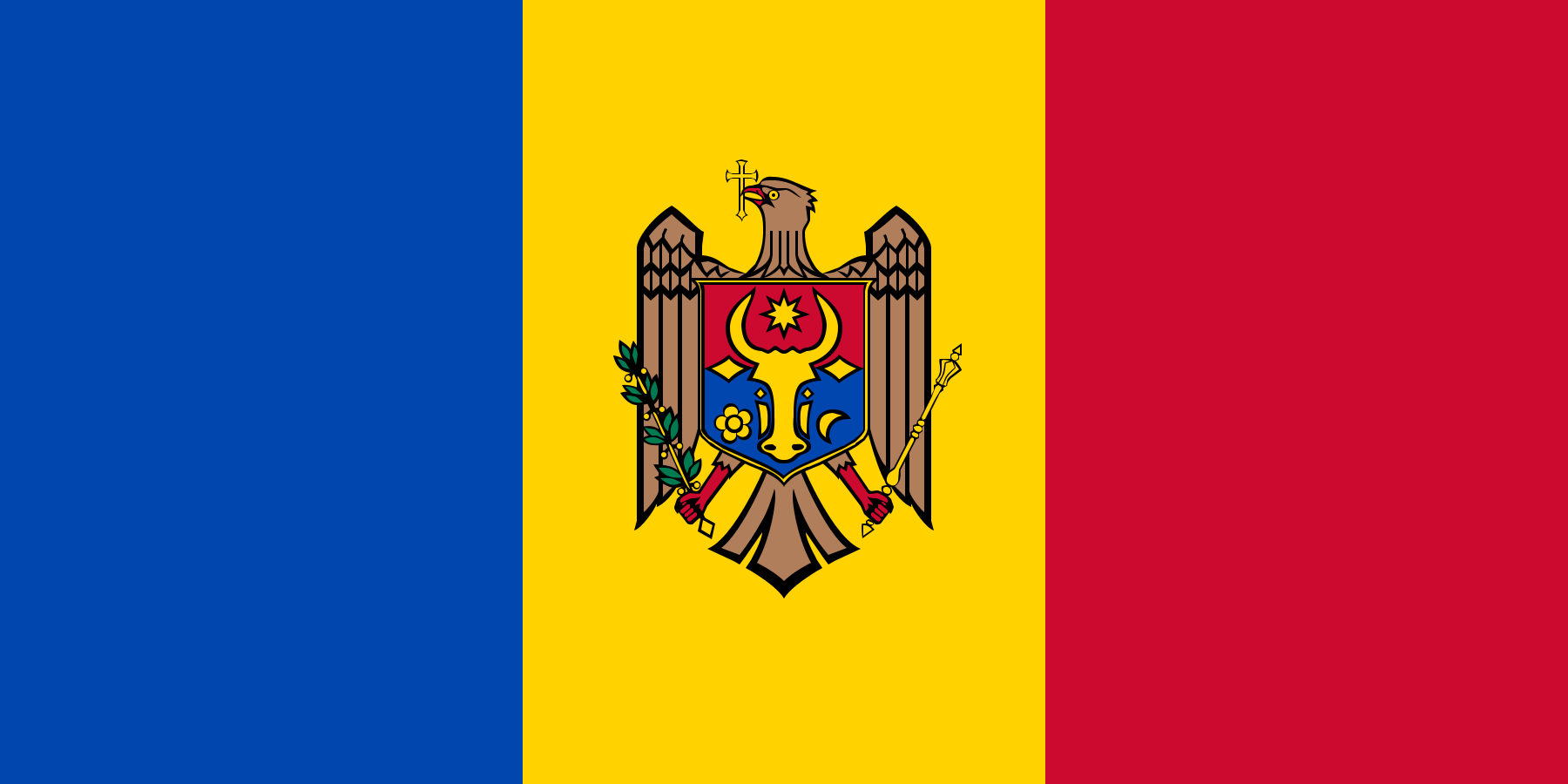
A politician who moved from Soviet party leadership to Moldova's presidency
In the 1996 runoff, backed by left and centrist forces, he defeated Mircea Snegur to win the presidency.
Pyotr Luchinsky rose through the party apparatus of the Moldavian Soviet republic and became a link between late Soviet republican politics and the making of the independent Moldovan state. He became first secretary of the Communist Party of Moldova's Central Committee in 1989 and served on the CPSU Politburo from 1990 to 1991. After independence, he was ambassador to Russia and speaker of parliament before winning the 1996 presidential election and serving as Moldova's second president from 1997 to 2001. His career shows how Soviet institutional continuity and the adjustment of a new state's sovereignty and foreign orientation could converge in one politician.
Career timeline
1960–1971Instructor, department head, secretary and first secretary of the Moldavian Leninist Komsomol Central Committee
1971–1976Secretary of the Communist Party of Moldova Central Committee and member of its Politburo
1976–1978First secretary of the Communist Party's Chișinău City Committee
1978–1986Deputy chief of a department of the CPSU Central Committee
1986–1989Second secretary of the Communist Party of Tajikistan Central Committee
1989–1990First secretary of the Communist Party of Moldova Central Committee
1990–1991Secretary of the CPSU Central Committee and member of its Politburo
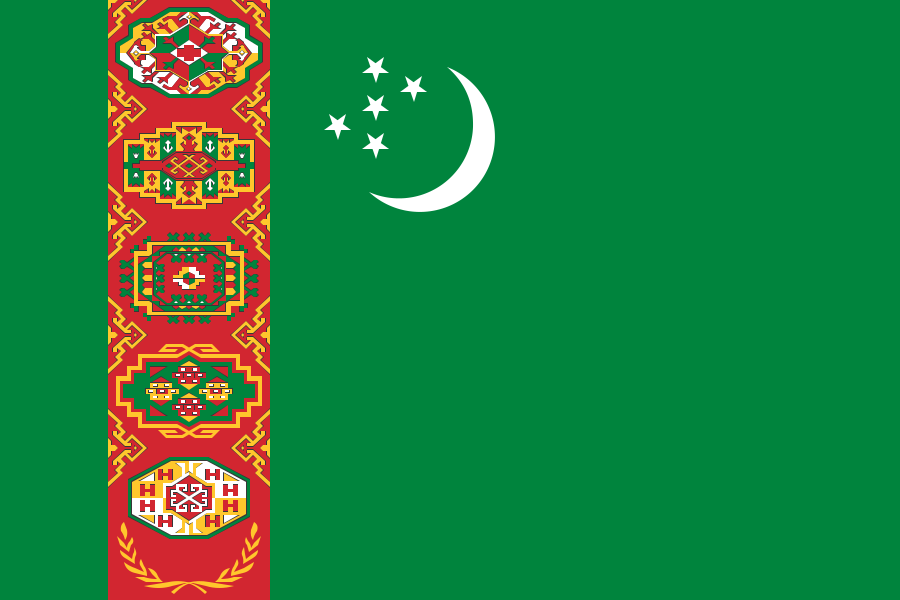
A Turkmen leader who turned late-Soviet rule into personal rule over an independent state
At the 1991 9+1 meetings, he weighed a reworked union against preserving Turkmenistan’s autonomy.
Saparmurat Niyazov was the Soviet-era party and government leader who became independent Turkmenistan’s first president. He led the Turkmen delegation in the 9+1 meetings during the 1991 New Union Treaty process, while the republic’s guarded autonomy limited his role in the negotiations themselves. After independence he invoked neutrality and state sovereignty while concentrating power in the presidency and using the Ruhnama and an extensive personality cult to organize public life. His rule remains a case of post-Soviet state formation fused with authoritarian consolidation.
Career timeline
1962Joined the Communist Party of the Soviet Union
1970–1980Cadre in the Communist Party of Turkmenistan Central Committee
1980–1984First Secretary of the Ashgabat City Party Committee
1985Chairman of the Council of Ministers of the Turkmen SSR
1985–1991First Secretary of the Communist Party of Turkmenistan
1990–1991Chairman of the Supreme Soviet of the Turkmen SSR
1990–2006President of Turkmenistan
1991Head of Turkmenistan’s delegation at the 9+1 New Union Treaty meetings