He recalled that his task had “extended the history of the Soviet state by one day.”
Andrei Grachev was a specialist in international affairs and a journalist who worked on the international meaning and domestic politics of Soviet reform. After the August 1991 coup, he became Mikhail Gorbachev’s aide and final presidential press secretary, observing at close range both negotiations to preserve the Union and the disintegration of its state institutions. His memoirs and deposited personal papers document the tension between perestroika’s promise of democratic renewal and the acceleration of the Union’s collapse.
Career timeline
1964–1966Referent, Committee of Youth Organizations of the USSR
1966–1973Soviet representative at the Budapest editorial office of Youth of the World
1973First deputy chairman, Committee of Youth Organizations of the USSR
1973–1978Referent, CPSU Central Committee International Department
1978–1989CPSU Central Committee Department of Foreign Political Propaganda
1989–1991Deputy head, CPSU Central Committee International Department
1991Aide and press secretary to Soviet President Mikhail Gorbachev
1992–presentJournalist, political commentator and author
Soviet Union
Soviet communism
1941–2018
○ Natural causes
An Estonian communist leader who chose to preserve the Soviet Union
In 1991, as Estonian independence approached, he joined the Politburo while backing the Soviet Union.
Lembit Annus was a Moscow-aligned Estonian communist leader who stood at the centre of the late Soviet conflict over national independence and preserving the Union. From December 1990 until the party was banned in August 1991, he was First Secretary of the Communist Party of Estonia on the CPSU platform, and in 1991 he joined the CPSU Politburo. After the party's dissolution, he remained active in communist politics as a Pravda correspondent and Tallinn municipal councillor.
Career timeline
1941Born in Kohtla-Järve, Estonian SSR
1963Joined the Communist Party of the Soviet Union
1983–1989Editor-in-chief of Eesti Kommunist
1990First Secretary of the Kalinin District Committee of the Communist Party of Estonia
1990–1991First Secretary of the Communist Party of Estonia on the CPSU platform
1991Member of the CPSU Politburo
1991–1999Estonia correspondent for Pravda and Tallinn City Council member
Soviet Union
Soviet communism
1941–2020
○ Natural causes
The last Soviet culture minister
In his diploma performance as Hitler, Gubenko poured all his hatred for the man who killed his parents into the role. Lyubimov saw it and immediately brought him to the Taganka Theatre.
An actor and film director who rose from war orphan to People's Artist of the RSFSR. He was the first working arts professional to become Soviet Minister of Culture (1989–1991) since Anatoly Lunacharsky. After the USSR collapsed, he entered left-wing politics, serving as chair of the Duma's Culture Committee and deputy speaker of the Moscow City Duma, where he defended Soviet cultural heritage. Following the Taganka Theatre split, he founded and led the Sodruzhestvo Aktyorov Taganki until his death in 2020.
The Communist Party secretary who led Latvia's Supreme Council through the restoration of independence
On 14 January 1991, General Kuzmin's ultimatum to the chairman of the Supreme Council was simple: repeal the laws Latvia had adopted, or the army would act. Gorbunovs did not repeal them, and a week later flew to Moscow to face Gorbachev.
A farmer's son from Pilda in eastern Latvia, he graduated from construction college, Riga Polytechnical Institute, and the Moscow Academy of Social Sciences, then rose through the Latvian Communist Party apparatus to become Central Committee secretary for ideology. He broke with the party's hard line in 1988 by backing the Latvian Popular Front, and as Chairman of the Supreme Council presided over the 4 May 1990 session that declared the Soviet Union an occupying power and began the transition to restored independence. During the January 1991 Barricades he stood firm against General Kuzmin's ultimatum, then flew to Moscow on 21 January to confront Gorbachev directly.
Career timeline
1959–1965Technician at Nīkrāce state farm, employee at Riga Agricultural Engineering Institute, Soviet Army service
1970–1974Senior lecturer at Riga Polytechnical Institute, Kirov district Komsomol first secretary
1974–1988Various posts in the Latvian Communist Party Central Committee, rising to secretary for ideology
1988–1990Chairman of the Presidium of the Supreme Soviet of the Latvian SSR
1990–1993Chairman of the Supreme Council of the Republic of Latvia, acting head of state after independence
1993–1995Speaker of the 5th Saeima
1995–2002Deputy Prime Minister, Minister for Environmental Protection and Regional Development, Minister for Transport
Soviet Union
Soviet communism
1942–2020
○ Natural causes
The last Soviet defence minister and final Marshal of Aviation
On 25 December 1991, as Gorbachev's nuclear briefcase was transferred to Yeltsin, Shaposhnikov told the press: "The nuclear button is in reliable hands."
A career officer who rose from fighter pilot to Commander-in-Chief of the Soviet Air Force over three decades, Shaposhnikov played a decisive role in the August 1991 coup when, as air force chief, he proposed to Defence Minister Yazov that troops be withdrawn from Moscow and the Emergency Committee be dissolved. After the coup's collapse Gorbachev appointed him the Soviet Union's last Defence Minister, and on 26 August 1991 he was promoted Marshal of Aviation, the final person in Soviet history to receive a rank bearing the word 'marshal.' He oversaw the transfer of nuclear command from Gorbachev to Yeltsin, served as CIS Joint Armed Forces Commander-in-Chief and later as Secretary of Russia's Security Council, before heading Aeroflot and advising Sukhoi.
Career timeline
1963Graduates Kharkov Higher Military Aviation School, commissioned as fighter pilot
1969Graduates Gagarin Air Force Academy
1985–1987Commander, Air Forces of the Odessa Military District
1987–1988Commander, Air Forces of the Group of Soviet Forces in Germany
1990–1991Commander-in-Chief of the Soviet Air Force and Deputy Minister of Defence
1991.08–1992.02Minister of Defence of the USSR (last)
The Supreme Soviet chairman who stood with Yeltsin against the coup, then fell to Yeltsin's tanks
During the October 1993 siege of the White House, when Yeltsin offered safety guarantees, Khasbulatov replied: 'I need no guarantees, I can offer guarantees to Yeltsin myself.'
Ruslan Khasbulatov was a Chechen-born Soviet economist and Russian politician who became the last chairman of the RSFSR Supreme Soviet. On the day of the August 1991 coup, he was Yeltsin's closest ally: he personally drafted the appeal 'To the Citizens of Russia' and helped organize the defense of the White House. After the Soviet collapse, however, he turned the parliament into the center of opposition to Yeltsin's economic reforms and concentration of power, leading to the 1993 constitutional crisis in which he and Vice-President Rutskoy commanded the parliamentary resistance until tanks shelled the building and they were arrested. Amnestied in 1994, he left politics and returned to academia, teaching world economics at his alma mater.
Career timeline
1965Graduated from the Faculty of Law, Moscow State University
1970–1990Professor and head of the Department of International Economic Relations, Moscow Institute of National Economy (Plekhanov)
1990.03Elected RSFSR People's Deputy from the Grozny constituency
1990.06–1991.10First Deputy Chairman of the RSFSR Supreme Soviet
1991.07–10Acting Chairman of the RSFSR Supreme Soviet
1991.10–1993.10Chairman of the RSFSR/Russian Federation Supreme Soviet
1994–2023Head of the Department of World Economics, Plekhanov Russian University of Economics
The last Soviet soldier to leave Afghanistan, the face of the Soviet withdrawal
On 15 February 1989, standing on the Friendship Bridge, he told a Soviet TV reporter: "There is not a single Soviet soldier left behind me."
A Soviet general who served three tours in the Soviet–Afghan War and, as the last commander of the 40th Army (1987–1989), directed the Soviet withdrawal. He was made a Hero of the Soviet Union in 1988 for Operation Magistral, which lifted the siege of Khost. On 15 February 1989 he crossed the Friendship Bridge on foot, the last Soviet soldier to leave Afghanistan, the symbolic end of the nine-year war. He went on to command the Kyiv Military District, served as First Deputy Minister of Internal Affairs of the USSR, and as Deputy Minister of Defence of Russia. In 1991 he ran for vice-president alongside Nikolai Ryzhkov. In the post-Soviet era he served twelve years as governor of Moscow Oblast, embodying the political transition of the Soviet military elite.
Career timeline
1965–1969Motorized rifle platoon and company commander, Baltic Military District
1972–1978Battalion commander → regiment commander → chief of staff, 9th Motorized Rifle Division, North Caucasus MD
She tried to negotiate independence through pragmatism; her resignation removed the last obstacle to the military option
She wept before her cabinet. "It seems we have failed to achieve anything. We are doomed."
Lithuania's first post-independence prime minister (1990–1991), she led the country through the most dramatic ten months of the Soviet collapse. A founding member of Sąjūdis, she rose from deputy prime minister of the Lithuanian SSR to prime minister, and as the 'Amber Lady' (a name the Western press coined after her meetings with Bush, Thatcher, and Kohl) she gave the newborn republic a diplomatic presence. Unlike the uncompromising parliamentary chairman Vytautas Landsbergis, she was a pragmatist who sought negotiated exit, but on 8 January 1991 Gorbachev refused her request for a guarantee of no military action; she resigned the next day. Five days later Soviet forces killed 14 civilians in Vilnius. She narrowly lost the 2004 presidential runoff to Valdas Adamkus and later served as agriculture minister.
Career timeline
1965–1986Instructor and docent in industrial economics, Vilnius University
1986–1988Deputy director, Agricultural Economics Research Institute, Lithuanian SSR
1989–1990Deputy chair, Council of Ministers, Lithuanian SSR
1990.03–1991.01Prime Minister of the Republic of Lithuania
Scientist-president who moved from reformist promise to prolonged rule
At the Supreme Soviet session on 26 August 1991, Akayev declared the draft Union Treaty 'unacceptable' and demanded a confederal revision.
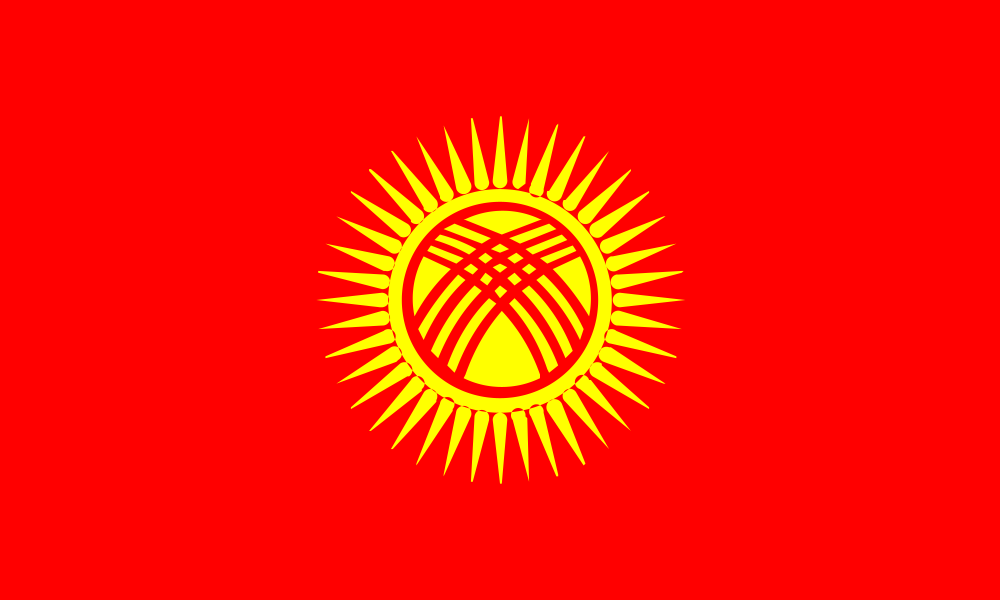
A physicist and former president of Kyrgyzstan's Academy of Sciences, Akayev was elected the republic's first president in 1990 as an outsider to the senior party apparatus. Amid late-Soviet ethnic conflict and demands for sovereignty, he promoted pluralism and market reform, then quickly condemned the 1991 coup attempt and led Kyrgyzstan toward independence. At the Novo-Ogaryovo negotiations he put republican sovereignty first, calling the August treaty draft unacceptable and demanding a revision closer to confederation. His later rule brought extended presidential terms, family-centered politics and corruption allegations, ending in his overthrow during the 2005 popular protests.
Career timeline
1967–1988Researcher and professor, Frunze Polytechnic Institute; head of computer engineering
1987–1989Vice-president, Academy of Sciences of the Kirghiz SSR
1989–1990President, Academy of Sciences of the Kirghiz SSR
1990.10–1991.08President of the Kirghiz SSR
1991.08–2005.03President of Kyrgyzstan
1991.08.26At the Supreme Soviet, opposed the New Union Treaty draft and demanded a confederal revision
2005–presentProfessor and researcher at Moscow State University, based in Russia
The last Soviet-aligned communist leader of Estonia amid a party split
When the party split in 1990, Sillari became first secretary of the faction that retained its link to the CPSU.
Enn-Arno Sillari rose from factory engineering into the city and central structures of the Estonian Communist Party. When the party split in 1990 between a majority seeking Estonian sovereignty and a faction remaining with the CPSU, he led the latter, attempting to preserve both the Soviet institutional link and an organized communist movement in Estonia. As a CPSU Central Committee Politburo member and first secretary of the CPSU-aligned Estonian Communist Party in 1990–91, his authority was tied to a union whose political basis was collapsing. He continued to lead the party after Estonia restored independence, but resigned after its defeat in the 1992 parliamentary elections and later worked in business.
Career timeline
1967Graduated from Kaunas Polytechnic Institute, specializing in mechanical processing of fibers
1967–1972Worked as an engineer and production specialist at the Keila factory in Tallinn
1972–1976Head of the industry and transport department, Lenin District Party Committee, Tallinn
1984–1986First Secretary of the Tartu City Party Committee
1986–1989First Secretary of the Tallinn City Party Committee
1989–1990Chairman of the Supreme Soviet of the Estonian SSR
1990–1991Member of the CPSU Central Committee Politburo
1990–1992First Secretary of the CPSU-aligned Estonian Communist Party
1992–2024Estonian businessman and co-owner of Balteco
The philosopher who proposed the one sentence that declared the Soviet Union dead at Belovezh
At the Belavezha hunting lodge, turning to Shushkevich and Kravchuk: 'Would you guys agree to sign a sentence which would state that the Soviet Union as the subject of international law is ceasing to exist?'
Yeltsin's closest aide and the intellectual architect of the Soviet dissolution. A Marxist philosophy teacher from the Urals, he rose through perestroika to become Yeltsin's right hand, and in September 1991 delivered the 'Burbulis Memorandum' (Gaidar's group's strategy document) to Yeltsin at his Black Sea retreat, setting Russia on a course of economic independence. That December in the Belavezha forest, he turned to Shushkevich and Kravchuk and asked, 'Would you agree to a sentence stating the USSR as a subject of international law is ceasing to exist?', and co-signed the accords that opened with those words. He became a lightning rod for criticism of the reforms and was removed by spring 1992, spending his later decades quietly as a Duma deputy and senator.
Career timeline
1973–1983Taught Marxist philosophy at Ural Polytechnic Institute
1987–1989Founded Sverdlovsk 'Discussion Podium' political club
1989–1990USSR People's Deputy; Inter-regional Deputies' Group
A Georgian party official at the edge of Soviet collapse
“The law should be enforced, but it should be enforced without victims.”
Givi Gumbaridze was a Communist Party official who rose from archival and party-organizational work to the top leadership of the Georgian Soviet Socialist Republic. A former state-security chief, he governed as national mobilization intensified and party rule collided with popular demands. After the bloody Tbilisi crackdown of 1989, he called for both accountability and order, but could not reverse the crisis of Soviet authority.
Career timeline
1966–1967Served in the Soviet Army
1968–1972Researcher in Georgia’s central state archives and aide in the republic’s Supreme Soviet apparatus
1977–1983Official in the Georgian Communist Party Central Committee’s administrative-organs department
1983–1985First Secretary of the Zestafoni District Party Committee
1988First Secretary of the Tbilisi City Party Committee
1988–1989Chairman of the Georgian SSR Committee for State Security
1989–1990First Secretary of the Communist Party of Georgia
1990–1991Member of the CPSU Politburo
1989–1990Chairman of the Presidium of the Supreme Soviet of the Georgian SSR
The Sumgait party boss handed a flag and photographed at the head of the mob
Left isolated by the crowd, the republic flag thrust into his hands, Muslimzade walked where the mob led him; the scene was filmed and sent to the Party Central Committee.
A Komsomol careerist who rose to first secretary of the Sumgait city party committee, he was the party official who faced the crowd at the outset of the February 1988 Sumgait pogrom and, in attempting to calm it, found himself handed an Azerbaijan SSR flag and photographed leading the march. Muslimzade later maintained that he was steering the column away from the Armenian district toward the sea, but the tail of the procession splintered into groups that fanned out into Armenian neighbourhoods. Dismissed from all posts and expelled from the party days after the pogrom, he became both a scapegoat for the violence and an enduring symbol of the party's loss of control.
Career timeline
1971–1974Instructor, Press Department, Ministry of Communications, Azerbaijan SSR; secretary, 26 Baku Commissars District Committee, Komsomol
1974–1978Head of Komsomol Organisations Dept, CC Komsomol of Azerbaijan; Chairman, Committee of Youth Organisations; instructor, Organisational-Party Work Dept, CC CP Azerbaijan
1978–1985First Secretary, Central Committee of the Lenin Komsomol of Azerbaijan
1985–1988First Secretary, Sumgait City Committee, Communist Party of Azerbaijan
1989–1991Vice-President, Azerbaijan Association of Joint Ventures and International Unions
1991People's Deputy, Supreme Council of the Republic of Azerbaijan
A party cadre who moved from army organization to the late Soviet Politburo
In April 1991, while responsible secretary of the All-Army Party Committee, he joined the late Soviet Politburo.
Mikhail Semyonovich Surkov was a Soviet party organizer and politician whose career developed within the armed forces' political apparatus. After working in party-control posts in the army, he entered the Politburo shortly before the Soviet Union's dissolution, embodying the late system's reliance on institutional cadres amid crisis. He later carried that experience into the Communist Party of the Russian Federation, the State Duma, and the Accounts Chamber.
Career timeline
1960Began working as an apprentice fitter
1965–1977Served in the Soviet armed forces and graduated from the Lenin Military-Political Academy
1988–1990Head of the political department of a combined-arms army
1990–1991Secretary of the All-Army Party Committee and responsible secretary of the party commission under the Main Political Directorate
1991Member of the CPSU Central Committee and Politburo member
1995–1999State Duma deputy and deputy chair of the Defence Committee for the Communist faction
2000–2007Auditor of the Accounts Chamber of the Russian Federation
Soviet Union
Soviet communism
1945–2011
○ Natural causes
Soviet airborne forces commander and deputy defence minister in the August 1991 coup
On 19 August 1991, during the GKChP coup, Achalov coordinated the entry of airborne troops into Moscow and was tasked with blockading the Ostankino television centre.
Born on 13 November 1945 in the village of Atamash, Atninsky District, Tatar ASSR, and died in Moscow on 23 June 2011. He graduated from the Kazan Tank School (1966) and the Armoured Forces Academy (1973), commanded the 7th Guards Airborne Division (1978), the 8th Guards Army (1985–1987) and the Leningrad Military District as chief of staff (1987–1989), and became a major-general in 1980. He commanded the Soviet Airborne Forces from January 1989 to December 1990 and was Deputy Minister of Defence of the USSR from December 1990 to September 1991, becoming colonel-general in 1989. Named in the GKChP indictment among the deputy defence ministers who joined the conspiracy at the 17 August 1991 meeting, he sided with the Supreme Soviet in the 1993 crisis, was appointed Defence Minister by Alexander Rutskoy, arrested and amnestied in February 1994.
Career timeline
1966–1973Tank platoon and company commander, 8th Guards Army (GSFG)
1973–1975Deputy commander, 243rd Training Self-Propelled Artillery Regiment, 44th Training Airborne Division
In April 1991, he joined the Soviet Union's final Politburo as Kyrgyzstan's representative.
Amanbayev was an agricultural specialist who rose through the Kyrgyz Communist Party's regional and central apparatus. In 1991, as the Soviet Union moved toward dissolution, he became first secretary of the Communist Party of Kyrgyzstan and a member of the CPSU Politburo, but both positions ended within months as the Union collapsed. He later served in the government of independent Kyrgyzstan, embodying institutional continuity between the late Soviet party apparatus and the new state.
Career timeline
1966Graduated from the Kyrgyz Agricultural Institute
1971–1973Director of the Osh state breeding station; first secretary of the Alay district party committee
1981–1985Secretary of the Osh regional committee of the Communist Party of Kyrgyzstan
1985–1988Secretary of the Central Committee of the Communist Party of Kyrgyzstan
1988–1991First secretary of the Issyk-Kul regional committee
1990–1991Chair of the Issyk-Kul regional Soviet; People's Deputy of the USSR
1991First secretary of the Communist Party of Kyrgyzstan; member of the CPSU Politburo
1993–1995Deputy prime minister of the Kyrgyz Republic
Russia's only vice president: stood with Yeltsin against the coup, then fell to Yeltsin's tanks
During the shelling of the White House on 4 October 1993, Rutskoy shouted live on radio: "If the pilots can hear me, get your combat machines up! This gang has settled in the Kremlin.… Save the perishing democracy!"
One of the last Heroes of the Soviet Union and the only vice president Russia ever had. A combat pilot who flew 485 sorties in the Su-25 over Afghanistan, was shot down twice and captured, and received the Hero of the Soviet Union title in 1988. Elected RSFSR vice president in 1991 as Yeltsin's running mate, he helped organize the White House defense during the August coup, delivered a letter to Lukyanov demanding a medical examination of Gorbachev, and persuaded Patriarch Alexy II to declare the Church's support for Yeltsin. He later broke with Yeltsin over economic policy and power concentration, sided with the parliament, and was proclaimed acting president during the 1993 constitutional crisis before being arrested when tanks shelled the White House.
Career timeline
1971Graduated from Barnaul Higher Military Aviation School
1980Graduated from Gagarin Air Force Academy
1985–1988Afghanistan: commander, 378th Independent Attack Aviation Regiment; deputy commander, 40th Army Air Force
1988Awarded Hero of the Soviet Union
1990RSFSR People's Deputy, member of the Supreme Soviet
1990Graduated with distinction from the General Staff Academy
1991.07–1993.10Vice President of the RSFSR/Russian Federation
1993.09–10Proclaimed acting president by parliament; arrested
The airborne commander who held the coup's key and handed it to Yeltsin
'With a single airborne regiment I could restore order in two hours': Grachev's boast on the eve of the First Chechen War proved the prelude to disaster.
Pavel Grachev was an airborne general who earned the Hero of the Soviet Union title in Afghanistan for achieving objectives with minimal losses, rising to command all Soviet Airborne Forces in December 1990. On the first day of the August 1991 coup he obeyed Defence Minister Yazov's order and brought the 106th Guards Airborne Division into Moscow, but the next day he opposed the planned storming of the White House, switched his allegiance to Yeltsin, and sent troops to defend the parliament: the pivot that broke the coup's military spine. After the Soviet collapse he became Russia's first defence minister, backed Yeltsin during the 1993 constitutional crisis, and presided over the disastrous First Chechen War, leaving office in 1996 amid corruption allegations and the derisive nickname 'Pasha-Mercedes.'
Career timeline
1965–1969Ryazan Higher Airborne Command School (gold medal)
The last Gosplan chairman who presided over the dissolution of Soviet planning
On the end of the planned economy: "We proposed a mechanism to bring the vulnerable closer to public goods through the market. But nobody wanted to listen."
The last steward of Soviet central planning, he managed the transition from plan to market as First Deputy Prime Minister and inaugural Minister of Economy and Forecasting under the Pavlov government, when Gosplan was reorganized into the new ministry in May 1991. After the USSR's dissolution, he transformed into a successful post-Soviet industrial entrepreneur, founding the Avtotor auto assembly group.
Career timeline
1969–1974Engineer at VAZ construction site → Komsomol official in Tolyatti
1976–1982Deputy head then head of planning and economic department, VAZ
1982–1985Deputy general director for economics and planning, KAMAZ
1985–1988Department head at State Committee for Labor → Council of Ministers apparatus
1989–1991Chairman, USSR State Committee for Labor and Social Questions
1991.03–05Deputy Prime Minister of the USSR
1991.05–11First Deputy PM and Minister of Economy and Forecasting (Gosplan successor)
after 1991Founded International Privatization Fund → Chairman of Avtotor Holding
Soviet Union
Soviet communism
1950–2002
○ Killed in crash
The airborne deputy commander who, sent against the White House, switched sides and helped break the August coup
On the night of 20 August 1991, with Grachev's consent, Lebed returned to the White House and secretly told the defenders: 'The assault will begin at 2:00 AM.'
Born into poverty in Novocherkassk, the son of a carpenter who had spent years in the Gulag, he witnessed the Novocherkassk massacre at age twelve and became a Soviet airborne forces general. He served as a battalion commander in Afghanistan and was appointed deputy commander of the Airborne Forces for combat training in February 1991. On the first day of the August coup he led Tula paratroopers to surround the White House on Pavel Grachev's orders, but switched to Yeltsin's side the next day and secretly informed the defenders of the planned 2:00 AM assault, a defection that helped break the coup. After retiring from the army he placed third in the 1996 presidential election, negotiated an end to the First Chechen War as Secretary of the Security Council, and was governor of Krasnoyarsk Krai when he died in a helicopter crash.
Career timeline
1969–1981Cadet → training officer (platoon & company commander), Ryazan Higher Airborne Command School
1981–1982Commander, 1st Battalion, 345th Separate Airborne Regiment, Afghanistan
Leader of the Soyuz faction who nearly turned a parliamentary session into a constitutional coup
On 17 June 1991, as the concluding speaker of the session, Alksnis told the Supreme Soviet that the Union Treaty was unconstitutional and that deputies must back Pavlov's Cabinet because it 'works for the USSR, for the preservation of this state.'
A Soviet Air Force colonel of Latvian descent who became the most visible hardliner in the USSR Congress of People's Deputies. As co-chairman of the Soyuz faction, he demanded martial law, called for Gorbachev's ouster, and on 17 June 1991 urged an immediate vote on Pavlov's emergency-powers resolution, drawing the accusation that he was staging a constitutional coup. After the Soviet collapse he served two terms in the Russian Duma, was beaten by riot police defending the anti-Yeltsin parliament in 1993, and spent his last decades as an unreconstructed Soviet patriot.
Career timeline
1973–1992Soviet Air Force service (senior engineer-inspector, Baltic MD Air Force HQ)
1989–1991People's Deputy of the USSR (Riga district No. 294)
1990–1991Deputy of the Supreme Soviet of the Latvian SSR
1990–1991Co-chairman of the Soyuz faction
2000–2007Deputy, Russian State Duma (3rd and 4th convocations)
2013–2015Head of Tuchkovo urban settlement, Moscow Oblast
Architect of the 500 Days Program: perestroika economist who drafted a rapid transition from planned economy to market
During coal-mine research in the 1970s, a collapse trapped him and four workers waist-deep in ice water for ten hours. Three died in hospital after rescue. Yavlinsky later recalled: "We were saved, but three out of five died in hospital."
Soviet economist and politician from Lviv. After graduating from the Plekhanov Institute and researching coal-mine labour, he became head of the Joint Economic Department of the USSR Council of Ministers in 1989 under Leonid Abalkin. In 1990, with Mikhail Zadornov and Aleksei Mikhailov, he authored the 500 Days Program (a roadmap for transitioning from a planned to a market economy in under two years) and was appointed Deputy Chairman of the RSFSR Council of Ministers. When Gorbachev compromised with Nikolai Ryzhkov's alternative, Yavlinsky resigned in October 1990; he founded the EPICenter think tank and later launched Yabloko in 1993, becoming a fixture of Russia's liberal opposition.
Career timeline
1976–1980Researcher, All-Union Coal Industry Management Research Institute (VNIUUgol)
1980–1989Sector head for heavy industry → deputy head of consolidated department → head of social development and population, State Committee for Labour and Social Affairs
1989–1990Head, Joint Economic Department, USSR Council of Ministers
1990.07–11Deputy Chairman, RSFSR Council of Ministers; Chairman, State Commission for Economic Reform
1991.08–12Deputy Chairman, USSR Committee for Operational Management of the National Economy (vice-premier rank)
1991.10–12Member, Political Consultative Council under the President of the USSR
1990–1993Founder and director, EPICenter for Economic and Political Research
An Estonian legal scholar who challenged the Soviet official narrative in the language of law
On the Yakovlev commission, he argued that the Estonian Soviet Socialist Republic was legally null and void.
Igor Gräzin is an Estonian legal scholar and politician whose work has ranged across legal theory, philosophy of law, and comparative jurisprudence. Elected to the Congress of People's Deputies of the Soviet Union in 1989, he served on the Yakovlev commission examining the secret protocols and the legal meaning of the Baltic states' incorporation. His intervention brought legal expertise into the political struggle over sovereignty and historical memory during the Soviet Union's final crisis.
Career timeline
1952Born in Tartu
1975Graduated in law from Tartu State University
1979–1987Researched law at Soviet state and law institutions and earned a doctorate
1988–1989Headed the law department of the Estonian Academy of Sciences Institute of Philosophy, Sociology and Law
1989–1991Member of the Congress of People's Deputies and the Yakovlev commission
1990–2000Professor and researcher at the University of Notre Dame
A ruler who recast the loss of the Soviet Union as a narrative of state restoration
“The collapse of the Soviet Union was the greatest geopolitical catastrophe of the century.”
Vladimir Putin is a Russian politician and former Soviet security officer who rose to national power amid the crises of the 1990s. Alternating between the presidency and premiership, he strengthened federal and presidential authority while making the restoration of Russia’s international influence a central narrative of rule. In 2005, he called the Soviet collapse “the greatest geopolitical catastrophe of the century,” a remark that condensed his memory of dissolution as a Russian experience of loss and dislocation. His rule also narrowed political competition and independent media while expanding the state’s military interventions abroad.
Career timeline
1975–1991Officer, KGB of the Soviet Union
1990–1996Head of the Committee for External Relations and senior deputy official, Saint Petersburg administration
1998–1999Director, Federal Security Service (FSB)
1999Secretary, Security Council of the Russian Federation