Ukrainian independence leader who headed the People's Republic but whose role in pogroms remains fiercely contested
Do not separate the fate of Ukraine from the fate of Russia. If Russia suffers defeat, the consequences of this catastrophe will also affect Ukraine.
A social-democratic journalist from Poltava who rose from military secretary of the Central Rada in 1917 to commander-in-chief of the Ukrainian People's Army and head of the Directorate of the Ukrainian People's Republic. He fought to defend Ukrainian independence against Bolsheviks, White armies, and Poland, but was forced into exile, first in Poland and then Paris, after defeat in 1920. An estimated 50,000 Jews were massacred by forces under his command, and whether he was unable or unwilling to stop the killings remains fiercely disputed. In 1926 he was assassinated in Paris by the Jewish anarchist Sholem Schwarzbard, who called it vengeance for the pogroms.
Career timeline
1900–1917Activist in the Revolutionary Ukrainian Party and USDRP; journalist leading the Ukrainian national movement
1917.05–12Secretary of Military Affairs, Central Rada; led organization of Ukrainian armed forces
1918.01–03Commander of Haydamaky Kish; suppressed Bolshevik Arsenal uprising in Kyiv
1918.11–1919.02Chief of Military Forces, Directorate of Ukraine
1919.02–1920.12Head of the Directorate and Supreme Commander, Ukrainian People's Army
1920.04Signed Warsaw Treaty with Poland, forming anti-Bolshevik alliance
1924–1926Published weekly Tryzub from exile in Paris
Ukrainian Social Democratic writer who led the Rada's General Secretariat and the Directory
Just as you created the dictatorship of workers and peasants in Russia, we must create a dictatorship of the Ukrainian language in Ukraine.
A Ukrainian Social Democratic writer, he led the Central Rada's General Secretariat in 1917 and retook Kyiv as first chairman of the Directory in 1918. Arguing for talks with the Soviets he broke with Petliura and resigned in 1919, dying in France in 1951.
Career timeline
1905Co-founder of the Ukrainian Social Democratic Workers' Party
1917Vice-president of the Central Rada and first head of its General Secretariat
1918.01Premier of the Ukrainian People's Republic, soon resigned
1918.12Retook Kyiv as chairman of the Directory
1919–1920Wrote the memoir Rebirth of a Nation
1920Deputy head of the Ukrainian SSR Sovnarkom; soon re-emigrated
Ukrainian nationalist leader who commanded the Sich Riflemen and built the UVO and OUN
Rotterdam, 23 May 1938: a Ukrainian-style box of chocolates handed over by his trusted contact Pavel Sudoplatov concealed a time bomb made in Moscow.
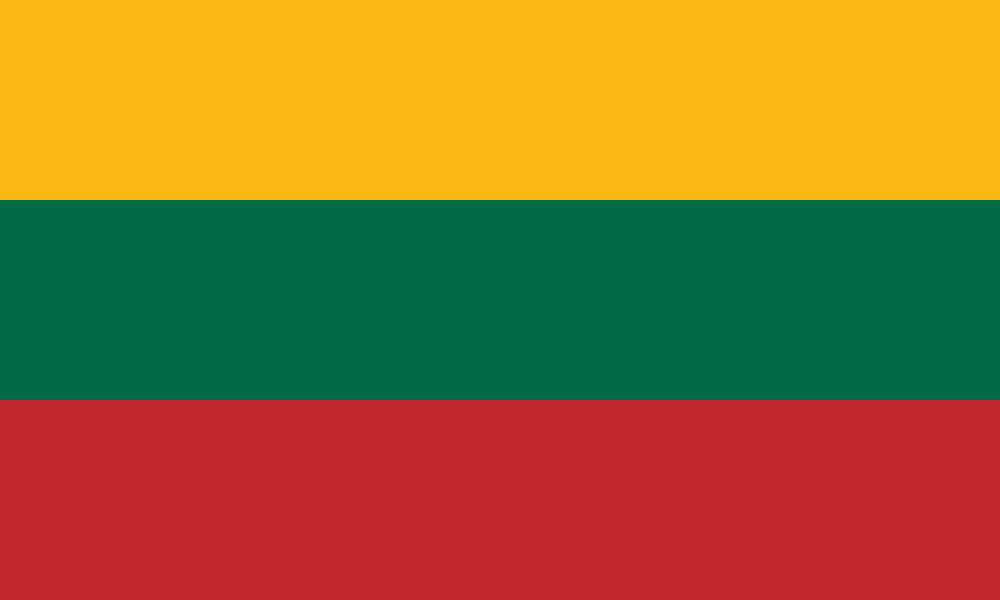
A Ukrainian military and political leader from Zashkiv in Austrian Galicia. After captivity in Russia during the First World War, he organized the Sich Riflemen in Kyiv in 1917 and became a leading commander of the Army of the Ukrainian People’s Republic. Following defeat in the independence war, he led the Ukrainian Military Organization (UVO) in exile and united several nationalist groups into the Organization of Ukrainian Nationalists (OUN) in Vienna in 1929, becoming its first leader. He connected émigré organizations across Europe and North America and sought international support for Ukrainian independence, but was assassinated in Rotterdam in 1938 by a bomb delivered by NKVD operative Pavel Sudoplatov, who had infiltrated the OUN. In 1929 he obtained Lithuanian citizenship and a passport, giving his émigré activity a legal basis, while his national and political identity and the aim of his movement remained consistently Ukrainian independence.
Career timeline
1914–1915Served in the Austro-Hungarian army; captured by Russia after the Battle of Makivka
1917–1920Organized and commanded the Sich Riflemen of the Ukrainian People’s Republic
1920–1929Cofounded and led the Ukrainian Military Organization (UVO)
1929–1938Founding leader of the Organization of Ukrainian Nationalists (OUN)
1938.05Assassinated in Rotterdam in Pavel Sudoplatov’s bombing operation
Ukrainian otaman who took Odesa for the Reds, then turned to revolt and pogrom
Proclaiming revolt in his May 1919 Universaл, he cried: "Ukrainian people! Take power into your own hands. Let there be no dictatorship of any one man or any one party."
The Ukrainian otaman who took Odesa for the Soviets in the spring of 1919, he rose against them in May and his troops massacred Jews at Yelysavethrad and elsewhere. He was shot by Makhno's men in July.
Career timeline
1901–1907Volunteered for the imperial army, fought in the Russo-Japanese War, and won three Crosses of St George.
1914–1916Served as an officer on the Southwestern Front in World War I, rising to staff-captain.
1918Led peasant partisans in Kherson province against the Austro-German occupiers and the Hetmanate.
1918–1919Served as chief of the Kherson Division of the Ukrainian People's Republic (Directory).
1919.02Went over to the Red Army, commanding the 1st Zadniprovska Brigade and then the 6th Ukrainian Soviet Division, and took Odesa in April.
1919.05Led the Hryhoriv uprising against the Red Army in May.