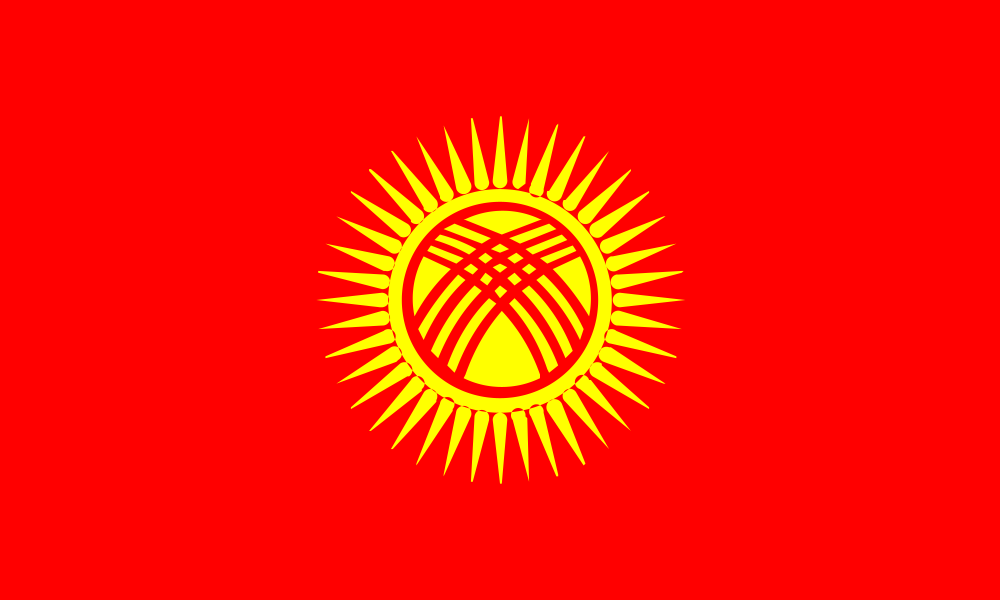
The builder who transformed Kirghizia from an agrarian to an industrial republic across the Khrushchev-Brezhnev era
In his later memoirs, he wrote of the project that was both his greatest legacy and his heaviest burden: "The Toktogul Hydroelectric Station — my pride and my pain."
Born to a poor peasant family and beginning as a schoolteacher, this Kyrgyz politician spent ten years (1945–1955) as an instructor at the CPSU Central Committee in Moscow, gaining the all-Union party apprenticeship that would define his career. As First Secretary of the Communist Party of Kirghizia from 1961 to 1985, he oversaw the construction of 150 large industrial facilities, including the Naryn hydroelectric cascade, Toktogul HPP, and Manas International Airport, and delivered over 510,000 new apartments. Gross industrial output rose fivefold and electricity generation twelvefold, transforming the republic from agrarian to industrial. A full member of the CPSU Central Committee (1961–1986), he also served in the parliament of independent Kyrgyzstan (1993–2005) after retirement.
Career timeline
1937–1939Teacher and head of studies, Kochkor secondary school
1941–1942Deputy head, Propaganda and Agitation Dept., Kochkor District Party Committee
1942–1943Instructor, Propaganda and Agitation Dept., CC CP of Kirghizia
1945–1955Instructor, CPSU Central Committee (Moscow)
1955–1956Editor-in-chief, republican daily Sovettik Kyrgyzstan
1956–1958Head, Propaganda and Agitation Dept., CC CP of Kirghizia
1958–1961First Secretary, Frunze City Party Committee
1959–1961Chairman, Supreme Soviet of the Kirghiz SSR
1961–1985First Secretary, CC CP of Kirghizia
1961–1986Member, CPSU Central Committee
1993–2005Deputy, Jogorku Kenesh (Parliament) of the Kyrgyz Republic
Kyrgyz writer and diplomat who carved a Central Asian voice into world literature
The *mankurt* of his novel — a slave tortured into forgetting even his own mother — became shorthand among Soviet intellectuals for the amnesia inflicted on a people severed from their history.
Chinghiz Aitmatov was among the most significant Soviet writers, a Kyrgyz who wrote mainly in Russian and fused Central Asian folklore with a humanist sensibility. His novella *Jamila* (1958), hailed by Louis Aragon as 'the most beautiful love story in the world,' brought world fame, and works like *Farewell, Gyulsary!* won him the Lenin Prize (1963) and three USSR State Prizes. His novel *The Day Lasts More Than a Hundred Years* (1980) wove steppe folklore and science fiction together, making the *mankurt*, a slave stripped of memory, a lasting metaphor for historical amnesia. A close adviser to Gorbachev, he endorsed perestroika and served as ambassador to Luxembourg (1990–1993) for the USSR and Russia, then for Kyrgyzstan to the EU, NATO, and UNESCO (2000–2008). His work, in 175 languages, carried a Central Asian voice into world literature.
Career timeline
1952–1956Worked as a veterinarian; published first stories
1956–1958Studied at the Maxim Gorky Literature Institute, Moscow
1959–1967Pravda correspondent in Kirghizia
1966–1989Deputy, Supreme Soviet of the USSR (7th–11th convocations)
1985–1991Cultural adviser to Gorbachev; Member, USSR Presidential Council
1986–1991First Secretary, Union of Writers of Kirghizia
1990–1993USSR/Russian Ambassador to Luxembourg
2000–2008Kyrgyz Ambassador to the EU, NATO, and UNESCO
The post-coup foreign minister of the collapsing Union
On August 21, 1991, with the coup still unfolding, Pankin appeared on Czechoslovak television — the only Soviet ambassador to publicly condemn the putsch as 'a fatal mistake on Yanayev's part,' demanding he 'correct it as soon as possible.'
A journalist who transformed Komsomolskaya Pravda into the Soviet Union's boldest youth paper and a literary critic who won the USSR State Prize. As a diplomat, he was the only Soviet ambassador to openly condemn the August 1991 coup. Appointed the last Soviet foreign minister, he established diplomatic relations with Israel and launched US-Soviet disarmament talks in his brief tenure before the Union dissolved.
At the presidential selection in the Supreme Soviet on 25 October 1990, neither he nor Apas Jumagulov won a majority, and Akayev was chosen first president on 27 October. In the 1995 election he lost to Akayev, 71.6 to 24.4 percent.
Kyrgyz Soviet party and state leader, born on 10 April 1933 in Alysh, Osh oblast, died on 31 July 2004 in Bishkek. A mining engineer trained at Kyzyl-Kiya and in Moscow, he began work in 1956 at the Kyzyl-Kiya coal administration and rose through party bodies. Elected first secretary of the Communist Party of Kirghizia on 2 November 1985, he held the post to 6 April 1991, was a member of the CPSU Central Committee from 1986 to 1991 and of the CPSU Politburo from 14 July 1990 to 25 April 1991. Chairman of the Supreme Soviet of the Kirghiz SSR in 1990, he lost the presidential selection to Akayev and the 1995 election. From September 1992 until 2004 he led the Party of Communists of Kyrgyzstan. Sources differ on the death date, 31 July or 1 August.
Career timeline
1956–1961Assistant chief engineer at the Komsomolskaya mine of the Kyzyl-Kiya coal administration, then assistant chief engineer of the Kirghizugol trust
1961–1973Instructor of the Osh regional party committee, student at the Alma-Ata higher party school, party-state control posts, head of the Osh regional party department for industry and transport, deputy head of a Central Committee department, first secretary of the Tash-Kumyr city party committee
1972–1974Chairman of the Frunze City Executive Committee
1974–1979Secretary of the Central Committee of the Communist Party of Kirghizia
1979–1985First Secretary of the Issyk-Kul Regional Party Committee
1985–1991First Secretary of the Central Committee of the Communist Party of Kirghizia (elected 2 November 1985 at the 21st plenum; released 6 April 1991 to move to the CPSU Central Committee apparatus). Member of the CPSU Central Committee 1986–1991 and of the CPSU Politburo from 14 July 1990 to 25 April 1991
1990Chairman of the Supreme Soviet of the Kirghiz SSR (elected 10 April 1990 at the first session of the 12th-convocation Supreme Soviet, released at his own request on 10 December 1990)
1991Consultant to the ideological department of the CPSU Central Committee (April–August 1991)
1992–2004Leader of the Party of Communists of Kyrgyzstan from September 1992; chairman of its central control commission and a member and deputy chairman of the executive council of the Union of Communist Parties–CPSU
1993–1996Director of the State Inspectorate for industrial safety and mining supervision (January 1993–June 1996)
1994–2004Chairman of the I. Razzakov Foundation from 1994
1995–2004Deputy of the Assembly of People's Representatives of the Zhogorku Kenesh (elected April 1995, re-elected April 2000); from 2000 a deputy of the Legislative Assembly
In April 1991, he joined the Soviet Union's final Politburo as Kyrgyzstan's representative.
Amanbayev was an agricultural specialist who rose through the Kyrgyz Communist Party's regional and central apparatus. In 1991, as the Soviet Union moved toward dissolution, he became first secretary of the Communist Party of Kyrgyzstan and a member of the CPSU Politburo, but both positions ended within months as the Union collapsed. He later served in the government of independent Kyrgyzstan, embodying institutional continuity between the late Soviet party apparatus and the new state.
Career timeline
1966Graduated from the Kyrgyz Agricultural Institute
1971–1973Director of the Osh state breeding station; first secretary of the Alay district party committee
1981–1985Secretary of the Osh regional committee of the Communist Party of Kyrgyzstan
1985–1988Secretary of the Central Committee of the Communist Party of Kyrgyzstan
1988–1991First secretary of the Issyk-Kul regional committee
1990–1991Chair of the Issyk-Kul regional Soviet; People's Deputy of the USSR
1991First secretary of the Communist Party of Kyrgyzstan; member of the CPSU Politburo
1993–1995Deputy prime minister of the Kyrgyz Republic