From Rosa Luxemburg's lawyer to KPD leader, his 'anti-putschism' took on Comintern adventurism
Right after the March Action of 1921 he wrote: 'When I conceived this pamphlet, the Communist Party had 500,000 members in Germany. Eight days later when I wrote it, the party was shaken to its foundations and its very existence called into question. The fallen, sacrificed to this Bakuninist madness, cry out: Never again!'
A socialist who rose from Rosa Luxemburg's lawyer to chairman of the German Communist Party (KPD). Expelled for his pamphlet Unser Weg, which condemned the 1921 March Action as 'Bakuninist putschism,' he returned via the USPD to lead the SPD left. Trotsky called him 'the only man in Germany who had a head to lose.'
Career timeline
1906Joined the SPD; began law practice in Frankfurt
1913Defended Rosa Luxemburg in court on charges of inciting soldiers to disobedience
1915–1918Co-founded the Spartacus League; Zimmerwald Left bureau; edited Spartakusbriefe
1918.12Introduced the 'National Assembly' debate at the KPD founding congress
1919.03–1921.02KPD chairman — rebuilt the party after the murders of Luxemburg, Liebknecht, and Jogiches
1920Led unification with the USPD left, turning the KPD into a mass party; championed the 'Open Letter' tactic
1921Expelled from the KPD for Unser Weg: Wider den Putschismus, his critique of the March Action
1922Returned to the SPD via the USPD; published Luxemburg's suppressed manuscript The Russian Revolution
1924–1930SPD Reichstag deputy; fought to expose the Liebknecht–Luxemburg murders and opposed the rising Nazi movement
Presiding judge of the Moscow show trials, Stalin's 'judicial guillotine'
To an Estonian lawyer he had just condemned to death, Ulrikh smiled and said: "So your profession came in handy after all!"
Chairman of the Military Collegium of the USSR Supreme Court (1926–1948) and the judicial face of the Stalin-era Great Purge. Born in Riga to a Baltic German revolutionary father and a Russian noble mother, he joined the Bolsheviks in 1910 and began his Cheka career in 1918. He presided over the Moscow show trials of Zinoviev, Kamenev, Bukharin, and Tukhachevsky (1936–1938), directing a body that handed down over 30,000 death sentences in two years. After the war he presided over the trials of Nazi collaborators Vlasov and Krasnov, and the leaders of the Polish Underground State. Reporting directly to Stalin outside the ordinary judicial hierarchy, he embodied a parallel justice system designed for political repression. Removed in 1948, he died of a stroke in 1951.
Career timeline
1910Joined RSDLP (Bolsheviks)
1914Graduated from Riga Polytechnical Institute, commercial dept.
1915–1917Podporuchik, Imperial Russian Army sapper battalion
1918–1919Head of Finance, NKVD and Cheka
1920Judge, Revolutionary Military Tribunal of the Republic
1921–1926Chairman, Military Collegium of RSFSR Supreme Court
1926–1948Chairman, Military Collegium of USSR Supreme Court
1935–1948Deputy Chairman, USSR Supreme Court
1948–1951Director, Higher Military-Juridical Courses, Military Law Academy
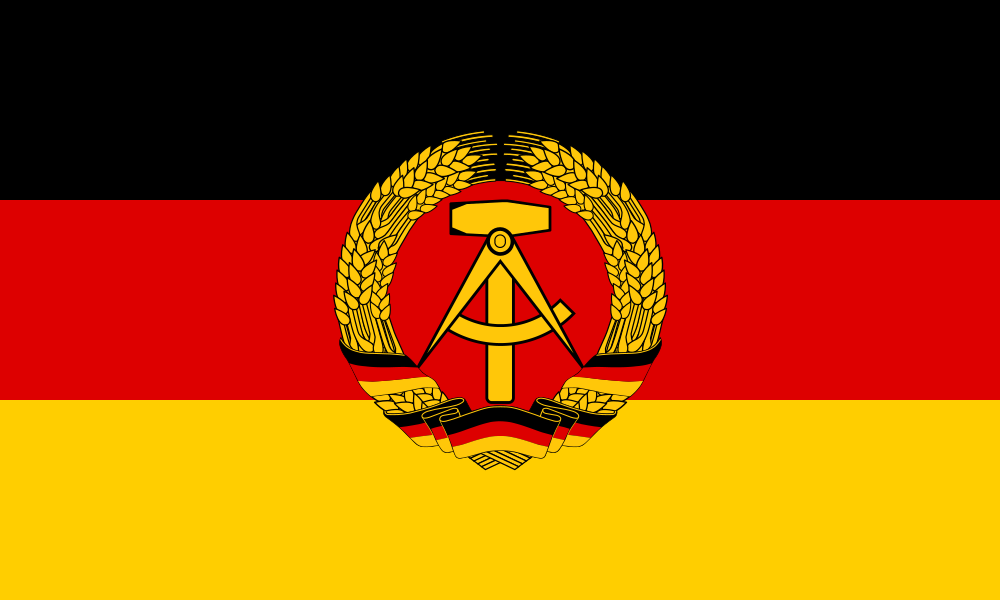
First East German justice minister, dismissed and imprisoned in 1953 after opposing the prosecution of striking workers
A toolmaker from Berlin, he joined the SPD in 1910 and sat in the Prussian Landtag from 1928 to 1933. Under the Nazis he took part in a resistance group and was twice imprisoned. After the war he supported the forced merger of the SPD and KPD, sat on the SED’s Central Committee, and in October 1949 became the GDR’s first Minister of Justice. In the trial of the Gladow gang he had adult criminal law applied unlawfully so that a death sentence was possible. In an interview with Neues Deutschland on 30 June 1953 he said that members of the 17 June strike leadership would not be punished on mere suspicion; denounced as an “enemy of the state and the party”, he was dismissed, expelled and arrested, and sentenced to eight years. Released and pardoned in 1956, readmitted to the party in 1958, he died in 1973.
East German jurist who succeeded Fechner as justice minister after the 1953 uprising and led its harsh political trials
Born into a liberal middle-class family in Bernburg, Anhalt, she was among the first women to study law in Germany. A Social Democrat, she married the physician Georg Benjamin, brother of Walter Benjamin, in 1926 and joined the KPD in 1927. Barred from practising law under the Nazis, she lost her husband in Mauthausen in 1942. After the war she worked in the justice administration of the Soviet zone, and as vice-president of the GDR Supreme Court presided over show trials of political undesirables and Jehovah’s Witnesses. On 15 July 1953 she succeeded Max Fechner, who had opposed prosecuting the striking workers, as minister of justice, and her heavy sentences against those arrested in June earned her the names “Red Hilde” and “the Red Freisler”. Ulbricht forced her to resign in 1967. She died in East Berlin in 1989.