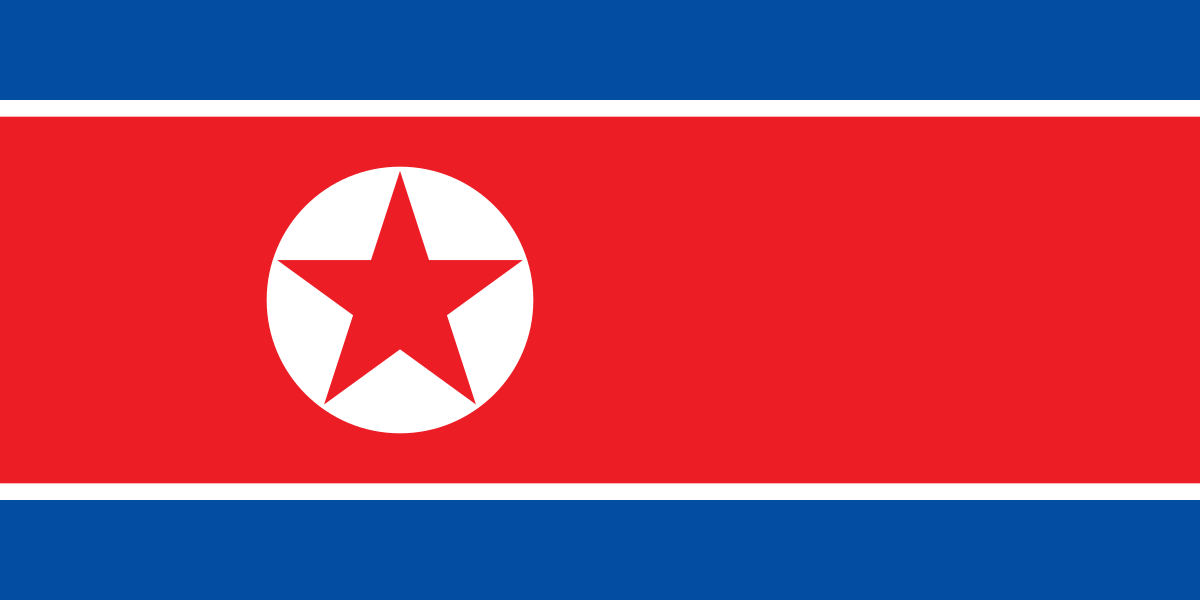
From civil-rights lawyer of the March 1st Movement to first Chairman of the DPRK Supreme People's Assembly: a progressive nationalist
When he submitted a motion of non-prosecution during the March 1st Movement trial, the Japanese courtroom erupted in protest — and the scene, reported nationwide, made Ho Hon the symbol of the anti-colonial lawyer.
One of colonial Korea's 'three great civil-rights lawyers,' he defended the 47 national representatives of the March 1st Movement and handled pro bono cases for workers and independence activists. Elected chairman of Singanhoe's Central Executive Committee in 1927, he led the united-front anti-Japanese struggle, and after liberation served as Prime Minister of the People's Republic of Korea and chairman of the South Korean Workers' Party before crossing north, becoming the bridge by which Korea's independence movement passed into socialism.
Career timeline
- 1907Passed the first Korean Empire bar examination
- 1919Defended March 1st Movement leaders; President, Korean Bar Association
- 1927Chairman, Central Executive Committee of Singanhoe
- 1945Vice Chairman, Preparatory Committee; Prime Minister, People's Republic of Korea
- 1946Chairman, South Korean Workers' Party
- 1948Chairman, Supreme People's Assembly; President, Kim Il Sung University
Independence activist, linguist, and Yan'an faction leader who served as the first head of state of the DPRK
On the day the People's Assembly adopted the new DPRK flag in July 1948, Kim Tu-bong personally lowered the Taegeukgi and raised its replacement. Barely a year earlier, he had been the man passionately explaining the old flag's philosophical meaning to a skeptical Soviet general.
A Hangul linguist trained under Chu Sigyŏng who led the Korean Independence League in Yan'an. Became the DPRK's first head of state in 1948, though real power lay with Kim Il Sung. Purged and vanished in the 1958 August Faction Incident.
Career timeline
- 1908–1916Studied Hangul under Chu Sigyŏng; helped compile MalMoi dictionary
- 1919Joined March First Movement, then exiled to Shanghai provisional government
- 1920–1930sCombined communist activism with linguistic research in Shanghai
- 1942–1945Founded Korean Independence League in Yan'an; led the Yan'an faction
- 1946.02–08Chairman of the New People's Party of Korea
- 1946.08–1949.06Chairman of the Workers' Party of North Korea Central Committee
- 1948.09–1957.09Chairman of the SPA Standing Committee — first head of state of the DPRK
- 1957–1958Dismissed from all posts over August Faction Incident; disappeared
Architect of the Korean Communist Party's rebirth; leader of the Workers' Party of South Korea
At his 1927 trial in Sinuiju, he ate his own excrement in court to feign insanity, securing medical release before escaping to Moscow.
The foremost leader of Korea's communist movement from the colonial era through liberation. He rebuilt the Communist Party of Korea and led the Workers' Party of South Korea, but after defecting north he was outmaneuvered by Kim Il-sung and executed as the scapegoat for the Korean War's defeat.
Career timeline
- 1921Joined Korean Communist Party (Irkutsk faction) in Shanghai
- 1922Secretary of Korean Communist Youth League; attended Far East Peoples' Congress in Moscow
- 1925Co-founded Communist Party of Korea; General Secretary of Korean Komsomol
- 1928–1930Studied at International Lenin School, Moscow; joined CPSU(B)
- 1931–1940Comintern Eastern Secretariat cadre; led underground organizing in Shanghai and Korea
- 1945Rebuilt Communist Party of Korea; became its leader and General Secretary
- 1946–1949Founded Workers' Party of South Korea; Vice Chairman (de facto leader)
- 1948–1953Deputy Premier and first Foreign Minister of the DPRK
The Manchurian guerrilla who became the KPA's first commander and the DPRK's nominal head of state
In December 1955, Choe Yong-gon presided over the trial of Pak Hon-yong and sentenced him to death, rejecting pleas for clemency from Mao Zedong and Zhou Enlai.
After military training at Yunnan and Whampoa academies, he led anti-Japanese guerrilla war in Manchuria as chief of staff of the 2nd Route Army and commander of the 7th Army of the Northeast Anti-Japanese United Army, forming the Manchurian trio with Kim Il Sung and Kim Chaek. Returning in 1945, he played the decisive role in converting Cho Man-sik's Korean Democratic Party to a communist line; upon the DPRK's founding in 1948 he became its first Minister of National Defence and Chief Commander of the Korean People's Army, the KPA's senior field commander during the Korean War. From 1957 to 1972 he chaired the Supreme People's Assembly Standing Committee, the DPRK's nominal head of state, and served as the regime's diplomatic face abroad. He received a state funeral at his death in 1976 and was interred in the Patriotic Martyrs' Cemetery.
Career timeline
- 1923–1924Graduated from Yunnan Military Academy
- 1925–1927Instructor at Whampoa Military Academy
- 1936–1940Chief of Staff, 2nd Route Army & Commander, 7th Army, Northeast Anti-Japanese United Army
- 1942–1945Deputy Chief of Staff, 88th Special Brigade, Soviet Far East
- 1946–1955Chairman, Central Committee of the Korean Democratic Party
- 1948–1957Minister of National Defence & Chief Commander, Korean People's Army
- 1957–1972Chairman, Standing Committee of the Supreme People's Assembly
- 1972–1974Vice President of the DPRK
Korean revolutionary military leader who fought alongside Kim Il Sung in the Manchurian anti-Japanese guerrillas
Kim Il Sung kept a small safe in his office throughout his life. When Kim Jong Il opened it after his father's death in 1994, he found only one photograph inside — a faded picture of Kim Il Sung with Kim Chaek.
Beginning with the Korean Communist Party and Chinese Communist Party in 1920s Manchuria, he committed himself to armed anti-Japanese struggle and rose to command guerrilla operations in the Northeast Anti-Japanese United Army alongside Kim Il Sung and Choe Yong-gon, the three known as the 'Manchurian partisan troika.' After returning to Korea in 1945, he became Kim Il Sung's closest comrade, leading the creation of the North Korean branch of the Communist Party and orchestrating the campaign to install Kim as paramount leader. When the DPRK was founded in 1948, he became its first Deputy Premier and Minister of Industry, directing postwar industrial reconstruction. He commanded Korean People's Army forces at the front during the Korean War and died of exhaustion in January 1951; the DPRK posthumously named a city, a university, and a steel complex after him.
Career timeline
- 1927Joined the Korean Communist Party; arrested and imprisoned in the Kando Communist Party incident
- 1930Joined the Chinese Communist Party; Secretary of the Dongjing District Committee
- 1933–1940Political commissar of the 3rd Route Army, Northeast Anti-Japanese United Army; Secretary of the North Manchuria Provincial Committee
- 1942–1945Political commissar, 3rd Battalion, 88th Special Brigade, Soviet Far East
- 1945–1946Led creation of the North Korean Branch of the Communist Party; first president of Pyongyang Academy
- 1946–1948Vice-chairman of the North Korean People's Committee; Political Committee member of the Workers' Party of North Korea
- 1948–1951Deputy Premier and Minister of Industry, concurrently Deputy Minister of National Defence
- 1950–1951Frontline commander of the Korean People's Army during the Korean War
The founder of North Korea returned from the Soviet Far East
On 14 October 1945, more than 100,000 gathered at Pyongyang's sports ground for a rally honouring the liberating Soviet army. A Soviet general introduced 'the national hero and famous partisan leader, comrade Kim Il Sung.' Onto the podium stepped a 33-year-old — the crowd stared in disbelief, having expected a legendary guerrilla in his fifties.
After guerrilla activity against Japanese rule, he served with the Soviet Far East’s 88th Separate Rifle Brigade in the 1940s and rose to the center of power in northern Korea under Soviet occupation authorities after 1945. Having founded the DPRK in 1948, he concentrated party, state, and military power over decades.
Career timeline
- 1930sAnti-Japanese guerrilla activity in Manchuria
- 1942–1945Served with the Soviet 88th Separate Rifle Brigade
- 1945–1948Built a power base in northern Korea under Soviet occupation
- 1948–1972Premier and Workers’ Party leader
- 1961Treaty of Friendship, Cooperation and Mutual Assistance with the USSR
- 1972–1994President of the DPRK
The successor between a Soviet birth record and the Paektu myth
One sentence at the 25 April 1992 military parade: "Glory to the heroic soldiers of the Korean People's Army!" — his only recorded public utterance in 17 years of rule.
Consolidated as successor from the 1970s, he inherited power after Kim Il Sung's death in 1994 and led the DPRK for 17 years through post-Soviet isolation, economic crisis, and the nuclear confrontation with the United States.
Career timeline
- 1941 or 1942Divergent Soviet and DPRK birth narratives
- 1964–1974Rose through the Workers’ Party Central Committee
- 1980Consolidated as successor at the Sixth Party Congress
- 1991–1994Supreme Commander and prepared succession to state power
- 1994–2011Supreme leader of the DPRK
- 2000First inter-Korean summit
Yan'an faction leader who drove the 1946 New People's Party merger and was purged in the August Faction Incident
At the plenum of 30 August 1956, Ch'oe criticized Kim Il Sung to his face, alongside the Soviet-Korean Pak Ch'ang-ok, over his concentration of personal power. It escalated into the 'August Faction Incident', after which the Yan'an faction was imprisoned or placed under surveillance.
An independence activist and communist, he served as a directing member of the Korean Volunteer Corps, an instructor at the Anti-Japanese Military and Political College, and vice-chairman of the North China Korean Independence League. After liberation he was vice-chairman of the Korean New People's Party, a standing and political committee member of the Workers' Party of North Korea, finance minister and deputy premier. After criticizing Kim Il Sung at the August 1956 plenum, he was purged and imprisoned, and is reported to have died in custody. The Encyclopedia of Korean Culture gives 1896–1957, English Wikipedia 1896–1960, and a Soviet document a birth year of 1898. His exact life dates and circumstances of death are disputed.
Career timeline
- 1923Returned home; joined the Korean Labour Mutual Aid Society and the Korean Communist Youth League
- 1928–1935Arrested in the 'Third Communist Party Incident', imprisoned six years, released 1935
- 1936Fled to China and joined the Korean National Revolutionary Party
- 1938Organized the Korean Youth Vanguard League, became a directing member of the Korean Volunteer Corps, and moved to Yan'an late that year as an instructor at the Anti-Japanese Military and Political College
- 1942Founded the North China Korean Independence League; central standing committee member and secretary
- 1945Vice-chairman of the North China Korean Independence League
- 1946.02Vice-chairman of the Korean New People's Party (chairman: Kim Tu-bong)
- 1946.08The merger with the Korean Communist Party formed the Workers' Party of North Korea; standing committee and political committee member
- 1947.02Head of the People's Inspection Bureau of the North Korean People's Committee
- 1948.04Took part in the North-South negotiations
- 1948–1952Minister of Finance
- 1952–1953Deputy premier
- 1953.02Deputy premier and finance minister
- 1955Minister of State Inspection
- 1956.08Criticized Kim Il Sung at the August plenum; the September plenum decided to restore him to the Central Committee
- 1957.09Expelled, purged and imprisoned in Pyongyang. Accounts differ on whether he died in 1957 or 1960.