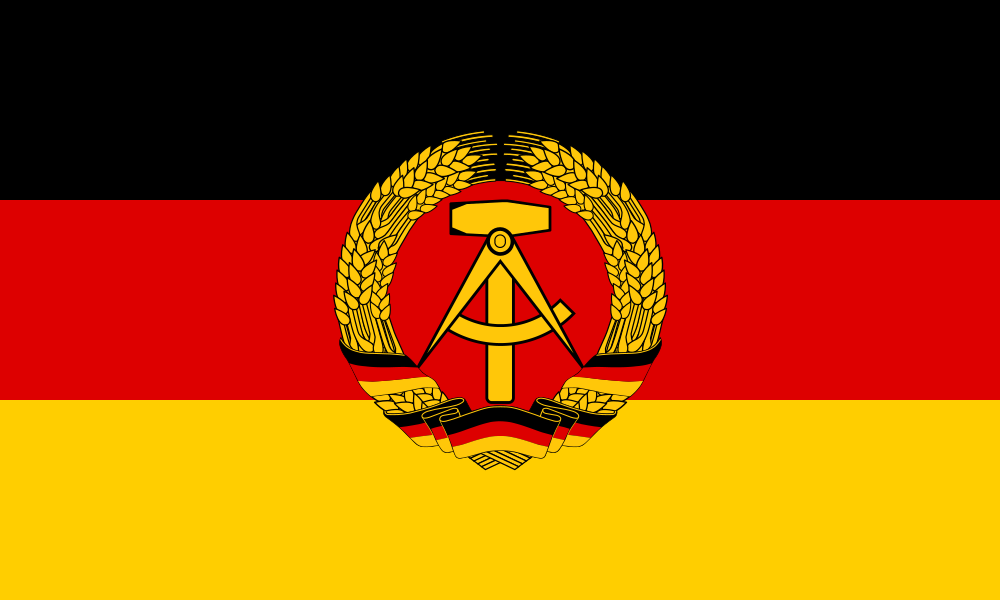
From border controller to the officer who ordered the Wall opened
“That’s why I gave my people the order: Open the barrier!”
Harald Jäger was a border-control officer who served the East German Ministry for State Security, enforcing the state’s travel controls and intelligence work. On 9 November 1989, without clear direction from his superiors, he faced a growing crowd and the danger of violence at Bornholmer Straße. He belonged to the machinery of control, yet that night he ordered the barrier opened, allowing thousands of East German citizens into West Berlin. He later acknowledged both the GDR’s inner contradictions and the freedom brought by the Wall’s fall.
Career timeline
1943Born in Bautzen
1961Volunteered for the German Border Police
1964–1989Served in the Ministry for State Security passport-control units
1976–1981Studied at the Stasi Law College and earned a law degree
1989Deputy commander at the Bornholmer Straße crossing
1989.11.09Ordered the Bornholmer Straße barrier opened without authorization
She tried to negotiate independence through pragmatism; her resignation removed the last obstacle to the military option
She wept before her cabinet. "It seems we have failed to achieve anything. We are doomed."
Lithuania's first post-independence prime minister (1990–1991), she led the country through the most dramatic ten months of the Soviet collapse. A founding member of Sąjūdis, she rose from deputy prime minister of the Lithuanian SSR to prime minister, and as the 'Amber Lady' (a name the Western press coined after her meetings with Bush, Thatcher, and Kohl) she gave the newborn republic a diplomatic presence. Unlike the uncompromising parliamentary chairman Vytautas Landsbergis, she was a pragmatist who sought negotiated exit, but on 8 January 1991 Gorbachev refused her request for a guarantee of no military action; she resigned the next day. Five days later Soviet forces killed 14 civilians in Vilnius. She narrowly lost the 2004 presidential runoff to Valdas Adamkus and later served as agriculture minister.
Career timeline
1965–1986Instructor and docent in industrial economics, Vilnius University
1986–1988Deputy director, Agricultural Economics Research Institute, Lithuanian SSR
1989–1990Deputy chair, Council of Ministers, Lithuanian SSR
1990.03–1991.01Prime Minister of the Republic of Lithuania
The philosopher who proposed the one sentence that declared the Soviet Union dead at Belovezh
At the Belavezha hunting lodge, turning to Shushkevich and Kravchuk: 'Would you guys agree to sign a sentence which would state that the Soviet Union as the subject of international law is ceasing to exist?'
Yeltsin's closest aide and the intellectual architect of the Soviet dissolution. A Marxist philosophy teacher from the Urals, he rose through perestroika to become Yeltsin's right hand, and in September 1991 delivered the 'Burbulis Memorandum' (Gaidar's group's strategy document) to Yeltsin at his Black Sea retreat, setting Russia on a course of economic independence. That December in the Belavezha forest, he turned to Shushkevich and Kravchuk and asked, 'Would you agree to a sentence stating the USSR as a subject of international law is ceasing to exist?', and co-signed the accords that opened with those words. He became a lightning rod for criticism of the reforms and was removed by spring 1992, spending his later decades quietly as a Duma deputy and senator.
Career timeline
1973–1983Taught Marxist philosophy at Ural Polytechnic Institute
1987–1989Founded Sverdlovsk 'Discussion Podium' political club
1989–1990USSR People's Deputy; Inter-regional Deputies' Group
The dissident strategist who negotiated a peaceful transition with communist power
A revolution for a constitution, not a paradise. An anti-utopian revolution. Because utopias lead to the guillotine and the gulag.
Raised in a communist family in Warsaw, he became a dissident after his imprisonment in the 1968 political crisis. As a strategist for the Workers' Defence Committee (KOR) and Solidarity, he participated in the 1989 Round Table talks, then as the founding editor of Gazeta Wyborcza led the election campaign and proposed the 'Your President, Our Prime Minister' formula that enabled a peaceful division of power with the communists. He later withdrew from politics to remain an influential journalist and liberal democratic voice.
Career timeline
1968Imprisoned for dissident activity
1977Active in Workers' Defence Committee (KOR)
1980–1989Solidarity adviser, re-imprisoned under martial law
1989Round Table negotiator, founding editor of Gazeta Wyborcza
1989.07Proposes 'Your President, Our Prime Minister' formula
Russia's only vice president: stood with Yeltsin against the coup, then fell to Yeltsin's tanks
During the shelling of the White House on 4 October 1993, Rutskoy shouted live on radio: "If the pilots can hear me, get your combat machines up! This gang has settled in the Kremlin.… Save the perishing democracy!"
One of the last Heroes of the Soviet Union and the only vice president Russia ever had. A combat pilot who flew 485 sorties in the Su-25 over Afghanistan, was shot down twice and captured, and received the Hero of the Soviet Union title in 1988. Elected RSFSR vice president in 1991 as Yeltsin's running mate, he helped organize the White House defense during the August coup, delivered a letter to Lukyanov demanding a medical examination of Gorbachev, and persuaded Patriarch Alexy II to declare the Church's support for Yeltsin. He later broke with Yeltsin over economic policy and power concentration, sided with the parliament, and was proclaimed acting president during the 1993 constitutional crisis before being arrested when tanks shelled the White House.
Career timeline
1971Graduated from Barnaul Higher Military Aviation School
1980Graduated from Gagarin Air Force Academy
1985–1988Afghanistan: commander, 378th Independent Attack Aviation Regiment; deputy commander, 40th Army Air Force
1988Awarded Hero of the Soviet Union
1990RSFSR People's Deputy, member of the Supreme Soviet
1990Graduated with distinction from the General Staff Academy
1991.07–1993.10Vice President of the RSFSR/Russian Federation
1993.09–10Proclaimed acting president by parliament; arrested
Architect of Poland's shock therapy and symbol of the post-communist transition
One should be prepared for the window of opportunity by pursuing what appears to be a useless hobby.
Architect of Poland's shock therapy. Appointed finance minister and deputy prime minister in the Mazowiecki government in 1989, he led the 'Balcerowicz Plan': rapid stabilization, price liberalization, and currency convertibility that made Poland the first Eastern Bloc country to undergo radical market reform. The plan tamed hyperinflation and set Poland on a path to become one of Europe's fastest-growing economies, but it also brought a 20% drop in GDP, mass unemployment, and fierce social backlash epitomized by the slogan 'Balcerowicz must go', making him the emblematic figure of the gap between what 1989 promised and what it delivered.
Career timeline
1970Graduates with distinction, SGH Warsaw School of Economics
1978–1980Researcher at Institute of Marxism-Leninism; leads informal reform team
1980sEconomic adviser to Solidarity
1989–1991Deputy PM & Finance Minister; launches the Balcerowicz Plan
1995–2000Chairman, Freedom Union party
1997–2000Deputy PM & Finance Minister (second term)
2001–2007Chairman, National Bank of Poland
2007–presentFounds and chairs the Civil Development Forum (FOR)
Hungary's reform premier who opened a gate in 1989
Hungary's border opening accelerated the East European chain of events leading to the fall of the Berlin Wall.
An economic-policy figure in Hungary's ruling party, he became the last prime minister of the Hungarian People's Republic in late 1988. As part of the reform leadership he pursued political and economic transition, and allowed East Germans to cross the Austrian border in 1989.
Career timeline
1988–1990Last prime minister of the Hungarian People's Republic
1989Allows East Germans to cross the Austrian border
1989–1990Leads government during the transition to multiparty politics
The Solidarity strategist who planned the 1980 Gdańsk strike, shaped the 21 Demands, and co-founded the MKS
In the Lenin Shipyard, in the course of implementing Lenin's theory, we folded up Marxism-Leninism.
He was the principal organiser of the August 1980 strike at the Gdańsk Lenin Shipyard: he drew up the strike plan, grouped and ranked the Twenty-One Demands, and co-founded the Inter-Enterprise Strike Committee (MKS), making him the architect of the event that gave birth to Solidarity. When martial law was declared in December 1981, he evaded internment and spent more than four years underground rebuilding Solidarity's clandestine networks, once attending his daughter's baptism disguised as a woman. Arrested in 1986 and released under amnesty, he later served as a member of parliament, Deputy Interior Minister, and Marshal of the Senate; in July 2010 he made Polish history as the shortest-serving acting president, holding the office for only a few hours.
Career timeline
1968Arrested for distributing protest fliers, sentenced to 3 years, amnestied 1969
1977–1978Co-organiser, Free Trade Unions of the Coast (WZZ)
A commissioning engineer caught in the Chernobyl disaster
Colleagues carried him from the ruined instrument room, but he never regained consciousness and died at 6 a.m. in the Pripyat hospital.
Vladimir Shashenok was a technician who commissioned and tested instrumentation and automation systems at nuclear power plants. While taking part in tests at Chernobyl Unit 4, he suffered spinal and rib fractures and severe thermal and radiation burns in the explosion; colleagues rescued him and carried him to the Pripyat hospital, where he died without regaining consciousness. He was one of the two people who died on the day of the disaster, marking how technical work at the plant placed ordinary workers at its immediate front line.
Career timeline
1970Graduated from Konotop Industrial Technical School
1970–1980Technical work in industrial and nuclear installations
1980–1984Instrumentation and automation commissioning and testing technician, Chernobyl Nuclear Power Plant
1984–1986Commissioning and testing technician, Smolenskatomenergonaladka
1986Died in the disaster while supporting tests at Chernobyl Unit 4
The shipyard nurse who, when the regime declared the strike over, held workers back and turned it into a solidarity strike
"You betrayed them. Now the authorities will crush us like bedbugs." To Wałęsa, the moment he declared the strike over.
A nurse at the Gdańsk Lenin Shipyard, she joined the founding of the Free Trade Unions of the Coast (WZZ) in 1978 and wrote for its underground paper The Coastal Worker on workplace safety and occupational disease, becoming one of the most determined opposition activists on the Baltic coast. On 16 August 1980, after management granted pay rises and Wałęsa declared the strike over, Pienkowska and Anna Walentynowicz physically blocked the shipyard gates and appealed to workers not to abandon the other factories that had joined them in solidarity, turning a local settlement into a movement-wide solidarity strike. Her intervention made the Inter-Enterprise Strike Committee (MKS) possible; she drafted demand number 16 on healthcare reform among the Twenty-One Demands and became a signatory of the Gdańsk Agreement on 31 August.
Career timeline
1978Co-founded WZZ, edited underground paper Robotnik Wybrzeża
1980.08.14–16Shipyard strike: handled external communications, decisive role in continuing the strike
1980.08.17–31MKS Presidium member, co-drafted 21 Demands, signed Gdańsk Agreement
1980–1981National chair, Solidarity Health Service Section
1981.12–1982.07Interned under martial law
1982–1989Underground Solidarity work, aid to victims of repression
Architect of the 500 Days Program: perestroika economist who drafted a rapid transition from planned economy to market
During coal-mine research in the 1970s, a collapse trapped him and four workers waist-deep in ice water for ten hours. Three died in hospital after rescue. Yavlinsky later recalled: "We were saved, but three out of five died in hospital."
Soviet economist and politician from Lviv. After graduating from the Plekhanov Institute and researching coal-mine labour, he became head of the Joint Economic Department of the USSR Council of Ministers in 1989 under Leonid Abalkin. In 1990, with Mikhail Zadornov and Aleksei Mikhailov, he authored the 500 Days Program (a roadmap for transitioning from a planned to a market economy in under two years) and was appointed Deputy Chairman of the RSFSR Council of Ministers. When Gorbachev compromised with Nikolai Ryzhkov's alternative, Yavlinsky resigned in October 1990; he founded the EPICenter think tank and later launched Yabloko in 1993, becoming a fixture of Russia's liberal opposition.
Career timeline
1976–1980Researcher, All-Union Coal Industry Management Research Institute (VNIUUgol)
1980–1989Sector head for heavy industry → deputy head of consolidated department → head of social development and population, State Committee for Labour and Social Affairs
1989–1990Head, Joint Economic Department, USSR Council of Ministers
1990.07–11Deputy Chairman, RSFSR Council of Ministers; Chairman, State Commission for Economic Reform
1991.08–12Deputy Chairman, USSR Committee for Operational Management of the National Economy (vice-premier rank)
1991.10–12Member, Political Consultative Council under the President of the USSR
1990–1993Founder and director, EPICenter for Economic and Political Research
The journalist who saved the Daugava River and led the Latvian Popular Front
'Standing up for the Daugava meant the same thing as standing up for an independent Latvia. The fight against the Daugavpils HPP was the start of our revolution.'
A Latvian journalist and politician. In 1986, his article in Literatūra un Māksla, co-written with Arturs Snips, sparked public opposition to the Daugavpils hydroelectric dam; the campaign gathered 30,000 signatures and forced the Soviet Council of Ministers to halt construction in 1987. At the founding congress of the Latvian Popular Front in October 1988 he was elected its first chairman, turning a mass movement born of environmental protest toward the political goal of restoring independence. He served as deputy speaker of the Supreme Council after the Front's 1990 electoral victory, resigned in 1992 and returned to journalism, later leading the Latvian Social Democratic Workers' Party and serving on the Riga City Council.
Career timeline
1979Began journalism, theatre and literary criticism
1986Published 'Thinking about the fate of the Daugava,' sparking anti-dam campaign. Named Most Popular Journalist
1988–1990Chairman of the Latvian Popular Front
1990–1992Deputy Speaker of the Supreme Council of Latvia
1992–1998Commentator and culture editor at Neatkarīgā Cīņa and other papers
2002–2005Chairman of the Latvian Social Democratic Workers' Party
Estonian former political prisoner who survived the Soviet camps and co-organized the first open rally of the Baltic independence movement
The Hirvepark demonstration, Ahonen said, 'broke open the path for the expression of opinion,' an historic turn he called 'the icebreaker effect.'
Heiki Ahonen was born in 1956 in Pärnu, Estonia. His grandfather was shot by the NKVD, his father imprisoned in the camps, and his mother deported to Siberia: every member of his family was repressed. Joining the underground resistance in 1977, he distributed samizdat and fed information on Soviet human rights violations to Western journalists; convicted of anti-Soviet agitation in 1983, he served five years in the Perm labour camps. Released in early 1987, he co-organised the Hirvepark rally that August, the first open mass demonstration demanding disclosure of the Nazi-Soviet pact's secret protocols, breaking the dam for the Baltic independence movement; then was forcibly expelled by the KGB, spent a decade in exile, and came home as the founding director of the Museum of Occupations.
Career timeline
1977–1983Underground resistance, samizdat distribution, human rights documentation
1983–1987Five years in Perm labour camps (anti-Soviet agitation)
1987.08Co-founder of MRP-AEG, co-organiser of Hirvepark rally
1988.01Co-founder, Estonian National Independence Party (ERSP)
1988–1989Deputy chairman, Help Center for Estonian Political Prisoners (Stockholm)
1989–1998Director of Estonian service, Radio Free Europe (Munich/Prague)
2003–2012Founding director, Museum of Occupations, Tallinn
Architect of shock therapy, the economist who dismantled the planned economy and laid the first stones of Russian capitalism
3 October 1993, live on television: "At this hour we cannot rely only on police and security forces. Muscovites, all Russians who cherish democracy and freedom, gather at the Mossovet building!" — thousands poured into the streets.
Grandson of writers Arkady Gaidar and Pavel Bazhov. After Moscow State University, he edited the economic sections of Kommunist and Pravda, arguing for market reform from within the party press. In November 1991 he became Yeltsin's Deputy PM and Minister of Economy and Finance; on 2 January 1992 he liberalised prices and launched privatisation, converting the Soviet planned economy into a market system. He served as Acting PM (June–December 1992) and during the 1993 constitutional crisis went on live television to call Muscovites into the streets. His reforms averted famine and collapse but wiped out millions' savings, a legacy that remains Russia's most polarising policy debate.
Career timeline
1978–1987Researcher at VNIISI and Academy of Sciences forecasting institute
1987–1990Editor of economic policy section, Kommunist journal
1990Head of economics at Pravda; founded the Institute for Economic Policy
1991.11–1992.03Deputy PM, Minister of Economy and Finance, then Finance Minister of Russia
1992.03–12First Deputy PM; Acting Prime Minister June–December 1992
1993.09–1994.01First Deputy PM and acting Economy Minister; TV appeal during October crisis
1993–1995State Duma deputy; leader of Choice of Russia faction
1994–2001Leader of Democratic Choice of Russia; co-chair of Union of Right Forces
1999–2003State Duma deputy; drove tax and budget-code legislation
1992–2009Director, Institute for the Economy in Transition (Gaidar Institute)
The shipyard worker who helped launch independent unionism
“We had been preparing for the strike for seven days, and the day came when it had to begin here in the shipyard.”
Jerzy Borowczak was a young Gdańsk shipyard worker who helped open the way to Poland's independent trade-union movement in 1980. With Bogdan Felski and Ludwik Prądzyński, he launched the strike on 14 August, demanding Anna Walentynowicz's reinstatement, higher wages, and a memorial to the victims of 1970. He continued resisting after martial law, enduring internment and dismissal before returning to the shipyard in 1989.
Career timeline
1977Graduated from the Gdańsk Shipbuilding Technical School
1979Worker at Gdańsk Shipyard and collaborator with the Free Trade Unions of the Coast
1980Launched the August strike with Bogdan Felski and Ludwik Prądzyński
1980–1981Founding member and deputy chair of the Solidarność shipyard committee
1981–1982Resisted martial law and was interned at Iława
1982–1989Worked for the Świetlik high-altitude work cooperative after dismissal
1989–1993Returned to the shipyard and chaired its Solidarność committee
2000–2023Member of the Polish Sejm and director of the Gdańsk Solidarity Centre Foundation