Minister of Communications Equipment Industry who oversaw Soviet military C3 infrastructure
At an April 1976 exhibition of the Ministry of Electronics Industry, fellow minister Valentin Proleyko noted: "He was stung that his own work was falling behind, caustic at every opportunity, and interested only in lodging complaints."
A communications engineer who began on Siberian installation sites, from 1974 to 1989 he spent fifteen years as USSR Minister of the Communications Equipment Industry, overseeing the secure communications, radio-relay, and radar equipment that formed the backbone of Soviet military command, control, and communications (C3). Moving to Minister of Communications in 1989, he pursued a unified network, and after the Soviet collapse he led Russian telecom firms through privatization.
Career timeline
1955–1957Engineer, Tomsk installation section, Design and Assembly Trust No. 5
1957–1959Head, Krasnoyarsk installation section, Design and Assembly Trust No. 5
1959–1961Deputy Chief Engineer, Design and Assembly Trust No. 5, Moscow
1965–1969Administrator, All-Union Design and Assembly Trust, USSR Ministry of the Radio Industry
1970–1974Deputy Minister of the Radio Industry of the USSR
1974–1989Minister of the Communications Equipment Industry of the USSR
The operator who ran Soviet machine-building and organized post-Soviet capital
During the August 1991 coup, Volsky got through to Gorbachev under house arrest and then told the world that the plotters' claim — that the Soviet leader was too ill to govern — was a lie.
He was the Central Committee Machine-Building Department head, economic aide to Andropov and Chernenko, and the figure who personified the transition from late-Soviet industrial management to post-Soviet business lobbying. As founder and 15-year president of the Russian Union of Industrialists and Entrepreneurs (RSPP), he turned the 'red directors' into an organized lobbying force that shaped the terms of Russia's market transition. During the August 1991 coup, he contacted Gorbachev under house arrest and publicly contradicted the plotters' claim that the Soviet leader was incapacitated by illness. He also served as Moscow's special administrator in Nagorno-Karabakh (1988–1990), deputy head of the Chechen peace mission (1995), and spent three months at Chernobyl in 1986 directing the industrial side of the disaster response.
Career timeline
1955–1969ZIL auto plant: assistant foreman → head of foundry → party committee secretary
1969–1983CC Machine-Building Dept: auto sector head → deputy head → first deputy head
1983–1984Economic aide to General Secretary Andropov
1984–1985Economic aide to General Secretary Chernenko
1985–1990Head of CC Machine-Building Department
1988–1990Chairman, Special Administration Committee for Nagorno-Karabakh
1990–2005President, Russian Union of Industrialists and Entrepreneurs (RSPP)
1991.08–12Deputy PM of the USSR (industry and military complex)
The deputy defence minister who, at Tbilisi, pushed for force without waiting for the Politburo
"A decision must be adopted here on the scene": to the Georgian Defence Council, Tbilisi, 8 April 1989
A career officer who rose from Suvorov military school to the top of the Soviet Army, Kochetov was promoted to Army General in 1988 and appointed First Deputy Minister of Defence in January 1989. That April he was dispatched to Tbilisi, where he told the Georgian Defence Council that 'the magnitude of the crisis is not fully appreciated in Moscow' and that 'a decision must be adopted here on the scene,' opening the path to the use of force without Politburo clearance. The crackdown on 9 April killed 21 people, and subsequent documentary research established that Kochetov was acting on Yazov's instructions and that Gorbachev had not been informed in advance.
Career timeline
1952Graduated Lvov Infantry School; platoon and company commander, GSVG
1965Graduated Frunze Military Academy; regimental commander, North Caucasus MD
1973Graduated General Staff Academy; commander, 24th 'Iron' Division
1977–1979Commander, 7th Guards Army
1982–1985Commander, Southern Group of Forces (Hungary)
1985–1988Commander, Transcaucasus Military District
The last leader of Armenia's Communist Party before the Soviet collapse
In late 1990, he led Armenia's Communist Party while the political foundations of its rule were already shaking.
Stepan Pogosyan was an Armenian Communist Party politician and historian who spent much of his career directing mass media and publishing in Soviet Armenia. He represented a party leadership whose state base and political influence were weakening as the socialist system came apart. From late 1990 to 1991, he served as First Secretary of the Communist Party of Armenia and as a member of the CPSU Central Committee Politburo, then retired from political work.
Career timeline
1955–1958Secretary of the Komsomol committee at Yerevan State University
1958–1962Official of the Armenian Komsomol Central Committee, then First Secretary of Yerevan's Komsomol committee
1962–1967Secretary and First Secretary of the Armenian Komsomol Central Committee
1967–1970First Secretary of the Ararat district party committee
1970–1988Chairman of the Armenian SSR State Committee for Television and Radio
1988–1990Director of the Armenian SSR Council of Ministers' information agency, then Chairman of the State Committee for Publishing
1990–1991First Secretary of the Central Committee of the Communist Party of Armenia and member of the CPSU Central Committee Politburo
The last Communist leader of Tajikistan in the Soviet era
Resigning in August 1991, he told the deputies "I will go, but you will regret it," later calling politics "the dirtiest thing in the world."
Qahhor Mahkamov was a mining engineer turned Tajik Communist official who spent decades directing economic planning and republican administration. As perestroika widened national self-awareness and political conflict, he pursued reform within the Soviet framework but faced growing public distrust and nationalist pressure. He became Tajikistan’s first president in 1990, then resigned in 1991 after backing the failed August coup in Moscow. His career shows both the institutional continuity of a Soviet republic and the political limits exposed by its dissolution.
Career timeline
1953Began work as an engineer at the Shurab coal mine
1963–1982Chairman of the Tajik SSR State Planning Committee and deputy chairman of its Council of Ministers
1982–1986Chairman of the Council of Ministers of the Tajik SSR
1985–1991First Secretary of the Communist Party of Tajikistan and member of the CPSU Central Committee
1990Chairman of the Presidium of the Supreme Soviet of the Tajik SSR
1990–1991First President of Tajikistan
2000–2016Lifetime member of Tajikistan’s National Assembly
Last surviving GKChP member who led the Soviet space industry
In 1991 I stood up for the defense of our state.
A technocrat who rose from mounter at the Kharkov instrument plant to Minister of General Machine-Building, overseeing the entire Soviet rocket and space industry, and led the Energia–Buran reusable spacecraft programme, the last great project of Soviet spaceflight. In 1988 he became CC CPSU Secretary for Defence Industry, directing the Party's military-industrial policy, and in August 1991 he joined the eight-member State Committee on the State of Emergency (GKChP) in a failed attempt to prevent the USSR's dissolution, for which he was imprisoned for a year and a half. At his death in 2021 he was the GKChP's last survivor.
Career timeline
1950–1962Mounter and radio-equipment tuner at Kharkov Instrument-Engineering Plant
From Soviet economic planner to independent Ukraine’s first prime minister
In 2016, the man who had signed away the USSR revealed his own grief: 'As a man, I'm ashamed to admit it, but when Crimea was annexed, I cried like a child.'
Vitold Fokin was a Ukrainian Soviet economic official who began as a mining engineer and experienced both the operation of a planned economy and the pressures of state transformation. He led Ukraine’s government around independence while confronting economic crisis and the collapse of the Union. In December 1991, he signed the Belovezha Accords for Ukraine alongside Leonid Kravchuk, helping establish the post-Soviet order. Late in life, his controversial positions in the Donbas negotiations ended his public role.
Career timeline
1954–1963Mining engineer and manager in the Luhansk region
1963–1971Manager in the Donbas anthracite industry
1971–1987Department head and deputy chair of Ukraine’s State Planning Committee
1987–1990Deputy chair of Ukraine’s Council of Ministers and head of the State Planning Committee
1990–1991Chair of the Council of Ministers of the Ukrainian SSR
1991–1992First prime minister of Ukraine
1991Ukrainian signatory of the Belovezha Accords
2020First deputy head of Ukraine’s delegation to the Trilateral Contact Group
In 1988, after testifying on the INF treaty before the Soviet parliament, Bessmertnykh lingered in a Kremlin corridor to chat with an American journalist in easy English about the treaty's political significance — informality unusual for a top Soviet official.
A career diplomat and the first MGIMO graduate to head the Soviet Foreign Ministry, Bessmertnykh succeeded Shevardnadze in January 1991. A seasoned Americanist shaped by thirteen years at the Soviet embassy in Washington, he oversaw the signing of the START I treaty, laid groundwork for the Madrid Middle East peace conference, and became the first Soviet foreign minister to visit Israel. He advanced a 'belt of friendship and cooperation' concept to reorient Soviet diplomacy toward all perimeter states. Refusing to join the GKChP during the August 1991 coup but declining to publicly condemn it, he was dismissed within days. He later founded Russia's Foreign Policy Association and continued as an analyst.
The Marxist revolutionary who overthrew Portuguese colonial rule and led Mozambique to independence
“The liberation of Africa is the liberation of the continent, or it is nothing.”
Mozambique's independence leader and first president. As FRELIMO chairman, he waged armed struggle to end Portuguese colonial rule and built a socialist state. A crucial ally of liberation movements against Rhodesia and South African apartheid.
Career timeline
1963Exiled to Tanzania, joins FRELIMO; guerrilla training in Algeria
1966FRELIMO Secretary for Defense
1968Commander-in-chief of the Mozambican liberation army
1970Becomes FRELIMO President; adopts Marxism-Leninism as party ideology
1974Negotiates independence with Portugal's new government — Lusaka Accord
1975–1986First President of the People's Republic of Mozambique
1984Signs the Nkomati non-aggression pact with South Africa
1986.10Killed in plane crash at Mbuzini, South Africa, returning from Zambia
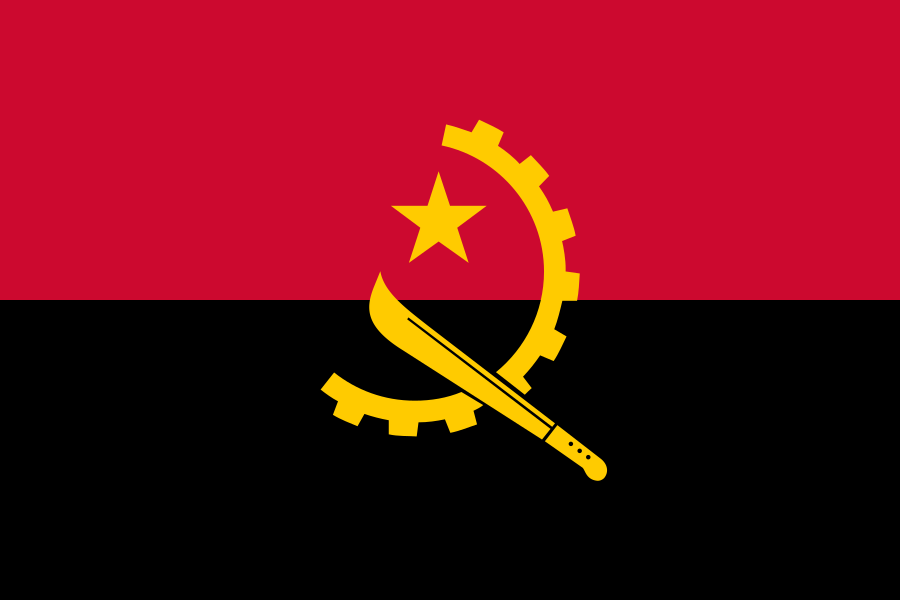
Founder of Angola's People's Armed Forces and its first Defence Minister
After the October 1976 plenum, Carreira officially declared that "for the MPLA, the only socialism that exists is the socialism of Marx, Engels and Lenin, scientific socialism."
First Defence Minister of independent Angola, founder and commander-in-chief of the People's Armed Forces (FAPLA), and the MPLA's military strategist second only to Agostinho Neto. After the October 1976 Central Committee plenum he officially declared that 'for the MPLA, the only socialism that exists is the socialism of Marx, Engels and Lenin, scientific socialism,' marking the party's adoption of Marxism-Leninism. He directed the suppression of the 1977 Nitista uprising and its military tribunals, but lost power after Neto's death in 1979 and spent his last years denouncing Angola's 'savage capitalism.'
Career timeline
1957Joined the independence movement
1961Deserted the Portuguese army, joined the MPLA
1971Secretary-General of the MPLA
1975–1980First Defence Minister of the People's Republic of Angola
1982Graduated from the Voroshilov General Staff Academy, first African officer to earn a general's diploma
1983–1986Commander of the People's Air Force of Angola
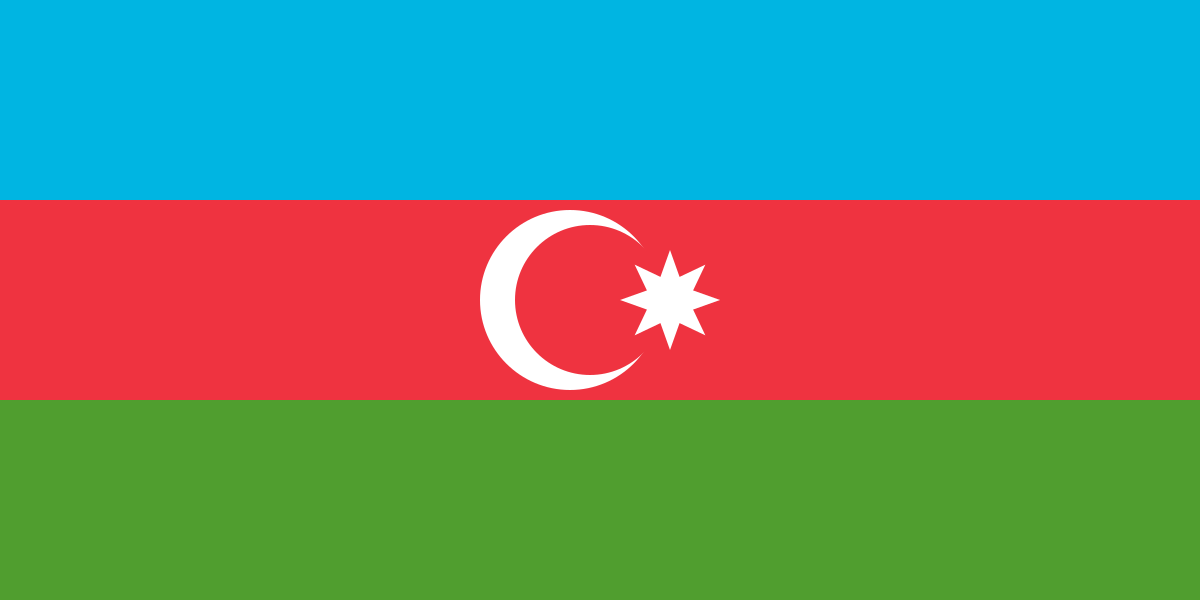
Heydar Aliyev's successor who crumbled before the Karabakh crisis
In connection with the events that occurred in Nagorno-Karabakh and Sumgait, I recognize that I morally have no right to lead the party organization of the republic.
First Secretary of the Azerbaijan Communist Party (1982–1988), appointed after Heydar Aliyev was promoted to Moscow. Personally honest but politically inert, he proved unable to manage the cascading crises of February 1988, when the Nagorno-Karabakh Autonomous Oblast soviet voted for transfer to Armenia and the Sumgait pogrom erupted days later. Distrusted by Gorbachev, he resigned in May declaring that he 'morally had no right to lead the republic's party organization,' and withdrew entirely from public life thereafter.
Career timeline
1949Mechanic, Baku gas office
1957Graduated Azerbaijan Polytechnic Institute; assistant, senior lecturer, deputy dean of construction
1968–1971Deputy Head, Construction and Public Utilities Dept, Council of Ministers, Azerbaijan SSR
1971–1974Head, Construction and Urban Economy Dept, CC Azerbaijan CP
1974–1978First Secretary, Sumgait City Party Committee
1978–1982Secretary, CC Azerbaijan CP
1982–1988First Secretary, CC Azerbaijan CP
1990–1992Chairman, State Committee for Industrial Safety and Mining Control, Azerbaijan
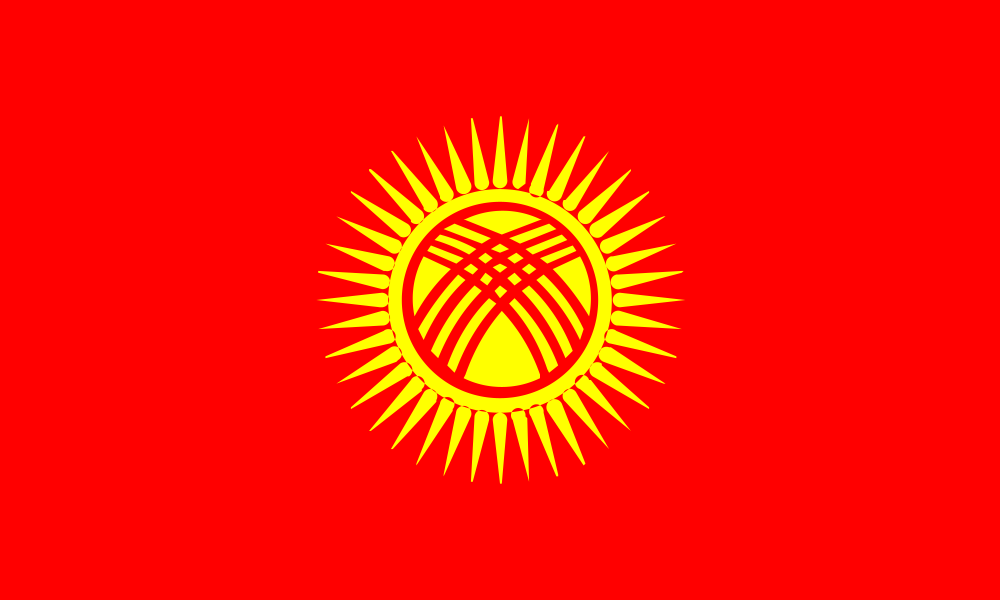
At the presidential selection in the Supreme Soviet on 25 October 1990, neither he nor Apas Jumagulov won a majority, and Akayev was chosen first president on 27 October. In the 1995 election he lost to Akayev, 71.6 to 24.4 percent.
Kyrgyz Soviet party and state leader, born on 10 April 1933 in Alysh, Osh oblast, died on 31 July 2004 in Bishkek. A mining engineer trained at Kyzyl-Kiya and in Moscow, he began work in 1956 at the Kyzyl-Kiya coal administration and rose through party bodies. Elected first secretary of the Communist Party of Kirghizia on 2 November 1985, he held the post to 6 April 1991, was a member of the CPSU Central Committee from 1986 to 1991 and of the CPSU Politburo from 14 July 1990 to 25 April 1991. Chairman of the Supreme Soviet of the Kirghiz SSR in 1990, he lost the presidential selection to Akayev and the 1995 election. From September 1992 until 2004 he led the Party of Communists of Kyrgyzstan. Sources differ on the death date, 31 July or 1 August.
Career timeline
1956–1961Assistant chief engineer at the Komsomolskaya mine of the Kyzyl-Kiya coal administration, then assistant chief engineer of the Kirghizugol trust
1961–1973Instructor of the Osh regional party committee, student at the Alma-Ata higher party school, party-state control posts, head of the Osh regional party department for industry and transport, deputy head of a Central Committee department, first secretary of the Tash-Kumyr city party committee
1972–1974Chairman of the Frunze City Executive Committee
1974–1979Secretary of the Central Committee of the Communist Party of Kirghizia
1979–1985First Secretary of the Issyk-Kul Regional Party Committee
1985–1991First Secretary of the Central Committee of the Communist Party of Kirghizia (elected 2 November 1985 at the 21st plenum; released 6 April 1991 to move to the CPSU Central Committee apparatus). Member of the CPSU Central Committee 1986–1991 and of the CPSU Politburo from 14 July 1990 to 25 April 1991
1990Chairman of the Supreme Soviet of the Kirghiz SSR (elected 10 April 1990 at the first session of the 12th-convocation Supreme Soviet, released at his own request on 10 December 1990)
1991Consultant to the ideological department of the CPSU Central Committee (April–August 1991)
1992–2004Leader of the Party of Communists of Kyrgyzstan from September 1992; chairman of its central control commission and a member and deputy chairman of the executive council of the Union of Communist Parties–CPSU
1993–1996Director of the State Inspectorate for industrial safety and mining supervision (January 1993–June 1996)
1994–2004Chairman of the I. Razzakov Foundation from 1994
1995–2004Deputy of the Assembly of People's Representatives of the Zhogorku Kenesh (elected April 1995, re-elected April 2000); from 2000 a deputy of the Legislative Assembly
The last Communist Party first secretary of Soviet Armenia
He left the CPSU Politburo because the Nagorno-Karabakh question remained unresolved.
Vladimir Movsisyan was a politician who rose through the agricultural and party administration of Soviet Armenia. In 1990 he became first secretary of the republic’s Communist Party and a member of the CPSU Politburo, but left the Politburo after the Nagorno-Karabakh question remained unresolved. After the Soviet collapse, he remained involved in refugee administration, defence, and agricultural policy, helping shape the institutions of independent Armenia.
Career timeline
1958–1965Chief veterinarian in several districts of the Armenian SSR
1969–1973First secretary of the Artashat district party committee
1975–1978Head of the Agriculture Department of the Communist Party of Armenia
1984–1990First deputy chairman of the Council of Ministers of the Armenian SSR
1990First secretary of the Communist Party of Armenia and member of the CPSU Politburo
1991Deputy Minister of Agriculture and Food of the USSR
Asked in 2005 to change the constitution for a third term, he answered, "If you don't leave power, power will leave you."
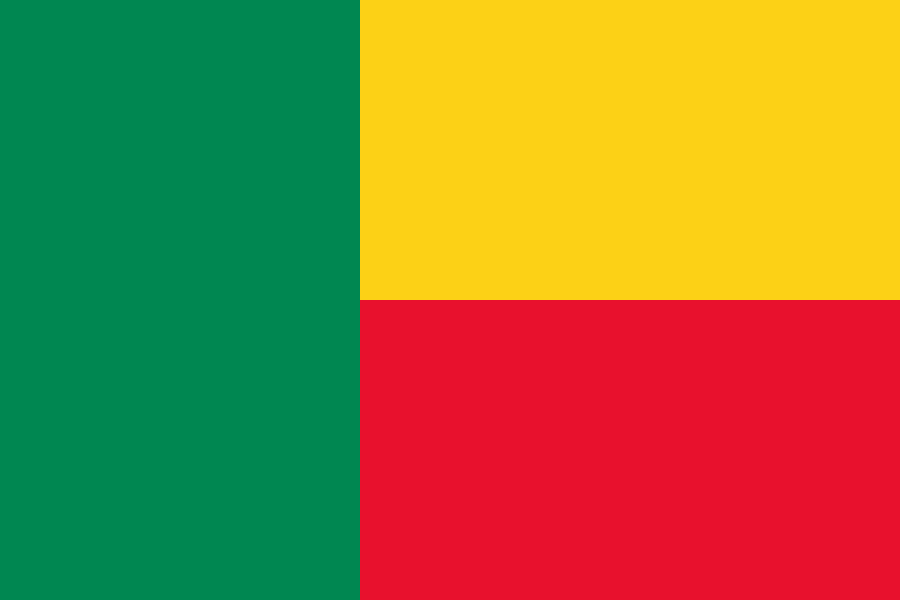
Beninese leader who took power in the 1972 coup. He declared Marxism-Leninism in 1974 and established a people’s republic the following year. Amid economic crisis he accepted the 1990 National Conference’s transition and transferred power after losing to Soglo in 1991.
Career timeline
1961Aide-de-camp to President Hubert Maga
1967Chairman of the Military Revolutionary Council
1972Seized power in a military coup
1974Declared Marxism-Leninism the state ideology
1975Founded the People's Republic of Benin and a one-party state
The reformist Politburo member who called 1956 a 'popular uprising' and dismantled his own party's orthodoxy
In West Berlin he said the East German 'anti-fascist protective rampart' was a 'disgrace' that had to come down.
A reformist member of the Hungarian Socialist Workers' Party (MSZMP) Politburo and the ideological patron of the reformers. On 28 January 1989 he told radio listeners that the 1956 Hungarian Revolution was a 'popular uprising,' demolishing the party's foundational lie; in May that year, in West Berlin, he called the Berlin Wall a 'disgrace.' Together with Otto von Habsburg he sponsored the Pan-European Picnic in August 1989, opening the first crack in the Iron Curtain, and later stood as the Socialist Party's presidential candidate but was defeated.
Career timeline
1950Joined the Hungarian Working People's Party
1957–1969Agitprop head and secretary, Bács-Kiskun County committee
1976–1980Minister of Culture
1980–1982Minister of Education
1982–1988Secretary-General, Patriotic People's Front
1988–1989MSZMP Politburo member and Minister of State
1989.01Declared the 1956 Revolution a 'popular uprising'
1990MSZP Deputy President and presidential candidate; defeated
The last Komsomol heavyweight who ran the Soviet publishing empire
The day after Yegorychev openly criticised Brezhnev's defence policy at the 1967 CC plenum, Pastukhov called him: "I'm proud of you." Yegorychev replied: "Borya, why did you do that? You've ruined your life."
A Soviet functionary who led the Komsomol as First Secretary from 1977 to 1982, heading the 40-million-strong youth organisation at the height of the Brezhnev era. He oversaw massive youth mobilisation (the BAM railway, the first ski expedition to the North Pole) and became a full member of the CPSU Central Committee in 1978. As chairman of Goskomizdat (1982–1986) he ran the Soviet publishing and censorship apparatus, then served as ambassador to Denmark and to Afghanistan during the withdrawal and its aftermath. After the Soviet collapse he continued as Russian First Deputy Foreign Minister, CIS Affairs Minister, and State Duma deputy, embodying the late Soviet elite's continuity into post-Soviet governance.
Career timeline
1958Graduated Bauman Moscow Higher Technical School (mechanical engineering); 2nd Secretary, Bauman District Komsomol
1959–1961First Secretary, Bauman District Komsomol, Moscow
1961–1962Second Secretary, Moscow City Komsomol Committee
1962–1964First Secretary, Moscow City Komsomol Committee
1964–1977Secretary, Komsomol Central Committee
1977–1982First Secretary, Komsomol Central Committee
1982–1986Chairman, USSR State Committee for Publishing, Printing and Book Trade (Goskomizdat)
1986–1989Ambassador of the USSR to Denmark
1989–1992Ambassador of the USSR/Russia to Afghanistan
1992–1996Deputy Minister of Foreign Affairs, Russian Federation
1996–1998First Deputy Minister of Foreign Affairs, Russian Federation
1998–1999Minister for CIS Affairs, Russian Federation
A Belarusian party organizer who sought continuity as the Union dissolved
After the 1991 coup failed, he called the State Committee's formation “a crime against the party.”
Anatoly Malofeyev was a Soviet and Belarusian politician who rose from industrial work through party administration to republican leadership. In the final years of perestroika, he led Belarus's Communist Party with a record of regional administration and a union-preserving party line, and supported the State Committee on the State of Emergency in 1991. After the coup's defeat, he sought to preserve the party organization and later worked in the parliamentary politics of independent Belarus.
Career timeline
1933Born in Gomel
1949–1952Mechanic at railway-car repair plants in Gomel and Minsk
1952–1956Served in the Soviet Navy
1962–1975Worked in Gomel and Mozyr party organizations, becoming Mozyr city first secretary and a Gomel regional party secretary
1978–1985Chairman of the Gomel regional executive committee and first secretary of the Communist Party of Belarus regional committee
1985–1990First secretary of the Communist Party of Belarus Minsk regional committee
1990–1991First secretary of the Communist Party of Belarus Central Committee and member of the CPSU Politburo
1996–2000First chairman of the House of Representatives of Belarus's National Assembly
Nuclear industry minister who inherited Sredmash in the shadow of Chernobyl
Ryabev later recalled: 'I was in Chernobyl from 2 May and worked there more than a month. All that time I felt something terrible, heavy for all of us had happened — and pain and resentment at what had occurred.'
A physicist from Vologda who trained at MIFI and began his career at the secret nuclear weapons institute VNIIEF in Sarov. As director of VNIIEF from 1974, he led development of new nuclear warheads before moving to the Central Committee's Defense Industry Department to oversee the entire medium machine-building sector. In November 1986, in the immediate aftermath of Chernobyl, he succeeded Yefim Slavsky as Minister of Medium Machine-Building, taking command of the entire Soviet nuclear weapons and atomic energy complex. He later served as Deputy Chairman of the USSR Council of Ministers with responsibility for the fuel and energy complex. After the Soviet collapse, as First Deputy Minister of Atomic Energy of the Russian Federation, he helped preserve the nuclear weapons complex and devoted himself to the multi-volume documentary history of the Soviet atomic project.
Career timeline
1957–1963Engineer, senior engineer at VNIIEF (KB-11), Sarov
1963–19672nd Secretary, Kremlyov City Party Committee
1967–1969Deputy chief engineer for production, VNIIEF
1974–1978Director, VNIIEF
1978–1984Head of medium machine-building sector, Defense Industry Dept., CC CPSU
1984–1986Deputy, then 1st Deputy Minister of Medium Machine-Building
1986–1989Minister of Medium Machine-Building, USSR
1989–1991Deputy Chairman, USSR Council of Ministers; Chairman, Bureau for Fuel-Energy Complex
1993–20021st Deputy Minister of Atomic Energy, Russian Federation
The most qualified female cosmonaut candidate, grounded by politics
She told Tereshkova, 'The Komsomol and the party have irreparably spoiled you,' Kamanin recorded in his diary.
A Moscow Aviation Institute graduate and the only pilot among the five women selected for the cosmonaut corps in 1962, she scored highest on her final exams, and medical director Yazdovsky ranked her first for flight. But Kamanin recorded her independent manner as 'arrogance,' her smoking and drinking as 'moral instability,' and Korolev told her a working-class woman was needed for the flight, so Tereshkova was chosen. She later trained for an all-female Voskhod mission with a spacewalk, but the program was cancelled, and she never flew.
Career timeline
1951–1957Graduated Moscow girls' school No. 156 with gold medal; Moscow Aviation Institute (liquid rocket engines)
1957–1962Assigned to OKB-1, then researcher at Academy of Sciences Applied Mathematics Division under Keldysh
1962.04Selected for women's cosmonaut group (5); enlisted in Soviet Air Force
1962–1963Vostok-6 training; highest exam score; assigned second backup to Tereshkova
1965–1966Trained for Voskhod-4 female spacewalk mission (cancelled)
1969–1988Senior researcher at Gagarin Training Center; taught orbital mechanics to cosmonauts
1988–2023Senior researcher at Institute of History of Natural Science and Technology, RAS; head of cosmonautics history group
A politician who linked internationalism with regional rule
In February 1978, during an Asia-Africa people's solidarity session in Nicosia, Black September militants took him hostage; within forty minutes everyone except the Egyptian and Palestinian delegates was released.
Alexander Dzasokhov was a Soviet party and diplomatic politician whose career grew out of youth organizations and solidarity work with Asia and Africa. After serving as ambassador to Syria and leading the North Ossetian party organization, he reached a position where international politics and the nationality question converged. At the 28th CPSU Congress he was elected to the Politburo and Central Committee Secretariat, making him part of the last Soviet leadership as reform and the Union’s dissolution intersected. He later served in the Russian State Duma and as president of the Republic of North Ossetia–Alania, where he dealt with federal relations and interethnic tensions.
Career timeline
1957First Secretary, Ordzhonikidze City Komsomol Committee
1967–1986First Secretary, then First Deputy Chair, Soviet Committee of Solidarity of Asian and African Countries
1986–1988Soviet Ambassador to Syria
1988–1990First Secretary, North Ossetian Regional Committee of the CPSU
1989–1991People’s Deputy of the USSR; Chair of the Supreme Soviet Committee on International Affairs
1990–1991Member of the CPSU Politburo and Central Committee Secretariat
1993–1998Deputy of the Russian State Duma
1998–2005President of the Republic of North Ossetia–Alania
Gagarin's second backup, the cosmonaut ranked third for the first flight who never reached orbit
On 18 February 1966, the note he left his wife before leaving home: "Zinok! You were always the best. You'd have to search to find a woman like you. Forgive me."
In January 1961 the State Commission ranked the first-flight candidates: Gagarin, Titov, Nelyubov. He was the second backup for Vostok 1 and later trained as backup for the Vostok 3/4 dual flight, but in March 1963 a clash with a military patrol at Chkalovskaya station (drunk, and refusing to apologize) cost him his place in the cosmonaut corps. Exiled to a fighter unit in the Far East, he fell into alcoholism and depression; on 18 February 1966 he stepped in front of a train, aged thirty-one. His existence was kept secret until glasnost, his image airbrushed from the 'Sochi Six' photograph and his name erased from official histories.
Career timeline
1957Graduated Yeysk Naval Aviation School; naval aviation pilot
1960.03Selected for first cosmonaut group (Vanguard Six)
Youngest KGB general turned its highest-ranking defector-critic
"I like Americans very much. But after seven months here I am convinced more than ever that the Communist system is better than yours." — 24-year-old KGB officer Kalugin, posing as a Fulbright scholar to Newsweek, 1959.
A KGB Major General who, as the youngest general in the agency's history, headed foreign counterintelligence (Directorate K) and directed Cold War espionage against the United States. He broke with the service in the late 1980s, publicly denouncing its corruption, backed Yeltsin during the 1991 coup, and emigrated to the US, where his memoirs exposed the inner workings of the KGB.
Career timeline
1952–1956KGB Foreign Languages Institute, Leningrad
1956–1958Higher Intelligence School No. 101, KGB
1958–1959Operational trainee, Columbia University under Fulbright cover
1960–1964Operative, KGB New York residency (Radio Moscow cover)
1965–1970Deputy resident / acting chief, KGB Washington residency
1971–1973Deputy head, 2nd Service (later Directorate K), First Chief Directorate
1973–1980Head, Directorate K (foreign counterintelligence), First Chief Directorate
1980–1987First deputy chief, KGB Leningrad Directorate
1990Elected People's Deputy, Supreme Soviet of the USSR
Re-entry: the capsule engulfed in 3,000-degree plasma, ten Gs pressing on his body. Inside, Gagarin whistled — Shostakovich's "The Motherland Hears, The Motherland Knows." He later wrote in his autobiography: "I sang that song the whole way down to Earth."
A collective-farm carpenter’s son circled the planet in 108 minutes on April 12, 1961: “Poyekhali!”, let’s go. In the middle of the Cold War he became the one man both camps loved. Training for a return to space, he died in a MiG crash in 1968. He was thirty-four.
Career timeline
1955–1957Air force pilot
1960Selected for the first cosmonaut group
1961.04.12Vostok 1: the first human spaceflight, 108 minutes
1961–1967World tours; deputy head of cosmonaut training
A Soviet republican leader who asserted institutional authority in crisis
“A state of emergency was declared and troops were sent in without the republic’s consent.”
Elmira Kafarova was an Azerbaijani Soviet politician and diplomat who moved through education and foreign-affairs administration before leading the republic’s Supreme Soviet. In January 1990, she publicly protested the declaration of emergency in Baku and the entry of Soviet troops, stating that the decision had been taken while she was in Moscow and without her knowledge. Her institutional dissent, unusual within the Soviet republican leadership, illuminates how the nationalities crisis became a collision among republican institutions, a mass movement, and Union power.
Career timeline
1958Graduated from Azerbaijan State University; pursued philological research
1966–1970First Secretary of the Komsomol Central Committee of the Azerbaijan SSR
1971Ideology secretary of the Baku City Party Committee
1980–1983Minister of Education of the Azerbaijan SSR
1983–1987Minister of Foreign Affairs of the Azerbaijan SSR
1987–1989Deputy Chair of the Council of Ministers of the Azerbaijan SSR
1989–1990Chair of the Presidium of the Supreme Soviet of the Azerbaijan SSR
1990–1992Chair of the Supreme Soviet of Azerbaijan