First to open the door to the cosmos, and the first to draw it from inside
"It was so quiet I could even hear my heart beat. I was surrounded by stars and was floating without much control." — the first human to walk in space, 18 March 1965.
A Siberian miner's son, Leonov became the first human to walk in space on 18 March 1965, floating outside Voskhod 2 for twelve minutes, and nearly dying when his suit ballooned so badly he had to bleed oxygen to squeeze back into the airlock. He was also the first artist in space, sketching an orbital sunrise with coloured pencils tethered together in weightlessness. A decade later, as commander of Soyuz 19, he led the Soviet half of the Apollo-Soyuz Test Project (the first US-Soviet docking in orbit) and forged a lifelong friendship with American commander Thomas Stafford. From 1976 to 1982 he served as deputy director of the Yuri Gagarin Cosmonaut Training Center and chief cosmonaut, overseeing the next generation. Twice Hero of the Soviet Union and a major general of aviation, he produced over 200 space-themed paintings across a life that fused exploration with art.
Career timeline
1957Graduated Chuguev Air Force Pilots School; fighter pilot
1959Assigned to reconnaissance regiment, Group of Soviet Forces in Germany
1960Selected to first cosmonaut group (alongside Yuri Gagarin)
1965.03.18Voskhod 2: first spacewalk in history, 12 min 9 sec
1968Selected as first Soviet Moon-landing commander; program cancelled
1971Soyuz 11 prime crew commander; replaced on medical grounds — backup crew all died on reentry
1975.07Soyuz 19 commander: Apollo-Soyuz Test Project, first US-Soviet docking
1976–1982Deputy director, Gagarin Cosmonaut Training Center; Chief Cosmonaut
1991Retired as Major General of Aviation
2002–2019Member, Supreme Council of United Russia party
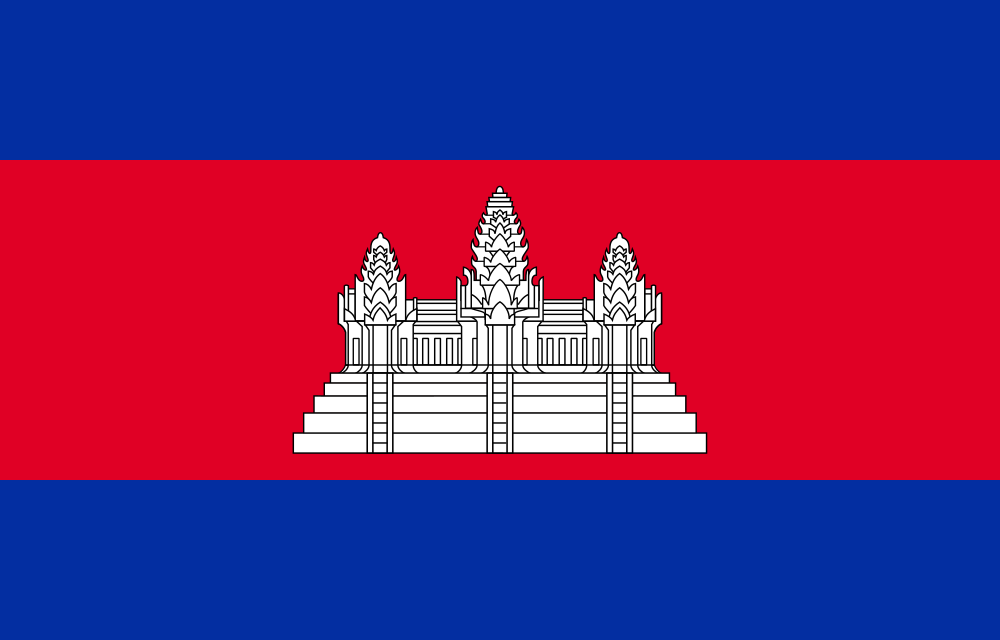
At the December 1978 Kratie congress he proclaimed the overthrow of the Pol Pot regime and an independence moving toward socialism, and was elected president of the National Salvation Front.
A Cambodian leader who broke with the Khmer Rouge and cooperated with Vietnam. He led the People’s Republic of Kampuchea after the 1979 regime change. Reconstruction combined state, cooperative and household activity while war and international disputes over representation continued.
Career timeline
1979Chairman of the People's Revolutionary Council
1981Chairman of the Council of State and General Secretary of the People's Revolutionary Party
1991Stepped down as party general secretary
1992Stepped down as chairman of the Council of State
The communist propagandist who became Ukraine's first president and signed the Soviet Union out of existence
It was a long road we walked to Belavezha. It was not by accident; it was our deliberate choice because we had no other option.
A party man who spent three decades climbing the propaganda and ideology apparatus of the Ukrainian Communist Party, Kravchuk pivoted to 'national communism' after becoming chairman of the Supreme Soviet in 1990. At the Novo-Ogaryovo negotiations he insisted on a confederation, not a federation, and delayed the signing of the new Union Treaty until September; after the August 1991 coup collapsed, he presided over Ukraine's Declaration of Independence on 24 August. Elected Ukraine's first president on 1 December 1991, he signed the Belavezha Accords with Yeltsin and Shushkevich a week later, formally ending the Soviet Union. His presidency saw the surrender of Ukraine's nuclear arsenal and a deep economic slump, but he stepped down after a peaceful electoral defeat and remained active in politics as a deputy.
Career timeline
1958–1970From political-economy teacher to head of agitation and propaganda, Chernivtsi region
1970–1980Rose through CC CPU agitation and propaganda department
1980–1988Head of CC CPU agitation and propaganda department
1988–1989Head of CC CPU ideology department
1989–1990.06CC CPU secretary, Politburo member, second secretary
1990.07–1991.08Chairman of Supreme Soviet of Ukraine; presided over independence declaration
1991.12–1994.07First President of Ukraine; signed Belavezha Accords; lost to Kuchma
1994–2006People's Deputy, parliamentary leader of SDPU(o)
The last minister who tried to preserve the Soviet machine-tool industry through perestroika
Asked in 2012 about the state of the industry, Panichev answered: 'Many development programs have already been adopted. Over thirty government documents on machine-tool building alone. Nothing has budged.'
Nikolai Panichev was the last Minister of Machine Tool and Instrument Building Industry of the USSR (1986–1991), a production administrator who rose from lathe operator to director at the Leningrad Ilyich plant over twenty-five years before joining the ministry. As minister he sought to keep Soviet machine-tool manufacturing competitive by introducing CNC machines, flexible manufacturing modules, and robotic complexes, but the sector was caught between the old command system and the half-built market reforms. After the Soviet collapse he founded the Russian machine-tool association Stankoinstrument and chaired the public council of former USSR and RSFSR ministers. His 2004 memoir Razlom (Fracture) offers a first-hand account of late-Soviet industrial achievement and the failure of reform.
Career timeline
1953–1955Served in the Soviet Army
1955–1956Chairman, Dribin District DOSAAF Committee
The general who sent men onto the Chernobyl roof when the robots died
'How is this possible?' I still cannot stop asking myself. 'Did we come from the Stone Age, to collect sheets of lead and cut makeshift protection for vital organs?'
A Soviet civil defence general and doctor of technical sciences. Four months after the Chernobyl explosion, when every remote-controlled robot had failed, the government commission handed him the most dangerous decontamination zone. He ordered lead sheeting stripped from the walls of government offices and improvised into protective gear, then ran 3,828 soldiers through the roofs of reactor 3 in 40–90-second shifts; they cleared 200 tonnes of highly radioactive debris by hand. He developed radiation sickness, wrote two books about the operation, and was nominated for Hero of the Soviet Union, only to be struck from the list after a conflict with the chief of staff of the Kiev Military District.
Career timeline
1953Graduated Kharkov Military Technical School
1963Graduated Kharkov Automobile and Highway Institute, mechanical engineering
1967–1972Instructor at Moscow Military School of Civil Defence; adjuncture at Kuibyshev Engineering Academy
1972–1986Senior specialist, Military Technical Committee; First Deputy Chief, All-Union Civil Defence Research Institute; Deputy Chief of Civil Defence Staff, RSFSR
1986Commander, removal of highly radioactive debris from Chernobyl danger zones
1988Commander, rescue operations after the Spitak earthquake
1990s–Published memoirs; member of Union of Russian Writers; Sholokhov Literary Prize
The cosmonaut who spent five days alone in orbit, setting a solo spaceflight record that still stands
On 18 June 1963, while Vostok 5 was still orbiting, the Party Central Committee reviewed his application and admitted him as a full member without a candidate period.
Soviet cosmonaut, the fifth to fly in space. Launched on 14 June 1963 aboard Vostok 5, he orbited Earth 81 times over nearly five days, setting a solo space endurance record that still stands. The original Vostok plan called for two women to fly simultaneously, but the mission was restructured as one woman and one man: Bykovsky launched two days before Valentina Tereshkova. He went on to command Soyuz 22 (1976) and Soyuz 31 (1978) with East Germany's first cosmonaut Sigmund Jähn, becoming the only Vostok/Voskhod-era cosmonaut to complete three spaceflights.
Career timeline
1955Graduated Kachinsk Military Aviation Academy; fighter pilot
1960Selected in first cosmonaut group
1962.08Backup pilot for Vostok 3
1963.06.14–19Vostok 5: 81 orbits, 4 d 23 h 6 min; solo endurance record
1976.09.15–23Soyuz 22 commander, Earth observation mission with Vladimir Aksyonov
1978.08.26–1978.09.03Soyuz 31 commander, Salyut 6 visiting mission with East German Sigmund Jähn
1988–1990Director, House of Soviet Science and Culture, Berlin
Propaganda-trained culture minister who executed glasnost-era cultural liberalization
In June 1989, the USSR Supreme Soviet reviewed Premier Ryzhkov's proposed cabinet and rejected Zakharov's renomination as culture minister. For the first time in decades, the rubber-stamp legislature told a sitting minister he was unqualified and sent him packing.
Trained as an economist, he rose through the Leningrad party organization's propaganda and agitation apparatus to reach Moscow, where Gorbachev appointed him Minister of Culture in 1986. His tenure oversaw a decisive shift in Soviet cultural policy: the publication of previously banned books, the relaxation of film censorship, and expanded autonomy for artistic creation. He personally mediated the acrimonious split of the Moscow Art Theatre. In 1989 the newly empowered Supreme Soviet rejected his renomination, the first major case of the legislature exercising real confirmation power over a sitting minister. After leaving office, he served as deputy premier of the Russian republic and later wrote memoirs judging the Gorbachev era a 'reign of missed opportunities.'
Career timeline
1957–1973Lecturer in political economy at Tomsk and Leningrad institutes; doctorate in economics (1973)
1973–1983Head of Propaganda and Agitation Department, then Secretary of Leningrad Oblast Committee, overseeing culture, science, and education
1983–1986First Deputy Chief of CC Propaganda Department → Second Secretary of Moscow City Committee under Boris Yeltsin
1986–1989Minister of Culture of the USSR, lifting bans on books, easing censorship, and granting theatres autonomy during glasnost
1989–1990Deputy Chairman of the RSFSR Council of Ministers
A steadfast defender of Latvia's Communist Party at the Soviet Union's end
After the August 1991 coup attempt, he was arrested, becoming a jailed defendant after trying to preserve the Soviet union-wide order.
Alfrēds Rubiks was a Latvian communist politician formed by work in Riga's municipal administration and the Communist Party of Latvia. In the conflict between the Soviet system and Latvian independence, he sought to preserve the party's union-wide order, and his support for the August 1991 coup attempt brought arrest, conviction, and imprisonment. After his release, he continued that political line as leader of the Socialist Party of Latvia and later as a Member of the European Parliament.
Career timeline
1954–1957Served in the Soviet Army
1957–1961Process engineer at the Riga Electromachine-Building Plant
1982–1984Minister of Local Industry of the Latvian SSR
1984–1990Chairman of the Riga City Executive Committee
1990–1991First Secretary of the Central Committee of the Communist Party of Latvia and member of the CPSU Politburo
1991–1997Imprisoned over the 1991 coup attempt, sentenced to eight years in 1995
1999–2015Chairman of the Socialist Party of Latvia
Second human to orbit Earth and builder of Soviet military space systems
"Once you have your arms and legs arranged properly, space sleep is fine... I slept like a baby." — the first human to sleep in orbit, Vostok 2, August 1961.
Soviet cosmonaut and military space commander. On 6 August 1961, aboard Vostok 2, he became the second human to orbit Earth; his 17-orbit, 25-hour flight, the first long-duration mission, proved humans could eat, sleep, and work in space. At 25, he remains the youngest orbital pilot in history. He was the first to manually pilot a spacecraft, the first to film Earth from orbit, and the first to experience space sickness. After his flight he led cosmonaut training for the Spiral orbital spaceplane, and from 1979 to 1991 served as First Deputy Chief of GUKOS/UNKS, the USSR Ministry of Defence space directorate, overseeing military space systems including the Marshal Nedelin-class tracking ships. Elected to the Russian State Duma as a CPRF member (1993–2000).
Career timeline
1957Graduated Stalingrad Military Aviation School; fighter pilot, Leningrad Military District
1960Selected in first cosmonaut group
1961.04Backup pilot for Vostok 1 (Yuri Gagarin)
1961.08Vostok 2 — 17 orbits, 25 hr 18 min; second human to orbit Earth
1965–1968Head of cosmonaut training group for Spiral orbital spaceplane
1968Graduated Zhukovsky Air Force Engineering Academy
1972Graduated General Staff Military Academy; Deputy Chief of Space Command and Control
1973–1979Deputy Chief of GUKOS for research and development
1979–1991First Deputy Chief of UNKS, USSR MoD; Lt. Gen. → Col. Gen.
The conservative apparatchik who founded the Russian republic's Communist Party
Gorbachev later said: 'I have known Polozkov for a very long time. He is an honest, decent fellow, but stupid and uneducated. Someone writes something for him, and he recites it.'
Founding First Secretary of the Communist Party of the RSFSR (1990–1991), the first republican-level Communist Party in Russian history, and the public face of the conservative anti-perestroika opposition within the CPSU. In May 1990 he contested Boris Yeltsin for the chairmanship of the RSFSR Supreme Soviet and led in early counts before the Politburo ordered him to stand down; weeks later the founding congress elected him to lead the new Russian party. A provincial apparatchik who had run the Krasnodar party organization for five years, he rose to the CPSU Politburo but was caught between reformers and hardliners, resigning after a heart attack in August 1991. He remained a symbolic elder of the Russian communist movement through the CPRF's consultative council after the party's dissolution.
Career timeline
1957–1962Komsomol and party functionary, Solntsevo district, Kursk Oblast
1969–1972Deputy department head, Kursk Oblast Party Committee
1972Chairman, Rylsk District Executive Committee
1973–1978CPSU Central Committee apparatus
1980–1983CPSU Central Committee apparatus
1983–1984Ideology secretary, Krasnodar Krai Party Committee
1984–1985Sector head, Organizational-Party Work Dept, CPSU CC
1985–1990First Secretary, Krasnodar Krai Party Committee
1990–1991First Secretary, CPRSFSR CC · CPSU Politburo member
The last Soviet trade minister, formed in consumer cooperatives
In 1987, he reported declining sugar reserves to the government, putting figures to the consumer crisis.
Kondrat Terekh was a Soviet economic administrator who rose from village-cooperative bookkeeper to become the last Minister of Trade of the USSR (1986–91) during perestroika. Bearing responsibility for all-Union consumer distribution until the planned economy's collapse, he stood at the front line of a consumer crisis of rationing and shortages.
Career timeline
1952–1954Senior accountant in a rural consumer cooperative
1954–1958Served in the Soviet Navy
1959–1963Director of Vileyka city food trade
1967–1977Minsk regional trade chief and First Deputy Chairman of Belkoopsoyuz
1977–1984Chairman of Belkoopsoyuz
1984–1986Deputy Chairman of the Council of Ministers of the Byelorussian SSR
The Shanghai worker-rebel who rose “like a helicopter” to party vice-chairman, youngest of the Gang of Four
The youngest of the Gang of Four: from a Shanghai mill's militia office he led the November 1966 rebel headquarters and the 1967 Shanghai Commune, was second-ranked CCP vice-chairman by 38, and was seized in the 6 October 1976 coup.
From Jilin, he fought in the Korean War and became a security cadre at a Shanghai cotton mill. In 1966 he led the worker-rebel “Workers’ General Headquarters”, the driving force of the “January Storm” that seized the Shanghai government in 1967, and ran the Shanghai Revolutionary Committee with Zhang Chunqiao and Yao Wenyuan. Picked by Mao as a successor of worker origin, he became party vice-chairman at the Tenth Congress in 1973, mocked as a “helicopter” for his rapid, inexperienced rise. Arrested with the Gang of Four in October 1976, he was sentenced to life in 1981 and died of liver disease in custody in 1992.
Career timeline
1967–1976Vice-chairman of the Shanghai Revolutionary Committee
The party apparatus gatekeeper who managed Gorbachev's documents, then betrayed him
On August 18, 1991, Boldin flew to Foros alongside Baklanov, Varennikov, and Shenin to deliver an ultimatum to Gorbachev — the man whose paper flow he had managed for a decade.
An economist by training who graduated from the Timiryazev Agricultural Academy and the CC Academy of Social Sciences, he worked in the Central Committee apparatus from 1961 and later served as agricultural department head and economic commentator at Pravda. In 1981 he became Gorbachev's assistant, and in 1987 he was appointed head of the CC General Department, the office controlling the entire document flow of the Politburo and Secretariat, adding the post of presidential chief of staff in 1990. During the August 1991 coup, however, he sided with the State Emergency Committee and was one of the four emissaries who flew to Foros to confront Gorbachev; arrested after the coup's failure, he was detained and then amnestied in 1994.
Career timeline
1961–1965Central Committee apparatus
1969–1981Pravda agricultural department head and economic commentator
1981–1987Assistant to CC Secretary and General Secretary Gorbachev
1987–1991Head of the CC General Department
1990–1991Chief of Staff to the President of the USSR
On August 19, 1991, the day the GKChP coup began, Shebarshin 'demonstratively' played tennis all day.
The last chief of the KGB First Chief Directorate, a career officer who built decades of field experience in Pakistan, India, and Iran. He kept his distance from the August 1991 coup, served a single day as acting KGB chairman after its failure before Boris Yeltsin blocked him, and later chronicled Soviet foreign intelligence's final chapter in his memoirs.
Career timeline
1958–1962Interpreter and Third Secretary, Soviet Embassy in Pakistan
1962Joined KGB First Chief Directorate, trained at School No. 101
1964–1968KGB intelligence officer under diplomatic cover, Pakistan
1971–1977Deputy rezident, then rezident, KGB India
1979–1983KGB rezident in Iran
1983–1987Deputy chief, then chief, Information-Analytical Directorate, PGU KGB
1987–1989Deputy chief of PGU KGB (Middle East and Africa)
1989–1991Deputy Chairman of the KGB and Chief of the First Chief Directorate
Khrushchev's son and Chelomei's guidance-system engineer
During the Apollo 11 Moon landing in 1969, Khrushchev tried to watch the historic moment through a telescope from Ukraine — with a KGB officer at his side.
Soviet rocket engineer and computer scientist. The son of Nikita Khrushchev, he developed guidance systems for cruise missiles and the Proton space booster at Vladimir Chelomei's OKB-52 design bureau, contributing to submarine-launched missiles, military spacecraft, Moon vehicles, and the Proton booster. At age 28 he was named a Hero of Socialist Labor and awarded the Order of Lenin in 1963. He later served as first deputy director of the Control Computer Institute (INEUM), and after moving to the United States in 1991 taught Cold War history and the Soviet space program at Brown University's Watson Institute while publishing several books on his father's era.
Career timeline
1958Graduated Moscow Power Engineering Institute; joined OKB-52 (Chelomei design bureau)
1958–1968OKB-52 engineer → deputy department chief — guidance systems for cruise missiles, military spacecraft, Moon vehicles, Proton booster
1959Awarded Lenin Prize
1963–1964Leading constructor and deputy head of OKB-52
1963Hero of Socialist Labor and Order of Lenin
1968–1991Control Computer Institute (INEUM) — section head → first deputy director
1991–2020Moved to USA; Senior Fellow and professor, Watson Institute, Brown University
Ukrainian SSR head of state during Chernobyl who pushed the evacuation of 526,000 children from Kyiv against Moscow's resistance
Recalling the interior deputy minister's report on the morning of 26 April 1986: 'The fire was put out, everything is fine. The people? Some are having a wedding, some are gardening, some are fishing in the Pripyat River.'
As Chairwoman of the Presidium of the Supreme Soviet of the Ukrainian SSR during the Chernobyl disaster, she defied Moscow's directives and oversaw the evacuation of 526,000 children from Kyiv and contaminated zones in just five days. Born the daughter of a miner in Kryvyi Rih, she rose through Komsomol and the deputy ministry of education to become the republic's formal head of state in 1985, spending her tenure navigating between central information control and the realities on the ground. In 1989 she refused to sign the resolution banning the People's Movement of Ukraine (Rukh), and after retirement led children's and women's welfare foundations while maintaining a sympathetic view of the Soviet system and a critical stance toward independent Ukraine.
Career timeline
1954–1957Pioneer leader, geography teacher, school Komsomol secretary in Kryvyi Rih
1957–1962Secretary of Kryvyi Rih city Komsomol, then Dzerzhinsky district party committee
1962–1969Secretary and department head, Komsomol Central Committee of Ukraine
1969–1972Deputy Minister of Education, Ukrainian SSR
1975–1985Deputy Chair, Presidium of the Supreme Soviet, Ukrainian SSR
1985–1990Chair of the Presidium, Supreme Soviet, Ukrainian SSR (head of state)
1985–1989Deputy Chair, Presidium of the Supreme Soviet, USSR
The first director of Chernobyl who built the plant and was held responsible for its catastrophe
In the station courtyard I saw pieces of graphite under my feet, but I still could not imagine that the reactor had been destroyed.
Born in Tashkent as the eldest son of Russian workers, he studied energy engineering and built his career at thermal power plants. In 1970 he was appointed construction manager and first director of the Chernobyl Nuclear Power Plant, which he led for sixteen years; plagued by construction delays and defective materials, he submitted his resignation, but a Party supervisor tore it up. Dismissed immediately after the 1986 disaster, he was sentenced to ten years in 1988; after his release he continued working on Chernobyl liquidation until his death in Kyiv in 2021.
Career timeline
1959Graduated Tashkent Polytechnic, joined Angren Thermal Power Plant
1966Rose to deputy chief engineer at Slavyansk Thermal Power Plant
1970–1986First director and construction manager, Chernobyl Nuclear Power Plant
1986.07Expelled from CPSU and dismissed after the disaster; arrested in August
1988.07Sentenced to 10 years, served in Donetsk penal colony
1991.09Released early, worked in Ukraine's trade ministry
1995–2015Chernobyl liquidation work at Ukrinterenergo
Soviet physicist who linked fusion science, Chernobyl, and nuclear disarmament
Less than a month after absorbing radiation at Chernobyl, Velikhov chaired an international meeting on nuclear test-ban verification — turning disaster into a disarmament opening.
Soviet physicist who pioneered plasma physics for controlled fusion and MHD power. His 1959 thesis discovered magnetorotational instability, now foundational to astrophysics; in 1962 he identified electrothermal instability. He led the Soviet controlled-fusion program from 1973 and was Vice-President of the USSR Academy of Sciences (1978–1991), bridging the Kurchatov Institute and the Academy. During Chernobyl (1986) he served as Gorbachev's science advisor for reactor containment, then led science diplomacy for nuclear disarmament. After the Soviet collapse he sustained the Kurchatov Institute and became founding chairman of ITER, building the framework for joint US-Soviet-European-Japanese fusion research.
Career timeline
1958Graduated from Moscow State University, Physics
1961Joined the Kurchatov Institute of Atomic Energy
1971–1978Director, Magnetic Laboratory, Troitsk branch
1973–1991Scientific head, Soviet controlled-fusion program
1978–1991Vice-President, USSR Academy of Sciences
1986Science advisor to Gorbachev for Chernobyl cleanup
1989–1990Member, CPSU Central Committee
1989–2015Director → President → Honorary President, Kurchatov Institute
The final head of Soviet Moldavia's Communist Party
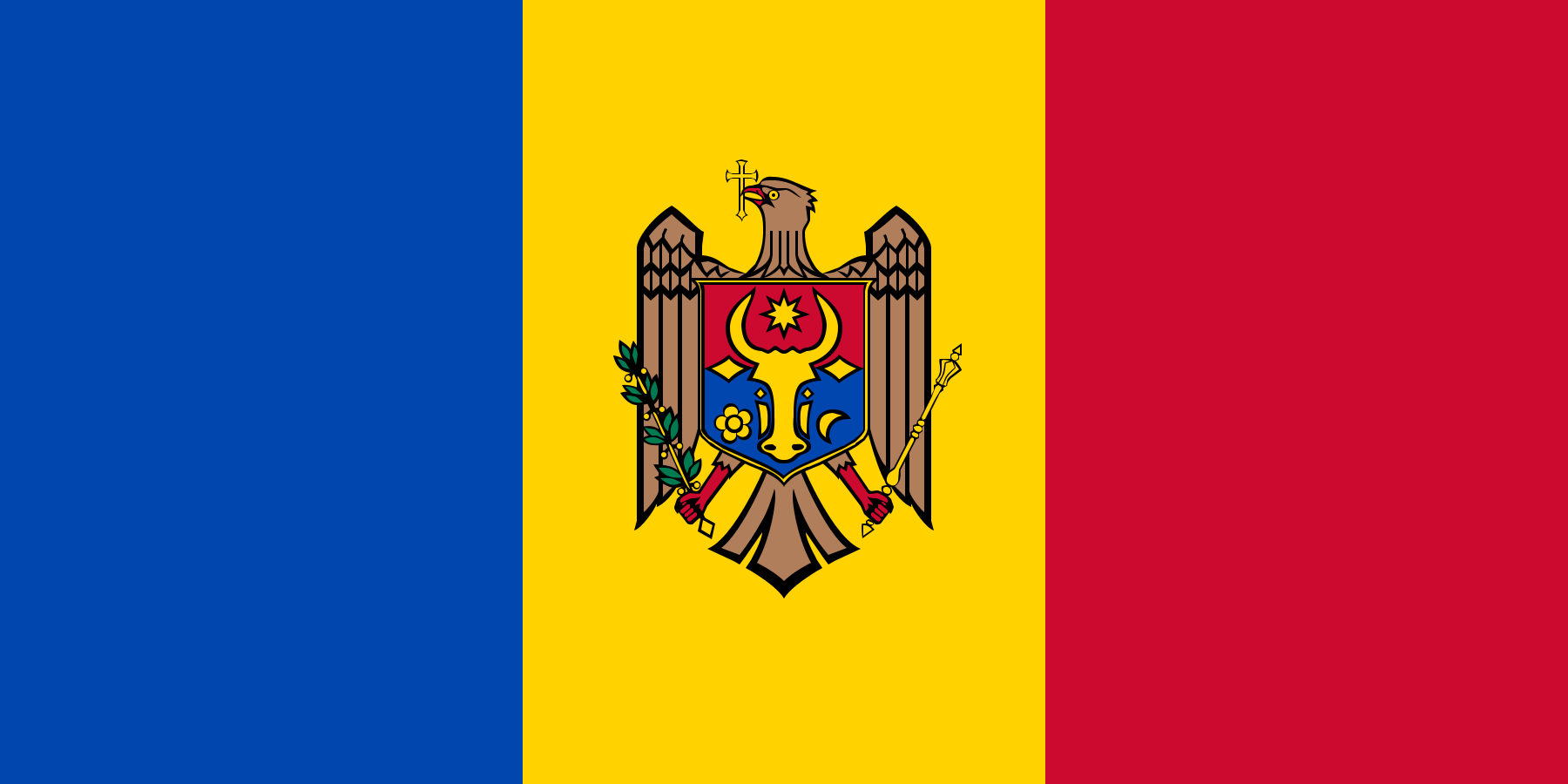
He called the 1991 banning of the Communist Party “an illegitimate act.”
Grigore Eremei was a Moldavian party and state official whose career reached its decisive moment at the end of the Soviet system. As First Secretary of the Communist Party of Moldavia in 1991, he occupied the republic's leading party post while the Union was breaking apart and Moldova moved toward independence. After the party was dissolved, he continued in public life as a Moldovan diplomat and parliamentarian, linking a Soviet political career to the institutions of the independent republic.
Career timeline
1952Began working as a village secondary-school librarian
1954–1956Served in the Soviet Army
1966–1970First Secretary of the Kotovsk district party committee
1970–1980Deputy and First Deputy Chairman of the Council of Ministers of the Moldavian SSR
1980–1990Chairman of the Moldavian republican council of trade unions
1989–1991People's Deputy of the USSR
1991First Secretary of the Communist Party of Moldavia and member of the CPSU Politburo
The last Chief of the Soviet General Staff, who refused to fire on civilians and twice drafted military reform
“These were young people expressing their views in the square. The task before me was to resolve the conflict without bloodshed.” — when asked why he refused the Kazakh party leadership's order to deploy troops against the 1986 Alma-Ata protests.
A professional soldier who rose from conscript to the highest military post in the USSR: Chief of the General Staff. As commander of the Central Asian Military District, he refused the Kazakh party leadership's demand to send troops against the December 1986 Alma-Ata protests, resolving the standoff without bloodshed. Twice entrusted with drafting military reform, first as First Deputy Chief of the General Staff under Gorbachev and again as Chief in 1991, he advocated shorter conscription, brigade-based organization, and a defensive posture, clashing with Defence Minister Yazov and later the Russian military establishment. Appointed Chief of the General Staff after the August 1991 coup, he held the post barely four months before the Soviet Union itself dissolved, making him the last man to hold the office.
Career timeline
1954Conscripted, artillery regiment, Turkestan Military District
1967–1968Motor rifle battalion commander, GSVG — seized airfield and key points near Prague
1979–1981Commander, 28th Combined Arms Army, Belorussian Military District
1984–1987Commander, Central Asian Military District — refused to deploy troops to Alma-Ata, Dec 1986
1987–1988First Deputy Chief, General Staff — drafted military reform, clashed with Yazov, removed
1989–1991First Deputy Chief of General Staff & Warsaw Pact Joint Armed Forces Chief of Staff
1991.08Chief of the General Staff, USSR — appointed after coup, dismissed as USSR dissolved
1992–1994Military inspector-adviser, presidential military adviser, retired 1994
Architect of perestroika cadres, last surviving Politburo member
In January 1989, Vilnius city party leaders sent Razumovsky a second appeal for a response to their criticisms — none came, and that December the Lithuanian CP declared independence.
Gorbachev's cadre chief, Razumovsky headed the CC Organizational-Party Work Department (1985–1988) and chaired the Party Building and Cadre Policy Commission (1988–1990), driving the largest personnel turnover of perestroika. An agronomist who rose to First Secretary of Krasnodar Kraikom (1983–1985), he became CC Secretary and candidate Politburo member in 1986. Under Gorbachev's banner of intra-party democracy, his rigid delegate quotas fueled a backlash in Lithuania's Communist Party that contributed to its secession. He later served as Consul General in Shanghai (1990–1992) and is, as of 2025, the last living member of the 1986 Politburo.
Career timeline
1958Graduated Kuban Agricultural Institute, collective farm agronomist
1959–1961First Secretary, district Komsomol committee
1964–1967First Secretary, Korenovsk District Party Committee
1967–1971Head, Organizational-Party Work Dept, Krasnodar Kraikom
1971–1973Deputy then head of sector, CC Org-Party Work Dept
1973–1981Chairman, Krasnodar Krai Executive Committee
1981–1983Head, Agricultural Dept, USSR Council of Ministers Admin
1983–1985First Secretary, Krasnodar Kraikom CPSU
1985–1988Head, CC Org-Party Work Dept (succeeding Ligachev)
1986–1990Secretary, CPSU Central Committee
1988Head, CC Party Building and Cadre Work Dept
1988–1990Chairman, CC Commission on Party Building and Cadre Policy; candidate PB member
Organizational-Party Work deputy chief who witnessed Sumgait, and said 'we were a day late'
Gorbachev says we were three hours late: nothing of the sort. We were a day late! Because we waited a whole day for the decision to send in troops.
A railway engineer who rose through the party apparatus to become deputy head of the CPSU Central Committee Organizational-Party Work Department (1987–1988) under Gorbachev. On the night of February 28, 1988, he and KGB deputy chairman Filipp Bobkov arrived in Sumgait, where he witnessed the mutilated corpses of the pogrom and later testified that Moscow's response was 'a day late, not three hours.' He later served as First Secretary of the Zaporizhzhia obkom (1988–1990) and Second Secretary of the Central Committee of the Communist Party of Ukraine and Politburo member (1990–1991), before working in Moscow as vice-president of the Russian Union of Commodity Producers after the USSR dissolved.
Career timeline
1959Graduated Moscow Railway Engineering Institute; worked at Zaporizhzhia Electric Locomotive Repair Plant
1960–1967Komsomol secretary → First Secretary, Zaporizhzhia Oblast Komsomol
1967–1974First Secretary, Lenin District Party Committee → Mayor of Zaporizhzhia
1974–1986Secretary for industry → Second Secretary, Zaporizhzhia Obkom CPU
1987–1988Deputy Head, CC Organizational-Party Work Department
1988.02Joined Volsky's group, dispatched to Sumgait
1988–1990First Secretary, Zaporizhzhia Obkom CPU
1990–1991Second Secretary and Politburo member, CC CPU
The Kurchatov chemist who led science at Chernobyl, then left the full truth on tapes before hanging himself
"I did not lie in Vienna… but I did not tell the full truth."
Valery Legasov was a Soviet inorganic chemist and first deputy director of the Kurchatov Institute of Atomic Energy, who arrived at the Chernobyl disaster site on the evening of 26 April 1986 as the scientific leader of the government commission. He proposed dropping boron and sand into the burning reactor, spent a total of 60 days on site, and later presented a five-hour report to the IAEA in Vienna that drew international attention but stopped short of revealing the RBMK reactor's full design flaws. On 27 April 1988, the day after the disaster's second anniversary, he hanged himself in his Moscow apartment; the audio tapes he recorded beforehand exposed the cover-ups and systemic failures of the Soviet nuclear establishment and became a primary source for historians.
Career timeline
1961–1964Engineer → shift supervisor, Siberian Chemical Combine (Tomsk-7)
1964–1972Researcher, Kurchatov Institute; Candidate of Chemical Sciences 1967, Doctor of Chemical Sciences 1972
1972–1983Deputy director for scientific work, Kurchatov Institute
1981Full member, USSR Academy of Sciences
1983–1988First deputy director, Kurchatov Institute; Chair of Radiochemistry, Moscow State University
1986–1988Member, government commission for Chernobyl accident liquidation
Gromyko protégé and arms negotiator remembered for the "Walk in the Woods"
On July 16, 1982, Kvitsinsky and Paul Nitze left the formal Geneva arms talks for an unofficial walk in the woods, sketching a compromise on intermediate-range nuclear forces. Both governments rejected it — but the conversation became Lee Blessing's Broadway play "A Walk in the Woods."
A leading Soviet Germanist and protégé of Andrei Gromyko, Yuli Kvitsinsky served on the front lines of Soviet diplomacy toward the West for over three decades. As head of the Soviet delegation to the Geneva INF negotiations from 1981, his famous "walk in the woods" with American negotiator Paul Nitze in July 1982, an informal attempt to sketch a compromise on intermediate-range nuclear missiles, became an iconic Cold War moment that later inspired a Broadway play. As Ambassador to West Germany (1986–1990), he helped prepare the "Two Plus Four" treaty framework for German reunification, and as First Deputy Minister of Foreign Affairs in 1991 he oversaw European security affairs. After a post-Soviet hiatus, he returned as Russia's ambassador to Norway (1997–2003) and served as a CPRF deputy in the State Duma until his death.
Career timeline
1959–1965Translator, attaché, third secretary, second secretary, USSR Embassy in the GDR
1965–1978Second secretary, first secretary, expert-consultant, deputy head, Third European Department, USSR MFA
1978–1981Minister-Counsellor, USSR Embassy in the FRG
1981–1986Ambassador-at-Large, USSR MFA; head of USSR delegation to Geneva nuclear arms talks
1986–1990Ambassador of the USSR to the FRG; candidate member (1986–89), full member (1989–90) of CPSU Central Committee
1990–1991Deputy Minister of Foreign Affairs of the USSR
1991First Deputy Minister of Foreign Affairs of the USSR (May–September)
1997–2003Ambassador of Russia to Norway
2003–2010Deputy, State Duma (4th & 5th convocations); First Deputy Chairman, International Affairs Committee