The technocrat who rose from defense-plant apprentice to Politburo overseer of the military-industrial complex
During the Great Patriotic War, the eighteen-year-old Zaikov, working twelve-hour shifts in a defense plant, ran away to the front three times. Each time he was sent back to the factory — and so his path as a defense-industry man began.
A factory-floor technocrat who rose from apprentice die-maker in Leningrad's defense plants to Politburo member and CC Secretary (1985–1990) overseeing the entire Soviet military-industrial complex. Inheriting the defense portfolio from Grigory Romanov, he chaired the Politburo commission on nuclear and conventional arms reduction and was one of a handful of senior officials fully aware of the Soviet Union's prohibited biological weapons programme. After Boris Yeltsin's ouster in 1987 he concurrently served as First Secretary of the Moscow City Party Committee. Awarded Hero of Socialist Labour (1971) for directing the defense electronics enterprises Novator and Leninets, he embodied the pragmatist industrial manager elevated to the highest party ranks.
Career timeline
1940–1945Apprentice die-maker and fitter at Leningrad defense plants; tried to volunteer for the front three times
1961–1971Director of the Leningrad State Plant 'Novator'
1974–1976General Director of the scientific-production association 'Leninets'
1976–1983Chairman of the Leningrad City Executive Committee
1983–1985First Secretary, Leningrad Oblast Committee
1985–1990CC Secretary for defense industry and machine-building; Politburo member (1986–90)
1987–1989First Secretary, Moscow City Committee (concurrent)
The architect of glasnost: the ideology chief who dismantled the ideology
May 19, 1983, on Eugene Whelan's farm in Amherstburg, Ontario. Walking a lane between corn and soybean fields, Yakovlev later said he "threw caution to the wind" and told Gorbachev what he considered utter stupidities in foreign affairs. By the end of that walk the two were comrades in reform.
Born 2 December 1923 in the village of Korolyovo, Yaroslavl province, into a peasant family. Called up in 1941, he commanded a marine infantry platoon on the Volkhov Front, was gravely wounded in the legs in August 1942, and was demobilised in February 1943. He joined the party in 1944, moved to the Central Committee apparatus in 1953, and studied at Columbia University in 1958–59 as an exchange student. In November 1972 an article against great-power chauvinism pushed him out of the party apparatus; from 1973 he spent ten years as ambassador to Canada. He became director of IMEMO in August 1983, then propaganda chief in 1985 and a full Politburo member in 1987, driving glasnost and the re-examination of history. In 1989 he chaired the inquiry that confirmed the secret protocols. He died in Moscow on 18 October 2005 after a long illness.
Career timeline
1941–1943Marine platoon commander; gravely wounded August 1942, demobilised February 1943
1953–1972Rises through the CC apparatus to acting deputy head of propaganda
1973–1983A decade as ambassador to Canada
1983–1985Director of the IMEMO institute
1985–1990Propaganda chief and Politburo member: designs glasnost
1989–Chairs the secret-protocols inquiry, then the rehabilitation commission
First Secretary of the Estonian Communist Party (1978–1988) who resisted perestroika and pushed Russification until Moscow replaced him.
He spoke almost no Estonian and what he did speak came out in a thick Russian accent, earning him the nickname 'Yestonian.'
Born in Tomsk, Siberia, to Estonian Bolshevik parents, he was a native Russian speaker who spoke Estonian with a thick accent. In 1978 he replaced Johannes Käbin, who had led Estonia for 28 years, as First Secretary and became an extreme Russificator; he survived an assassination attempt in 1979. After the Hirvepark rally of 1987 he mobilised the entire party apparatus in a furious counter-campaign, branding the demonstration anti-Soviet nationalism, but in June 1988 Moscow forced his resignation and replaced him with Vaino Väljas.
Career timeline
1947Graduated Tomsk (now Omsk) Transport Institute, joined the CPSU, railway engineer in the Estonian SSR
1948–1953Secretary, Tallinn Regional Committee, Communist Party of Estonia
1953–1957Department head, Central Committee, Communist Party of Estonia
1957Graduated Correspondence Higher Party School
1957–1960Deputy Chairman, Economic Council of the Estonian SSR
1960–1978Secretary, Central Committee, Communist Party of Estonia
1978–1988First Secretary, Central Committee, Communist Party of Estonia
1988–1990Member, Party Control Committee under the CPSU Central Committee
On 17 June 1991, in a closed session of the Supreme Soviet, Kryuchkov warned that Western 'agents of influence' had penetrated the reformist camp and joined Premier Pavlov's demand for extraordinary cabinet powers. Two months later the coup he organized collapsed in three days and he was arrested.
Born on 29 February 1924 in Tsaritsyn (later Stalingrad, now Volgograd). He worked at Stalingrad artillery factories in 1941–43, graduated as a jurist in 1949, and served as an investigator and prosecutor in Stalingrad districts in 1946–1951. Posted to the Soviet embassy in Budapest as third secretary in 1955–59, he lived through the Hungarian events of 1956. In 1967 he followed Andropov into the KGB, heading its Secretariat and then, from 1974 to 1988, the First Chief Directorate. Appointed KGB chairman on 1 October 1988, he held the post to 1991 and was a Politburo member in 1989–90. He led the August 1991 State Emergency Committee (GKChP), was arrested on 22 August 1991, released in January 1993, and amnestied by the State Duma in February 1994 without a completed trial. He died in Moscow of a heart attack on 23 November 2007.
Career timeline
1956Third secretary in Budapest, under Andropov
1967–1974Andropov’s secretariat at the KGB
1974–1988Heads the First Chief Directorate, foreign intelligence
The last RSFSR premier who tried not to break Russia away
October 1989, at the CC CPSU meeting on the RSFSR political system: "Creating a separate Russian Communist Party is the path to splitting the Soviet Union." He directly opposed Gorbachev's plan.
A Soviet institutional figure who rose from aviation plant engineer to first secretary of the Kuibyshev and Voronezh regions. Sidelined as ambassador to Cuba under late Brezhnev, he was politically revived when Andropov sent him to Krasnodar to purge corruption. In 1983 he became chairman of the RSFSR Council of Ministers and a full Politburo member, leading the Russian republic's government for five years; immediately after Chernobyl he served as deputy chairman of the government commission dealing with the disaster. In 1988 he moved to chairman of the RSFSR Supreme Soviet Presidium, but when Gorbachev pushed for a separate Russian Communist Party in the final years of perestroika, Vorotnikov openly opposed it, defending the RSFSR within the union framework to the end.
Career timeline
1942–1960Kuibyshev aviation plant: engineer → party committee secretary
A Belarusian party leader who combined agricultural development with late-Soviet reform
He called himself a “progressive conservative” who restrained innovation pursued merely for its own sake.
An agricultural specialist by training, Yefrem Sokolov rose through local administration and party work to become a practical leader of Soviet Belarus. He expanded the Brest region's productive infrastructure through large livestock complexes and road construction, receiving the title Hero of Socialist Labour in 1986. During perestroika he called for clearer ownership rules and wider republican economic authority, and ordered the publication of maps showing radioactive contamination in Belarus after the Chernobyl disaster, while describing himself as a progressive conservative wary of innovation for its own sake. He left the republican party leadership in 1990 and briefly served on the CPSU Politburo that year.
Career timeline
1944–1950Served in the Red Army's 5th Separate Reserve Sapper Regiment
1956–1958Agronomist and agricultural inspector in Brest Region
1958–1961Second secretary of the Ivanovo district party committee
1961–1965First secretary of the Urlyut yub district party committee and other posts in the Kazakh SSR
1969–1977Deputy head and head of the agricultural department of the Communist Party of Belarus Central Committee
1977–1987First secretary of the Brest Regional Party Committee
1987–1990First secretary of the Communist Party of Belarus Central Committee
1990Member of the CPSU Central Committee Politburo
His name 'Rafiq' means 'comrade' in Arabic. When Gorbachev elevated him to chairman of the Soviet of Nationalities, Ukrainian Komsomol leader Valeriy Tsybukh dubbed him 'Gorbachev's personal Rafiq.'
Born the son of a farm laborer, he rose through the Tashkent city party and the republic foreign ministry to become First Secretary of the Uzbek Communist Party in 1988. Tasked with stabilizing the republic after the Rashidov cotton scandal, he earned Gorbachev's confidence and was elevated the following year to chairman of the Soviet of Nationalities. An Uzbek who reached the highest federal tier, he presided over the multinational Union's final parliament as the state itself dissolved around him.
Career timeline
1950s–1970sRises through Uzbek republic diplomatic and party administration
1986–1988First Secretary of the Uzbek Communist Party after Rashidov, managing the post-scandal republic
1989–1991Chairman of the Soviet of Nationalities, the last representative line during the Union’s collapse
1991His office disappears amid the August coup and dissolution of the Union
after 1991Lives in Russia after 1991 as a late-Soviet republic elite figure
The unknown Russian party functionary whose appointment to Kazakhstan ignited the Zheltoksan uprising
On 16 December 1986, the 5th Plenum of the Central Committee of the Communist Party of Kazakhstan in Almaty lasted just eighteen minutes. When Moscow's envoy Razumovsky announced Kunaev's dismissal and Kolbin's appointment, the hall fell into heavy silence.
Gennady Kolbin was a textbook Brezhnev-era party apparatchik who spent his career in the CPSU apparatus, but his 1986 appointment by Gorbachev as First Secretary of the Communist Party of Kazakhstan placed him unexpectedly at a historical watershed. An ethnic Russian from Nizhny Tagil with no prior connection to Kazakhstan, his installation (replacing the Kazakh Dinmukhamed Kunaev at an 18-minute plenum) triggered the Zheltoksan (December) uprising, when thousands of young Kazakhs poured into the streets of Alma-Ata in what became the first mass anti-Moscow protest of the perestroika era. After three turbulent years he was replaced by Nursultan Nazarbayev, recalled to Moscow to chair the Party Control Committee, and retired in 1990. He died of a heart attack on the Moscow Metro in 1998 and lay unidentified for five days.
Career timeline
1959–1962Second/First Secretary, Lenin District Committee, Nizhny Tagil
1962–1970Second/First Secretary, Nizhny Tagil City Committee
At the Čierna nad Tisou talks, watching Katushev argue the Soviet case, Czechoslovak National Assembly President Josef Smrkovský observed that he did so "with the toughness of two Molotovs put together."
A mechanical engineer from the Gorky Automobile Plant who rose rapidly under Brezhnev's patronage, becoming the youngest CC Secretary in 1968 at age 40. During the Prague Spring he handled Soviet negotiating work with the Czechoslovak leadership and went on to oversee relations with the entire socialist bloc. His sudden demotion to Deputy Premier in 1977 marked the end of his inner-circle career; after serving as ambassador to Cuba, he returned under Gorbachev as Minister of Foreign Economic Relations, managing the practical work of opening the Soviet economy. After the USSR's collapse he lived out a quiet retirement as a commercial bank executive.
Career timeline
1960sRises through Gorky regional and party economic-management work
1968–1977CC secretary handling industrial and economic coordination
1977–1982Deputy chairman of the Council of Ministers, involved in economic administration
1982–1985Works on Comecon and foreign-economic cooperation
1988–1991Minister of Foreign Economic Relations, managing trade and joint-venture opening during perestroika
The only Lithuanian to sit in the CPSU Politburo and the last pro-Moscow party leader, imprisoned for the January Events
In 2000, President Adamkus offered him a pardon; he refused: 'I am not guilty before the motherland.'
Born in Alytus, Lithuania, he worked as a labourer from 1942 before rising through the Communist Party apparatus to become, after the CPL split in 1989, the first secretary of the pro-Moscow Lithuanian Communist Party (CPSU platform). In opposition to the March 1990 declaration of independence, he appealed to Gorbachev for military intervention and led the National Salvation Committee, which provided the political cover for the Soviet assault on the Vilnius television tower in January 1991. Fourteen civilians died in the operation; he was arrested in Minsk in 1994 and sentenced in 1999 to twelve years for anti-state organization and complicity in murder. He refused a presidential pardon, declaring himself not guilty before his homeland, and was released on 13 January 2006.
Career timeline
1942–1944Carpenter and machinist in Udmurtia
1944–1955Komsomol and party work; graduated Vilnius Pedagogical Institute
1963–1976Senior researcher, Institute of Party History; professor, Vilnius Engineering-Building Institute
1976–1990Professor of scientific communism, Vilnius Pedagogical Institute
1990–1991First Secretary, CC, CPL (CPSU platform)
1990–1991Member, Politburo, CPSU Central Committee
1991–1994Fled to Belarus
1994–2006Arrested, sentenced to 12 years; released January 2006
The agronomist who pushed a sovereignty declaration through the Soviet system and led Estonia out of the empire
Lukyanov warned him of a ten-year sentence for 'anti-constitutional activity.' Rüütel stood his ground: 'We will convene the Supreme Council and put the Declaration of Independence to a vote,' inadvertently saying 'Independence' instead of 'Sovereignty,' as he later recalled.
An agricultural economist from the Estonian island of Saaremaa, Rüütel rose through the Soviet system: rector of the Estonian Agricultural Academy, Communist Party functionary, and finally chairman of the Presidium of the Estonian SSR Supreme Soviet in 1983. On 16 November 1988, defying Moscow's threat of imprisonment, he pushed the Estonian sovereignty declaration through the legislature, opening the first crack in the Soviet edifice; in 1990, as chairman of the Supreme Council, he declared Soviet rule illegal and initiated the transition to restored independence. After independence he was elected president in 2001 and served until 2006, steering Estonia into NATO and the European Union.
Career timeline
1949–1950Senior agronomist, Saaremaa Executive Committee agricultural department
1955–1957Teacher, Tartu School of Agricultural Mechanization
1957–1963Senior zootechnician and director, experimental farm of the Veterinary and Animal Husbandry Research Institute
1963–1969Director, Tartu Reference State Farm
1969–1977Rector, Estonian Academy of Agriculture
1977–1979Secretary for agriculture, Central Committee of the Communist Party of Estonia
1979–1983First Deputy Chairman, Council of Ministers of the Estonian SSR
1983–1990Chairman, Presidium of the Supreme Soviet of the Estonian SSR
1990–1992Chairman, Supreme Council of the Republic of Estonia
Gorbachev's agriculture successor who became his last internal critic
At a January 1989 Politburo session he snapped at Gorbachev: "I'm sick of these reorganizations of agriculture. If farming doesn't get priority, the program will fail. Isn't this clear to the Council of Ministers, the Politburo, and to you, Mikhail Sergeyevich?"»
An agronomist who served twelve years as First Secretary of the Mari ASSR, he inherited Gorbachev's agriculture portfolio as Central Committee Secretary in 1985. He fleshed out the farm revival program conceived under Andropov and backed Gosagroprom, the merger of six agricultural ministries. But he turned sharply critical when bureaucratic consolidation failed to fix production. After repeated Politburo confrontations with Gorbachev, he was removed from both the Politburo and Secretariat in September 1989 at age sixty.
Career timeline
1950–1958Chief agronomist at MTS, agricultural school instructor, Krasnoyarsk party organs
1961–1967Second Secretary, Tatar Oblast Committee
1967–1979First Secretary, Mari Oblast Committee
1979–1983Chairman of Soyuzselkhozkhimiya · Deputy Minister of Agriculture USSR
1983–1985Minister of Agriculture RSFSR
1985–1989Secretary of the Central Committee for Agriculture
The philosopher who gave perestroika its humanist foundations: from defending genetics to founding the science of Man
"I criticize the very concept of 'Party science.' Politics concerns only the philosophical interpretation of science, not the evaluation of science itself" — Genetics and Dialectics, 1968
A Marxist philosopher who dismantled Lysenkoism on philosophical grounds. As Gorbachev's advisor, he placed 'authentic humanism' at the core of perestroika and pioneered bioethics and the interdisciplinary study of Man. Served as Pravda editor-in-chief and Politburo member.
Career timeline
1953Graduated Philosophy Faculty, Moscow State University (silver medal)
1958Kandidat in philosophy — Determinism and Teleology
1965–1968Assistant to CPSU Central Committee Secretary for Ideology
1966Doctor of Philosophical Sciences — Problems of Biological Methodology
1968–1977Editor-in-chief, Voprosy Filosofii; publishes Genetics and Dialectics
1976Corresponding member of the USSR Academy of Sciences
1987Full Academician of the USSR Academy of Sciences
1986–1987Editor-in-chief, Kommunist; host of 'Philosophical Conversations' on Central TV
1987–1989Science, education and culture advisor to General Secretary Gorbachev
1989–1991Editor-in-chief, Pravda
1989–1990Secretary, CPSU Central Committee
1990–1991Member of Politburo, CPSU Central Committee
1991–1999Founding director, Institute of Man, Russian Academy of Sciences
The Arabist premier who turned his plane around over the Atlantic
"The first demonstration to the world that Russia cannot be spoken to from a position of strength" — Russian analysts on Primakov's Atlantic turnaround, March 1999
The USSR's leading Arabist and a pragmatist who spanned intelligence, diplomacy, and high politics. After serving as Pravda's Middle East correspondent, he directed IMEMO and the Institute of Oriental Studies, and became a candidate Politburo member in 1989. As head of the KGB First Chief Directorate in 1991 he founded Russia's SVR foreign intelligence service. As Foreign Minister he championed a multipolar 'Primakov Doctrine,' and as Prime Minister in 1999 he famously turned his plane back over the Atlantic upon learning of NATO's bombing of Yugoslavia.
Career timeline
1953–1962State Radio Arabic desk; researcher, IMEMO
1962–1970Pravda Middle East correspondent, based in Cairo
1970–1977Deputy director, IMEMO; secret Middle East missions
1977–1985Director, Institute of Oriental Studies, USSR Academy of Sciences
1985–1989Director, IMEMO; Academician, USSR Academy of Sciences
1989–1990Candidate Politburo member; Chairman, Soviet of the Union
1991Head, PGU KGB → Central Intelligence Service → SVR director
1996–1998Foreign Minister of Russia; Primakov Doctrine
1998–1999Prime Minister of Russia; Atlantic turnaround
The last ideology secretary who dismantled ideology opened the spetskhran and abolished party orthodoxy
In autumn 1988 he obtained Solzhenitsyn's works through the KGB. He admired One Day in the Life but dismissed Gulag Archipelago as mere polemic — then opened the spetskhran and returned Solzhenitsyn's published books to the open shelves.
A peasant's son from Yaroslavl, Medvedev earned a doctorate in economics from Leningrad University, rose through the propaganda and science departments, and became CC secretary in 1986 and Politburo member with the ideology portfolio in 1988. He repealed Zhdanov's 1946 crackdown on the journals Zvezda and Leningrad, abolished subscription limits on periodicals, and returned forbidden books, including works by Solzhenitsyn and Trotsky, from the spetskhran to open library shelves. He replaced CPSU history and scientific communism courses with 20th-century socio-political history and served on the commission re-examining Stalin-era repressions. A core Gorbachev intimate, he left all posts with the Soviet collapse and spent his remaining decades as a researcher at the Gorbachev Foundation.
Career timeline
1951–1968Graduates Leningrad University economics; professor, doctorate
1968–1970Secretary, Leningrad city party committee
1970–1978Deputy head, CC Propaganda Department
1978–1983Rector, CC Academy of Social Sciences
1983–1986Head, CC Science and Education Department
1986–1990CC Secretary, then Ideological Commission chair and Politburo member
1990–1991Member, USSR Presidential Council
1992–2025Researcher, Gorbachev Foundation and RAS Institute of Economics
Gorbachev's classmate turned critic: the last speaker of the Soviet parliament
“Gorbachev and Yeltsin were afraid that if I conducted the V Congress of People's Deputies, the deputies might nullify all the results of the August victory of democracy.” — Lukyanov on why he was arrested.
Anatoly Lukyanov was a Soviet jurist and statesman who helped design the USSR's constitutional architecture and defended it to the end. A law-school contemporary of Mikhail Gorbachev, he co-drafted the 1977 Soviet Constitution, headed the General Department of the CPSU Central Committee, and became the last Chairman of the Supreme Soviet (1990–1991). An early Gorbachev ally, he grew alarmed at the union's unraveling and broke publicly with him at the June 1991 plenum. Arrested as a GKChP sympathizer, he spent fifteen months in prison before co-founding the Communist Party of the Russian Federation in 1993 and serving three terms in the Duma. A Doctor of Juridical Sciences who published poetry as Anatoly Osenev, he embodied the Soviet establishment intellectual who refused to accept the liquidation of the system he served.
Career timeline
1956–1961Senior consultant, Legal Commission of the USSR Council of Ministers
1961–1976Senior referent, then deputy department head, Presidium of the Supreme Soviet
1977–1983Chief of the Secretariat, Presidium of the Supreme Soviet
1983–1985First Deputy Head, General Department, CPSU Central Committee
1985–1987Head, General Department, CPSU Central Committee
1987–1988Secretary, CPSU Central Committee (legal and administrative affairs)
1988–1990Candidate member, CPSU Politburo
1990–1991Chairman, Supreme Soviet of the USSR
1993–2003Deputy, State Duma of the Russian Federation (CPRF)
Gorbachev's man for the Karabakh crisis who fled Baku as Black January consumed Soviet Azerbaijan
On the night of the 25th, Vezirov called to say 'catastrophe is brewing and we must ask Moscow for help': from Ayaz Mutallibov's recollections
First Secretary of the Azerbaijan Communist Party (1988–1990), appointed by Gorbachev as the Nagorno-Karabakh conflict spiraled. Of Karabakh descent and a career diplomat who had spent over a decade outside the republic, he was untainted by local corruption but could command neither the entrenched party clans nor the street. Having lost all control as mass protests and anti-Armenian pogroms convulsed Baku in January 1990, he fled to Moscow before Soviet troops opened fire on civilians, and was afterward blamed by the central government and Heydar Aliyev alike.
Career timeline
1954–1956Secretary, then Second Secretary, CC Azerbaijan Komsomol
1956–1959First Secretary, CC Azerbaijan Komsomol
1959–1970Secretary, CC All-Union Komsomol
1970–1976First Secretary, Kirovabad City Committee, then Head of Industry Dept, CC Azerbaijan CP
1976–1979USSR Consul-General, Calcutta
1979–1985USSR Ambassador to Nepal
1985–1988USSR Ambassador to Pakistan; involved in Afghan withdrawal talks
1988–1990First Secretary, CC Azerbaijan Communist Party
The last party first secretary who tilted Nagorno-Karabakh toward Armenia
From the rostrum of the USSR Supreme Soviet, July 1988: "The optimal solution in this situation would be to detach Karabakh from Azerbaijan. I see no alternative."
An Armenian party functionary born in Stepanakert in 1931, Poghosyan was appointed First Secretary of the Nagorno-Karabakh Autonomous Oblast Party Committee on 24 February 1988, inheriting an explosive situation barely four days after the regional soviet voted to unify with Soviet Armenia. Within weeks he chaired a party plenum that formally petitioned Moscow to transfer Karabakh to Armenia, and in July he told the USSR Supreme Soviet from the rostrum that he saw no alternative to separating Karabakh from Azerbaijan. Moscow removed him in January 1989 and replaced the oblast leadership with Arkady Volsky's Special Administration Committee; Poghosyan retired to Moscow and died there in 2000.
Career timeline
c. 1987–1988.02Deputy Chairman, NKAO Executive Committee; Head of Agroprom
1988.02–1989.01First Secretary, Nagorno-Karabakh Autonomous Oblast Party Committee
1989People's Deputy of the USSR (Stepanakert electoral district)
In a New Year's address broadcast at 12:00 Moscow time on 31 December 1999: "I am resigning. I have done everything I could. … I want to ask you for forgiveness, because many of our hopes have not come true."
Born in Butka in the Urals in 1931 to a peasant family ruined as kulaks in collectivisation, he died in Moscow in 2007. A construction engineer who joined the party in 1961, he served as first secretary of the Sverdlovsk regional party (1976–85) and Moscow city party chief (1985–87), and was removed after criticising the leadership at the Central Committee plenum of 21 October 1987. He became an RSFSR people's deputy in 1990 and then chairman of the RSFSR Supreme Soviet (1990–91), winning the presidency in June 1991 and serving until 1999.
Career timeline
1976–1985First Secretary of Sverdlovsk region
1985–1987Moscow party chief; popular for attacking privilege
1987Removed after criticizing the leadership to its face
1989–1990Landslide deputy; chairs the Russian parliament; quits the party
1991.06President of Russia, the first direct election
1991.08Faces down the coup
1991.12Signs the Belavezha accords
1999.12.31Resigns, asking his people’s forgiveness
In the small hours before his election as General Secretary on 11 March 1985, back from the Politburo meeting, Gorbachev told Raisa in the garden: "We cannot go on living like this." Reform began with those words.
The reformer the system elected for itself. He tried to save it with glasnost and perestroika, decided in 1989 that the tanks would not fire in Eastern Europe, and in 1991, confined for three days at his Foros dacha, signed the papers in which his own office ceased to exist. Applauded abroad and resented at home, he outlived the country he ended by thirty-one years.
Career timeline
1970–1978First Secretary of Stavropol region
1978–1985CC Secretary for agriculture; Politburo at forty-nine
1985.03Elected General Secretary
1986–1988Glasnost and perestroika; Chernobyl
1987–1989The INF treaty, the Afghan withdrawal, non-intervention in Eastern Europe
1990First president of the USSR; the Nobel Peace Prize
Recalled from Nicaragua in June 1988, he led Estonia's Communists through the sovereignty declaration, the first breach in the Soviet wall.
"Our deputies have shown their will to see Estonia as a sovereign and equal member within the Soviet Union," he said after the sovereignty vote, November 1988.
An Estonian from the island of Hiiumaa, Väljas rose through Komsomol and party ranks from the 1950s, becoming a secretary of the Central Committee of the Estonian Communist Party by the 1970s. Suspected of nationalist sympathies, Moscow pushed him into diplomatic exile in 1980, making him ambassador to Venezuela and then Nicaragua. On 16 June 1988 he was recalled to replace the hardliner Karl Vaino as First Secretary; working with the Popular Front, he steered through Estonia's declaration of sovereignty that November, the first such assertion by a Soviet republic. He voted for the restoration of Estonian independence in August 1991 and later chaired the Estonian Democratic Labour Party.
Career timeline
1949–1955Various Komsomol posts; graduated Tartu State University (1955)
1955–1961First Secretary, Central Committee, ELKNÜ (Estonian Komsomol)
1961–1971First Secretary, Tallinn City Committee, Communist Party of Estonia
1963–1967Chairman, 6th Supreme Soviet of the Estonian SSR
1971–1980Secretary, Central Committee, Communist Party of Estonia
1980–1988Soviet Ambassador to Venezuela (1980–86), then Nicaragua (1986–88)
1988–1990First Secretary, Central Committee, Communist Party of Estonia
1992–1995Chairman, Estonian Democratic Labour Party
The communist who split his party from Moscow and became independent Lithuania's first president
When Gorbachev flew to Vilnius in January 1990 to press him to reverse the party's split, he did not yield: the congress had decided, and not even he had the authority to undo it.
A manager of the Soviet Lithuanian economy, Brazauskas became first secretary of the Lithuanian Communist Party in 1988 with Sajudis's backing, and in December 1989 led the party's decision to split from the CPSU, the first ruling party of a union republic to break with Moscow. After independence he won the first direct presidential election in 1993, showing that a former communist could come to power by ballot, managed relations with Russia while opening the road to NATO and the EU, and served as prime minister from 2001 to 2006.
Career timeline
1965–1967Minister of Construction Materials Industry, Lithuanian SSR
1967–1977First Deputy Chairman, Gosplan, Lithuanian SSR
1977–1987Secretary, Central Committee, Communist Party of Lithuania
1988–1989First Secretary, Central Committee, Communist Party of Lithuania
1989–1990First Secretary, Independent CPL (split from CPSU)
1990Chairman, Presidium of Supreme Soviet, Lithuanian SSR
1993–1998President of the Republic of Lithuania
2001–2006Prime Minister of the Republic of Lithuania
The last leader of Armenia's Communist Party before the Soviet collapse
In late 1990, he led Armenia's Communist Party while the political foundations of its rule were already shaking.
Stepan Pogosyan was an Armenian Communist Party politician and historian who spent much of his career directing mass media and publishing in Soviet Armenia. He represented a party leadership whose state base and political influence were weakening as the socialist system came apart. From late 1990 to 1991, he served as First Secretary of the Communist Party of Armenia and as a member of the CPSU Central Committee Politburo, then retired from political work.
Career timeline
1955–1958Secretary of the Komsomol committee at Yerevan State University
1958–1962Official of the Armenian Komsomol Central Committee, then First Secretary of Yerevan's Komsomol committee
1962–1967Secretary and First Secretary of the Armenian Komsomol Central Committee
1967–1970First Secretary of the Ararat district party committee
1970–1988Chairman of the Armenian SSR State Committee for Television and Radio
1988–1990Director of the Armenian SSR Council of Ministers' information agency, then Chairman of the State Committee for Publishing
1990–1991First Secretary of the Central Committee of the Communist Party of Armenia and member of the CPSU Central Committee Politburo
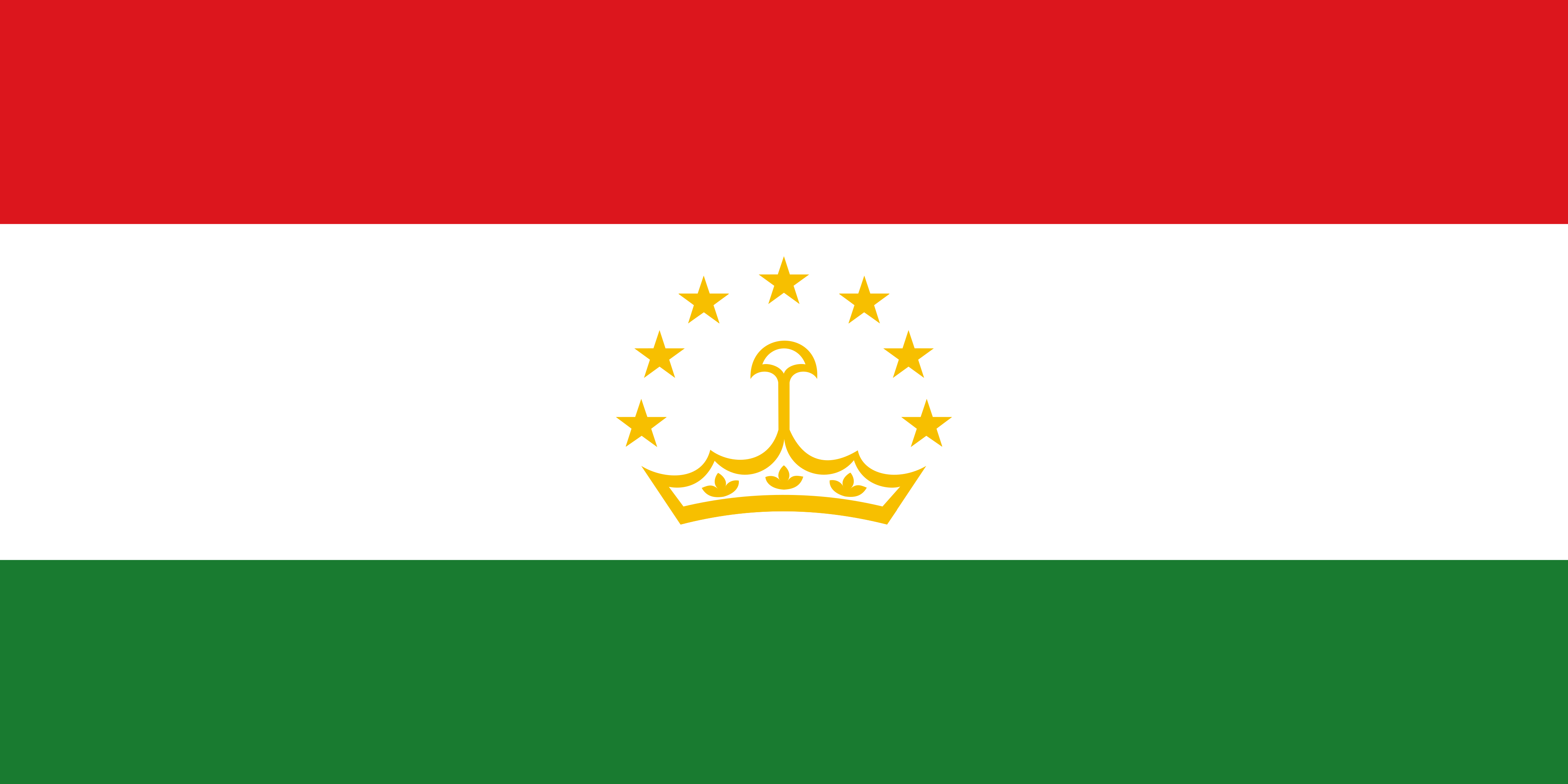
The last Communist leader of Tajikistan in the Soviet era
Resigning in August 1991, he told the deputies "I will go, but you will regret it," later calling politics "the dirtiest thing in the world."
Qahhor Mahkamov was a mining engineer turned Tajik Communist official who spent decades directing economic planning and republican administration. As perestroika widened national self-awareness and political conflict, he pursued reform within the Soviet framework but faced growing public distrust and nationalist pressure. He became Tajikistan’s first president in 1990, then resigned in 1991 after backing the failed August coup in Moscow. His career shows both the institutional continuity of a Soviet republic and the political limits exposed by its dissolution.
Career timeline
1953Began work as an engineer at the Shurab coal mine
1963–1982Chairman of the Tajik SSR State Planning Committee and deputy chairman of its Council of Ministers
1982–1986Chairman of the Council of Ministers of the Tajik SSR
1985–1991First Secretary of the Communist Party of Tajikistan and member of the CPSU Central Committee
1990Chairman of the Presidium of the Supreme Soviet of the Tajik SSR
1990–1991First President of Tajikistan
2000–2016Lifetime member of Tajikistan’s National Assembly