On 4 November 1956, as Soviet forces attacked, he took refuge with his family in the Yugoslav Embassy.
Géza Losonczy was a Hungarian journalist and politician who emerged from the communist movement while challenging its repression and dogmatism. Alongside Imre Nagy’s reform circle, he became involved in the upheaval over popular mobilization and the limits of one-party rule, serving as a minister of state in the revolutionary government of 1956. Arrested after the Soviet intervention, he died in prison while on hunger strike awaiting trial, his death forming part of the state repression directed at the Imre Nagy group.
Career timeline
1935–1936Editor of the student journal Tovább
1939–1941Joined the Hungarian Communist Party and worked for Népszava
1945–1949Head of domestic politics at Szabad Nép
1949–1951State secretary under culture minister József Révai
1951–1954Imprisoned after a political show trial
1954–1956Journalist at Magyar Nemzet and organizer of the Petőfi Circle
1956.10–11Minister of state in Imre Nagy’s second and third governments
1957Scheduled defendant in the Imre Nagy trial; died in prison during a hunger strike
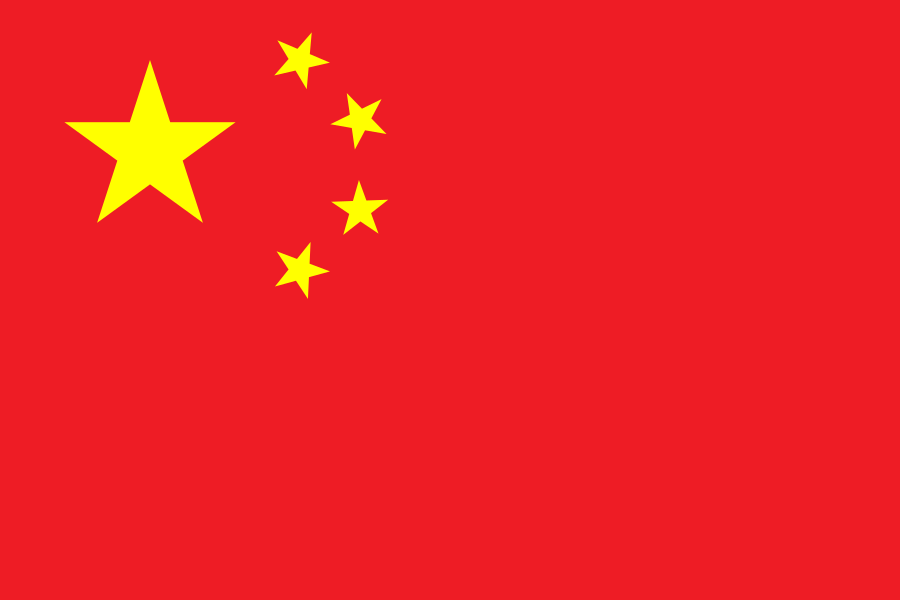
Theoretician of the Gang of Four who organized the Shanghai People's Commune and championed all-round dictatorship over the bourgeoisie
At his 1980 trial, Zhang remained silent and refused to speak until his family was permitted to visit him years later.
A core theoretician of China's Cultural Revolution and member of the Gang of Four. He joined the Chinese Communist Party in 1938 and rose as editor of Shanghai's Jiefang Daily. His 1958 article 'Destroy the Ideology of Bourgeois Right' caught Mao Zedong's attention; as a member of the Central Cultural Revolution Group, he organized the Shanghai People's Commune in 1967, overthrowing the existing municipal government. As vice premier in 1975, he authored 'On Exercising All-Round Dictatorship Over the Bourgeoisie,' formalizing the class-struggle line of the socialist transition, and remained faithful to his Maoist convictions through arrest and imprisonment until his release in 1998.
Career timeline
1938Joined the Chinese Communist Party
1949–1966Editor, Jiefang Daily (Shanghai)
1966–1969Member, Central Cultural Revolution Group
At a Moscow City Committee bureau meeting in October 1961, Demichev was blunt: 'Leaving Stalin's body in the Mausoleum would be blasphemy.' Days later, on the night of 31 October, the body was secretly removed and buried beneath the Kremlin wall.
Starting as Khrushchev's aide, he served as a candidate Politburo member for 24 years and became a central figure in ideological management. He was a key initiator of Stalin's body removal from the Mausoleum in 1961 (a symbolic peak of de-Stalinization) yet as Brezhnev-era Minister of Culture he enforced conservative control over the arts. Associated with Shelepin's faction but also a patron of 'village prose' writers like Glazunov and Soloukhin, he defied simple categorization. He remained a steward of Soviet culture and ideology through the system's final decades.
Career timeline
1950sRises through the Moscow party organization and Central Committee propaganda line
1961–1974CC secretary for ideology and culture, managing post-thaw cultural control
1974–1986Minister of Culture, overseeing official arts, performance and publishing administration
after 1986Leaves the central stage as cultural policy changes under Gorbachev
Partisan commander “Vanagas” who led the Union of Lithuanian Freedom Fighters from 1952, the last commander to be captured
Born to a Lithuanian immigrant family in New Britain, Connecticut, he came to Lithuania at the age of three. He graduated from the War School of Kaunas in 1940 and worked as a teacher, and after the NKVD pressured him to spy on his students he joined the partisans in early 1945 under the nom de guerre Vanagas (“Hawk”). He commanded the Dainava military district and the Southern Lithuania Region, published underground newspapers, and in 1949 became first deputy chairman of the Union of Lithuanian Freedom Fighters. Succeeding Jonas Žemaitis as its leader in 1952, he ordered an end to armed struggle in favour of passive resistance. Betrayed by a former classmate, he was arrested in October 1956, tortured and executed in November 1957. The Simon Wiesenthal Center has alleged that a unit he commanded in the June 1941 uprising took part in killing Jews; the Lithuanian government denies this.
Career timeline
1940Graduated from the War School of Kaunas
1945Joined the partisans; brigade commander
1947Commander of the Dainava military district
1949First deputy chairman of the Union of Lithuanian Freedom Fighters
From Izvestia editor to Soviet of the Union chairman: a Brezhnev-era media mandarin who became the face of the supreme legislature
When Andropov took power after Brezhnev's death, Tolkunov — who had once worked alongside him in the Central Committee — asked to return to newspaper work. Andropov offered him Pravda; Tolkunov chose Izvestia instead.
A Soviet journalist and state leader born into a railway worker's family who began as a Pravda reporter in 1938. During World War II he served as a war correspondent across multiple fronts, and from the early 1960s worked in the CPSU Central Committee's department for relations with socialist countries, managing the party's external propaganda line. Appointed editor-in-chief of Izvestia in 1965, he led the paper for 11 years before being transferred to head the Novosti Press Agency in 1976, then returned to Izvestia in 1983 when his old CC colleague Andropov came to power. Elected Chairman of the Soviet of the Union in 1984, he served until 1988 as the institutional head of the USSR's supreme legislative body.
Career timeline
1938–1939Reporter, Pravda information dept → literary contributor, assistant to editor-in-chief
Stalin's son-in-law who criticized Lysenko, recanted, then built Rostov University over 31 years as rector
Stalin at the Politburo, turning on Yuri Zhdanov: "What, don't you know that our entire agriculture rests on Lysenko?"
Son of Andrei Zhdanov and briefly Stalin's son-in-law, Yuri Zhdanov was appointed head of the CC Science Department at age 28 in 1947, becoming a key science-policy official in late Stalinism. In April 1948 he publicly criticized Lysenko's theories (Stalin summoned him to the Politburo with the rebuke "Don't you know our entire agriculture rests on Lysenko?") and Zhdanov was forced to publish a humiliating recantation in Pravda. He took part in the 1950 antisemitic campaign against Jewish scientists, yet after Stalin's death he rebuilt his career as rector of Rostov State University (1957–1988), transforming it over 31 years into one of the USSR's top universities. An organic chemist with over 800 publications, he discovered acylotropy and chaired the North Caucasus Scientific Center.
Career timeline
1941–1945Instructor and literary propagandist, Main Political Directorate, Red Army
1947–1948Head of the Science Department, Agitprop Directorate, CC VKP(b)
1948–1950Head of the Science Sector, Agitprop Department, CC VKP(b)
1950–1952Head of Science and Higher Education Department, CC VKP(b)/CPSU
1952–1953Head of Natural and Technical Sciences and Higher Education Dept, CC CPSU
1952–1956Member of the CPSU Central Committee
1953–1957Assistant, docent, professor, Rostov State University; Head of Science and Culture, Rostov obkom
The official who exposed the fabricated Doctors' Plot
The review team's conclusion in 1953 was unequivocal: “The Doctors' Plot was fabricated, the doctors were innocent, and they should be released.”
Nikolai Mesyatsev was a postwar Soviet Komsomol and state official whose career reveals the tension between political direction and factual investigation. In 1953, assigned by Malenkov to review the Doctors' Plot and the Abakumov case, he helped establish quickly that the doctors' case had been fabricated. He later recalled that Stalin himself had ordered a review before his death, a disputed testimony that must be weighed alongside other evidence. He subsequently led Soviet state television and radio, overseeing the construction of the Ostankino center and the expansion of multi-program broadcasting.
Career timeline
1941–1945Investigator, Navy commissariat, NKVD Special Departments and SMERSH
1946–1952Official, Central Committee of the Komsomol
1953State security investigative unit, review of the Doctors' Plot
1955–1959Secretary, Komsomol Central Committee
1962–1964Minister-counsellor in China; deputy head of CPSU international-relations department
1964–1970Chairman, Soviet State Committee for Television and Radio Broadcasting
1970–1972Soviet Ambassador Extraordinary and Plenipotentiary to Australia
1972–1988Senior researcher and head of historical sciences, INION
Lithuanian partisan leader who crossed the Iron Curtain in 1947 to seek Western support and was killed by the MGB after returning
Born to a farming family in the village of Juodbūdis near Kaunas, he joined the Catholic youth organisation Ateitis and the far-right, antisemitic and anti-Soviet Lithuanian Activist Front (LAF) at secondary school, and was imprisoned by the NKVD during the Soviet occupation of 1940–1941. After the Red Army returned in 1944 he worked in the Kaunas underground, joined the armed resistance in 1946 and commanded the Birutė brigade of the Tauras military district. At the end of 1947 he crossed the Iron Curtain with partisan documentation for the West, was trained by French intelligence and the CIA, and wrote Fighters for Freedom. Parachuted back by the CIA in 1949–1950, he was killed by the MGB near Pabartupis in the autumn of 1951. According to several witnesses he took part in the Lietūkis garage massacre in Kaunas in 1941; the Lithuanian government denies this.
Career timeline
1940–1941Imprisoned by the NKVD
1946Joined the armed resistance; commander of the Birutė brigade
Youngest member of the Ulbricht Group who fled to Yugoslavia in 1949 and became a leading Western scholar of Soviet communism
Born Vladimir Leonhard in Vienna, he went into Soviet exile with his Communist mother in 1935; she was arrested in 1936 and spent twelve years in the Vorkuta camps. After the Comintern school he became an announcer for Radio Free Germany, and on 30 April 1945 he returned to Berlin as a member of the Ulbricht Group. He worked in the agitation and propaganda department of the KPD and then SED Central Committee and from 1947 lectured at the party college. Convinced that Germany would replicate the Soviet system, he fled via Czechoslovakia to Yugoslavia in March 1949 and moved to West Germany in 1950. His 1955 memoir Die Revolution entlässt ihre Kinder became an international bestseller, and from 1966 to 1987 he taught Soviet history at Yale.
Longest-serving Pravda editor and gatekeeper of Brezhnev-era print orthodoxy
He said he refused to investigate 'the dirty linen of our history.'
A Marxist philosopher turned journalist, Afanasyev served as editor-in-chief of Pravda from 1976 to 1989, the longest tenure in the paper's history, and for 13 years was the ultimate gatekeeper of Soviet print orthodoxy. Under him Pravda reached its peak circulation of 10.6 million, and as chairman of the USSR Journalists' Union and a Central Committee member he faithfully translated the party line into newsprint. He authored the widely used textbook Fundamentals of Philosophical Knowledge and became a full member of the USSR Academy of Sciences. Dismissed in 1989 after reprinting an Italian newspaper's article on Boris Yeltsin's alleged drinking and being forced to issue an unprecedented apology, his fall marked the collapse of the old editorial order under glasnost.
Career timeline
1940–1953Red Army service, paratroops and SMERSH counterintelligence officer
1953–1960Lecturer and department head, Chelyabinsk Pedagogical Institute
1960–1968Professor, Academy of Social Sciences, CPSU Central Committee
1968–1974Deputy and first deputy editor-in-chief, Pravda
Zamyatin delivered the sharpest criticism yet of the Carter administration, declaring the U.S. was 'embarking on the role of world gendarme,' and became the first high-level Soviet official to publicly charge that Hafizullah Amin was a CIA agent. — FRUS, January 28, 1980
A Soviet diplomat and party propaganda chief who, as Director General of TASS and Chairman of the CPSU Central Committee International Information Department, oversaw the USSR's foreign information and propaganda apparatus under Brezhnev. He led the team of ghostwriters for Brezhnev's three-volume memoirs, winning the Lenin Prize in 1978. In his later years he served as ambassador to the United Kingdom, until he was forced to resign for refusing to condemn the August 1991 coup. He was a central figure in the management of the Soviet Union's external image and information control during the Cold War.
Career timeline
1944–1946Graduates Moscow Aviation Institute and Higher Diplomatic School, enters MFA
1946–1962Serves in MFA at UN and IAEA missions, becomes Permanent Representative to IAEA
1962–1970Head of MFA Press Department, managing foreign announcements and press briefings
1970–1978Director General of TASS, head of the USSR's official news agency
1978–1986Chairman of CC International Information Department, directing party foreign propaganda
1978Leads ghostwriting team for Brezhnev's memoir trilogy, awarded Lenin Prize
1986–1991Soviet Ambassador to the UK, forced to resign after refusing to condemn August coup
The party functionary who ran Soviet cinema as a state Hollywood: blockbusters, Oscars, and ideological control
When Andropov called after watching 'Siberiade' and demanded, 'Isn't this an anti-Soviet film?', Yermash replied, 'I'm a Siberian myself — that's how it was,' and the film stood.
Filipp Yermash chaired the USSR State Committee for Cinematography (Goskino) from 1972 to 1986, controlling all Soviet film production, distribution, and censorship throughout the Brezhnev stagnation era. Born to a Siberian peasant family and a decorated WWII sapper, he rose through the Komsomol and Sverdlovsk party apparatus to become cinema sector head at the Central Committee's culture department in 1962. As Goskino chairman, he pursued mass-audience blockbusters like 'Moscow Does Not Believe in Tears' and 'Air Crew' alongside auteur works by Tarkovsky and Konchalovsky, restructuring the industry around profitability in a bid to build a Soviet Hollywood. Removed after fierce criticism at the 1986 filmmakers' congress, his tenure nonetheless saw Soviet cinema win two Oscars.
Career timeline
1941–1945Red Army sapper; Order of the Red Star, Medal for Courage
1951–1956Second then First Secretary, Sverdlovsk City Komsomol
1956–1962Head, Dept of Science, Schools & Culture, Sverdlovsk Regional Party Committee
1962–1972Cinema sector head → Deputy head, CC Culture Dept
1972–1986Chairman, USSR State Committee for Cinematography (Goskino)
Brezhnev-era chief of all Soviet publishing and censorship
Rebuking publishers who dared print positive reviews of Bulgakov's work, he declared: 'I don't understand why we should publish a writer who never accepted Soviet power.'
As chairman of Goskomizdat for twelve years under Brezhnev, he controlled the entire Soviet publishing apparatus, all books, newspapers, and magazines, making him the de facto chief of censorship. A journalist by training, he rose from regional newspaper editor to deputy editor of Pravda before taking the helm of the State Committee for Publishing in 1970. Under his watch, the USSR led the world in per-capita book production and undertook ambitious projects like the 200-volume Library of World Literature, yet he remained an ideological hardliner who publicly attacked publishers for issuing positive reviews of Bulgakov, a writer who 'never accepted Soviet power.' After Andropov came to power, he was promoted to head of the CC Propaganda Department, but Gorbachev sidelined him to the ambassadorship in Hungary.
Career timeline
1940–1941Literary contributor, district newspaper Novaya Zhizn, Voronezh Oblast
1942–1946Radio specialist, Western and 2nd Belorussian Fronts; entered Berlin
1948–1960Editor of district and regional newspapers, culminating as editor of Voronezh Oblast party organ Kommuna
1960–1963Instructor and sector head for press, radio, and TV, CC Propaganda Department for the RSFSR
1963–1965Chairman, RSFSR Council of Ministers State Committee for Publishing
1965–1970Deputy editor, then first deputy editor, Pravda
1970–1982Chairman, USSR State Committee for Publishing, Printing and the Book Trade (Goskomizdat)
1982–1985Head, CC Propaganda Department
1985–1990Ambassador Extraordinary and Plenipotentiary to Hungary
The architect of glasnost: the ideology chief who dismantled the ideology
May 19, 1983, on Eugene Whelan's farm in Amherstburg, Ontario. Walking a lane between corn and soybean fields, Yakovlev later said he "threw caution to the wind" and told Gorbachev what he considered utter stupidities in foreign affairs. By the end of that walk the two were comrades in reform.
Born 2 December 1923 in the village of Korolyovo, Yaroslavl province, into a peasant family. Called up in 1941, he commanded a marine infantry platoon on the Volkhov Front, was gravely wounded in the legs in August 1942, and was demobilised in February 1943. He joined the party in 1944, moved to the Central Committee apparatus in 1953, and studied at Columbia University in 1958–59 as an exchange student. In November 1972 an article against great-power chauvinism pushed him out of the party apparatus; from 1973 he spent ten years as ambassador to Canada. He became director of IMEMO in August 1983, then propaganda chief in 1985 and a full Politburo member in 1987, driving glasnost and the re-examination of history. In 1989 he chaired the inquiry that confirmed the secret protocols. He died in Moscow on 18 October 2005 after a long illness.
Career timeline
1941–1943Marine platoon commander; gravely wounded August 1942, demobilised February 1943
1953–1972Rises through the CC apparatus to acting deputy head of propaganda
1973–1983A decade as ambassador to Canada
1983–1985Director of the IMEMO institute
1985–1990Propaganda chief and Politburo member: designs glasnost
1989–Chairs the secret-protocols inquiry, then the rehabilitation commission
A Soviet European who excavated dialectical logic from Marx's Capital
“Idealism is not the elementary error of a naive schoolboy imagining a ghost. Idealism is a speculative interpretation of the objectivity of the ideal form — the fact of its existence in the space of human culture, independent of the will and consciousness of individuals.” — Dialectics of the Ideal, 1976
The most original thinker in Soviet Marxist philosophy. He formalized the dialectical method of ascent from the abstract to the concrete as the core logic of Marx's Capital, and argued in his landmark 1962 article 'The Ideal' that ideal forms exist objectively in culture, language and signs, not as products of individual brains, igniting a lasting philosophical controversy. His ideas provided the foundation for V.V. Davydov's developmental education theory and for Meshcheryakov's Zagorsk experiment in deaf-blind education. His magnum opus Dialectical Logic (1974) expanded Marxist dialectics from epistemology into a philosophy of culture and mind.
Career timeline
1942–1945Artillery lieutenant, 1st and 2nd Belorussian Fronts, fought to Berlin
1950Graduated Moscow University philosophy faculty with distinction; aspirantura
1953Researcher, Institute of Philosophy, USSR Academy of Sciences (for life)
1955Banned from teaching at Moscow University for 'Hegelianism'
1960Published The Dialectics of the Abstract and the Concrete in Marx's 'Capital'
1962Published 'The Ideal' in the Philosophical Encyclopedia
1968Defended doctoral dissertation; published On Idols and Ideals
1974Published magnum opus Dialectical Logic: Essays in History and Theory
Khrushchev's son-in-law and the editor who turned Izvestia into the most-read Soviet newspaper of the thaw
“Don't have a hundred roubles, marry like Adzhubei” — the Moscow joke of the 1950s that captured how thoroughly his rise was entwined with being Khrushchev's son-in-law.
Alexei Adzhubey was the face of Soviet journalism during the Khrushchev thaw. As editor-in-chief of Izvestia from 1959 to 1964, he transformed the staid government organ into a lively, widely read daily, quadrupling its circulation from 1.6 million to over 6 million. He spearheaded the creation of the Union of Journalists of the USSR in 1959, co-authored the Lenin Prize-winning Face to Face with America (1960) about Khrushchev's US visit, and secured an exclusive interview with President John F. Kennedy in 1961. His bold decision to publish Aleksandr Tvardovsky's banned satirical poem Tyorkin in the Other World in Izvestia in 1963 showed he was more than just Khrushchev's son-in-law: he was a genuine editorial innovator who pushed the boundaries of permissible speech.
Career timeline
1943–1945Red Army, Moscow Military District Song and Dance Ensemble
1947–1952Journalism faculty, Moscow State University
1951–1957Komsomolskaya Pravda, editorial board
1957–1959Editor-in-chief, Komsomolskaya Pravda
1959–1964Editor-in-chief, Izvestia
1959Initiated founding of the Union of Journalists of the USSR
1960Co-author, Face to Face with America; Lenin Prize
1961–1964Member, CC CPSU; Deputy, Supreme Soviet of the USSR
1963Published Tvardovsky's banned Tyorkin in the Other World in Izvestia
1964Stripped of all posts after Khrushchev's ouster; demoted to department head at Soviet Union magazine
The International Department theorist who designed Soviet Third World policy under Brezhnev
Brutents and the International Department experts judged the 1979 Afghanistan invasion 'stupid.' Their boss Ponomarev, who might have conveyed that view, was excluded from the decisive December meetings.
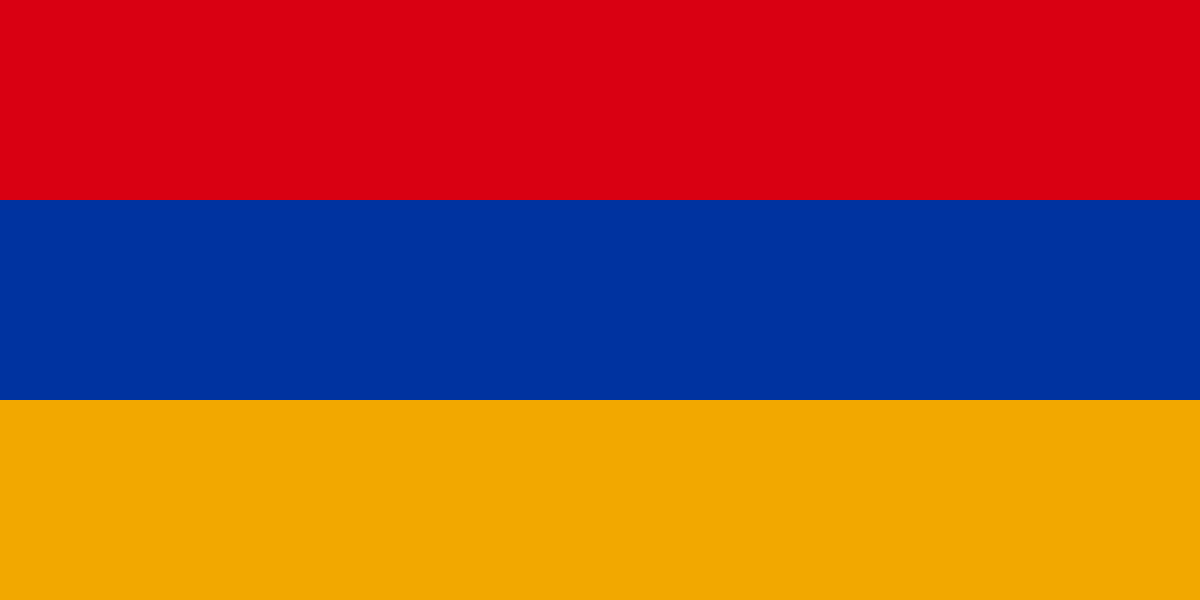
An Armenian-born Soviet International Department theorist, he was the operational architect of Soviet Third World policy under Brezhnev and early Gorbachev. As First Deputy Head he led the formulation of the 'national democracy' concept, and was one of the few inside the department to argue against the Afghanistan invasion.
Career timeline
1946–1948Psychiatrist, Baku psychiatric hospital
1950–1954Lecturer, Baku City Committee of the CPSU
1954–1958Postgraduate, Academy of Social Sciences; defends candidate dissertation in 1958
1961–1969Head of national-liberation movement department, Problems of Peace and Socialism (Prague)
1961–1976Responsible posts in the CC International Department, planning Third World policy
1976–1986First Deputy Head, CC International Department
1986–1990Candidate member, CPSU Central Committee
1997–2017Vice-President, Russian Foreign Policy Association
The physicist who held the Kremlin to the Helsinki human-rights promises it signed
At his closed trial in May 1978 he told the court: 'Trials like these cannot cure the ills and failings of society to which the documents of the Helsinki Group bear witness.'
A particle-accelerator physicist who became the founder of the Soviet Union's first human-rights monitoring group. In 1956 he called Stalin and Beria 'killers who held power' at a party meeting and was expelled and dismissed; twenty years later, in May 1976, he founded the Moscow Helsinki Group to monitor Soviet compliance with the Helsinki Final Act's human-rights provisions. It was an effort to turn the third-basket promises the Kremlin had itself signed back against it from within. Arrested in February 1977 and sentenced to seven years' camp plus five years' exile, he was stripped of citizenship and deported to the United States in 1986, ending as a professor of physics at Cornell.
Career timeline
1952–1956Physicist in the secret nuclear laboratory later ITEP
1956Denounces Stalin and Beria; expelled from the Party and dismissed
1956–1972Yerevan Physics Institute; Doctor of Sciences in 1963
1968Corresponding member of the Armenian Academy of Sciences
1973Founds the first Amnesty International group in the USSR
1976.05Founds and chairs the Moscow Helsinki Group
1977–1986Arrested; sentenced to seven years' camp and five years' exile
1986Denationalized and deported; professor at Cornell
The psychiatrist who diagnosed colonialism itself as the disease
“For Europe, for ourselves and for humanity, comrades, we must set afoot a new man.” — The Wretched of the Earth, 1961
Psychiatrist and anti-colonial revolutionary from Martinique. His Black Skin, White Masks (1952) dissected the psychological violence of colonialism; The Wretched of the Earth (1961) theorized the liberation struggle. Joined the Algerian FLN and died of leukemia at thirty-six.
Career timeline
1944–1945Fights with the Free French forces
1952Black Skin, White Masks
1953–1956Runs the Blida hospital, treating torture's victims and its practitioners alike
1956–1961Joins the FLN; editor and roving ambassador
A Brezhnev favorite who became the Soviet face of dialogue with Eurocommunism
"Brezhnev's favorite was Ponomarev's first deputy, Vadim Zagladin," recalled Stanislav Menshikov. "Gifted hunting trophies, taken on trips, in photos always right behind the General Secretary."
For 24 years in the CC International Department (13 as First Deputy Head under Boris Ponomarev), he was Moscow's key interlocutor with Western European communist parties. Close to Mitterrand, Brandt, and Napolitano during the Eurocommunist era, he articulated a reformed communism converging with European social democracy and, with Ivan Frolov, co-developed the 'new political thinking' that underpinned Gorbachev's foreign policy.
Career timeline
1949–1952Graduates from MGIMO and begins teaching there
1954–1964Journalist at New Times (Moscow) and Problems of Peace and Socialism (Prague)
1964–1967Consultant, CC International Department
1967–1975Deputy Head, CC International Department
1975–1988First Deputy Head, CC International Department — manages Western European communist party relations under Ponomarev
1988–1991Advisor to Mikhail Gorbachev
1992–2006Advisor, Gorbachev Foundation; Vice-President, Euro-Atlantic Cooperation Association
The East German Politburo spokesman whose mistake brought down the Berlin Wall
Asked 'When does it take effect?' at the press conference, he shuffled through his papers and replied: 'As far as I know… immediately, without delay.'
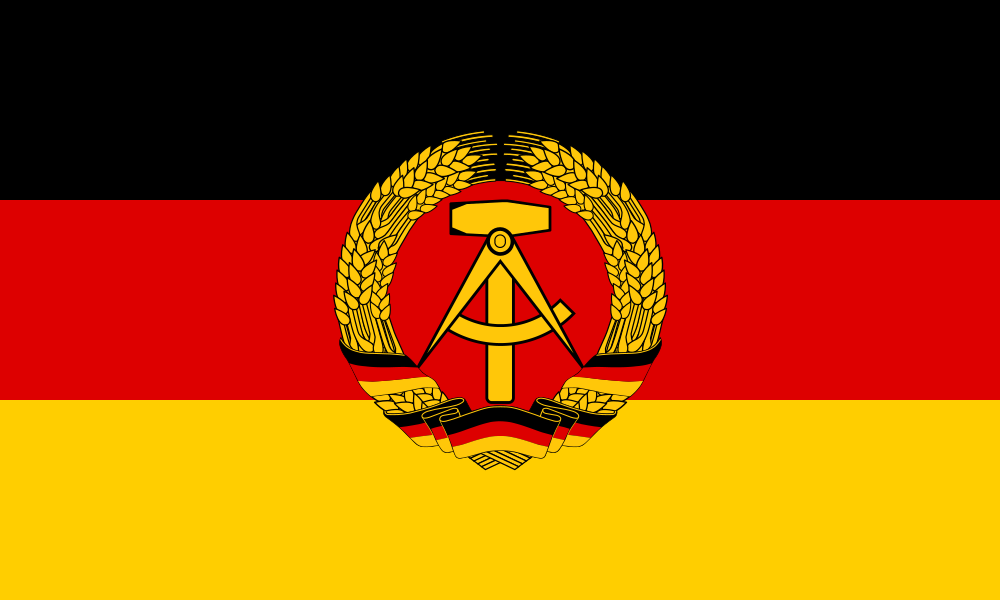
The GDR's leading propagandist, he rose from editor-in-chief of Neues Deutschland to SED Politburo member and First Secretary of East Berlin. On 9 November 1989, asked at a press conference when new travel regulations would take effect, he answered 'immediately, without delay,' triggering the rush that breached the Berlin Wall that night. He later called his mistake 'the final nail in the coffin' of the regime; after reunification he was convicted for the border deaths, but his public acceptance of moral guilt earned him a reduced sentence.
Career timeline
1947Began journalism career as editor at FDGB paper Tribüne
1952Joined the SED
1967–1968Studied at the CPSU party academy in Moscow
1978–1985Editor-in-chief of Neues Deutschland, the SED central organ
1981–1989SED Central Committee member and Politburo candidate, full member from 1984
1985–1989First Secretary of the SED East Berlin district
1989.11.09Triggered the Wall's fall by announcing travel rules effective immediately
1997–2000Sentenced to 3 years for border deaths; pardoned after serving one
Writer and economist, rapporteur of Benin's National Conference
In the 10 March 1991 first round he took third place with 165,174 votes (14.21%); one reference gives 162,498 votes instead.
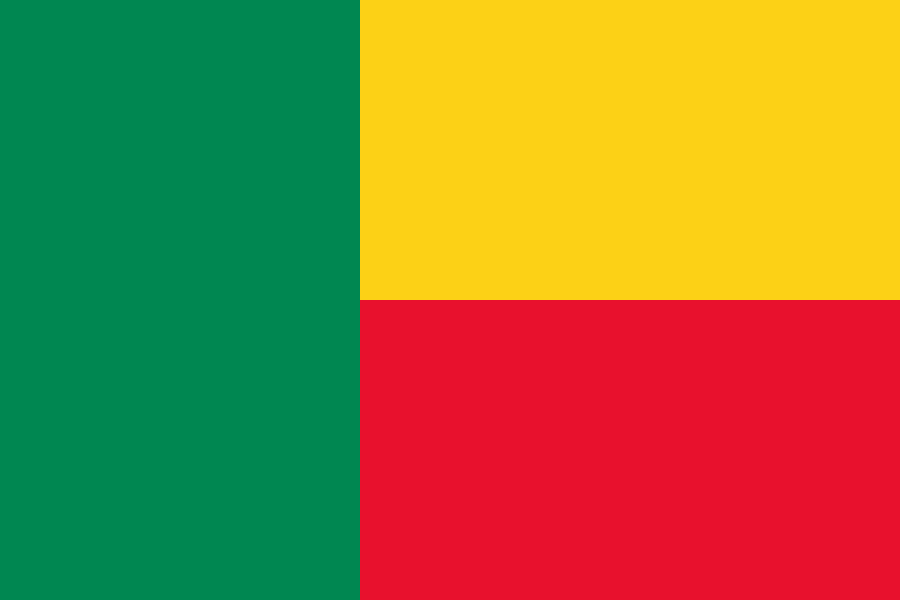
Beninese writer, economist and politician. Born in Porto-Novo in 1929, he served as Dahomey's information minister from 1960 to 1963. In the 1991 presidential election he placed third in the first round with 14.21% as the candidate of Notre Cause commune, and in 2006 he became Benin's first Médiateur de la République.
Career timeline
1958–1960In Paris wrote L'Afrique révoltée and Afrique debout and edited the left-wing paper L'Étudiant Noir.
1960–1963Secretary of state at the presidency and information minister of Dahomey.
1964–After a Harvard International Affairs Center appointment he taught at the Geneva Graduate Institute and Georgetown University.
1991–1996National Assembly deputy and chair of the commission on foreign relations, cooperation, development, defence and security.
1996–1999Minister of Planning, Economic Restructuring and Employment Promotion.
2006–2013First Médiateur de la République of Benin.
The last ideology secretary who dismantled ideology opened the spetskhran and abolished party orthodoxy
In autumn 1988 he obtained Solzhenitsyn's works through the KGB. He admired One Day in the Life but dismissed Gulag Archipelago as mere polemic — then opened the spetskhran and returned Solzhenitsyn's published books to the open shelves.
A peasant's son from Yaroslavl, Medvedev earned a doctorate in economics from Leningrad University, rose through the propaganda and science departments, and became CC secretary in 1986 and Politburo member with the ideology portfolio in 1988. He repealed Zhdanov's 1946 crackdown on the journals Zvezda and Leningrad, abolished subscription limits on periodicals, and returned forbidden books, including works by Solzhenitsyn and Trotsky, from the spetskhran to open library shelves. He replaced CPSU history and scientific communism courses with 20th-century socio-political history and served on the commission re-examining Stalin-era repressions. A core Gorbachev intimate, he left all posts with the Soviet collapse and spent his remaining decades as a researcher at the Gorbachev Foundation.
Career timeline
1951–1968Graduates Leningrad University economics; professor, doctorate
1968–1970Secretary, Leningrad city party committee
1970–1978Deputy head, CC Propaganda Department
1978–1983Rector, CC Academy of Social Sciences
1983–1986Head, CC Science and Education Department
1986–1990CC Secretary, then Ideological Commission chair and Politburo member
1990–1991Member, USSR Presidential Council
1992–2025Researcher, Gorbachev Foundation and RAS Institute of Economics
Principal architect of the Brezhnev-era 'developed socialism' doctrine
In January 1986, he sent Gorbachev a letter warning that the perestroika he had launched 'faces inevitable failure.' Days later he was dismissed as editor of Kommunist.
A Soviet social philosopher and theorist who served as editor-in-chief of Kommunist, the CPSU's chief theoretical journal, from 1976 to 1986. He was the principal systematizer of 'developed socialism,' the official ideology of the Brezhnev era, arguing that the USSR had reached a mature stage of socialism requiring prolonged consolidation rather than a rapid leap to communism. His orthodox Marxism set him against reformist thinkers such as Anatoliy Butenko and Alexander Tsipko, and he became an early target when Gorbachev launched perestroika. In January 1986 he sent Gorbachev a letter predicting the reforms would fail, and was immediately dismissed from Kommunist; he spent his later decades at Moscow State University and led the revival of Stalin's collected works.
Career timeline
1955Graduated from Moscow State University, Faculty of Philosophy
1955–1958Bryansk Oblast Komsomol committee
1958–1959Instructor, Armavir Pedagogical Institute
1961–1964Lecturer, MSU Faculty of Philosophy
1966–1974Consultant to deputy head, CC CPSU Propaganda and Agitation Dept.
1974–1976First deputy editor-in-chief, Pravda
1976–1986Editor-in-chief, Kommunist
1976–1986Full member, CPSU Central Committee
1979–1987Deputy, Supreme Soviet of the USSR (Tajik SSR)
1986–2015Professor and senior researcher, MSU Faculty of Philosophy