On 1 March 1921, before the Kronstadt uprising, Kalinin entered the fortress unarmed with his wife, was met with applause at Anchor Square, but the sailors derailed his speech with jeers and catcalls.
A peasant-born Bolshevik metalworker who became the Soviet Union's formal head of state from 1919 until his death in 1946, serving 27 years as the country's nominal president. He signed the key laws of the mass-repression period, including the 7 August 1932 decree on state property, the 1 December 1934 decree on simplified terror cases, and the 7 April 1935 decree lowering criminal responsibility to 12. He also approved a cipher from the Belarusian first secretary proposing to shoot 3,000 and expel 9,800 people, and in March 1940 signed the order to execute 25,700 Polish officers and prisoners. Yet on 4 May 1932 he voted against the expulsion of 38,000 peasant families as unfounded, and the reversal halted the operation.
Stalin's close friend and the 17-year organizational backbone of the Soviet state, the first fall that opened the Great Purge
"Coco, they are old Bolsheviks like me, like you. You won't shed the blood of old Bolsheviks!" Yenukidze tried to dissuade Stalin from putting Kamenev and Zinoviev on trial and executing them. Stalin replied: "Remember, Avel — whoever is not with me is against me."
An Old Bolshevik (party member since 1898), co-founder of the Baku Social-Democratic organization and the underground 'Nina' press in the Caucasus. As Secretary of VTsIK (1918–1922) and then the TsIK of the USSR (1922–1935), he managed the apparatus of the Soviet state's highest formal body for 17 years, across the formation and consolidation of the Union. A close member of Stalin's inner circle and godfather to Nadezhda Alliluyeva, he was the first individual recipient of the Order of Lenin (No. 3). His expulsion in 1935, the first member of the XVII Congress Central Committee to fall, was a significant prelude to the Great Purge.
Career timeline
1898Co-founder of the Baku Social-Democratic organization
1901–1906Co-founded and ran the underground 'Nina' press in the Caucasus
1902–1914Arrested seven times; exiled to Kresty, Metekhi Castle, Onega, Turukhansk
1917Petrograd Soviet executive committee, VRK member, October uprising participant
1918–1922Secretary of the All-Russian Central Executive Committee (VTsIK)
1922–1935Secretary of the Central Executive Committee (TsIK) of the USSR
1932First individual recipient of the Order of Lenin (No. 3)
1935/1959Expelled from CC and party; arrested and shot 1937; rehabilitated 1959
On 9 January 1905, 16-year-old factory worker Nikolai Shvernik witnessed the 'Bloody Sunday' shootings before the Winter Palace. That autumn he joined the Bolsheviks.
A Petersburg worker who joined the Bolsheviks at 17, he built the Soviet trade-union system as First Secretary of the All-Union Central Council of Trade Unions for 14 years. He succeeded Kalinin as Chairman of the Supreme Soviet Presidium in 1946, though real power lay with Stalin and the Politburo. During the war he directed industrial evacuation and the Nazi atrocities investigation commission; after Stalin's death he worked with Khrushchev as head of the Party Control Committee, overseeing the rehabilitation of victims of political repression.
Career timeline
1920s–1930sRises through trade-union and party administration
1938–1946Chairman of the Soviet of Nationalities, a pillar of Stalin-era formal federal representation
1946–1953Chairman of the Supreme Soviet Presidium, the titular head of state
1953–1956Moves into trade-union and state-administrative elder roles after Stalin
1956 이후Works on rehabilitation and discipline issues through party-control bodies
Architect of Byelorussian Soviet statehood who turned the gun on himself
On 16 June 1937, publicly denounced at the Party congress for insufficiently purging 'enemies of the people,' Chervyakov returned to his office during the recess and shot himself. Officials attributed it to 'family reasons.'
He signed the 1919 manifesto proclaiming the Byelorussian SSR and served as its first head of government and state (1920–1937). A USSR Central Executive Committee co-chairman, he championed Belarusisation and founded the Belarusian State University. He shot himself in 1937 amid the Great Purge after Party censure.
Career timeline
1909–1915Rural teacher in Vilna Governorate; graduated from Vilna Teachers' Institute (1915)
1915–1917Served in the Imperial Russian Army; graduated from Alexandrovsk Military School (1916), ensign
1917.5Joined RSDLP(b); helped lead the founding of the Belarusian Social Democratic Labour Party
1918.1–6Commissar for Belarusian Affairs (Belnatskom), RSFSR People's Commissariat of Nationalities
1919.1Signed the BSSR proclamation manifesto as member of the Provisional Workers' and Peasants' Government; People's Commissar for Education, Litbel SSR
1920–1924Chairman, Council of People's Commissars (first) and Chairman, CEC of the BSSR
1922–1937Co-chairman of the USSR Central Executive Committee (four-member presidium alongside Kalinin, Petrovsky, Narimanov)
1924–1937Chairman, Central Executive Committee of the BSSR
At the October 1939 Vilnius celebrations, Paleckis publicly demanded President Smetona's resignation — and was arrested and sent to a forced-labor camp. Eight months later, under Soviet auspices, he returned as Lithuania's new head of state.
He became a leader during Lithuania’s Sovietization and later chaired the Soviet of Nationalities. He is a symbolic figure of Baltic republic representation.
Career timeline
1920s–1930sWorks as a Lithuanian left-wing journalist and politician
1940Becomes head of the people’s government during Soviet annexation of Lithuania
1940–1967Chairman of the Lithuanian SSR Presidium, the official face of the republic
1966–1970Chairman of the Soviet of Nationalities, symbolizing Baltic republic representation
1970 이후Retires into honorary posts and memoir work
The 20-year formal head of state of the Russian republic under Brezhnev
"He had the firm administrative hand of an authoritative man and knew construction better than anyone." — Contemporary assessment
Mikhail Yasnov rose from leather worker and courier to the formal head of state of the Russian SFSR for nearly two decades. As Moscow City Executive Committee chairman (1950–1956), he directed the second reconstruction of the capital: completing the Stalinist high-rises, launching mass housing in the southwest, opening the metro ring line, and doubling residential construction. He served briefly as RSFSR premier (1956–1957), then spent nineteen years as Chairman of the RSFSR Supreme Soviet Presidium (1966–1985), the republic's ceremonial head of state throughout the Brezhnev era. A construction engineer who had directed Moscow's defensive fortifications during the Battle of Moscow, he was remembered by contemporaries as harsh but effective.
Career timeline
1918–1922Courier, People's Commissariat of Health RSFSR
1922–1928Leather factory worker
1925Graduated workers' faculty, Moscow State University; joined CPSU
1928–1930Military service, Red Army
1930–1938Managerial posts in Moscow construction trusts
1938–1949Deputy/First Deputy Chairman, Moscow City Executive Committee; directed defensive construction during Battle of Moscow
1949–1950Deputy Minister of Urban Construction, USSR
1950–1956Chairman, Moscow City Executive Committee; simultaneously Chairman of the Soviet of the Union (1950–1954)
1956–1957Chairman, Council of Ministers of the RSFSR
1957–1966First Deputy Chairman, Council of Ministers of the RSFSR
1966–1985Chairman, Presidium of the Supreme Soviet of the RSFSR (republican head of state)
The Latvian who chaired the Soviet of Nationalities for a decade under Brezhnev
On December 8, 1983, at a Human Rights Day press conference, Rubenis described the exiled Andrei Sakharov as "a talented but sick man" whose banishment to Gorky "was necessary above all for himself, to preserve his peace of mind."
A Moscow-born Latvian Soviet politician who served as Chairman of the Latvian SSR Council of Ministers and Chairman of its Supreme Soviet Presidium before chairing the Soviet of Nationalities (1974–1984) for a decade under Brezhnev. His decade-long tenure was a rare case of a non-Russian republican cadre stably occupying a key federal parliamentary post, and he exemplified the loyal technocrats Arvīds Pelše elevated after the 1959 purge of Latvian national communists.
Career timeline
1934–1941Worked as agronomist after graduating from technical school
1942–1943Editor, Stakhanovsky Trud district newspaper, Rybinsk
1947–1948Second Secretary, Daugavpils Uyezd Committee, CP Latvia
1958–1960Head of Agriculture & Procurement Dept, Gosplan of Latvian SSR
1960–1961Head of Agricultural Dept, CC CP Latvia
1962–1970Chairman, Council of Ministers of the Latvian SSR
1970–1974Chairman, Presidium of Supreme Soviet of Latvian SSR; Deputy Chairman, Presidium of USSR Supreme Soviet
1974–1984Chairman, Soviet of Nationalities of the USSR Supreme Soviet
Uzbek SSR figure who chaired the Soviet of Nationalities
In a meeting with Crimean Tatar civil rights activists, she openly opposed their return to Crimea, bluntly stating that Uzbekistan needed their labor.
Rising from the Uzbek republic leadership, she chaired the Soviet of Nationalities. Her career shows the link between central power and republic elites under Brezhnev.
Career timeline
1940s–1950sRises through Uzbek Komsomol, party and state administration
1959–1970Chairwoman of the Uzbek SSR Supreme Soviet Presidium
1970–1974Chairwoman of the Soviet of Nationalities, reaching a high post in central federal representation
1974Leaves office amid Uzbek leadership changes and political pressure
A Soviet republican leader who asserted institutional authority in crisis
“A state of emergency was declared and troops were sent in without the republic’s consent.”
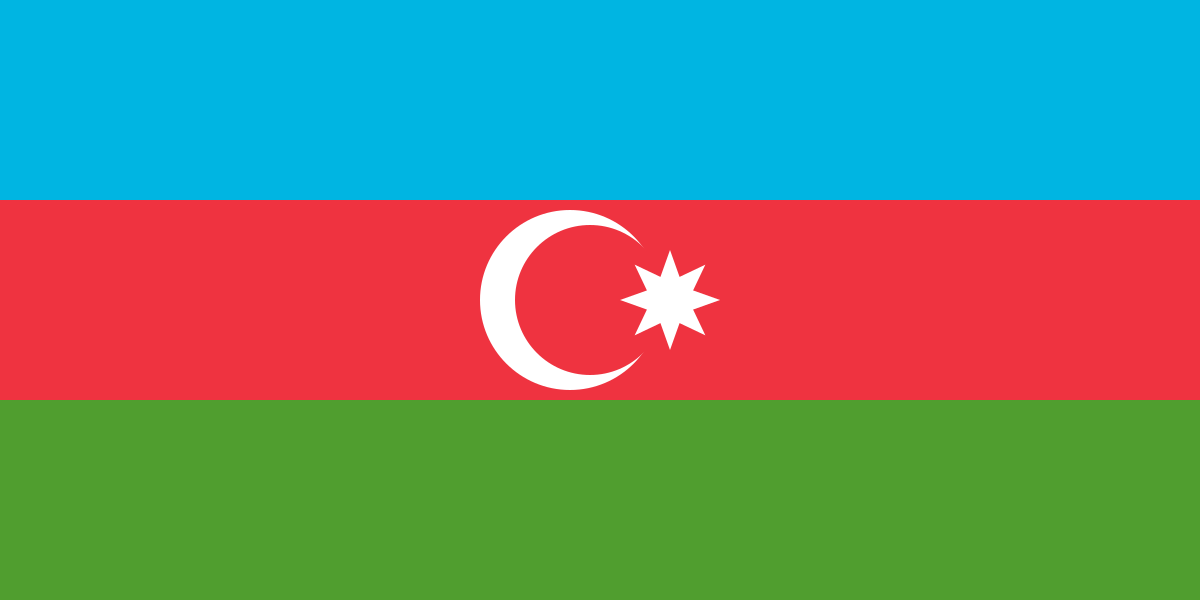
Elmira Kafarova was an Azerbaijani Soviet politician and diplomat who moved through education and foreign-affairs administration before leading the republic’s Supreme Soviet. In January 1990, she publicly protested the declaration of emergency in Baku and the entry of Soviet troops, stating that the decision had been taken while she was in Moscow and without her knowledge. Her institutional dissent, unusual within the Soviet republican leadership, illuminates how the nationalities crisis became a collision among republican institutions, a mass movement, and Union power.
Career timeline
1958Graduated from Azerbaijan State University; pursued philological research
1966–1970First Secretary of the Komsomol Central Committee of the Azerbaijan SSR
1971Ideology secretary of the Baku City Party Committee
1980–1983Minister of Education of the Azerbaijan SSR
1983–1987Minister of Foreign Affairs of the Azerbaijan SSR
1987–1989Deputy Chair of the Council of Ministers of the Azerbaijan SSR
1989–1990Chair of the Presidium of the Supreme Soviet of the Azerbaijan SSR
1990–1992Chair of the Supreme Soviet of Azerbaijan
Ukrainian SSR head of state during Chernobyl who pushed the evacuation of 526,000 children from Kyiv against Moscow's resistance
Recalling the interior deputy minister's report on the morning of 26 April 1986: 'The fire was put out, everything is fine. The people? Some are having a wedding, some are gardening, some are fishing in the Pripyat River.'
As Chairwoman of the Presidium of the Supreme Soviet of the Ukrainian SSR during the Chernobyl disaster, she defied Moscow's directives and oversaw the evacuation of 526,000 children from Kyiv and contaminated zones in just five days. Born the daughter of a miner in Kryvyi Rih, she rose through Komsomol and the deputy ministry of education to become the republic's formal head of state in 1985, spending her tenure navigating between central information control and the realities on the ground. In 1989 she refused to sign the resolution banning the People's Movement of Ukraine (Rukh), and after retirement led children's and women's welfare foundations while maintaining a sympathetic view of the Soviet system and a critical stance toward independent Ukraine.
Career timeline
1954–1957Pioneer leader, geography teacher, school Komsomol secretary in Kryvyi Rih
1957–1962Secretary of Kryvyi Rih city Komsomol, then Dzerzhinsky district party committee
1962–1969Secretary and department head, Komsomol Central Committee of Ukraine
1969–1972Deputy Minister of Education, Ukrainian SSR
1975–1985Deputy Chair, Presidium of the Supreme Soviet, Ukrainian SSR
1985–1990Chair of the Presidium, Supreme Soviet, Ukrainian SSR (head of state)
1985–1989Deputy Chair, Presidium of the Supreme Soviet, USSR