Night, 16 April 1917 (3 April O.S.), Finland Station, Petrograd. Returning from exile, Lenin spoke from an armoured car, condemning the Provisional Government and calling for a continent-wide European proletarian revolution; over the following days he set out the April Theses.
Lenin was a Russian revolutionary, politician and theorist, born Vladimir Ilyich Ulyanov in Simbirsk in the Russian Empire. He led the Bolshevik faction from the 1903 RSDLP split and directed the October Revolution of 1917. His government redistributed land, nationalised banks and large industry, withdrew from the First World War by the Treaty of Brest-Litovsk, and promoted world revolution through the Communist International. At the same time its state security services carried out the Red Terror, in which tens of thousands were killed or interned, and it defeated right- and left-wing anti-Bolshevik armies in the Civil War of 1917–1922. Facing wartime devastation, famine and popular uprisings, he proposed the New Economic Policy in 1921. He died at Gorki on 21 January 1924, and Stalin succeeded him as the pre-eminent figure in the Soviet government.
Career timeline
1895–1900Arrest; Siberian exile
1900–05Iskra and What Is to Be Done?; the Bolshevik faction forms
1902Published What Is to Be Done?
1909Published Materialism and Empirio-criticism
1914–17Zimmerwald Left: turn the imperialist war into civil war
1916Wrote and published Imperialism, the Highest Stage of Capitalism
1917.4Returns; the April Theses
1917.10Forces the insurrection; chairs Sovnarkom
1918–21Brest peace, civil war, War Communism
1918Published The State and Revolution, written in 1917
1921The retreat into NEP
1922–24Strokes; dictates the Letter to the Congress
The leader born to a poor Georgian family who came to dominate party and state
At 4:30 a.m. on 22 June 1941 Zhukov and Timoshenko came to the Kremlin to report the German invasion. By Zhukov's account Stalin was pale, holding an empty, untobaccoed pipe. When Molotov reported Germany's declaration of war, he sank silently onto a chair and fell into a long pause.
Born 18 December [O.S. 6 December] 1878 to a poor family in Gori, Georgia, he joined the Marxist RSDLP as a youth and edited Pravda, raising Bolshevik funds through robberies and kidnappings while enduring repeated arrests and internal exile. After the October Revolution of 1917 he entered the party's governing Politburo and helped oversee the founding of the USSR in 1922, the year he became General Secretary. Collectivisation and rapid industrialisation followed, along with the 1932–33 famine and the Great Purge, then victory in the Second World War. He died at the Kuntsevo dacha on 5 March 1953. In his lifetime 1879 was also held to be his birth year.
Career timeline
1902–17Underground work, repeated exile; Pravda in 1917
1913Published Marxism and the National Question
1917–22Commissar of Nationalities; the Tsaritsyn front
1922General Secretary: the power of appointment
1924Published Foundations of Leninism
1928–33The Great Break: collectivization, the Five-Year Plans
1936–38The Great Terror
1941–45Chairs the GKO; Supreme Commander
1945–53Postwar rule and Cold War; dies March 1953
1952Published Economic Problems of Socialism in the USSR
He opened the coffin lid, and became the first leader to die in bed
On 18 November 1956, at a reception at the Polish embassy in Moscow, he told Western ambassadors: "Whether you like it or not, history is on our side. We will bury you!" Envoys of twelve NATO nations and Israel walked out.
He rose through the party apparatus in Stalin's shadow, and after Stalin's death won the power struggle of 1953 to become First Secretary. On 25 February 1956 his Secret Speech to a closed session of the 20th Party Congress denounced Stalin's purges and launched de-Stalinization. He crushed the 1956 Hungarian uprising with Soviet troops, and in the 1962 Cuban Missile Crisis withdrew the missiles in exchange for a U.S. pledge not to invade Cuba. His colleagues voted him out on 14 October 1964; in retirement he wrote memoirs, and he died in Moscow on 11 September 1971.
Career timeline
1935–38Moscow First Secretary; the Metro
1938–49First Secretary of Ukraine
1942–43Military council member at Stalingrad
1953–64First Secretary of the party
1954–56The Virgin Lands; the Secret Speech
1957Defeats the Anti-Party Group
1961The 22nd Congress; Stalin’s body moved out of the mausoleum
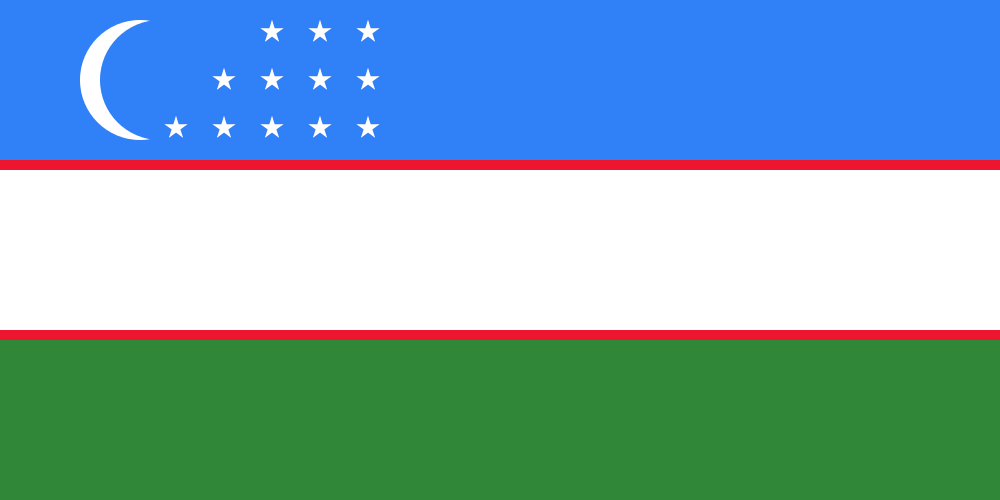
First ethnic Uzbek to head the CP of Uzbekistan, who drove collectivization and cotton monoculture before the Great Purge destroyed him
"I am now a stripped, human-like beast." Recorded as Ikramov's last word at the Third Moscow Trial in March 1938, though other sources give the variant "you have turned me into an animal," so the exact wording is not settled.
Born in September 1898 in Tashkent into an Uzbek peasant family. He joined the Bolsheviks in February 1918, led party organs in Turkestan during the Civil War, and was secretary of the CC of the CP of Turkestan in 1921–1922. After studying at Sverdlov Communist University from 1922, he sat on the Orgburo that founded the CP of Uzbekistan in 1924–1925. From 1929 he was First Secretary, the first ethnic Uzbek in the post, and drove forced collectivization, making Uzbekistan the USSR's main cotton supplier. Elected to the all-Union Central Committee in 1934, he was dismissed in 1937, arrested on 20 September 1937, sentenced to death at the Third Moscow Trial in March 1938 and shot. Fully rehabilitated and restored to the party in June 1957.
Career timeline
1918–1920Teacher and inspector, Namangan education; head of rural work, Fergana oblast committee
1920–1921Deputy chairman Namangan revkom, chairman Muslim Bureau, executive secretary Fergana and Syrdarya oblast committees
1921–1922Head of organization department and secretary, CC CP of Turkestan
1922–1924Studied at Sverdlov Communist University, Moscow
1924–1929Orgburo for founding CP Uzbekistan; secretary Tashkent oblast; CC second secretary; editor of Kommunist
1929–1937First Secretary, CC CP Uzbekistan — drove collectivization and cotton monoculture
1934–1937Member, CC VKP(b) — sole ethnic-minority member
1937–1938Dismissed and arrested; sentenced to death at Third Moscow Trial; executed
On 7 October 1979, at the GDR's 30th-anniversary celebrations in East Berlin, photographer Régis Bossu captured Brezhnev and Erich Honecker in a socialist fraternal kiss. The photograph became the basis of Dmitri Vrubel's 1990 Berlin Wall mural, 'My God, Help Me to Survive This Deadly Love'.
He took part in Khrushchev's removal and replaced him as First Secretary, consolidating power by the late 1960s. He was General Secretary from 1964 until his death in 1982, and twice Chairman of the Presidium of the Supreme Soviet, 1960–1964 and 1977–1982. After the Khrushchev Thaw his rule brought increased repression and censorship: by the mid-1970s an estimated 10,000 political and religious prisoners were held. Hostile to reform, he presided over the 'Era of Stagnation' of corruption and shortages; after 1975 his health collapsed and he withdrew from governing while remaining the highest authority. Abroad he ordered the 1968 invasion of Czechoslovakia and approved the 1979 intervention in Afghanistan, while pursuing détente and reaching nuclear parity with the United States. He was made a Hero of the Soviet Union four times; his 1978 Order of Victory was annulled in 1989.
Career timeline
1950–52First Secretary of Moldavia
1954–56Runs the Virgin Lands campaign in Kazakhstan
1964.10Leads Khrushchev’s removal; becomes First Secretary
1968The invasion of Czechoslovakia; the Brezhnev Doctrine
1972–79Détente: SALT I and II, the Helsinki Accords
The philosopher Stalin elevated to the Politburo in his final act
In his 1964 book Historical Materialism, Chesnokov broke with the Stalinist line: 'Dogmatists and sectarians who extend the dictatorship of the proletariat to the entire period of socialism essentially share Stalin's erroneous thesis on the intensification of class struggle under socialism.'
Soviet Marxist philosopher and party ideologue. A specialist in historical materialism and Herzen's worldview, his 1948 study won the Stalin Prize in 1951. As editor of Voprosy Filosofii (1949–1952) and then head of the CC Philosophy and History Department and editor of Kommunist (1952–1953), he rose to the core of late Stalinist ideological management. At the 19th Congress in October 1952 Stalin elevated him to the Presidium (the last philosopher on the party's supreme body) only for him to be removed the day after Stalin's death. After serving as a Gorky regional official and chair of State Radio and Television, he returned to Moscow State University, where in his 1964 book he openly repudiated Stalin's thesis on intensifying class struggle under socialism.
Career timeline
1931–1943Lecturer and department head, Sverdlovsk University
1943–1947Department head, then propaganda secretary, Sverdlovsk City Committee
1947–1948Deputy head, Science Department, CC Propaganda Directorate
1948–1951Deputy director, Institute of Philosophy, USSR Academy of Sciences
1949–1952Editor-in-chief, Voprosy Filosofii
1952–1953Presidium member; head of Philosophy & History Dept; editor, Kommunist
1953–1957Department head, then secretary, Gorky Regional Committee
1957–1959Chairman, State Committee for Radio and Television
1959–1967Head, Dept of Historical Materialism, Moscow State University
1967–1970Vice-rector, Academy of Social Sciences, CC CPSU
February 1985: the first General Secretary to receive a ballot in his hospital bed — a campaign won without a single speech
A Brezhnev aide who became General Secretary after Andropov, but whose failing health sharply limited his rule. His short tenure became the interlude before Gorbachev.
Career timeline
1984–1985General Secretary
1984–1985Chairman of the Presidium of the Supreme Soviet
A Belarusian party leader who combined agricultural development with late-Soviet reform
He called himself a “progressive conservative” who restrained innovation pursued merely for its own sake.
An agricultural specialist by training, Yefrem Sokolov rose through local administration and party work to become a practical leader of Soviet Belarus. He expanded the Brest region's productive infrastructure through large livestock complexes and road construction, receiving the title Hero of Socialist Labour in 1986. During perestroika he called for clearer ownership rules and wider republican economic authority, and ordered the publication of maps showing radioactive contamination in Belarus after the Chernobyl disaster, while describing himself as a progressive conservative wary of innovation for its own sake. He left the republican party leadership in 1990 and briefly served on the CPSU Politburo that year.
Career timeline
1944–1950Served in the Red Army's 5th Separate Reserve Sapper Regiment
1956–1958Agronomist and agricultural inspector in Brest Region
1958–1961Second secretary of the Ivanovo district party committee
1961–1965First secretary of the Urlyut yub district party committee and other posts in the Kazakh SSR
1969–1977Deputy head and head of the agricultural department of the Communist Party of Belarus Central Committee
1977–1987First secretary of the Brest Regional Party Committee
1987–1990First secretary of the Communist Party of Belarus Central Committee
1990Member of the CPSU Central Committee Politburo
In the small hours before his election as General Secretary on 11 March 1985, back from the Politburo meeting, Gorbachev told Raisa in the garden: "We cannot go on living like this." Reform began with those words.
The reformer the system elected for itself. He tried to save it with glasnost and perestroika, decided in 1989 that the tanks would not fire in Eastern Europe, and in 1991, confined for three days at his Foros dacha, signed the papers in which his own office ceased to exist. Applauded abroad and resented at home, he outlived the country he ended by thirty-one years.
Career timeline
1970–78First Secretary of Stavropol region
1978–85CC Secretary for agriculture; Politburo at forty-nine
1985.3Elected General Secretary
1986–88Glasnost and perestroika; Chernobyl
1987–89The INF treaty, the Afghan withdrawal, non-intervention in Eastern Europe
1990First president of the USSR; the Nobel Peace Prize
Last First Secretary of the Ukrainian Communist Party on the eve of the Soviet dissolution
Addressing the Central Committee upon his election as First Secretary in June 1990: "We will never return to the days when the party monopolised power. But neither will we allow Ukraine to become a testing ground for political experiments."
A mechanical engineer by training, Gurenko rose from technologist to factory director at the Donetsk Machine-Building Plant before turning to party work in 1976. He served as secretary of the Donetsk Oblast Party Committee and deputy chairman of the Ukrainian SSR Council of Ministers, and took part in the disaster response as deputy chairman of the state commission after the 1986 Chernobyl accident. Backed by Gorbachev, he became First Secretary of the Ukrainian Communist Party Central Committee and a full member of the CPSU Politburo in June 1990, only to resign in August 1991 when party activity was banned after the failed coup. In independent Ukraine he returned to parliament and chaired the economic policy committee, helping reorganize the former communist political current.
Career timeline
1958–1976Donetsk Machine-Building Plant: engineer-technologist → director (1970–1976)
1976–1980Secretary, Donetsk Oblast Committee, Communist Party of Ukraine
1980–1987Deputy Chairman, Council of Ministers, Ukrainian SSR
1986Deputy Chairman, State Commission for the Chernobyl accident
1987–1990Secretary → Second Secretary, CPU Central Committee
1990–1991First Secretary, CPU Central Committee; Member, CPSU Politburo
1998–2006People's Deputy, Verkhovna Rada (3rd–4th convocations); Chairman, Committee on Economic Policy
A Moscow party organizer at the Soviet Union's end
His life, he later recalled, was divided into a before and after the Communist Party ban.
Yuri Prokofyev was a Soviet party cadre who rose through Moscow's party and administrative organizations. As first secretary of the Moscow City Party Committee, he worked at the point where reform collided with the party's disintegration, and joined the Politburo in 1990. He was involved in the activity of the State Committee on the State of Emergency in 1991 without being a member, then turned to memoir writing and technology enterprises after the Soviet Union and the Communist Party were banned.
Career timeline
1957Pioneer leader at a Moscow school
1960Joined the Communist Party of the Soviet Union
1968Cadre in the Moscow City Party Committee's organizational work
1977–1985Secretary and first secretary of the Kuibyshev District Party Committee in Moscow
1986–1988Secretary of the Moscow City Executive Committee
1988–1989Secretary and second secretary of the Moscow City Party Committee
1989–1991First secretary of the Moscow City Party Committee
1990–1991Member of the CPSU Central Committee and Politburo
A Georgian party official at the edge of Soviet collapse
“The law should be enforced, but it should be enforced without victims.”
Givi Gumbaridze was a Communist Party official who rose from archival and party-organizational work to the top leadership of the Georgian Soviet Socialist Republic. A former state-security chief, he governed as national mobilization intensified and party rule collided with popular demands. After the bloody Tbilisi crackdown of 1989, he called for both accountability and order, but could not reverse the crisis of Soviet authority.
Career timeline
1966–1967Served in the Soviet Army
1968–1972Researcher in Georgia’s central state archives and aide in the republic’s Supreme Soviet apparatus
1977–1983Official in the Georgian Communist Party Central Committee’s administrative-organs department
1983–1985First Secretary of the Zestafoni District Party Committee
1988First Secretary of the Tbilisi City Party Committee
1988–1989Chairman of the Georgian SSR Committee for State Security
1989–1990First Secretary of the Communist Party of Georgia
1990–1991Member of the CPSU Politburo
1989–1990Chairman of the Presidium of the Supreme Soviet of the Georgian SSR