Stalin’s spymaster who eliminated Trotsky, then spent fifteen years in Stalin’s prisons
Beria was not in the least interested in whether the people we recommended were guilty or innocent. He asked one single question: 'Are you sure we need them?' — Special Tasks
Born the son of a miller in Melitopol, he joined the Red Army at twelve and survived the lawless chaos of the Civil War before rising through the GPU as a covert operative. In 1938 he assassinated OUN leader Yevhen Konovalets in Rotterdam on Stalin's personal order, and in 1940 he and Naum Eitingon ran Operation Duck, eliminating Leon Trotsky. During the German-Soviet war, as head of the 4th Directorate he directed partisan and sabotage warfare behind enemy lines and oversaw atomic espionage (Group S). Arrested in 1953 as Beria's 'accomplice,' he served fifteen years in prison, then wrote historical novels under a pseudonym and was fully rehabilitated in 1992 after the USSR collapsed. His memoir Special Tasks is the first insider account of the Soviet intelligence services' most secret operations.
Career timeline
1919–1921Red Army boy soldier; captured, escaped, homeless in Odessa
1921–1932GPU and OGPU intelligence officer in Ukraine
1933–1938INO OGPU/NKVD — infiltrated OUN in Berlin, covert operations abroad
1938Assassinated Konovalets in Rotterdam; acting head of NKVD foreign intelligence (Nov–Dec)
1939–1941Deputy head of foreign intelligence; Operation Duck — Trotsky assassination
1941–1946Head of 4th NKVD Directorate — partisan/sabotage warfare; atomic intelligence Group S
1946–1953Post-war sabotage ops against NATO; deputy head of MVD First Chief Directorate (1953)
1953–1968Arrested as Beria accomplice; 15-year sentence served in Vladimir Prison
1968–1996Released, wrote novels under pseudonym; fully rehabilitated 1992, published Special Tasks
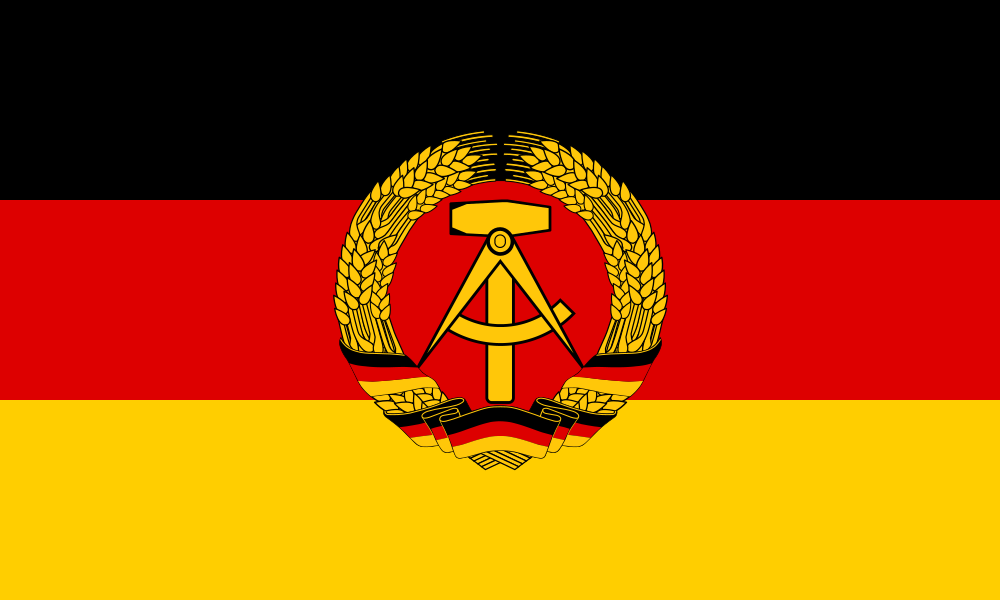
East Germany's 'Master of Fear': the Stasi chief who ruled state security for 32 years
“All this blithering over to execute or not to execute, for the death penalty or against — all rot, Comrades. Execute! And, when necessary, without a court judgment.” — to senior Stasi officers, 1982
A communist militant from Berlin's Wedding district, Mielke fled to the USSR after the 1931 killing of two Berlin policemen and was trained by the NKVD. After the Spanish Civil War he returned in 1945 to help build the GDR's state security apparatus, leading the Stasi from 1957 to 1989 and expanding it into a 90,000-strong surveillance network. The Stasi controlled all of East German society while training armed groups across the Third World and Western Europe, extending socialist-bloc security architecture. He fell with the regime in 1989 and was convicted after reunification for the 1931 murders.
Career timeline
1925Joined the KPD
1931Fled to USSR after Bülowplatz police murders
1936–1939Served in International Brigades, Spain (Captain)
1945Returned to Berlin, Police Inspector Lichtenberg
1950Deputy Minister of State Security, State Secretary
1957–1989Minister for State Security (Stasi chief)
Stalin's security chief who commanded SMERSH and ruled the MGB
In 1949, interrogating the eminent scientist Lina Stern, he shouted "Why you old whore!" She replied: "So that's the way a minister talks to an academician."
Stalin's late-era security chief who rose from Red Army volunteer at 14 through the OGPU and Gulag, survived the Great Purge, and was entrusted with SMERSH, the wartime military counterintelligence directorate, where his direct line to Stalin earned him absolute trust. As MGB minister after the war, he designed and executed the Leningrad Affair purges and the crackdown on the Jewish Anti-Fascist Committee, serving as Stalin's key counterweight to Beria. In 1951, denounced by a subordinate for allegedly covering up the Doctors' Plot, he was devoured by the very apparatus he had built; after Stalin's death he was tried for fabricating the Leningrad Affair and shot in 1954.
Career timeline
1930sRises in the NKVD through Great Terror-era security work
1943–1946Heads SMERSH, the wartime military counterintelligence directorate
1946–1951Minister of State Security, commanding the postwar security apparatus
1949–1951Involved in postwar purge episodes such as the Leningrad Affair
1951–1954Arrested, then tried and shot after Stalin’s death
Prague Spring interior minister whose security reforms were undermined by KGB subversion and internal betrayal
On the day of the invasion, Pavel's dismissed deputy Šalgovič helped the KGB arrest Dubček, and the Interior Ministry slipped from its minister's hands.
A Czechoslovak communist who fought in the Spanish Civil War and commanded the People's Militia during the 1948 coup, Pavel became deputy interior minister and participated in the regime's repressions. Arrested in 1951, he was tortured and sentenced to 25 years in the Slánský trial, then acquitted in 1955. Returning as interior minister during the 1968 Prague Spring, he pushed to reform the StB and exposed six KGB liaison agents in his ministry, but his deputy Viliam Šalgovič collaborated with the KGB to arrest Dubček during the invasion, collapsing Pavel's reforms.
Career timeline
1932Joined Communist Party of Czechoslovakia
1935Studied at International Lenin School, Moscow
1937–1939Fought in Spanish Civil War; commanded Dimitrov Battalion
1947Chief Secretary, Defense and Security Dept, KSČ Central Committee
1948Chief of Staff, People's Militia; Deputy Interior Minister
1951–1955Arrested, tortured; sentenced to 25 years (1953); acquitted and released (1955)
1968.4–8Minister of Interior of Czechoslovakia
1968–1973Forced to resign; expelled from KSČ; died under StB surveillance
The first communist interior minister, builder of the Securitate, purged in 1952 alongside Pauker and Luca for "shielding" them
The May 1952 plenum charged Georgescu with a "conciliatory attitude" toward the right deviation and pushed him out of the Politburo and the interior ministry. The man who had built the Securitate was arrested by that same Securitate the following February.
Born to a working-class family in Chitila near Bucharest, he worked as a typographer, joined the Romanian Communist Party in 1929 and was active in the printers' union. Arrested in 1941 and sentenced to ten years, he served alongside Gheorghiu-Dej in the Caransebeș prison and, released in August 1944, became a secretary of the Central Committee. As interior minister in the Groza government from March 1945 until 1952 he controlled the police and security organs, directing the rigging of the 1946 election, the arrest and trial of Maniu and the National Peasant leadership in 1947, the founding of the Securitate in 1948 and the suppression of armed resistance. Inside the party he stood close to Ana Pauker and Vasile Luca and counted as the third figure of the "Muscovite faction"; at the May 1952 plenum he was removed from the Politburo and the interior ministry for a "conciliatory attitude" toward the right deviation. Arrested in February 1953, he was released without trial in 1956, expelled from the party and put in charge of a printing plant. He was rehabilitated in 1968 when the Ceaușescu leadership reviewed the purges of the Dej era, and died in Bucharest in 1976.
Career timeline
1929Joined the Romanian Communist Party; active in the printers' union
1941–1944Arrested; sentenced to ten years; imprisoned at Caransebeș
1944Released; secretary of the Central Committee
1945–1952Minister of Internal Affairs
1948Oversaw the founding of the Securitate
1952Removed from the Politburo and the interior ministry
1953–1956Arrested; released without trial; expelled from the party
The Mongoose architect whose six-phase Cuba overthrow plan convinced the Soviets invasion was coming
When McNamara asked what the 'x-factor' on his metrics list was, Lansdale replied: 'The feelings of the common rural Vietnamese people.' McNamara erased it and said he couldn't measure it.
A U.S. Air Force major general who turned advertising into a doctrine of psychological warfare, Lansdale first made his name helping crush the Hukbalahap rebellion in the Philippines by weaponizing local folklore, then ran the Saigon Military Mission as a close confidant of Ngô Đình Diệm. In February 1962 he submitted to President Kennedy the six-phase Cuba Project, a schedule that aimed for open revolt and overthrow of the Castro government by the first two weeks of October. The document became a crucial piece of Soviet intelligence: it convinced Moscow that a U.S. invasion of Cuba was imminent and helped trigger the missile crisis. Forced to retire in 1963 after refusing to abandon Diệm, Lansdale was later recognized as a founding figure of modern counterinsurgency and psychological operations.
Career timeline
1941–1947Served in Army Military Intelligence and OSS; promoted to major
1947–1950Transferred to USAF as captain; instructor at Strategic Intelligence School
Interior minister who built the ÁVH secret police, then fell as the first major victim of Stalinist show trials in Eastern Europe
At his show trial, responding to the prosecutor's demand for the death penalty: 'I fully agree with your statements, Mr. Prosecutor, and want to state in advance that I will consider the verdict of the court justified' (September 1949)
A Hungarian Communist politician who served as Minister of Interior (1946–1948), founding the ÁVH secret police and directing the early purges that built the Rákosi regime. He had fought in the Spanish Civil War as political commissar of the Hungarian battalion of the International Brigades and organized the underground resistance during World War II. Seen by Rákosi as a rival, he was demoted to Foreign Minister and then arrested in 1949 on fabricated charges of Titoism, becoming the first major victim of the Stalinist show trials in Eastern Europe. His rehabilitation and reburial on 6 October 1956 before 100,000 mourners became a demonstration against the regime and a key precursor to the Hungarian Revolution three weeks later.
Career timeline
1931Joined the illegal Hungarian Communist Party (KMP) and communist youth league (KIMSZ)
1935Led building-workers' strike; arrested and deported
1937–39Political commissar and party secretary, Hungarian battalion, International Brigades; severely wounded at the Battle of the Ebro
1941–44Returned to Hungary; underground resistance, CC secretary, co-led the Hungarian Front
1946.03–1948.08Minister of Interior — founded ÁVH state security, directed early show trials and purges
1948.08–1949.05Minister of Foreign Affairs
1949.09–10Show trial on charges of Titoist espionage; sentenced to death and executed
1956Rehabilitated; state reburial on 6 October drew 100,000 mourners, precursor to the Hungarian Revolution
Tito's third man, who directed the Cominform purges
Interior minister Ranković wrote after the 1948 split that 'it was impossible to know whom to trust and that one's closest comrades may now be the enemy.'
A Yugoslav communist leader regarded as the third most powerful figure after Tito and Kardelj. In May 1944 he created OZNA, the Partisan security agency; after the war he headed the interior ministry and the State Security Administration (UDBA) and oversaw the anti-Stalinist purges that followed the 1948 Soviet–Yugoslav split, building special camps for Cominformists on Goli Otok and Sveti Grgur in 1949. In Kosovo, the period 1947–1966 is colloquially called 'the Ranković era' for a police-state repression of Albanians; lesser campaigns targeted Hungarians in Vojvodina and Muslims in Sandžak. He opposed federal decentralization and defended centralism, and in 1966 the Brioni plenum removed him from all posts and expelled him from the party. He died in Dubrovnik in 1983.
Career timeline
1928Joined the Communist Party of Yugoslavia
1929–1935Arrested and imprisoned for communist activity
1941–1945Served on Partisan Supreme Staff; founded OZNA (1944)
1946–1953Minister of Interior of Yugoslavia and head of UDBA
1948–1955Directed anti-Cominform purges; built the Goli Otok camp
1963–1966Vice President of Yugoslavia
1966Dismissed from all posts at the Brioni plenum; expelled from the party
State-security officer who led Soviet foreign intelligence for 15 years
His fifteen years at the head of Soviet foreign intelligence were the longest tenure in the history of Soviet and Russian foreign intelligence: acting head from June 1955, confirmed in May 1956, in post until July 1971. This documented record is the core of his significance.
Born on 3 September 1909 in Bolshoye Ozhogino, Kostroma gubernia, to a peasant family; he died on 12 November 1983 and was buried at Novodevichy Cemetery. He worked as a welder and hull marker at Leningrad shipyards and joined the party in February 1930; recruited into the state-security organs in February 1939, he served in the Leningrad NKVD Water Department and in 1940 spent over seven months abroad on intelligence work under cover as assistant captain of the passenger ship Svaneti. During the war he headed the 1st (Intelligence) Department of the Leningrad NKVD/NKGB, preparing reconnaissance-diversionary groups for insertion behind enemy lines. From 1946 he served in the MGB central apparatus and as adviser in Romania. Acting head of the KGB First Chief Directorate from June 1955, confirmed in May 1956, he directed Soviet foreign intelligence until July 1971.
Career timeline
1926–1931Welder and hull marker at Baltic Shipyard and Northern Shipyard, Leningrad
1931–1934Red Army service; graduates evening Communist University at Lenin Military-Political Academy
1934–1939Komsomol and party political worker; secretary of the Baltic Sea Shipping Company party committee
1939–1941Joins NKVD Leningrad Water Department; undertakes reconnaissance missions abroad under shipping cover
1941–1945Heads 1st (Intelligence) Department, NKVD/NKGB Leningrad; infiltrates 40+ sabotage-reconnaissance groups behind German lines
1946–1952MGB central apparatus; missions in Scandinavia, Balkans, and Middle East; adviser to Romanian Securitate
1952–1955Deputy head (from 1954), then first deputy head (from August 1955) of the KGB First Chief Directorate
1955–1971Acting head of the KGB First Chief Directorate from June 1955, confirmed as head in May 1956, in post until July 1971
1971–1975Senior Adviser to the Chairman of the KGB
1939–1941Over seven months abroad on intelligence work in 1940 under cover as assistant captain of the passenger ship Svaneti
1941–1944Deputy head of the Leningrad NKVD/NKGB 1st (Intelligence) Department from August 1941, head from November 1942
Vichy police chief who negotiated with the occupier
On 2 July 1942, he agreed to place the French police at the occupier’s disposal for the arrest of Jews.
René Bousquet was a senior French civil servant who pursued Vichy police collaboration while presenting it as a defense of French administrative sovereignty. He negotiated with German security officials for room to operate a French police force, while supplying that force to the persecution and deportation of Jews. His decisions helped make the July 1942 Vélodrome d'Hiver roundup possible, after which he escaped the main force of the post-Liberation purge and returned to influential business and political circles.
Career timeline
1930Gained national recognition for rescue work during the floods and received the Légion d’honneur
1931Chief of staff to Pierre Cathala at the Interior Ministry
1933Sub-prefect
1939–1942Prefect of the Marne and regional prefect
1942–1943Secretary-general of the Vichy police
1950년대–1993년Businessman and political influence broker in finance and the press
The KGB man who led the GRU for 24 years: Soviet military intelligence's longest-serving chief
On 18 March 1963, KGB colonel-general Ivashutin was introduced to the GRU leadership by Marshal Biryuzov as their new chief — a KGB man sent to clean up after Penkovsky. Everyone assumed he would stay briefly. He stayed 24 years.
Trained as a military pilot before transferring to NKVD counterintelligence, he rose to head SMERSH on the Southwestern and 3rd Ukrainian Fronts during World War II. He became KGB first deputy chairman in 1956 and acting chairman in November 1961. Parachuted into the GRU in 1963 after Penkovsky's betrayal, he stayed for 24 years, the longest tenure in GRU history, building a real-time threat-warning command post, the Lourdes SIGINT station in Cuba, and the Space Intelligence Department. He shaped the institutional foundations of Soviet military intelligence during the Cold War and was named Hero of the Soviet Union in 1985.
Career timeline
1931–39Aviation school → pilot → Zhukovsky Academy → transferred to NKVD
1939–41NKVD special department, 23rd Rifle Corps; Soviet-Finnish War
1941–43Deputy chief, NKVD special departments — Transcaucasian, Crimean, North Caucasus Fronts
Beria's inner circle and an organiser of the Great Terror
On 29 August 1949 he took part in the first Soviet nuclear test, of 22 kilotons, at the Semipalatinsk test site.
A Soviet state-security official and general-lieutenant, he was one of the active organisers of Stalin's Great Terror and a member of Beria's inner circle. He worked as a locksmith at the Konotop mechanical factory, entered the Samara Energy Institute in 1931, and in March 1932 was directed by a party Central Committee decision into the state-security organs, joining the OGPU Higher School. After the February 1941 split of the NKVD he became People's Commissar of State Security of the Ukrainian SSR and organised repressions against OUN members and their families in Western Ukraine. In March 1953 Beria installed him as MVD minister of Ukraine, where he removed oblast MVD chiefs who insisted on a forceful solution against the OUN-UPA; arrested in Kyiv on 30 June 1953, he was executed that December, and in 2000 rehabilitation was refused.
Career timeline
1939–1941Head of the Investigative Unit, NKVD; deputy head of the Main Economic Directorate
1941People's Commissar of State Security, Ukrainian SSR
1941–1943Head of the Economic Directorate, NKVD
1943–1945Deputy head of SMERSH counter-intelligence
1945–1953Deputy head of the First Main Directorate, security and counter-intelligence for the atomic project
Brezhnev's 16-year police chief who rebuilt the MVD into a modern force
In 1971, as the Politburo prepared to expel Solzhenitsyn, Shchelokov submitted a memo — 'On the Solzhenitsyn Question' — proposing to publish Cancer Ward and give him a Moscow apartment. It was rejected, but a serving interior minister going to bat for a dissident writer had no parallel in the Brezhnev era.
A Dnipropetrovsk comrade of Brezhnev, he served a record-breaking sixteen years as Soviet interior minister. He raised police salaries sharply, earmarked 10% of new housing for MVD personnel, and created a network of police academies topped by the USSR's first MVD Academy, elevating the despised militia into a professional state institution. He befriended Rostropovich and Vishnevskaya, petitioned the Politburo to save Solzhenitsyn from exile, and was the first senior official to order the search for Nicholas II's remains. During Andropov's succession purge he was stripped of every rank and decoration and shot himself.
Career timeline
1938–39First Secretary, Krasnogvardeysky district committee, Dnipropetrovsk
1939–41Chairman, Dnipropetrovsk City Soviet — begins working under Brezhnev
1941–45Political commissar, Southern/North Caucasus Fronts; chief of political dept, 218th Div. & 28th Corps; ends war as colonel
1951–65First Deputy Chairman, Moldavian Council of Ministers → Chairman, Moldavian Sovnarkhoz
1965–66Second Secretary, CP Moldavia
1966–82Minister of Internal Affairs (Min. of Public Order until 1968) — 16 years, promoted to Army General
1982–84Transferred to Defence Ministry inspectorate → expelled from CC, stripped of rank & awards on corruption charges
Soviet spy who posed as a German officer in Nazi-occupied Ukraine and personally eliminated high-ranking officials
Surrounded by UPA fighters near Boratyn in March 1944, Kuznetsov pulled the pin on a grenade and blew himself up along with his attackers.
A legendary Soviet intelligence agent and partisan. A linguistic prodigy who mastered six German dialects, he posed as Wehrmacht Oberleutnant Paul Siebert in Rivne, the capital of Nazi-occupied Ukraine, personally eliminating six high-ranking German officials. He was the first to obtain German plans for a massive tank offensive at Kursk and uncovered Operation Long Jump, the plot to assassinate the Big Three at the Tehran Conference. Killed in a firefight with Ukrainian nationalists in 1944, he was posthumously made Hero of the Soviet Union.
Career timeline
1926Enrolled at Tyumen Agricultural College, withdrew after father's death
1927–1929Studied at Talitsa Forestry College, self-taught German, Esperanto, and Polish
1930–1932Forest surveyor in Komi-Permyak Okrug, began cooperating with OGPU
1932–1938Studied at Sverdlovsk Industrial Institute, monitored foreign engineers at Uralmash
1938NKVD special agent, monitored German diplomats in Moscow
1942Joined 'Victors' partisan unit, infiltrated Rivne as Paul Siebert
1943Obtained Kursk tank offensive plans and Long Jump intelligence
1943–1944Eliminated 6+ high-ranking German officials in Rivne and Lviv
1944.3.9Killed in action against UPA near Boratyn
1944.11.5Posthumously awarded Hero of the Soviet Union
Albania's postwar interior minister and deputy premier
Born in Negovani (modern Flampouro, Greece). The Special Court he led in March–April 1945 tried about 60 former public figures and sent 17 to the firing squad; some contemporaries called him the most powerful person in Albania at the time.
A participant in the founding meeting of Albania's Communist Party and a Politburo member from its creation, he headed the Directorate of People's Protection from December 1944 and ran the Sigurimi, then in March–April 1945 led the Special Court that purged opponents. Interior Minister and Deputy Prime Minister in 1946–1948, he was removed, arrested as a Titoist and executed in 1949.
Career timeline
1937Co-founder and first chairman of the Korçë Communist Group; by the late 1930s counted, alongside Enver Hoxha and Koço Tashko, among Albania's prominent communists.
1941–Participant in the founding meeting of the Communist Party of Albania; Politburo and Central Committee member from its creation.
1943Elected organizational secretary in absentia in March; became a member of the General Staff on 10 July.
1944Promoted to lieutenant-general at the Përmet Congress and appointed vice-president of the Anti-Fascist Council of National Liberation (KANÇ).
1944–1946Director of the Directorate of People's Protection (Drejtoria e Mbrojtjes së Popullit), the OZNA-modeled organ that carried out the brutal suppression of regime opponents.
1945Headed the Special Court of March–April 1945, which tried about 60 people and sentenced 17 to be shot and 8 to life imprisonment.
1946–1948Minister of the Interior, Deputy Prime Minister, chairman of the State Control Commission, vice-president of the Presidium of the People's Assembly, and deputy for Korçë.
1948In October moved from Interior Minister to Minister of Industry; stripped of his posts and expelled by the Central Committee; arrested on 28 November.
1949At his May trial he confessed to a Tito-backed assassination plot and was sentenced to death; executed on 11 June.
From Nuremberg assistant prosecutor to chief justice of the USSR, the Supreme Court chairman who presided over political trials
In February 1966, RSFSR Supreme Court Chairman Smirnov personally sentenced writers Andrei Sinyavsky and Yuli Daniel to seven and five years of hard labour for anti-Soviet agitation — they had published satirical fiction abroad under pseudonyms.
A Leningrad University law graduate who joined the procuracy in 1934, he served as assistant to chief Soviet prosecutor Roman Rudenko at Nuremberg (presenting the case for Nazi crimes against civilians across occupied Europe) and as deputy prosecutor at the Tokyo tribunal, establishing Japanese aggression at Lake Khasan and Khalkhin Gol. As chairman of the RSFSR Supreme Court he personally presided over the Sinyavsky–Daniel trial (1966), sentencing two writers to hard labour for publishing satirical works abroad, and in 1972 he became chairman of the USSR Supreme Court, leading the Soviet judiciary through twelve years of the Brezhnev era. He embodied the duality of the Soviet legal establishment: a jurist who prosecuted fascism at international tribunals while enforcing political conformity at home.
Career timeline
1934–1941Senior investigator, Leningrad/Murmansk procuracy; military investigator, Leningrad Front
1942–1946Investigator for especially important cases, USSR Procuracy; assistant to chief prosecutor at Nuremberg
1946–1948Deputy prosecutor from USSR, Tokyo International Military Tribunal
The NKVD sniper lieutenant who shot the Japanese gendarme on Frinovsky's order
On Frinovsky's personal order, Vinevitin, attached to his retinue at Zaozernaya, silenced the Japanese gendarme with a single well-aimed shot to the head.
An NKVD lieutenant of the Posyet border detachment who rose from sniper instructor to chief of its engineering service. On 15 July 1938, at Zaozernaya Hill, he shot dead a Japanese gendarme on Manchurian soil on the personal order of First Deputy Commissar Frinovsky, the spark that ignited the Lake Khasan war. Wounded, he slipped out of hospital to rejoin his unit, then on the night of 1 August was shot by his own sentry after giving the wrong password.
Career timeline
1930–1932Studied at the railway vocational school in Liski
1932–1935Railway road master and section chief; head of the 5th construction section, Uryupinsk
1935Drafted into the NKVD border troops
1935–1938Sniper instructor, then chief of engineering service, Posyet border detachment (lieutenant)
1938.07.15Shot the Japanese gendarme at Zaozernaya on Frinovsky's order
1938.08.01Killed by his own sentry
1938.10.25Posthumously Hero of the Soviet Union and Order of Lenin
Engineer of the Doctors' Plot, NKVD bookkeeper turned deputy minister
Beria's last words to Ryumin: 'You and I will not see each other again. We will liquidate you.' 28 March 1953.
An NKVD bookkeeper who rose to deputy head of the MGB. After denouncing minister Abakumov, he fabricated the Doctors' Plot and drove the culminating anti-Jewish purge of late Stalinism. Arrested after Stalin's death and executed.
Career timeline
1937Joined NKVD as a bookkeeper
1948Assigned to MGB Department for Specially Important Cases
1951Head of Specially Important Cases Dept → Deputy MGB head, engineered Doctors' Plot
The investigator who became Armenia's security minister at thirty-one
Extracting a confession from poet Titian Tabidze in 1937, Krimyan recorded his sole co-conspirator: 17th-century folk hero Saakadze — a name every Georgian knew except the interrogator.
Born into a working-class family in Kars in 1913, Krimyan entered the security organs at eighteen as a trainee with the Transcaucasian GPU. He rose fast inside the Georgian NKVD in Tbilisi during the Great Terror, becoming chief of its Investigative Department, and led the 1937 investigation of Ivan Orakhelashvili. Appointed Armenia's Minister of State Security in 1945 at just thirty-one, he was removed in 1947 for 'un-party behavior' and demoted to Ulyanovsk. Dismissed from the organs entirely in 1951 over illegal arrests and interrogation methods, he was swept up after Beria's fall, tried at Tbilisi, and shot in 1955.
Career timeline
1932–1935Trainee in the Economic Department of the Transcaucasian GPU, then authorized officer
1935–1937Senior operative, then assistant section chief, UGB NKVD of the Georgian SSR
1937–1938Section chief, UGB NKVD of the Georgian SSR
1938–1940Deputy chief, then chief, of the Investigative Department, NKVD of the Georgian SSR
1940–1941Deputy chief of the NKVD Administration for Lvov Oblast
1941–1943Deputy chief of the NKGB and NKVD Administration for Yaroslavl Oblast
1943–1945Chief of the NKGB Administration for Yaroslavl Oblast
1945–1947People's Commissar, then Minister, of State Security of the Armenian SSR
1947–1950Chief of the MGB Administration for Ulyanovsk Oblast
1951–1953Head of the personnel department, Ministry of Food Industry of the Armenian SSR
The Nazi Gestapo chief who made Lyon a center of terror
At his 1987 Lyon trial, he denied the Izieu roundup and said: “I fought the Resistance. It was war.”
Klaus Barbie was an SS and Sicherheitsdienst officer who commanded the Gestapo in occupied Lyon, organizing systematic persecution of the French Resistance and Jews. He arrested and tortured Jean Moulin at Caluire and was responsible for deporting 44 Jewish children and their teachers from Izieu to Auschwitz. After the war, U.S. intelligence used him in anti-communist operations and helped him escape to Bolivia, where he avoided justice for decades before his 1987 Lyon trial and life sentence for crimes against humanity. His case exposes both the continuity of Nazi criminal networks and the impunity produced by Cold War anti-communism.
Career timeline
1935Joined the SS and began service in the Sicherheitsdienst
1940–1941SD service in Amsterdam, targeting Jews and communists
1942Assigned to Dijon for security work in occupied France
1942–1944Head of the Lyon Gestapo, repressing the Resistance and deporting Jews
1947–1951Agent of the U.S. Army Counterintelligence Corps
1951–1983Lived in Bolivia as Klaus Altmann
1987Lyon trial, convicted of crimes against humanity and sentenced to life
Budapest, 1956: from his embassy he watched Hungarian state-security officers strung up from lampposts, and urged military intervention. The sight haunted him for life; in Prague, Kabul and Warsaw, armed force was the only answer he saw.
Andropov was born 15 June [O.S. 2 June] 1914 in Stavropol province according to official data, though sources conflict on his birthplace and ancestry. Trained at Rybinsk water-transport college (1936), he rose through Komsomol work in Karelia, served as ambassador to Hungary (1954–57), headed the Central Committee department for socialist countries (1957–67) and chaired the KGB (1967–82). He directed the repression of dissidents: the Fifth Directorate was created on his proposal in 1967, and Sakharov was exiled to Gorky in 1980. He backed the 1968 intervention in Czechoslovakia and was among the initiators of the 1979 entry into Afghanistan. General Secretary from November 1982, he purged corrupt cadres and set reform planning in motion before his death on 9 February 1984.
Career timeline
1954–57Ambassador in Budapest through 1956
1957–67Heads the CC department for socialist countries
1967–82KGB chairman: the dissident crackdown, the Fifth Directorate
The double agent who made fiction a strategic weapon
On 9 June 1944, he told German commanders that the Normandy landings were only a diversion.
Juan Pujol García was a Spanish double agent who penetrated German intelligence while remaining loyal to Britain during the Second World War. From Lisbon, he built a fictitious network in Britain from public sources and won the confidence of his German handlers. After joining British intelligence, he combined invented agents with carefully timed real information to shape German decisions. In Operation Fortitude, his reports reinforced the story that Normandy was a diversion and that the main assault would come at Pas-de-Calais.
Career timeline
1931Compulsory service in a Spanish cavalry and artillery unit
1936–1939Served on both the Republican and Nationalist sides in the Spanish Civil War
1941–1942Operated from Lisbon as a self-created Abwehr agent
1942Recruited as a British double agent under the codename Garbo
1943–1944Ran the fictitious network with Tomás Harris
1944Spread the Pas-de-Calais main-attack deception in Operation Fortitude
1944Appointed a Member of the Order of the British Empire
The founding father of photo interpretation whose analysts spotted Soviet missiles in Cuba and triggered the crisis
"If there was ever a time I want to be right in my life, this is it": upon confirming the SS-4 missiles in the U-2 photos of Cuba, October 15, 1962
A Chicago-born geologist who began his intelligence career as a Navy photo interpreter during World War II, Lundahl joined the CIA in 1953 to lead its Photographic Interpretation Division and became the founding director of the National Photographic Interpretation Center (NPIC) in 1961, overseeing imagery analysis from U-2 spy planes and early reconnaissance satellites. On October 15, 1962, when NPIC analysts identified Soviet SS-4 medium-range ballistic missile sites in U-2 photographs of Cuba, Lundahl personally confirmed the finding and, saying 'If there was ever a time I want to be right in my life, this is it,' alerted CIA headquarters; the next morning he briefed President Kennedy at the White House. He led NPIC until his retirement in 1973, shaping U.S. imagery intelligence through the Cold War and earning the National Security Medal and an honorary knighthood.
Career timeline
1939–1942B.S. & M.S. in geology, University of Chicago
1942–1945Photo interpreter, U.S. Navy
1946–1953Chief Engineer, Photogrammetry Division, Naval Photographic Interpretation Center
1953–1961Chief, Photographic Interpretation Division, CIA
1961–1973Founding Director, National Photographic Interpretation Center
A survivor who transformed from Stalin's counter-intelligence chief to Brezhnev's trade diplomat
Arrested and tortured in 1951, he refused to confess and instead wrote Stalin a plan to reorganize state security from his cell — a gambit that won his release.
A central figure in Stalin-era Soviet counter-intelligence, he entered the NKVD at 29 and rose rapidly. As head of the MGB Second Chief Directorate (counter-intelligence) from 1946 to 1950, he led the postwar Soviet counter-intelligence apparatus and became Deputy Minister of State Security in 1950. Implicated in the 'Abakumov case' in 1951, he was arrested and imprisoned but refused to confess; rehabilitated after Stalin's death, he briefly headed the MGB First Chief Directorate (foreign intelligence) in early 1953. He later served as KGB advisor in East Germany and China, directed the KGB Higher School from 1962 to 1966, and in his later years chaired the USSR Chamber of Commerce and Industry (1983–1988), coordinating trade diplomacy with industrial espionage.
Career timeline
1938–1944Entered NKVD; headed NKVD/NKGB in Gorky, Kirov, and Kuibyshev Oblasts
1945–1946People's Commissar/Minister of State Security, Uzbek SSR
1946–1950Head of MGB 2nd Chief Directorate (counter-intelligence)
1950–1951Deputy Minister of State Security, USSR
1953Head of MGB 1st Chief Directorate (foreign intelligence)
1953–1957KGB Commissioner and Senior Advisor in East Germany
1962–1966Head of the KGB Higher School
1983–1988Chairman of the USSR Chamber of Commerce and Industry