“Order of the Red Banner No. 1”: Civil War hero and one of the first five marshals, extinguished in Lefortovo
Uniting scattered Red detachments, he fought his way across 1,500 km of the Urals in 54 days. For this immortal campaign Comrade Blyukher is awarded the Order of the Red Banner No. 1. — VTsIK decree, 28 September 1918
A peasant's son from Yaroslavl, he earned the Red Army's first Order of the Red Banner for his epic 1,500-kilometre Ural raid in 1918. Under Frunze he broke through the Perekop defences to expel Wrangel from Crimea, then as C-in-C of the Far Eastern Republic crushed the last White offensive at Volochayevka. As Sun Yat-sen's chief military advisor 'General Galin' he designed the Northern Expedition; he later commanded the Special Far Eastern Army, routing Manchu forces in the 1929 CER conflict. One of the first five Marshals in 1935, he defended the Soviet Far East against Japanese expansion, but was arrested after the costly Lake Khasan battle and died in Lubyanka. Rehabilitated 1956.
Career timeline
1914–1915WWI service, two St. George Crosses, severely wounded and discharged
1916Joined the Bolshevik Party
19181,500-km Ural raid — first Order of the Red Banner
Architect of Comintern propaganda and party history compiler
"We believe that Byelorussians are not a nation, and the ethnographic specifics that differentiate them from Russians must be erased" — in Zvyazda, the newspaper he edited, 6 October 1918.
A Latvian Bolshevik who built party organizations in Belarus and Latvia and twice served as First Secretary of the Communist Party of Byelorussia in the 1920s. As head of the Comintern Information-Propaganda Department he coordinated the ideological line of foreign communist parties, and as director of the Institute of Red Professorship (Party History) he authored the 1935 Short History of the CPSU, the direct precursor to the 1938 Short Course. Arrested in 1937, executed the following year, and rehabilitated in 1955.
Career timeline
1910Joined RSDLP(b)
1917Secretary of Minsk Soviet, editor of Zvyazda
1920–1922Secretary, Central Bureau of CP(b) of Byelorussia
1926–1927Head of Agitprop, CC VKP(b)
1927–1928First Secretary, CC CP(b) of Byelorussia
1928–1937Head of Information-Propaganda Dept., ECCI
1932–1935Director, Institute of Red Professorship (Party History)
1935–1937Deputy Head, Dept. of Party Propaganda & Agitation, CC VKP(b)
Architect of terror in Siberia, recanted his confession under torture
"Choose: the pen or the rubber truncheon." He took the pen, falsely confessed, then wrote to Stalin recanting it all.
Born to a Latvian farmhand, Eikhe joined the Social Democracy at fifteen in 1905. After years as a miner and stoker in Britain, he returned to Russia and, with Stalin's backing, ruled Siberia as its de facto master, driving brutal collectivisation and dekulakisation. A candidate Politburo member from 1935, he sat on an NKVD troika during the Great Terror, signing thousands of summary death sentences. Arrested in 1938, he was beaten with rubber truncheons until an eye was destroyed, yet refused to confess to espionage. In a famous letter to Stalin he repudiated his forced confession. Shot in 1940, Khrushchev cited him in the 1956 Secret Speech and he was posthumously rehabilitated.
Career timeline
1905Joins Latvian Social Democracy
1908–11Exile in Britain: coal miner, ship stoker
1917–19Riga Soviet presidium → Food Commissar of Soviet Latvia
1920Secretary, Chelyabinsk gubernia committee
1925–29Chairman, Siberian Krai executive committee
1929–301st Secretary, Siberian Krai committee
1930–371st Secretary, West Siberian Krai — directs collectivisation and dekulakisation
1935Candidate member, Politburo
1937NKVD troika member → People's Commissar for Agriculture
1938–40Arrested → tortured → recantation letter → shot
Co-creator of Constructivism who turned Suprematism into architecture, the international link of the revolutionary avant-garde
1920 — a red wedge slashing into a white circle. With two geometric shapes and three colors, Lissitzky said everything about the Civil War on a single poster.
Soviet painter, architect, and designer. His PROUN series extended Suprematism into three-dimensional space, and his poster 'Beat the Whites with the Red Wedge' became an icon of revolutionary graphics. He bridged the avant-garde and Western European modernism.
Career timeline
1909–1914Studied architecture at Darmstadt Technical University, graduated with honors
1915–1918Enrolled at Riga Polytechnic (evacuated to Moscow), qualified as engineer-architect
1919–1920Professor at Vitebsk People's Art School; core member of Malevich's UNOVIS group
1920Published 'Beat the Whites with the Red Wedge' poster; began PROUN series
1921–1925Lived in Berlin and Switzerland; co-published Veshch with Ehrenburg; joined De Stijl
1921, 1926–Professor at Vkhutemas and Vkhutein
1927–1928Designed All-Union Printing Exhibition and Soviet pavilion at Pressa (Cologne)
1930–1941Layouts for USSR in Construction, photomontage, designed Ogonyok printing plant
Kazakh nationalist who led the Kokand Autonomy and dreamed of an independent Turkestan
"I cannot accept the offer to lead the Turkestan Legion and refuse further cooperation. All the consequences of my decision, I realize." — Letter to Ribbentrop, 1941
Mustafa Shokay was a Kazakh nationalist political leader who headed the Kokand (Turkestan) Autonomy, the first modern autonomous government in Central Asia after the collapse of the Russian Empire. A graduate of Petrograd University's law faculty, he served as secretary of the Muslim faction in the State Duma and opposed the Tsarist colonial administration's policies in Central Asia. When the Bolsheviks crushed Kokand by force in 1918, he fled to France and spent two decades in exile, propagating the idea of Turkestan independence internationally through journals such as Yash Turkestan. In 1941, the Nazis offered him leadership of the Turkestan Legion, but after witnessing the conditions of Soviet POWs, he refused, and died in Berlin shortly afterward under suspicious circumstances.
Career timeline
1914–1917Secretary, Muslim Faction, Russian State Duma
1917Chairman, Turkestan National Council
1917Member, Turkestan Committee of the Provisional Government
1917–1918Foreign Minister, then Head, Kokand (Turkestan) Autonomy
1918–1919Member, Alash Orda Government
1921–1941Exiled journalist and editor, editor-in-chief of Yash Turkestan
On 30 June 1940 he wrote, “The final German victory over England is now only a question of time.”
Alfred Jodl was a career officer who served throughout the Second World War as chief of the Operations Staff of Germany's Armed Forces High Command, translating Nazi political decisions into military directives. In 1940 he judged final victory over Britain to be only a matter of time, while the OKW examined pressure and invasion options and coordinated the associated operational preparations and orders. He signed or circulated the Commissar and Commando Orders and bore responsibility for forced evacuation and the destruction of homes in occupied territory. Convicted on all four counts at the International Military Tribunal in Nuremberg, he was hanged in 1946.
Career timeline
1910Entered military service in the 4th Bavarian Field Artillery Regiment
1914–1918Artillery officer on the Western Front in World War I
1932–1935Served in the Army Operations Department
1935–1939Chief of the National Defense Section in the OKW
1939–1945Chief of the OKW Operations Staff
1944Promoted to Generaloberst
1945Defendant at Nuremberg and signatory of Germany's surrender instrument
The White ataman who ruled Transbaikal under Japanese protection and defied Kolchak
«…in the conditions of the nascent civil war, all softness and humanity must be cast aside»: justifying his White Terror policy in his memoirs About Myself.
Born a Transbaikal Cossack, he was a capable cavalry officer decorated with the Order of St. George in the First World War. In late 1917 he formed the Special Manchurian Detachment (OMO), opening one of the first fronts of the Siberian civil war; with Japanese military and financial backing he seized the Transbaikal region and established the 'Eastern Outskirts' government. He defied Kolchak's authority and built an independent power base, while the mass White Terror carried out under his rule was so brutal that US Army intelligence investigated it as a war crime. After his defeat in 1920 he continued anti-Soviet activities in Manchuria under Japanese patronage until Soviet forces captured him in 1945 and he was hanged.
Career timeline
1908–1911Graduated Orenburg Cossack Military School, commissioned as khorunzhiy
1914–1916Served in WWI, awarded Order of St. George 4th class and St. George's Weapon; promoted to yesaul
1917.12–1918Formed Special Manchurian Detachment (OMO), led anti-Bolshevik uprising in Transbaikal
1918–1919Captured Chita, elected Ataman of Transbaikal Cossack Host; clashed with Kolchak then reconciled
1920.1–10Supreme authority of Russian Eastern Outskirts, formed Far Eastern Army; defeated Oct, fled to Manchuria by plane
1921–1945Exile in Japan and Manchuria, collaborated with Japanese military; BREM chairman (1943–1945)
1945.8–1946.8Captured by Soviet forces, tried and hanged in Moscow
A New Deal administrator turned wartime diplomatic envoy
In Moscow in May 1945, Hopkins asked Stalin when Soviet forces would be ready for war against Japan, and Stalin named August 8.
Harry Hopkins was the administrator who organized U.S. public relief during the Great Depression around paid work, and Franklin D. Roosevelt’s closest adviser. After directing federal relief and public-works programs, he served as secretary of commerce and helped coordinate Lend-Lease and Allied cooperation during the war. Despite declining health, he negotiated with the Soviet Union as Roosevelt’s and Truman’s envoy, and in Moscow in May 1945 drew out Stalin’s position on the timing of the war against Japan and occupation zones, exposing the stakes of the postwar order in East Asia.
Career timeline
1913–1915Superintendent, Employment Bureau, New York Association for Improving the Condition of the Poor
1915–1918Executive secretary, New York City Bureau of Child Welfare
1921–1923General manager, American Red Cross Southwestern Division
1933–1935Administrator, Federal Emergency Relief Administration
1935–1938Administrator, Works Progress Administration
1938–1940United States secretary of commerce
1940–1945Special assistant to President Roosevelt and wartime envoy
Pioneer of Ukrainian national communism, the original 'Shumskyism'
In April 1926, Shumsky met Stalin privately in Moscow for over two hours, demanding Kaganovich's replacement by Ukrainian Vlas Chubar and accelerated Ukrainization. Stalin's resulting Politburo letter condemned 'Shumskyism' as nationalist deviation — a watershed in the suppression of Ukrainian national communism.
A symbol of Ukrainian national communism and the prototype of 'Shumskyism': the demand for substantive republican autonomy against Moscow's centralism. A Borotbist who rose to the CP(b)U Politburo, he drove the de-Russification of Ukraine's cities and proletariat and the promotion of Ukrainian cadres as People's Commissar of Education (1924–1927). His 1926 confrontation with Stalin led to his condemnation for 'nationalist deviation' and removal from all posts; his name became shorthand for the suppression of Ukrainian autonomy within the Soviet system. Arrested in 1933, he endured the Solovki camps and Krasnoyarsk exile before the NKVD murdered him upon release in 1946; rehabilitated in 1958.
Career timeline
1908Joined the Ukrainian Social Democratic Spilka
1917–1919Left-wing UPSR leader, then Borotbist Central Committee member
1919People's Commissar of Education, Ukrainian SSR (first term)
1920Led Borotbist merger into CP(b)U; Politburo & Orgburo member, Comintern ECCI member
1921–1923Plenipotentiary of the Ukrainian SSR to Poland
1924–1927People's Commissar of Education (second term); led Ukrainization drive
1927Condemned for 'Shumskyism'; rector in Leningrad
1933–1946Arrested, imprisoned, exiled; killed by NKVD upon release (rehabilitated 1958)
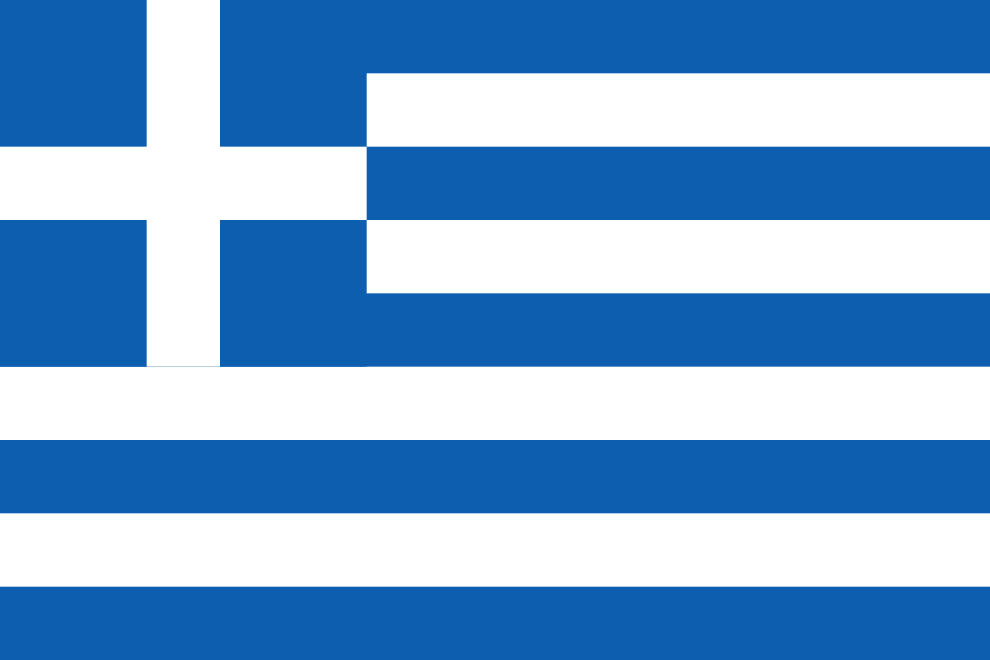
Patron of the restored monarchy and Metaxas dictatorship
On 4 August 1936, George II gave royal authorization to Metaxas as he suspended parliament and established the dictatorship.
George II was the Greek king who pursued the restoration and survival of the monarchy through successive political crises. After returning to the throne in 1935, he authorized Ioannis Metaxas's rise and the dictatorship established on 4 August 1936, joining royal authority to military authoritarianism. He maintained Greece's alignment with Britain during the war and opposed the Italian and German invasions, but his exiled government and post-liberation campaign for a royal return placed him in conflict with the resistance forces and left a contested political legacy. He died soon after returning to the throne in 1946.
Career timeline
1922–1924King of Greece, first reign
1935Returned as king after the restoration of the monarchy
1936–1941Head of state under the Metaxas regime
1940–1941Exercised supreme command of the Greek armed forces during the Axis invasion
1941–1944King associated with the government-in-exile based in London
1944–1946King in dispute over the post-liberation return, accepting a regency
1946–1947Returned as king and reigned until his death
A KKE leader who bore both the Resistance's victory and its defeat at the negotiating table
Regarding Siantos as 'an agent of the British', Zachariadis in 1946 delayed his own departure abroad, 'in no case wanting to leave Siantos behind'.
A tobacco worker turned labor organizer, Georgios Siantos became a leading figure of the Greek Communist Party (KKE). When Nikolaos Zachariadis was transferred to Dachau, Siantos served as the party's acting general secretary and led the KKE, National Liberation Front (EAM), and Greek People's Liberation Army (ELAS) through the German occupation. He directed EAM forces during the December 1944 fighting, opposed disarmament, yet ultimately pursued negotiation. In February 1945 he led the EAM delegation that signed the Varkiza Agreement, whose disarmament terms became, amid the subsequent White Terror and renewed civil conflict, the political defeat of the EAM.
Career timeline
1920President of the Karditsa tobacco workers' union
1922Secretary General of the Greek Confederation of Tobacco Workers; joined SEKE
1927Member of the KKE Central Committee and Politburo
1936Member of Parliament for Trikala with the Popular Front
1941Acting General Secretary of the KKE; led the party during the occupation
1944Secretary for Interior and Food in PEEA; directed EAM forces in the December fighting
1945Head of the KKE-EAM delegation negotiating and signing the Varkiza Agreement
The Comintern writer-revolutionary who bore literary witness to revolution and the rise of Stalinism
When he left the Soviet Union in 1936, all his manuscripts — two novels and a book of poems written in Orenburg exile — were confiscated. He was able to reconstruct only the poems from memory. "What I bring is not the truth itself, but testimony toward the truth," he later wrote.
Born in Brussels to Russian Narodnik exiles, he came of age in French anarchist circles and served five years in prison. Arriving in Soviet Russia in 1919, he joined the Bolsheviks and worked as a journalist, editor, and translator for the Comintern, also seeing action in the defence of Petrograd during the Civil War. He joined the Left Opposition in 1923; expelled and imprisoned in 1928, he turned to literature, producing Memoirs of a Revolutionary, Year One of the Russian Revolution, and the masterwork The Case of Comrade Tulayev. An international campaign secured his exit from the USSR in 1936; in exile in France and Mexico he continued writing, establishing himself as a giant of 20th-century revolutionary literature.
Career timeline
1909–1913Writer and editor for anarchist paper L'Anarchie in Paris; sentenced to 5 years over Bonnot Gang association
1917Active in CNT Barcelona, wrote for Tierra y Libertad; interned in French camp while trying to reach Russia
1919–1923Joined Bolsheviks; ran Comintern Romance-language publications, edited French edition of Inprekorr
1923–1927Joined Left Opposition; anti-Stalinist organising in Vienna, Berlin, and Leningrad
1928–1933Expelled from Party and imprisoned; turned to fiction — Men in Prison, Birth of Our Power
1933–1936Deported to Orenburg; international campaign won release from USSR in 1936
1936–1940Exile in Paris; denounced Moscow Trials in print, engaged in polemical correspondence with Trotsky
1941–1947Exile in Mexico; completed The Case of Comrade Tulayev and Memoirs; died of heart attack, 1947
The Yiddish theatre titan who toured the world for Stalin's war effort and was murdered on Stalin's orders
Gordon Craig, after seeing Mikhoels in Moscow, wrote: 'I do not recall a performance that stirred me as profoundly, to the core, as Mikhoels' performance of Lear.'
The towering figure of Soviet Yiddish theatre, who served as artistic director of the Moscow State Jewish Theatre (GOSET) from 1929 until his death, fusing socialist realism with Jewish national identity on the Yiddish stage. His 1935 Yiddish production of Shakespeare's King Lear drew acclaim from world theatre figures including Gordon Craig, and he was awarded the titles of People's Artist of the USSR and the Stalin Prize. During World War II, as the first chairman of the Jewish Anti-Fascist Committee, he toured the United States, Canada, Mexico, and Britain, rallying financial and political support for the Soviet war effort. In 1948 he was assassinated by MGB agents on Stalin's direct order. His murder became the signal for the postwar turn toward state antisemitism in the Soviet Union.
Career timeline
1919Joined Petrograd Jewish Theatre Studio
1920–1928Leading actor, Moscow State Jewish Theatre (GOSET)
1929–1948Artistic director and leading actor, GOSET
“They will end up putting me ashore with inadequate forces and get me in a serious jam... Then, who will get the blame?”
Major General John P. Lucas was a professional U.S. Army officer who served in both world wars and developed extensive experience in planning and command. At Anzio in 1944, he led VI Corps and chose to consolidate the beachhead rather than immediately exploit the surprise landing, a decision shaped by his doubts about the plan, the force available, and ambiguous orders from higher command. His corps endured the German counterattack, but he was relieved soon afterward, leaving his caution at Anzio as a lasting case in the tension between operational opportunity and force protection.
Career timeline
1911Commissioned in the U.S. Army as a second lieutenant, cavalry
1916Served in the Mexican Punitive Expedition
1918Commanded the 108th Field Signal Battalion, 33rd Infantry Division, and was wounded in France
1932–1936Served in the Personnel Division of the War Department General Staff
1941–1942Commanding general of the 3rd Infantry Division
1943–1944Commanding general of U.S. VI Corps in the Italian campaign and at Anzio
1946–1948Chief of the U.S. Military Advisory Group to the Nationalist Chinese government
1948–1949Deputy commander of the reactivated U.S. Fifth Army
Stalin's artillery chief from Tsaritsyn: Marshal who blocked the T-34, KV-1 and Katyusha
What the hell do we need rocket artillery for? The main thing is the horse-drawn gun.
A Stalin favourite since the Battle of Tsaritsyn, Kulik headed the Red Army's artillery directorate from 1937 to 1941, where his extreme conservatism led him to block the T-34 and KV-1 tanks, Katyusha rockets, and submachine guns, the very weapons that later saved the Soviet Union. His disastrous field commands in the Winter War and against Germany brought court-martial, demotion from Marshal to major-general in 1942, and eventual execution for treason in 1950.
Career timeline
1918–1920Chief of Artillery, 1st Cavalry Army
1926–1929Chief, Main Artillery Directorate (GAU)
1932–1936Commander-Commissar, 3rd Rifle Corps
1937–1941Chief, Main Artillery Directorate (GAU)
1939–1941First Deputy People's Commissar for Defence
1941Commander, 54th Army
1943Commander, 4th Guards Army
1944–1945Deputy Chief, Main Directorate for Formation & Manning
The radiochemist who led the Radium Institute and laid the institutional foundations of Soviet nuclear physics
On 1 December 1921, in his Petrograd laboratory, Khlopin personally obtained the Soviet Union's first high-activity radium preparation.
One of the founders of Soviet radiochemistry, he produced the country's first domestic radium in 1921 and formulated the law of microcomponent distribution between phases (Khlopin's law) in 1924. Succeeding Vernadsky as director of the Radium Institute, he installed Europe's first cyclotron there in 1937, creating the experimental basis for fission research. In June 1940 he and Vernadsky submitted a memorandum on the uranium problem that led to the creation of the Uranium Committee on 30 July, with Khlopin as its first chairman, placing him at the center of pre-war nuclear research coordination. After the war his institute developed the plutonium separation technology that made the 1949 test possible.
Career timeline
1915Began research at the Academy of Sciences Radiological Laboratory at Vernadsky's invitation
1921Obtained the first Soviet high-activity radium preparation
1922–1935Deputy director and head of the chemical department, Radium Institute
1936–1950Director of the Radium Institute
1940Chairman of the Academy of Sciences Committee on the Uranium Problem
1943, 1946, 1949Three-time Stalin Prize laureate
1945Founded the USSR's first radiochemistry chair at Leningrad University
A Yiddish poet who gave voice to Soviet Jewish culture
In “Etele,” Kvitko mourned Jewish victims of the Nazis through Yiddish language and Jewish memory.
Leib Kvitko was a Soviet Jewish poet who wrote in Yiddish, producing both poetry and influential children’s literature while bringing revolutionary and Jewish experience into the same literary world. During the war he worked with the Jewish Anti-Fascist Committee and edited its newspaper, Eynikayt, giving poetic form to reports and memories of the Nazi murder of Jews. After the war, the state’s turn against Jewish cultural institutions made that earlier public role dangerous: arrested in the JAC case, he was executed in 1952 and rehabilitated in 1955.
Career timeline
1917Published his first poem in Kyiv and his first collection, Liderlekh
1917–1921Yiddish poet of the Kyiv Group
1921–1925Lived in Berlin and Hamburg, joined the Communist Party of Germany, and conducted agitation among workers
1928–1941Worked on the autobiographical verse novel Yunge yorn
1941–1948Served on the Jewish Anti-Fascist Committee and edited Eynikayt
1947–1948Edited the literary and artistic almanac Heymland
1949–1952Imprisoned in the JAC case and sentenced to death by the Military Collegium
A field commander undone by the collision of orders and reality
After being told that no German field marshal had ever been captured alive, Paulus refused suicide and surrendered.
Friedrich Paulus was a German staff officer and general whose work included planning the invasion of the Soviet Union. As commander of the Sixth Army, he led the advance on Stalingrad, then became trapped between Hitler's order to hold the city and the army's collapse after the Soviet encirclement. He surrendered on 31 January 1943 and, in captivity, became a critic of the Nazi regime who joined anti-Nazi German officers' organizations sponsored by the Soviet Union. In postwar East Germany he researched military history, leaving a legacy shaped both by responsibility for an aggressive war and by his late break with Nazism.
Career timeline
1910Officer candidate, 111th Infantry Regiment of the Imperial German Army
1914–1918Served in the First World War and as a staff officer
1935–1939Chief of staff, Panzer Troop Command, then Tenth Army
1939–1940Chief of staff of the Tenth Army, later redesignated Sixth Army
1940–1941Deputy chief of the German Army General Staff
1942–1943Commander of the Wehrmacht's Sixth Army
1943Generaloberst, promoted to field marshal on 30 January
1954–1957Military-history research and teaching in East Germany
The poet of Doctor Zhivago and the refused Nobel Prize
The Doctor Zhivago affair brought publication, international politics, and a writer's survival into collision around one book.
A major Russian poet, translator, and author of Doctor Zhivago. The novel's first publication in Italy and his 1958 Nobel Prize drew fierce Soviet condemnation, and he declined the prize under pressure.
Career timeline
1914Publishes first poetry collection, Twin in the Clouds
1957Doctor Zhivago first published in Italy
1958Awarded Nobel Prize in Literature; declines under pressure
Stalin's personally approved CPGB General Secretary who led the party for 25 years
10 May 1920, Port of London. Pollitt convinced dockers not to load the SS Jolly George with munitions bound for Poland, then at war with Soviet Russia. The ship sailed empty on 15 May.
Founding member and General Secretary of the Communist Party of Great Britain for over 25 years, the most significant British communist of the 20th century. He persuaded London dockers to block munitions bound for Poland in the 1920 Hands Off Russia campaign. Appointed General Secretary with Stalin's personal approval, he was the party's secret 'Code Holder' in direct radio contact with Moscow. He supported the International Brigades during the Spanish Civil War and co-authored The British Road to Socialism, committing the CPGB to a parliamentary path. When Khrushchev denounced Stalin in 1956, Pollitt refused to take down Stalin's portrait from his living room.
Career timeline
1920Founding member of the CPGB
1924–1929National Secretary, NMM & British Bureau of Profintern
1929–1939General Secretary, CPGB (first term)
1939–1941Removed as General Secretary; retained in Political Bureau
"East Side Joan of Arc": from the IWW's Rebel Girl to first woman chair of the CPUSA
"We are Communist leaders, proudly and avowedly. We will prove to you that we are not a criminal conspiracy but a 33-year-old working-class political party, devoted to the immediate needs and aspirations of the American people." — Summation to the jury, Smith Act trial, April 24, 1952
American labor organizer and communist. Known as the IWW's "Rebel Girl" from age 15, she led the Lawrence strike and co-founded the ACLU. Elected CPUSA's first woman chair in 1961; died in Moscow and was given a Red Square state funeral.
Career timeline
1906First socialist speech, Harlem Socialist Club — arrested; joins IWW
1907–1916Full-time IWW organizer — Lawrence and Paterson strikes, Missoula and Spokane free-speech fights
1918Founds Workers' Defense Union to defend Espionage Act arrestees
1920Co-founds ACLU; leads Sacco and Vanzetti defense campaign
1936Joins CPUSA; writes weekly column for the Daily Worker
1940Expelled from ACLU board for Communist Party membership
1951–1955Convicted under Smith Act; serves 2 years at Alderson prison, writes The Alderson Story
1961–1964Chair of CPUSA National Committee; dies in Moscow — Red Square state funeral
A Finnish general at the boundary of war and diplomacy
In midsummer 1941 Mannerheim entrusted Finland's largest-ever field force, the 100,000-strong Army of Karelia, to Heinrichs for the advance toward the Svir River and Lake Onega.
Erik Heinrichs was a Finnish military commander who worked closely with Mannerheim across battlefield command and general-staff planning. After directing the defence of the Karelian Isthmus in the Winter War, he helped coordinate military cooperation with Germany in 1941 and then led the Army of Karelia in Finland’s offensive. The Weapons Cache Case ended his postwar command career, but he remained active as a military expert, taking part in the 1948 Moscow negotiations and writing a major two-volume biography of Mannerheim.
Career timeline
1915–1918Trained in Germany as a Finnish Jäger and fought on the Eastern Front
1918Commanded the 7th Jäger Battalion in the Finnish Civil War
1931–1938Commander of the 1st Division
1939–1940Commanded III Corps and the Army of the Karelian Isthmus in the Winter War
1940–1941Chief of the General Staff and participant in military talks with Germany in 1941
1941–1942Commander of the Army of Karelia during the offensive in East Karelia
1942–1944Chief of the General Staff, overseeing wartime coordination with German forces
1945Commander-in-Chief of the Finnish Defence Forces, resigning after the Weapons Cache Case
The five-star general who led D-Day and warned America against the military-industrial complex
There is only one thing to do when you go into this kind of thing. It must be a success.
A five-star general who served as Supreme Allied Commander in Europe during World War II, leading the D-Day invasion, and later became the 34th President of the United States. As president he pursued Cold War containment, backing coups in Iran and Guatemala, and in March 1960 authorized the CIA's covert program to overthrow Fidel Castro. After the Bay of Pigs failure, he told Kennedy that 'there is only one thing to do when you go into this kind of thing: it must be a success,' warning that hiding US involvement out of fear of emboldening the Soviets would only make them bolder. His farewell address warned against the 'military-industrial complex,' leaving a lasting caution about the machinery of permanent warfare.
Career timeline
1915Graduated from West Point
1942–1945Supreme Allied Commander, Europe (World War II)
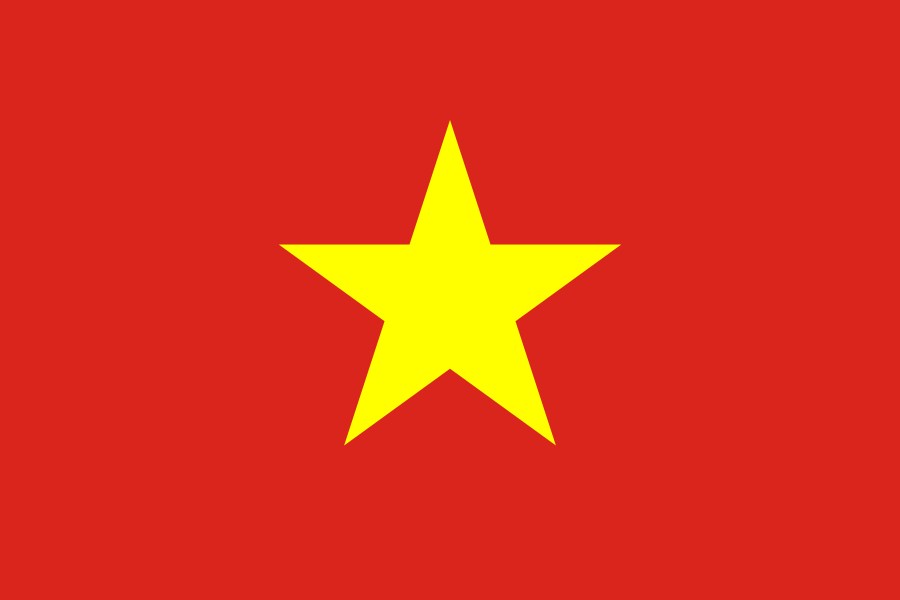
He took on France, Japan and America in turn to win Vietnam's independence
“Nothing is more precious than independence and freedom.” — wartime radio address, 1966
Vietnamese revolutionary. After three decades of exile, including helping found the French Communist Party and the Communist Party of Vietnam, he led the Viet Minh to declare Vietnam's independence in 1945. He led North Vietnam through wars against France and the United States, becoming the symbol of Vietnamese independence.
Career timeline
1911–1920Wanders the world as sailor and laborer; founding member of the French Communist Party
1925Published French Colonialism on Trial
1927Published the revolutionary training text The Revolutionary Path
1930Founds the Communist Party of Vietnam
1941–1945Founds the Viet Minh against Japanese and French rule
1945.9Declares independence; first President of the DRV
1946–1954First Indochina War; victory at Dien Bien Phu
1955–1969Leads the unification war as North Vietnam's president