A liberal statesman at the threshold of liberation and civil war
At Caserta, he agreed that military command after liberation would pass to the British commander, General Scobie.
A Greek liberal politician, Papandreou opposed the monarchy while also confronting the communist movement, combining social reform with firm anti-communism. During the Second World War he led the government-in-exile and, through the Lebanon Conference and the Caserta Agreement, helped establish a framework for resistance participation in government and the integration of armed forces. Returning in 1944 as prime minister of the Government of National Unity, he sought to restore state authority amid British intervention and conflict between EAM and non-EAM forces, a project that gave way to the Dekemvriana and civil war. He later founded the Centre Union and defended parliamentary democracy until his death under house arrest after the 1967 military coup.
Career timeline
1916Joined Venizelos's insurgent government and organised anti-monarchist support.
1923Minister of the Interior
1930–1932Minister of Education, expanding schools for refugee children.
1935Founded the Democratic Socialist Party of Greece
1944–1945Prime minister of the government-in-exile and Government of National Unity; represented Greece at Lebanon and Caserta.
1950–1952Deputy prime minister
1961–1965Leader of the Centre Union, winning the 1963 and 1964 elections.
1967–1968Held under house arrest by the military regime
On 9 January 1905, 16-year-old factory worker Nikolai Shvernik witnessed the 'Bloody Sunday' shootings before the Winter Palace. That autumn he joined the Bolsheviks.
A Petersburg worker who joined the Bolsheviks at 17, he built the Soviet trade-union system as First Secretary of the All-Union Central Council of Trade Unions for 14 years. He succeeded Kalinin as Chairman of the Supreme Soviet Presidium in 1946, though real power lay with Stalin and the Politburo. During the war he directed industrial evacuation and the Nazi atrocities investigation commission; after Stalin's death he worked with Khrushchev as head of the Party Control Committee, overseeing the rehabilitation of victims of political repression.
Career timeline
1920s–1930sRises through trade-union and party administration
1938–1946Chairman of the Soviet of Nationalities, a pillar of Stalin-era formal federal representation
1946–1953Chairman of the Supreme Soviet Presidium, the titular head of state
1953–1956Moves into trade-union and state-administrative elder roles after Stalin
1956 이후Works on rehabilitation and discipline issues through party-control bodies
"Ugly planes don't fly." The father of Soviet metal aviation.
Shown a model, Tupolev pronounced: "It's ugly. Ugly planes don't fly." The maxim became his lifelong creed — "Only beautiful airplanes fly well."
A student of Zhukovsky who built the world's first all-metal aircraft design bureau. Over 100 types flowed from his KB: the TB-1, TB-3, SB, and Tu-2 defined Soviet military aviation, while his all-metal stressed-skin philosophy reshaped the industry. Arrested in 1937 on charges of espionage, he designed the Tu-2 inside an NKVD sharashka. After the war came the Tu-16, the Tu-104 (the USSR's first jet airliner), the Tu-114, and the Tu-144, the world's first supersonic passenger aircraft. He mentored Korolev, Sukhoi, Petlyakov, Lavochkin, and Mil, a whole generation of Soviet aerospace. Three-time Hero of Socialist Labor, he died a natural death in 1972.
Career timeline
1909–18Student of Zhukovsky; Russia's first aviation calculation bureau
1918–36TsAGI deputy, founded all-metal aircraft KB
1925–34TB-1, TB-3, ANT-25, Maxim Gorky — the heavy bomber era
1937–41Arrested; designed Tu-2 in NKVD sharashka TsKB-29
The man whose name became the rebellion: SR leader of the Tambov 'Antonovshchina,' the largest peasant uprising against Bolshevik rule
'Power was not torn from the hands of the tsarist executioners to be handed over to a handful of executioner-communists' — from a leaflet distributed during the uprising
A Socialist Revolutionary militant who served a twenty-year katorga sentence in the Schlisselburg Fortress under the Tsar for armed expropriations. Freed by the February Revolution, he became chief of the Kirsanov district militia, but the Bolsheviks' grain requisitioning and local repression drove him underground in 1918. In August 1920 he seized leadership of the Tambov peasant uprising, building a partisan army of roughly twenty regiments and an alternative government based on Unions of the Working Peasantry: the revolt was so identified with him that it became known as the 'Antonovshchina.' He was killed in a firefight with GPU forces alongside his brother Dmitri in June 1922.
Career timeline
1905Joined the SR Party; participated in armed expropriations
The Peking University librarian who first embraced Marxism in China and nurtured the generation of Mao Zedong
In 'The Victory of Bolshevism' (November 1918): "Look! Every place in the world will see the victorious flag of Bolshevism and hear the triumphal song of Bolshevism. (…) From this day onward, this is no longer a world of the bourgeoisie, of capitalism, of imperialism. It is a world of labor, a world of Bolshevism!"
Pioneer of Chinese Marxism and co-founder of the CCP. As Peking University librarian he introduced Marxism to Mao Zedong and led the May Fourth Movement, championing the Russian Revolution. He architected the United Front and was executed by warlord Zhang Zuolin in 1927.
Career timeline
1907–1913Studied political economy at Beiyang College, Tianjin
1913–1916Studied at Waseda University; led anti-Yuan Shikai protests in Tokyo
1918–1927Peking University chief librarian, history professor, New Youth editor
1919Ideological leader and organizer of the May Fourth Movement
1920Founded Beijing communist cell; linked Voitinsky with Chen Duxiu
1921CCP co-founder at the 1st National Congress
1922–1924United Front architect; KMT Central Executive Committee member
1926–1927Turned to peasant armed revolution; directed CCP underground from Soviet embassy
Stalin's first secretary, keeper of his archive and author of his first biography
Bazhanov recalled Tovstukha matching ballot handwriting against registration forms: who crossed out Stalin's name? "He had only half a lung, but Stalin had complete confidence in him."
Stalin's first personal secretary (1918–1935) and head of the CC Secret Department (1926–1930), Tovstukha ran Stalin's private secretariat and controlled access to the Lenin Institute archive. He authored the first official biography of Stalin for the Granat Encyclopedia (1922) and directed the first edition of Lenin's Collected Works. As an émigré he joined the French Socialist Party and worked as a labourer; after returning he became secretary at the People's Commissariat for Nationalities, where his lifelong attachment to Stalin began. His management of the documentary record, above all selective access to Lenin's and Trotsky's papers, was a decisive ideological tool for the Stalin faction.
Career timeline
1905–09Revolutionary activity in Chernigov Social-Democratic organisation
1909–11Arrested for possession of banned books; exiled to Siberia
1912–17Fled abroad; labourer in Austria and France; joined French Socialist Party and Paris RSDLP(b) section
1917–18Secretary, Inspectorate Department, Central Staff of the Red Guard
1918–21Secretary and collegium member, People's Commissariat for Nationalities; attached to Stalin
1921–24Responsible worker in CC apparatus; organized and ran Stalin's personal secretariat
1922Wrote the first official biography of Stalin for the Granat Encyclopedia
1924–26Assistant director, Lenin Institute; prepared the first edition of Lenin's Collected Works
1926–30Head of the CC Secret Department and First Assistant to the General Secretary
1930–31Deputy director, Lenin Institute; editorial board of Proletarian Revolution
1931–35Deputy director and head of archives, Marx–Engels–Lenin Institute
1934–35Candidate member, CC VKP(b); member, Central Executive Committee of the USSR
In 1922, after he called Ordzhonikidze "Stalin's donkey", Ordzhonikidze struck him in the face with his fist. The timing is disputed: one report gives 20 October, while an English-language account places it in November.
Akaki Kabakhidze was a Georgian Old Bolshevik who joined the party in 1904 and belonged to the Society of Old Bolsheviks. Repression records give his birth in 1889 in Ambrolauri, Georgia, nationality Georgian, with residence in Tiflis. In 1922, as a member of the Georgian Communist Party Central Committee, he sided with those opposing Transcaucasian amalgamation, and that year, after calling Sergo Ordzhonikidze "Stalin's donkey", he was struck in the face with the fist. The timing is disputed between October and November accounts. Arrested on 22 December 1936, he was sentenced to death by the Military Collegium of the USSR Supreme Court on 24 June 1937, shot the next day, and rehabilitated on 2 April 1957. Identifying the 1922 figure with the executed man is a source-based inference; a namesake cannot be excluded.
Career timeline
1922년(10월설·11월설)Struck in the face with a fist in the clash with Ordzhonikidze
1922년 12월Figure linked to Lenin's criticism of the nationalities question
1904Joined the party; member of the Society of Old Bolsheviks
1922Member of the Georgian Communist Party Central Committee
1936–1937Arrested (1936), sentenced to death and executed (1937)
Author of the 1919 Karakhan Manifesto that renounced Tsarist unequal treaties with China
Karakhan became doyen of the Beijing diplomatic corps in 1925. The Bolshevik who scorned bourgeois manners nonetheless rode in a gilded six-horse coach, clad in evening clothes and white kid gloves, to present his credentials. Time magazine called him: "A Bolshevik who can wear white gloves gracefully."
Born into an Armenian lawyer's family in Tiflis, he joined the RSDLP at 15 in 1904, initially as a Menshevik. Siding with the Bolsheviks in 1917, he served as secretary of the Soviet delegation at Brest-Litovsk and became Deputy People's Commissar for Foreign Affairs. In 1919 he drafted and issued the 'Karakhan Manifesto' renouncing all Tsarist unequal treaties and privileges in China, a foundational document of Soviet Asia policy. As ambassador to China he concluded the 1924 Sino-Soviet agreement, and later served as ambassador to Turkey. Arrested in the Great Purge of 1937 on charges of a 'pro-fascist conspiracy,' he was shot and posthumously rehabilitated in 1956.
Career timeline
1904Joins RSDLP at 15, initially a Menshevik
1917.5Returns to Russia, joins the Mezhraiontsy
1917.8VI Congress: Mezhraiontsy merge into the Bolshevik Party
1917–1918Secretary, Soviet delegation at Brest-Litovsk peace talks
1918–1921Deputy People's Commissar for Foreign Affairs (RSFSR)
1921–1922Plenipotentiary Representative of the RSFSR to Poland
1922–1923Head of the Eastern Department, NKID
1923–1926Plenipotentiary Representative, later Ambassador, to China
1925Doyen of the Beijing diplomatic corps
1926–1934Deputy People's Commissar for Foreign Affairs (USSR)
1934–1937Plenipotentiary Representative of the USSR to Turkey
Bolshevik who built the Soviet Air Force and ran foreign trade
After the Arcos raid of 12 May 1927 in London, Rozengolts submitted a seven-page protest memorandum denying military espionage, but on 24 May Prime Minister Baldwin disclosed the seized documents to Parliament, and on 25 May Britain severed diplomatic relations and expelled him.
A Bolshevik from 1905, when he joined at 16, he became a Civil War political commissar, helped take Kazan and served against Kolchak. He headed the Soviet Air Force from 1922 to 1924, then spent 1925–1927 in London as chargé d'affaires through the Arcos raid and the break in Anglo-Soviet relations. Returning home, he broke with the opposition and joined the Stalinist apparatus. People's Commissar of Foreign Trade from 1930 to 1937, he was dismissed, arrested, sentenced to death in the 1938 Trial of the Twenty-One and shot.
Career timeline
1905–1917Joins Bolsheviks at 16, delegate to the 4th Congress; underground work as an insurance agent in Vitebsk, Kiev and elsewhere
1917Member of Moscow Soviet executive committee, Moscow Military Revolutionary Committee; takes part in October armed uprising
1918–1920Member of the Republic's Revolutionary War Council, commissar with 8th and 5th Armies; creates Tsektran transport committee
1922–1924Head of the Soviet Air Force; secret military talks with the German high command; signs the Declaration of 46
1925–1927Chargé d'affaires in London; Arcos raid (12 May), expulsion as relations break on 25 May
1927–1930Member and presidium member of the Central Control Commission; works in Rabkrin (Workers' and Peasants' Inspectorate)
1930–1937People's Commissar of Foreign Trade — directs trade during Five-Year Plans, clashes with Ordzhonikidze over equipment imports
1937–1938Dismissed 14 June, moved to State Reserves, arrested 7 October; sentenced to death in the third Moscow trial
Independence activist, linguist, and Yan'an faction leader who served as the first head of state of the DPRK
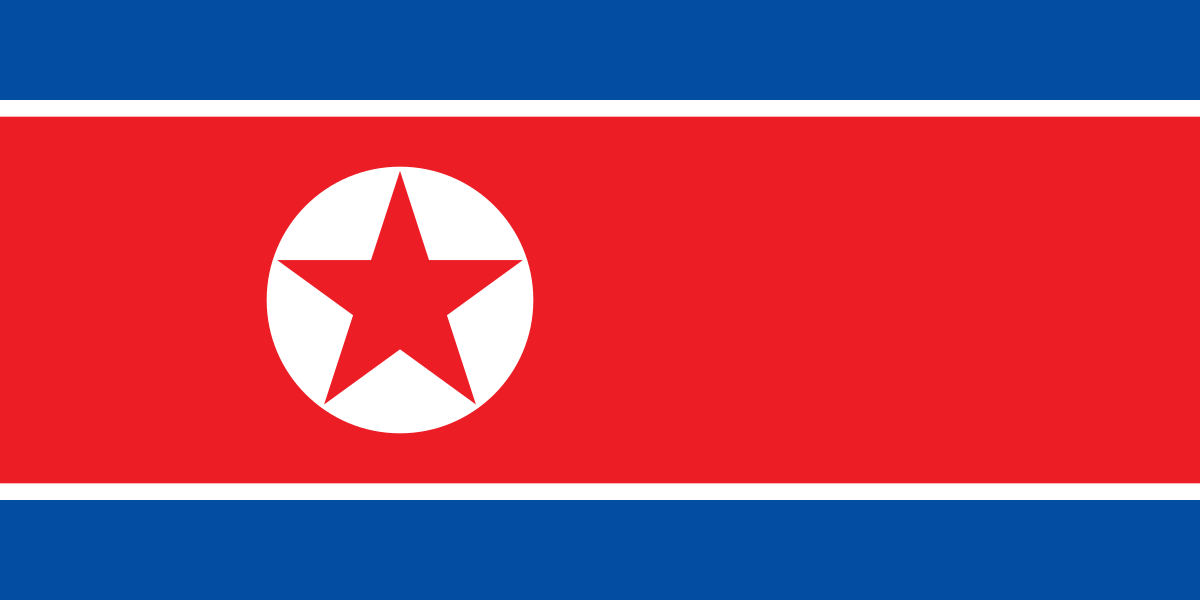
On the day the People's Assembly adopted the new DPRK flag in July 1948, Kim Tu-bong personally lowered the Taegeukgi and raised its replacement. Barely a year earlier, he had been the man passionately explaining the old flag's philosophical meaning to a skeptical Soviet general.
A Hangul linguist trained under Chu Sigyŏng who led the Korean Independence League in Yan'an. Became the DPRK's first head of state in 1948, though real power lay with Kim Il Sung. Purged and vanished in the 1958 August Faction Incident.
Career timeline
1908–1916Studied Hangul under Chu Sigyŏng; helped compile MalMoi dictionary
1919Joined March First Movement, then exiled to Shanghai provisional government
1920–1930년대Combined communist activism with linguistic research in Shanghai
1942–1945Founded Korean Independence League in Yan'an; led the Yan'an faction
1946.2–1946.8Chairman of the New People's Party of Korea
1946.8–1949.6Chairman of the Workers' Party of North Korea Central Committee
1948.9–1957.9Chairman of the SPA Standing Committee — first head of state of the DPRK
1957–1958Dismissed from all posts over August Faction Incident; disappeared
The quiet architect of the Red Army who confronted Stalin at Tsaritsyn as Trotsky's man
In January 1918, during the Brest-Litovsk peace negotiations, Mekhonoshin told a party meeting chaired by Lenin: 'We have no real fighting force. The front is bare. We cannot fight.'
Konstantin Mekhonoshin was a core military organizer in the founding era of the Red Army, who prepared the October armed uprising as a member of the Petrograd Military Revolutionary Committee and then, as Deputy People's Commissar for Military Affairs, built the skeleton of the new Red Army alongside Podvoisky and Sklyansky. As a member of the Republic's Revolutionary Military Council he served on multiple fronts, and in 1918 at Tsaritsyn he backed Trotsky's appointed Southern Front commander against Stalin and Voroshilov's independent line, playing a decisive role in their removal. After the Civil War he headed Vsevobuch, laying the foundations of the Soviet physical culture and sports system, before moving through Gosplan, Osoaviakhim, and the Institute of Oceanography; arrested in 1937 and shot the following year, he was rehabilitated in 1956.
Career timeline
1906–1913Joined student revolutionary circles in Perm; joined RSDLP as Bolshevik; underground work — transported explosives, printed leaflets
1913–1915St. Petersburg University; arrested and exiled twice; joined Russian Academy of Sciences Caspian Sea expedition
1915–1917.2Private in Pavlovsk Life Guard Regiment reserve battalion; built Bolshevik cell among soldiers
1917.4–10Leadership of Bolshevik Military Organization (Voyenka); Petrograd Soviet executive; imprisoned in Kresty after July Days
1917.10–11Member and chief of staff of Petrograd MRC; directed suppression of Kerensky-Krasnov counter-attack
1917.11–1918.9Deputy People's Commissar for Military Affairs; Supreme Military Council member; All-Russian Collegium for Red Army formation
1918.9–1919.7Member of RVSR; RVS member on Eastern, Southern, Caspian-Caucasus fronts — clashed with Stalin at Tsaritsyn
1920–1926RVS member of 3rd and 11th Armies (Soviet-Polish War, Baku operation); head of Vsevobuch; Chairman of Supreme Council of Physical Culture; Red Sportintern
1926–1937Military attaché in Poland; head of Gosplan defence sector; Osoaviakhim; Director of Oceanography Institute; deputy chief of Naval Intelligence
The industrial builder Lenin trusted; first People's Commissar for Defence Industry
On 1 October 1921 Lenin sent Rukhimovich, then Donetsk Gubernial Executive Committee chairman and manager of the Donugol and Khimugol trusts, a letter on the leasing out of small and medium Donbas mines.
Born in 1889 in the Rostov region to a worker's family, Rukhimovich entered the Social-Democratic movement in 1904 and was active in the Jewish Social-Democratic Workers' Party, the Bund. After emigration from 1906 to 1909 he worked in Ukraine, joined the party in 1913 and was mobilized into the army in 1914. As Donetsk Gubernial Executive Committee chairman and then Donugol Trust manager in the 1920s he directed emergency measures to restore Donbas coal extraction, later developed Kuzbass coal and served as Deputy Commissar for Heavy Industry. On 8 December 1936 he became first People's Commissar of the new Defence Industry Commissariat, was removed on 15 October 1937, shot the following year and rehabilitated in 1956.
Career timeline
1904–1917Bund activist; joined Bolsheviks (1913); chairman, Kharkov Military Revolutionary Committee
The first People's Commissar for Naval Affairs, whose Baltic sailors tipped the scales in October 1917
November 1, 1917, Gatchina Palace. Dybenko, having surrounded Kerensky-Krasnov's forces with thousands of armed sailors, addressed the Cossack delegation: "Hand over your general. Soviet power guarantees you safe passage home." By morning, General Krasnov was under arrest and Kerensky had fled in disguise. In one week, the fate of the revolution had been sealed.
Born to a Ukrainian peasant family in Chernigov, he became a Baltic Fleet sailor and joined the Bolshevik underground. Elected chairman of Tsentrobalt in April 1917, he funnelled thousands of armed sailors from Helsingfors and Kronstadt into Petrograd during the October Revolution, tipping the balance, arresting General Krasnov, and dispersing the Constituent Assembly. He captured Crimea and liberated Tsaritsyn during the Civil War, then helped crush the Kronstadt and Tambov rebellions. His marriage to Alexandra Kollontai made them the revolution's most celebrated couple.
Career timeline
1912Conscripted into Baltic Fleet; electrician on Imperator Pavel I; joined Bolshevik underground cell
1917.04–1918.03Chairman, Tsentrobalt; directed sailors into October uprising, arrested Gen. Krasnov, dispersed Constituent Assembly
1917.10–1918.03First People's Commissar for Naval Affairs; ousted after Narva defeat, expelled from party, acquitted at court-martial
1919.02–1919.09Commander, 1st Zadneprovskaya Division; captured Crimea, commanded Crimean Soviet Army
1919.10–1920.05Commander, 37th Rifle Division; liberated Tsaritsyn, routed Denikin's forces in North Caucasus
The Latvian Bolshevik who built Soviet military intelligence and was consumed by the purges
When the secret residents' conference in Denmark was uncovered in February 1935 and four senior officers of the central apparatus were seized at once, Berzin submitted his resignation.
Born in 1889 into a Latvian farm-labourer family, born Pēteris Ķuzis, and executed in 1938. He joined the Russian Social Democratic Labour Party in 1905, led guerrilla activity in Latvia, and after serving a katorga sentence for killing a policeman escaped from Siberian exile in 1914. Deputy People's Commissar of Internal Affairs of Soviet Latvia in 1919 and in Red Army intelligence from 1920, he headed the Fourth (Intelligence) Directorate from 1924 to 1935 and built the Soviet military-intelligence system. Chief military adviser to the Spanish Republic in 1936, he returned as intelligence chief in 1937, was arrested that November and executed on 29 July 1938; rehabilitated in 1956.
Career timeline
1905–07Joined the RSDLP; at 16 took part in armed activity in Latvia
1907–14Sentenced to eight years' katorga for killing a policeman (reduced to two for his minority); after prison exiled to Irkutsk, escaped in 1914
1917Took part in the storming of the Winter Palace; worked in the Cheka from December
1919.1–5Deputy People's Commissar of Internal Affairs, Soviet Latvia
1920–24Served in Red Army intelligence, the future GRU
1924–35Chief of the Fourth (Intelligence) Directorate; built the Soviet military-intelligence system
1935.4–1936.6Resigned after the Copenhagen failure; deputy commander of the Far Eastern Army (OKDVA)
1936.10–1937.5Chief military adviser to the Spanish Republic as 'General Grishin'; awarded the Order of Lenin
1937.6–8Reappointed GRU chief; dismissed and arrested within two months
1937.11–1938Arrested on 27 November in the 'Latvian National Centre' case, shot on 29 July 1938, rehabilitated in 1956
At the Belomor site in 1932, Kogan told Mikoyan: "'Zaklyuchenny' insults, 'lagernik' is dull — I've coined 'kanaloarmeyets,' canal-army soldier." Mikoyan approved; the abbreviation 'zek' was born from his term.
The son of a wealthy Jewish merchant in Siberia, Kogan began as an anarcho-communist and was sentenced to death in 1908 for armed robbery, commuted to hard labour. Joining the Bolsheviks in 1918, he rose through the Cheka and border troops. In 1930 he became the first chief of the newly created Gulag, where he was instrumental in institutionalizing the Soviet forced-labour system. From 1931 he directed the White Sea–Baltic Canal project, mobilizing roughly 170,000 prisoners to complete the 227-km waterway in under two years, at a cost of tens of thousands of lives. Tied to the Yagoda network, he was arrested in 1938, shot in 1939, and rehabilitated in 1956.
Career timeline
1930–1932Chief of the Gulag, OGPU
1931–1933Chief of construction of the White Sea-Baltic Canal
1932–1936Deputy chief of the Gulag
1936–1938Deputy People's Commissar of Water Transport
Yezhov’s intimate who rose to deputy commissar and died under interrogation
Arrested in December 1938, he was dead under interrogation within a month, one of the five names Yezhov's own deposition listed as accomplices.
Born to a peasant family in Tambov province, he joined the Bolsheviks in 1918 and came up through military commissar and district administrative posts before working in the Moscow city administration. Under Yezhov he became chief of the NKVD Administrative-Economic Directorate in July 1937, was promoted within weeks to deputy commissar of internal affairs, and in December 1937 moved on to serve as People's Commissar of the Timber Industry until October 1938. He held the rank of major of state security and the Order of the Red Star, and was married to Yezhov's secretary Serafima Ryzhova. Arrested in December 1938 after Yezhov's fall, he was one of the names Yezhov's own deposition listed as members of his conspiratorial group. He died on 19 January 1939 under interrogation conducted with unlawful methods, and was rehabilitated in 1955.
Career timeline
1911–1925Military commissar and district administrative posts
1930년대 전반Agricultural administration and Moscow city government
1937.7–8Chief, NKVD Administrative-Economic Directorate
1937.8–12Deputy People's Commissar of Internal Affairs
1937.12–1938.10People's Commissar of the Timber Industry
The Ukrainian party boss who denied the famine, felled by Stalin's bullet
On 26 April 1932, as famine spread in Ukraine, Kosior wrote to Stalin: "We do have isolated cases and even individual starving villages, but this is only the result of local bungling. All talk of 'famine' in Ukraine must be categorically rejected."
Born on 18 November 1889 (6 November O.S.) in Węgrów, Kingdom of Poland, Russian Empire, to a family of factory workers, he joined the party in 1907 and, after underground work in the Donbas and Kiev, took part in founding the Communist Party of Ukraine. Leading the Ukrainian party from 1928 to 1938, he drove collectivisation and industrialisation; he became a full Politburo member in 1930. He is criticised for reports denying the 1932-33 famine, yet also petitioned for relief. Arrested in May 1938, sentenced and shot on 26 February 1939, he was rehabilitated on 14 March 1956; in 2010 a Ukrainian court recognised him as one of the organisers of the 1932-33 famine.
Career timeline
1907–1917Underground Bolshevik in Donbas; multiple arrests and exile
1917.10Commissar of Petrograd Military Revolutionary Committee
1919–1920Secretary of CC CP(b)U
1926–1928Secretary of CC VKP(b), member of Orgburo
1928–1938General Secretary → First Secretary of CC CP(b)U
1930–1938Full member of Politburo CC VKP(b)
1938.5Arrested as 'Polish Military Organisation' spy
1939.2.26Sentenced to death by Military Collegium; shot same day
The 'Red Millionaire' who exposed Nazi terror through publishing, the Comintern's greatest propagandist, who broke with Stalin
"Stalin, you are a traitor!" — Münzenberg's response to the 1939 Molotov–Ribbentrop Pact
The Comintern's most brilliant mass-propagandist. He founded Workers International Relief, co-founded the League Against Imperialism, and his Brown Book (1933) exposed the Reichstag fire as a Nazi frame-up. He broke with Stalin and died under mysterious circumstances.
Career timeline
1915–1919Secretary, Intl. Union of Socialist Youth Organizations
1919–1921First Secretary, Young Communist International
1921–1937Founder & leader, Workers International Relief (IAH/Mezhrabpom)
1924–1933Reichstag deputy for Hesse-Nassau (KPD)
1927–1935Co-founder & leader, League Against Imperialism
Dismissed from the OGPU in 1931 for protesting Yagoda's "Vesna" frame-up, he returned under Yezhov to organize the troikas of the Great Terror.
A Cheka veteran, he became chief of the Soviet militia in 1934 and Yezhov's deputy at the NKVD in 1936, where he organized the regional troikas that issued mass death sentences during the Great Terror. Arrested in 1939, he was shot in 1941 and has never been rehabilitated.
Career timeline
1934–1936Chief of the Main Directorate of Workers' and Peasants' Militia, NKVD
1936–1938Deputy People's Commissar of Internal Affairs
1938–1939First Deputy People's Commissar of Railways
RSFSR Finance Commissar who commissioned the Narkomfin Building and authored the Sotsgorod linear-city concept
On the night of the October Revolution, Milyutin's detachment launched a frontal assault from the Arch of the General Staff onto the barricades around the Alexander Column——and was the first to cross that line.
Nikolai Milyutin was a Bolshevik revolutionary who participated in the storming of the Winter Palace, later serving as RSFSR People's Commissar of Finance (1924–1929). In that role he commissioned Moisei Ginzburg's Narkomfin Building, a landmark of Soviet Constructivist architecture, and in 1930 published Sotsgorod, his influential treatise advancing the linear-city concept for socialist urban planning. He edited the journal Sovetskaya arkhitektura (1931–1934) and continued to develop Marxist theories of settlement while holding educational and cultural posts through the 1930s. Though he survived the Great Purge, reportedly sleeping with a pistol under his pillow, Milyutin died of stomach cancer in 1942, leaving a legacy that bridged revolutionary state-building and avant-garde architectural thought.
Career timeline
1908Joined the Bolshevik faction of the RSDLP
1912–1916Trade Union of Office Workers board · Managed Putilov Works insurance fund
1917Took part in February Revolution, July Days, and storming of the Winter Palace
1921–1924Deputy Commissar of Social Security, RSFSR
1924–1929People's Commissar of Finance, RSFSR
1929–1930Chairman of the Lesser Sovnarkom, RSFSR
1931–1934Deputy Commissar of Education, RSFSR · Editor of Sovetskaya arkhitektura
1939–1941Artistic director, Palace of Soviets construction
In summer 1942, Hitler split Army Group South into Groups A and B to strike at Caucasus oil and the Volga at the same time, a decision that led to the encirclement and destruction of the Sixth Army.
Adolf Hitler (1889–1945) was born in Braunau am Inn, Austria-Hungary, and held Austrian citizenship by descent; he moved to Munich in 1913 and falsely registered as stateless. He joined the German Workers' Party in 1919, led it from 1921, and dictated Mein Kampf in prison after the failed 1923 Munich putsch. Released from Austrian citizenship in 1925, he remained stateless until he acquired German citizenship in 1932. Appointed chancellor on 30 January 1933, he used the Enabling Act of 23 March 1933 to build a dictatorship and became head of state on 2 August 1934 after Hindenburg's death. His regime was responsible for the genocide of about six million Jews and the deliberate killing of an estimated 19.3 million civilians and POWs. He died by suicide in Berlin on 30 April 1945.
Career timeline
1889–1918Born in Austria; served in the German Army during the First World War
1919Joined the German Workers' Party and entered politics
1921Leader of the National Socialist German Workers' Party
1923–1924Failed Munich putsch; dictated Mein Kampf in prison
1933Chancellor of Germany; established Nazi dictatorship
1934–1945Führer and head of state; directed the Second World War
1942Split Army Group South into Groups A and B, directing the Stalingrad and Caucasus offensives
Worker-Bolshevik who demanded press freedom from Lenin, sparking the 'myasnikovshchina' polemic
'Seventeen, then. Too many. But there is no other way. Revolution is not a ball.' — Myasnikov, planning the execution of Mikhail Romanov, 1918.
A Russian revolutionary and Motovilikha metalworker. He joined the Bolsheviks in 1905 and as deputy chairman of the Perm Cheka organized the execution of Grand Duke Mikhail Romanov in 1918. After the Civil War he openly attacked party censorship, demanding press freedom 'from monarchists to anarchists inclusive', a challenge that provoked Lenin's direct rebuttal and was branded 'myasnikovshchina.' Expelled from the RCP(b) in 1922, he founded the Workers' Group. In French exile he published 'The Latest Deception,' theorizing the USSR as state capitalism. He returned in 1944, was arrested, and executed the following year.
Career timeline
1905–1906Metalworker at Motovilikha arms plant; joined SRs then switched to RSDLP (Bolsheviks); combat-squad member
1906–1917Repeated arrests, escapes, and exile; Oryol Central Prison; freed by February Revolution
1917–1918Chairman of Motovilikha Soviet; VTsIK member; deputy chairman of Perm Cheka
1918–1920Organized execution of Grand Duke Mikhail; commissar 16th Division; chairman of Perm Gubernia Party Committee
1921–1923Founded Workers' Group; open polemic with Lenin over press freedom — 'myasnikovshchina'; expelled from RCP(b), arrested
1928–1944Fled via Iran and Turkey to France; wrote 'The Latest Deception,' theorizing the USSR as state capitalism
1944–1945Returned on Soviet embassy invitation; arrested immediately; executed 16 November 1945 (rehabilitated 25 December 2001)
The theorist who designed Japan's Manchurian expansion
“Who starts a war just because he wants oil?”
Kanji Ishiwara was an Imperial Japanese Army officer and military thinker who viewed Manchuria as a strategic base for a future war against the United States. As a Kwantung Army planner in 1931, he worked with Seishirō Itagaki to use the railway sabotage as a pretext for the Mukden Incident and the occupation of Manchuria. He later opposed an all-out war in China, confronting the consequences of his own expansionist project before his conflict with Hideki Tōjō ended his active career.
Career timeline
1909Graduated from Army Academy, commissioned infantry second lieutenant
1915–1918Studied at Army War College, graduated second
1921–1925Army War College instructor, studied in Germany
1928–1931Kwantung Army chief operations planner and operations chief
1935–1937Army General Staff operations chief and director
1937–1938Deputy chief of staff, Kwantung Army
1939–1941Lieutenant general, commander of 16th Division, retired to reserve
1941–1945Director of Ritsumeikan national defense institute, led East Asia League movement
Presiding judge of the Moscow show trials, Stalin's 'judicial guillotine'
To an Estonian lawyer he had just condemned to death, Ulrikh smiled and said: "So your profession came in handy after all!"
Chairman of the Military Collegium of the USSR Supreme Court (1926–1948) and the judicial face of the Stalin-era Great Purge. Born in Riga to a Baltic German revolutionary father and a Russian noble mother, he joined the Bolsheviks in 1910 and began his Cheka career in 1918. He presided over the Moscow show trials of Zinoviev, Kamenev, Bukharin, and Tukhachevsky (1936–1938), directing a body that handed down over 30,000 death sentences in two years. After the war he presided over the trials of Nazi collaborators Vlasov and Krasnov, and the leaders of the Polish Underground State. Reporting directly to Stalin outside the ordinary judicial hierarchy, he embodied a parallel justice system designed for political repression. Removed in 1948, he died of a stroke in 1951.
Career timeline
1910Joined RSDLP (Bolsheviks)
1914Graduated from Riga Polytechnical Institute, commercial dept.
1915–1917Podporuchik, Imperial Russian Army sapper battalion
1918–1919Head of Finance, NKVD and Cheka
1920Judge, Revolutionary Military Tribunal of the Republic
1921–1926Chairman, Military Collegium of RSFSR Supreme Court
1926–1948Chairman, Military Collegium of USSR Supreme Court
1935–1948Deputy Chairman, USSR Supreme Court
1948–1951Director, Higher Military-Juridical Courses, Military Law Academy