The Indian Marxist who debated Lenin on colonial revolution
"You are so young! I expected a grey-bearded wise man from the East." — Lenin's first words to the 27-year-old Indian revolutionary upon meeting him at the Kremlin, 1920.
Bengali Marxist. He debated Lenin on the colonial question at the 1920 Comintern Congress and founded the Mexican Communist Party (the first outside Russia) as well as the CPI. Expelled from the Comintern, he served six years in British prisons before turning to Radical Humanism.
Career timeline
- 1917Co-founded the Socialist Party of Mexico, soon transformed into the Mexican Communist Party
- 1919Founded the Mexican Communist Party, the first communist party outside Russia
- 1920Presented supplementary theses on the colonial question at the 2nd Comintern Congress, debated Lenin
- 1920Founded the Communist Party of India (Tashkent group) in exile
- 1922–1929Member of the Comintern Executive Committee and Presidium; secretary of the Chinese Commission
- 1929Expelled from the Comintern for siding with Bukharin's Right Opposition
- 1931–1936Arrested by British colonial authorities, imprisoned for 6 years on conspiracy charges
- 1940–1948Founded the Radical Democratic Party; supported the anti-fascist war effort
- 1947Published the New Humanism manifesto, articulating his Radical Humanist philosophy
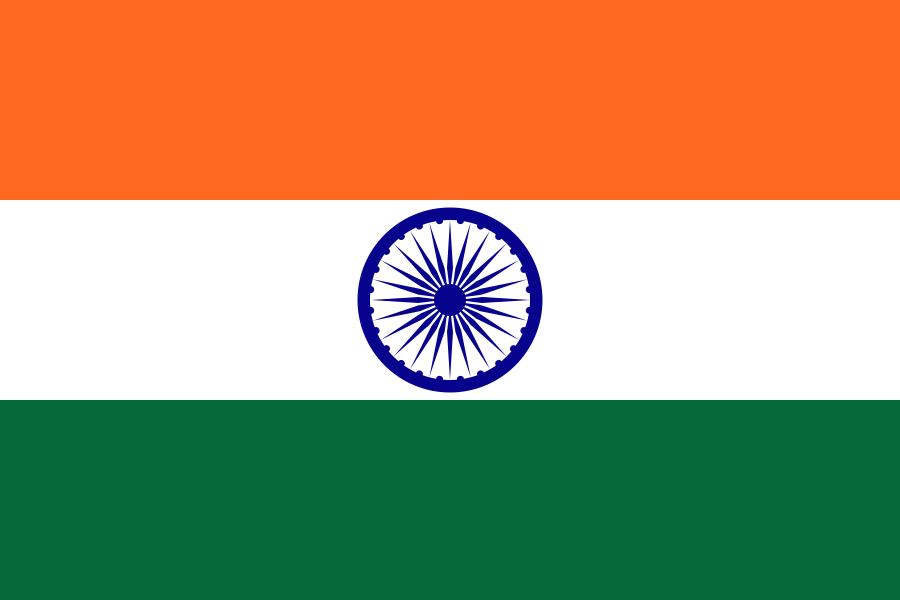
India's first prime minister and co-founder of the Non-Aligned Movement
'Long years ago we made a tryst with destiny, and now the time comes when we shall redeem our pledge… At the stroke of the midnight hour, when the world sleeps, India will awake to life and freedom.' (Independence eve address, 14 August 1947)
A towering leader of the Indian independence movement, he became independent India's first prime minister in 1947 and held the office until his death in 1964. He anchored the new republic in parliamentary democracy, secularism, and planned economic development, while charting a foreign policy of non-alignment that refused subordination to either Cold War bloc. With Tito he issued the 1954 joint statement that first defined 'non-alignment' as a positive, active policy, not passive neutrality, and went on to co-found the Non-Aligned Movement through the 1956 Brioni Declaration and the 1961 Belgrade summit. The Sino-Indian War of 1962 shook his domestic standing, yet he is remembered as the architect of the Indian republic.
Career timeline
- 1929, 1936–37President, Indian National Congress
- 1946–1947Interim Prime Minister of India
- 1947–1964Prime Minister of India
- 1947–1964Minister of External Affairs (concurrent)
The quiet diplomat who mediated a superpower nuclear standoff
“Neither would wish to be remembered by history, if any history survived, as having jointly precipitated the end of human civilization.”
U Thant was a Burmese teacher, civil servant and diplomat who became the third UN Secretary-General during the Cold War, when decolonization and international negotiation were reshaping the organization. During the Cuban Missile Crisis in 1962, he appealed to John F. Kennedy and Nikita Khrushchev, proposed a face-saving link between turning back Soviet ships and removing missiles from Cuba, then travelled to Cuba to discuss verification with Fidel Castro. His mediation lowered the danger of nuclear war, yet the UN's quiet diplomacy was long overshadowed by superpower-centered accounts of the crisis. He also directed peacekeeping in the Congo and pursued negotiations to end the Vietnam War, exposing the tension between an international institution's moral obligations and great-power politics.
Career timeline
- 1928–1931Teacher and headmaster, National High School, Pantanaw
- 1948Director of Broadcasting, Burma
- 1951–1957Secretary to the Prime Minister of Burma
- 1955Secretary of the Bandung Conference
- 1957–1961Burma's Permanent Representative to the UN
- 1961Chairman of the UN Congo Commission
- 1961–1971Secretary-General of the United Nations
- 1971–1974Senior fellow, Adlai Stevenson Institute of International Affairs