The Solidarity strategist who planned the 1980 Gdańsk strike, shaped the 21 Demands, and co-founded the MKS
In the Lenin Shipyard, in the course of implementing Lenin's theory, we folded up Marxism-Leninism.
He was the principal organiser of the August 1980 strike at the Gdańsk Lenin Shipyard: he drew up the strike plan, grouped and ranked the Twenty-One Demands, and co-founded the Inter-Enterprise Strike Committee (MKS), making him the architect of the event that gave birth to Solidarity. When martial law was declared in December 1981, he evaded internment and spent more than four years underground rebuilding Solidarity's clandestine networks, once attending his daughter's baptism disguised as a woman. Arrested in 1986 and released under amnesty, he later served as a member of parliament, Deputy Interior Minister, and Marshal of the Senate; in July 2010 he made Polish history as the shortest-serving acting president, holding the office for only a few hours.
Career timeline
1968Arrested for distributing protest fliers, sentenced to 3 years, amnestied 1969
1977–1978Co-organiser, Free Trade Unions of the Coast (WZZ)
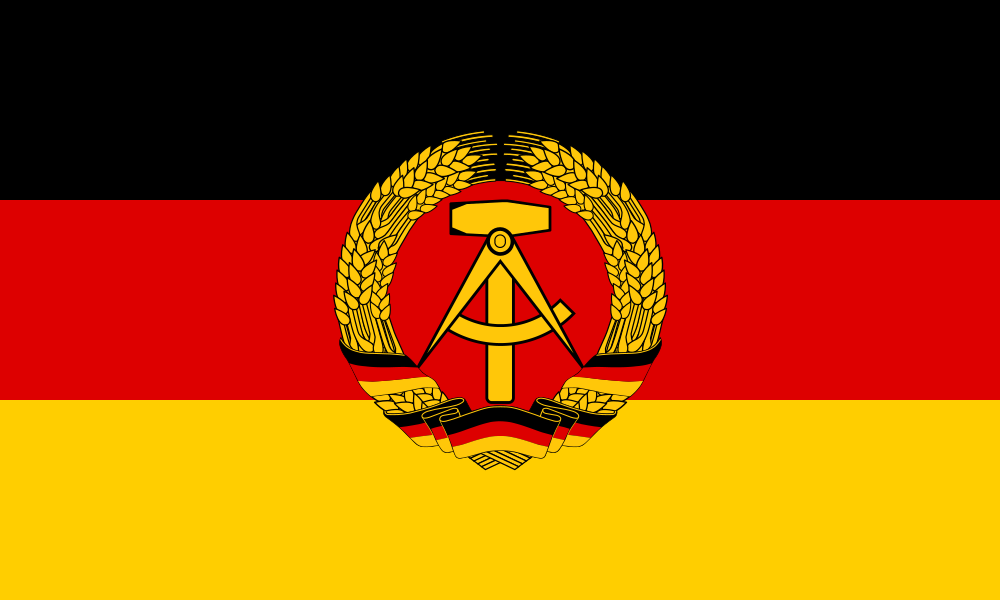
The last communist leader of East Germany, who succeeded Honecker, opened the Wall, and fell in 50 days
On 9 November 1989, Krenz read the travel regulation draft to the Central Committee, handed the note to Schabowski saying "Here, explain this to the journalists," and hours later the Berlin Wall was open.
Designated as Erich Honecker's successor, Egon Krenz was the last communist leader of East Germany, becoming SED General Secretary after Honecker was ousted in October 1989. Just three weeks into his tenure, he approved the draft travel regulations, read them to the Central Committee on 9 November, and handed the note to Günter Schabowski for announcement at a press conference; that night the Berlin Wall was opened. He promised reforms but never gained public trust, and resigned all his posts by early December. After reunification, he was convicted of manslaughter for the border deaths and served nearly four years of a six-and-a-half-year sentence.
Career timeline
1955Joined the Socialist Unity Party (SED)
1971–1974Chairman of the Ernst Thälmann Pioneer Organisation
1974–1983First Secretary of the FDJ Central Council
1983–1989SED Politburo member, CC Secretary for Security, Youth and Sport
1984–1989Deputy Chairman of the State Council
1989.10–12SED General Secretary
1989.10–12Chairman of the State Council and National Defence Council
The tram driver who carried the strike beyond the shipyard
On 15 August 1980, she stopped her tram near the Baltic Opera, helping set Gdańsk’s public-transport strike in motion.
Henryka Krzywonos was a Gdańsk tram driver and trade-union activist who connected action inside the shipyard with workers across the city. On 15 August 1980 she stopped her tram, helping launch the public-transport strike and spread the news that encouraged solidarity action in other workplaces. She represented transport workers in the Inter-Enterprise Strike Committee, signed the August Agreement, and later aided internees and distributed underground publications during martial law. Her later work running a family children’s home and serving in parliament linked shop-floor action with care and institutional politics.
Career timeline
1973–1978Tram driver, Provincial Transport Company, Gdańsk
A Solidarity leader beaten while linking workers’ and farmers’ demands
“You have to call them and try to persuade them to leave the building. It is very important and very urgent.”
Jan Rulewski was a Polish trade-union leader and democracy activist who headed Solidarity in the Bydgoszcz region. In 1981 he made farmers’ demand for an independent union a union-wide issue, and on 19 March he was beaten by militia during a session of the provincial council. The incident helped Solidarity organize a nationwide warning strike and exposed the tensions that preceded martial law. He was later interned under martial law and served in parliament after Poland’s democratic transition.
Career timeline
1944Born in Bydgoszcz
1965–1969Expelled from the Military University of Technology, then imprisoned after an attempted escape
1979Graduated in mechanical engineering from the Academy of Technology and Agriculture in Bydgoszcz
1980–1981Chair of Solidarity’s Bydgoszcz region
1981–1984Interned after martial law, then released under amnesty in 1984
Independence activist, linguist, and Yan'an faction leader who served as the first head of state of the DPRK
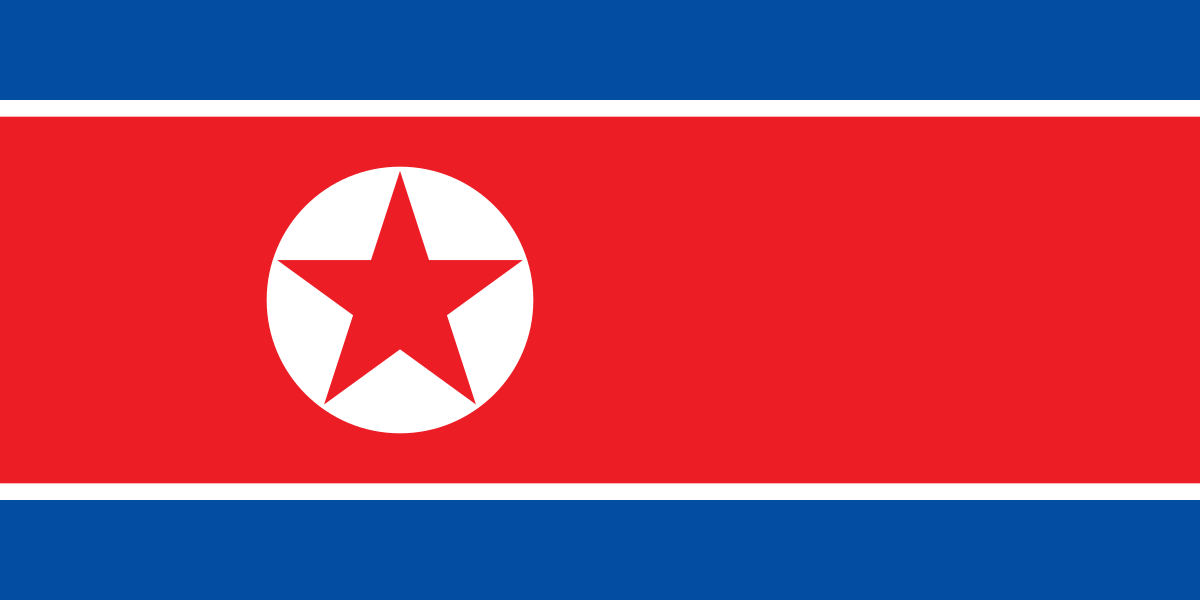
On the day the People's Assembly adopted the new DPRK flag in July 1948, Kim Tu-bong personally lowered the Taegeukgi and raised its replacement. Barely a year earlier, he had been the man passionately explaining the old flag's philosophical meaning to a skeptical Soviet general.
A Hangul linguist trained under Chu Sigyŏng who led the Korean Independence League in Yan'an. Became the DPRK's first head of state in 1948, though real power lay with Kim Il Sung. Purged and vanished in the 1958 August Faction Incident.
Career timeline
1908–1916Studied Hangul under Chu Sigyŏng; helped compile MalMoi dictionary
1919Joined March First Movement, then exiled to Shanghai provisional government
1920–1930년대Combined communist activism with linguistic research in Shanghai
1942–1945Founded Korean Independence League in Yan'an; led the Yan'an faction
1946.2–1946.8Chairman of the New People's Party of Korea
1946.8–1949.6Chairman of the Workers' Party of North Korea Central Committee
1948.9–1957.9Chairman of the SPA Standing Committee — first head of state of the DPRK
1957–1958Dismissed from all posts over August Faction Incident; disappeared
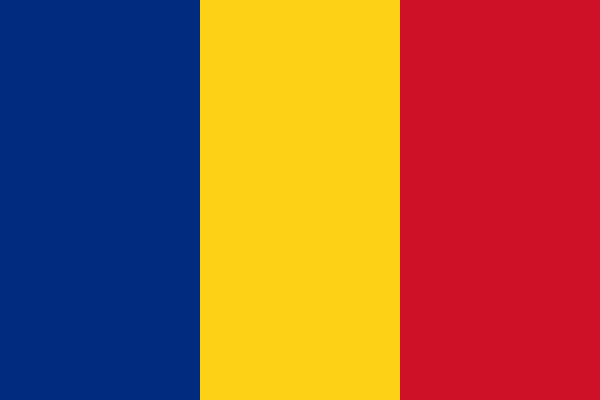
The Reformed pastor whose attempted eviction in Timișoara sparked the Romanian Revolution
The crowd forgot the initial reason for their resistance, and in general terms they opposed the regime itself.
A Hungarian Reformed pastor from Cluj, he openly criticised Ceaușescu's systematisation programme (the planned destruction of rural villages) and denounced human rights abuses in a secretly recorded interview with Hungarian television, making himself a target of the Securitate. On 16 December 1989, when parishioners gathered at his Timișoara parsonage to block his forced eviction, the protest swelled into an anti-regime uprising that became the direct trigger of the Romanian Revolution. After the revolution he was elected bishop of the Reformed Diocese of Királyhágómellék in Oradea, dedicated himself to rebuilding the church and Hungarian-language education, and served as a Member of the European Parliament from 2007 to 2019.
Career timeline
1975Graduated Protestant Theological Institute of Cluj; ordained Reformed pastor
1981–1982Contributed to underground journal Ellenpontok; first Securitate harassment
1986Appointed assistant pastor of the Reformed Church in Timișoara
1988–1989Openly criticised systematisation; secret TV interview made him a Securitate target
1989.12.16Protest against his eviction swelled into the Romanian Revolution
1990Elected bishop of the Reformed Diocese of Királyhágómellék in Oradea
2007–2019Member of the European Parliament (Vice-President 2010–2012)
Electrician who became president as the leader of Solidarity
If somebody had told me that I would be the leader to bring down communism... I never would have believed them. That is why I am the happiest man in the whole galaxy.
A shipyard electrician in Gdańsk, he led the 1980 strike that founded the independent trade union Solidarity and forced the communist government to sign the Gdańsk Agreement. Imprisoned under martial law and awarded the 1983 Nobel Peace Prize, he served as the unofficial opposition leader at the 1989 Round Table talks that negotiated Poland's peaceful transition from one-party rule. Elected Poland's first president by popular vote in 1990, he steered the country toward a market economy and secured the withdrawal of Soviet troops, but lost reelection in 1995 and retired from politics. One labour activist's victory became the signal that cracked the Soviet bloc.
Architect of Poland's shock therapy and symbol of the post-communist transition
One should be prepared for the window of opportunity by pursuing what appears to be a useless hobby.
Architect of Poland's shock therapy. Appointed finance minister and deputy prime minister in the Mazowiecki government in 1989, he led the 'Balcerowicz Plan': rapid stabilization, price liberalization, and currency convertibility that made Poland the first Eastern Bloc country to undergo radical market reform. The plan tamed hyperinflation and set Poland on a path to become one of Europe's fastest-growing economies, but it also brought a 20% drop in GDP, mass unemployment, and fierce social backlash epitomized by the slogan 'Balcerowicz must go', making him the emblematic figure of the gap between what 1989 promised and what it delivered.
Career timeline
1970Graduates with distinction, SGH Warsaw School of Economics
1978–1980Researcher at Institute of Marxism-Leninism; leads informal reform team
1980년대Economic adviser to Solidarity
1989–1991Deputy PM & Finance Minister; launches the Balcerowicz Plan
1995–2000Chairman, Freedom Union party
1997–2000Deputy PM & Finance Minister (second term)
2001–2007Chairman, National Bank of Poland
2007–현재Founds and chairs the Civil Development Forum (FOR)
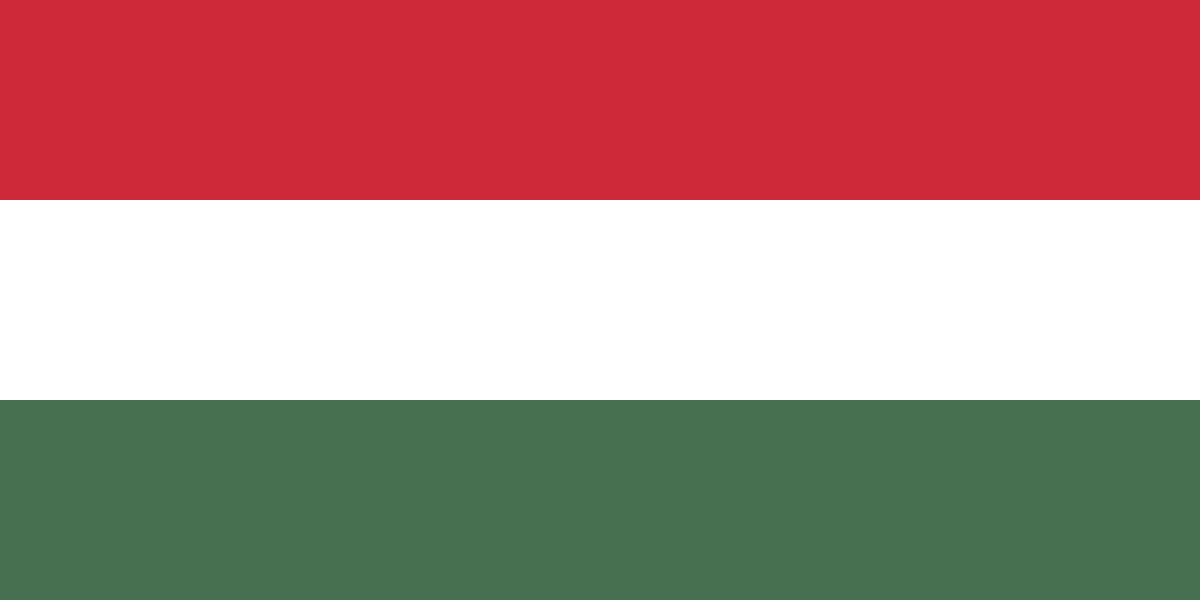
Hungary's reform premier who opened a gate in 1989
Hungary's border opening accelerated the East European chain of events leading to the fall of the Berlin Wall.
An economic-policy figure in Hungary's ruling party, he became the last prime minister of the Hungarian People's Republic in late 1988. As part of the reform leadership he pursued political and economic transition, and allowed East Germans to cross the Austrian border in 1989.
Career timeline
1988–1990Last prime minister of the Hungarian People's Republic
1989Allows East Germans to cross the Austrian border
1989–1990Leads government during the transition to multiparty politics
From Moncada to the presidency: the Revolution's indispensable number two for over half a century
“Fidel is irreplaceable, unless we all replace him together, each in his own place.” — speech to university students, 2006
Core commander of the Cuban Revolution: a founding member of the 26th of July Movement who fought at Moncada (1953), survived the Granma landing to reach the Sierra Maestra, and as Comandante of the Frank País Eastern Front built a guerrilla proto-state in Oriente. As minister of the Revolutionary Armed Forces from 1959 to 2008 (the longest-serving defense minister of any modern state), he forged Cuba's military and security apparatus and led the institutionalization of the Communist Party. Succeeding Fidel as president in 2008 and party first secretary in 2011, he oversaw cautious market reforms while preserving one-party rule, stepping down in 2018 and 2021 after more than half a century as the Revolution's indispensable number two.
Career timeline
1953Moncada Barracks attack — 13-year sentence, 22 months served
1956Lands from the Granma — guerrilla war in the Sierra Maestra
1958Promoted to Comandante; opens the Frank País Eastern Front
1959–2008Minister of the Revolutionary Armed Forces — longest-serving defense minister
2006–2008Acting president during Fidel's illness
2008–2018President of the Council of State and Council of Ministers
2011–2021First Secretary, Central Committee of the Communist Party of Cuba
2021Steps down as first secretary — retires from politics